

The ZAZ-965 has the shape of a small, cheerful machine, but its mechanical demands are less forgiving than its appearance suggests. Behind the four-seat cabin sits a V-shaped, air-cooled engine whose health depends on clean passages, correctly fitted shrouds, and accurate tuning. A tidy exterior gives little assurance that any of those things are right.
Built in Soviet Ukraine from 1960 to 1970, the Zaporozhets offered compact transport without a liquid-cooling system containing coolant that could freeze. That simplicity solved one practical problem while moving others into airflow, ignition, lubrication, and careful adjustment. For a prospective owner, the question is whether the car’s basic design makes it manageable, or whether its age and limited mechanical margin make every shortcut expensive.
- Why the ZAZ-965 Became an Air-Cooled Oddity
- Early and Late ZAZ-965: What Actually Changed
- What the ZAZ-965 Is Like on the Road
- Air Cooling Is Simple, Not Carefree
- Buying and Restoring a ZAZ-965 Without Being Misled
- The Myths That Make the ZAZ-965 Look Easier Than It Is
- Frequently asked questions
- How should a ZAZ-965 test drive be staged before purchase?
- What does a missing or modified cooling shroud mean for a ZAZ-965?
- Why can a recently restored ZAZ-965 develop leaks or failures again?
Why the ZAZ-965 Became an Air-Cooled Oddity
The ZAZ-965 brought a four-seat car within a footprint far smaller than that of a conventional family sedan. Its short body and rear-mounted, four-cylinder V-shaped gasoline engine made it distinctive in Soviet motoring, where owners also had to consider storage, maintenance, and operation through cold weather. The packaging gained cabin space relative to the car’s size, though four seats did not mean generous room for four adults.
Its air cooling had a sound practical basis. With no liquid coolant, there was no water to freeze in an improperly protected system. The engine also avoided the radiator, hoses, and related plumbing of a water-cooled car, removing several potential failure points from a machine intended for everyday use.
The trade-off was less visible. An axial fan had to direct air across hot engine parts through fitted shrouds, and that path needed to remain clear and intact. The absence of a radiator did not make heat disappear; it made engine temperature more dependent on airflow and accurate mechanical setup.
That distinction shapes the ZAZ-965’s appeal today. Its compact dimensions make it easy to understand as a piece of engineering, while its rear-mounted engine asks an owner to pay attention to details a casual inspection can miss. It is an oddity with a purpose, rather than an eccentric shape wrapped around trouble-free machinery.
Early and Late ZAZ-965: What Actually Changed
Similar-looking ZAZ-965s can contain different engines and revised components, so identify the car in front of you rather than relying on its silhouette. The main engine comparison is useful, but it does not establish that every other part matches its apparent production period.
| Specification | Early MeMZ-965 | Later MeMZ-966A |
|---|---|---|
| Displacement | 746 cc | Commonly listed at about 887 cc |
| Power | About 23 hp | Reference specifications commonly give about 27 hp; owner material often calls it a 30-hp engine |
| Cooling air | Forced-air cooling with an axial fan and shrouds | Same basic cooling principle; the air intake improved after 1962 |
| Transmission | Four-speed manual | Four-speed manual |
| Brakes | Hydraulic drums on all four wheels | Hydraulic drums on all four wheels |
The earlier MeMZ-965’s compression ratio was 6.5. The later engine’s power is less neatly expressed: about 27 hp is common in reference specifications, while “30-hp engine” appears in owner descriptions. Treat that difference as a reason to verify the installed unit, rather than to assume a power rating from a nickname or badge.
Both versions share the basic four-speed manual and hydraulic drum-brake layout, but brake parts, electrical details, engines, and intake arrangements can differ between individual cars. Check identification plates against the components actually fitted, especially on a restored vehicle. Parts ordered for the presumed year may otherwise be wrong for the assembly on the car.
The body measures approximately 3330 mm long, 1395 mm wide, and 1450 mm high. Those figures help explain the cabin’s limits, but they reveal little about a particular car’s mechanical condition. A later air intake is a worthwhile change; it is not proof that the engine will run cool under load.
What the ZAZ-965 Is Like on the Road

A ZAZ-965 asks for patience with its modest power and four-speed manual gearbox. Pulling away and climbing with passengers require more attention to gear choice than they would in a modern small car. The useful measure on a test drive is whether it maintains a steady pace without growing strained or losing power as it warms.
Reference figures often give a maximum speed of about 90 km/h. Owners commonly regard 80–90 km/h as a practical limit or an uncomfortable operating range, rather than an easy cruising speed. A claim that the car can reach a particular speed tells you little about how calmly it will hold it, or how an aged engine will respond afterward.
The rear engine is plainly audible because cabin sound insulation is weak. Noise becomes part of judging the car: listen for a consistent mechanical note, then notice any change under load or after a longer run. In a cabin this small, heat, noise, and the need to work the gearbox can make a brief pleasant drive a poor guide to longer journeys.
Luggage space is listed at approximately 100 liters, and the four seats leave limited room for people and belongings together. Fuel consumption of about 5.5–6 L/100 km appears in references and favorable reports, but it is not a dependable budget figure for an unknown car. Carburetor condition, ignition, engine wear, tires, and transmission drag can all alter the result.
Air Cooling Is Simple, Not Carefree
The ZAZ-965 uses forced-air cooling: an axial fan moves air through shrouds and across the cylinder fins. Those shrouds are functional parts of the system, directing the flow where heat must leave the engine. Dirty fins, gaps, or missing covers reduce the value of a working fan because the air can take the wrong route.
The air intake improved after 1962, yet overheating remained possible. Cooling capacity has a limited margin, particularly when the engine is worn or working hard in hot weather. A late intake should therefore be viewed as an improvement to inspect, rather than a cure for faults elsewhere.
When a warmed engine loses power, check the complete cooling-air path and ignition timing together. A spinning fan cannot compensate for air bypassing the cylinders or for a timing error that makes the engine generate excess heat.
Ignition set by ear can be close enough to start easily and still be wrong under load. Poor carburetor adjustment, worn components, and lubrication faults can also raise operating temperature. The cooling system and engine tune need to be assessed as one working assembly, especially if a car behaves well while idling but falters on the road.
An air-cooled engine cannot visibly boil over in the way a water-cooled one can, which makes overheating easier to dismiss. It may instead lose power while heat shortens its useful life. Check behavior after a full warm-up and under load; a clean cold start in a parking space is weak evidence of temperature control.
Oil deserves equal attention. The design lacks a full modern oil-filter system, so clean oil and regular service matter more than an owner accustomed to newer cars might expect. Ignoring lubrication because there is no coolant to check mistakes one simplified system for an engine that needs no routine care.
Buying and Restoring a ZAZ-965 Without Being Misled
Begin an inspection with the car cold, but do not finish it there. Look for complete cooling shrouds and clear fins, then check compression, crankcase gases, leaks, and mechanical play. A clean-looking body or freshly painted engine bay cannot establish that the engine will remain healthy once it has reached operating temperature.
During a proper drive, watch for declining power as the engine warms and for inconsistent response from the carburetor or fuel pump. Check how the distributor has been maintained, and listen and feel for irregular operation or excessive play in the manual gearbox. A brief run around the block may show that the car moves; it may leave the expensive problems untouched.
Inspect the hydraulic drum brakes as a working system rather than judging them by whether the pedal feels firm at rest. Their condition matters even on a car driven at modest speeds. Treat the gasoline heater separately: it needs its own inspection and should not be assumed safe or dependable simply because the engine starts and runs.
Restoration quality is harder to read than finish quality. Replacement components can leak again or fail quickly, and a recently rebuilt assembly may still have an adjustment fault. Ask what parts were fitted, what work followed the first road test, and whether any recurring problems were actually resolved.
Magnesium and aluminum components bring another caution. Old castings can suffer corrosion, damaged threads from overtightening, or the effects of earlier unqualified repairs. Before committing to a project, establish which parts are sound and which need replacement; scarce or poor-quality replacements can turn an apparently straightforward rebuild into repeated work.
The Myths That Make the ZAZ-965 Look Easier Than It Is
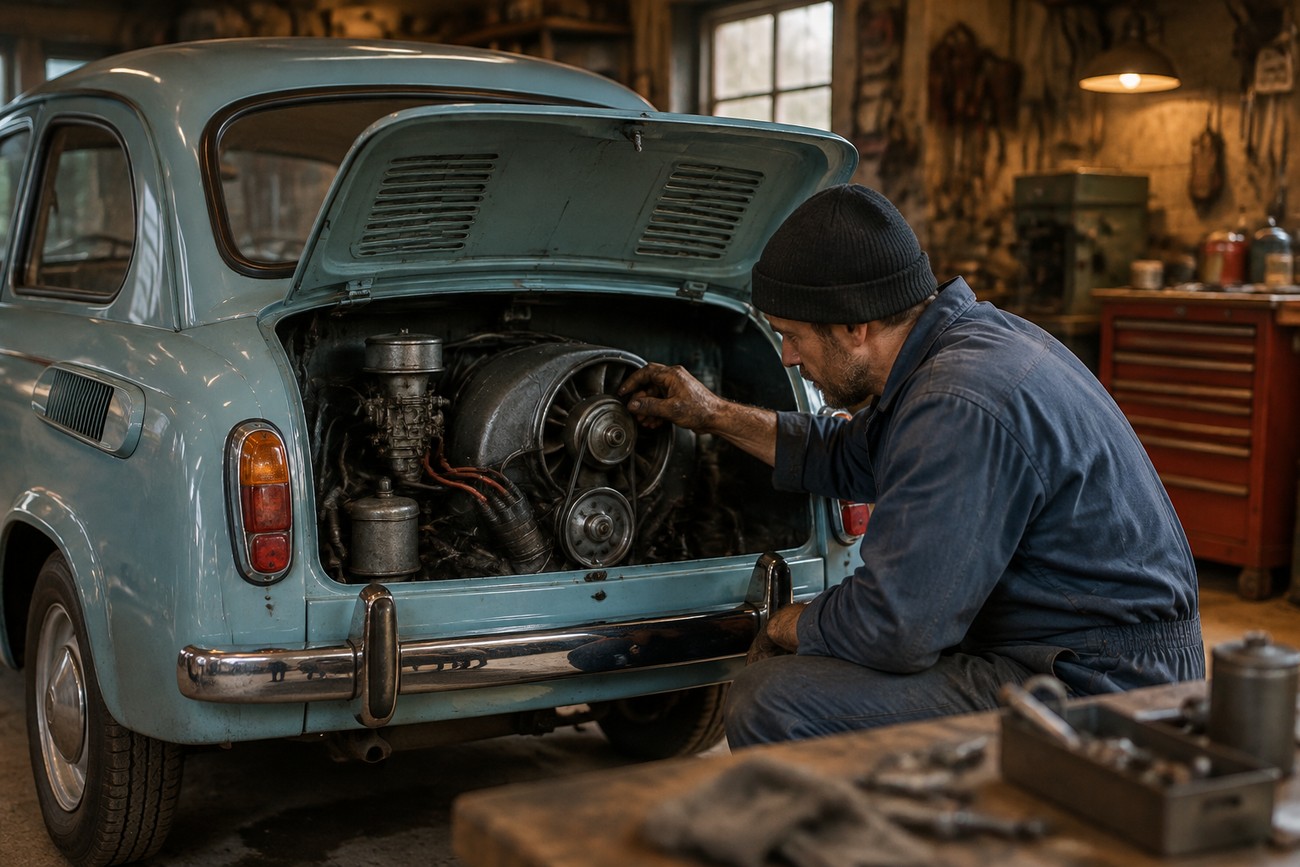
Air cooling removes the risk of frozen coolant; it does not eliminate overheating. The fan, fins, and shrouds need to work together, while ignition, carburetion, and lubrication must keep heat within the system’s limited margin. A car that runs happily at idle may still expose a fault on a warm climb.
Claims of effortless 100 km/h travel deserve similar skepticism. Reference data often places maximum speed at about 90 km/h, and owners commonly describe 80–90 km/h as a practical or uncomfortable limit. Choosing a car for regular journeys means judging its sustained behavior, noise, and mechanical condition rather than its most optimistic speed claim.
Likewise, about 5.5–6 L/100 km is a reference or favorable-use fuel figure, not a promise attached to every surviving example. Setting ignition by sound alone can increase heat and reduce power, even if the engine seems willing at first. Modern gasoline should not be adopted automatically without checking the engine’s actual compression, valve condition, carburetor setup, and ignition timing.
Mechanical simplicity does not guarantee a cheap restoration. Good parts can be scarce, old alloy components demand careful handling, and correct adjustment takes time. The ZAZ-965 can be rewarding as a carefully maintained historic car, provided you buy its present condition rather than its charming outline or a claim that it is easy to fix.
Frequently asked questions
The most useful purchase checks follow the order in which faults tend to appear: from a cold start through a fully warmed drive, then a close look after the engine stops. These three questions turn that approach into decisions you can use beside a prospective car.
How should a ZAZ-965 test drive be staged before purchase?
See the engine start cold, allow it to warm fully, then drive long enough to include ordinary acceleration and a sustained load where conditions safely permit. Note changes in response or sound as temperature rises, stop the engine, and try a warm restart. After the drive, inspect for fresh leaks and signs of excessive heat; if a seller permits only a cold start and a short idle, treat the engine’s behavior under load as unverified.
What does a missing or modified cooling shroud mean for a ZAZ-965?
A missing or altered shroud means the intended airflow across the cylinders may be disturbed, even if the fan operates. First establish what is absent or changed, then check the surrounding fittings and fins rather than accepting an explanation that the metal was removed for access or appearance. Until the complete air path is restored and the car is tested warm under load, its cooling condition remains uncertain.
Why can a recently restored ZAZ-965 develop leaks or failures again?
A fresh restoration can combine parts of uncertain quality with old alloy surfaces or damaged threads, allowing leaks to return despite careful cleaning and paint. Incorrect assembly can create another fault, while carburetor or ignition adjustment errors may only emerge after road use. Ask for details of the parts and work, inspect the affected joints, and give more weight to a successful warm test and follow-up checks than to the date of the rebuild.







