
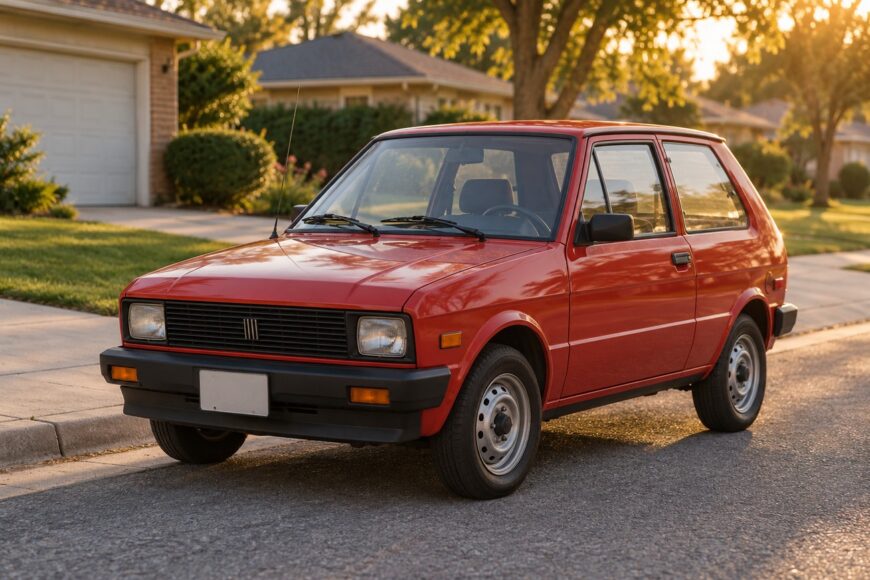
The Yugo GV still carries one of the harshest reputations in American motoring. It is remembered as the cheap little import that rattled, stalled, leaked, and became a punchline before many owners had finished paying for it. “The worst car in America” is an efficient label, which is precisely why it has survived longer than the car itself.
The mechanical criticism was not invented from nothing. Build quality varied, the cabin was noisy, highway performance was weak, and small failures could become a steady part of ownership. Yet the simple joke leaves out poor maintenance, differences between versions, and the fact that the Yugo was sold as a low-priced subcompact of its time rather than as a modern family car. The fair verdict is less entertaining: the GV was genuinely compromised, but the absolute label is too simple.
- What the Yugo GV Actually Was
- Performance and Versions: More Than One Yugo
- Why It Earned the Worst-Car Label
- The Ownership Problems Behind the Jokes
- Cheap to Buy, Expensive to Keep?
- Myth vs. Mechanical Reality: Was It Really the Worst?
- Frequently asked questions
- What is the absolute worst car ever made?
- Was the Yugo an American car?
- What is considered the ugliest car of all time?
What the Yugo GV Actually Was
The Yugo GV was the U.S.-market export version of the Yugoslavian Zastava Koral. Its engineering was related to the Fiat 127 and 128, so the car was not an isolated design created from scratch for American buyers. That ancestry gave it a familiar front-drive small-car layout and relatively straightforward mechanical systems.
Its main appeal was easy to understand. The GV offered basic transportation in a new-car package at a price far below most alternatives available in the United States. A commonly cited base price was about $3,990, a figure that made the Yugo memorable before anyone had formed an opinion about its suspension or door handles.
Low cost also shaped the car’s character. Buyers received limited refinement, simple trim, modest equipment, and a small engine. That could be acceptable for an owner treating the car as inexpensive urban transport, although American expectations for a new vehicle still included reasonable durability, quiet operation, and consistent assembly.
It is also misleading to discuss every Yugo as though it were mechanically identical. Production years, markets, engines, transmissions, and body styles introduced differences. That matters today because a surviving GV should be identified by its exact specification before an owner assumes that a repair procedure or replacement part applies.
Performance and Versions: More Than One Yugo
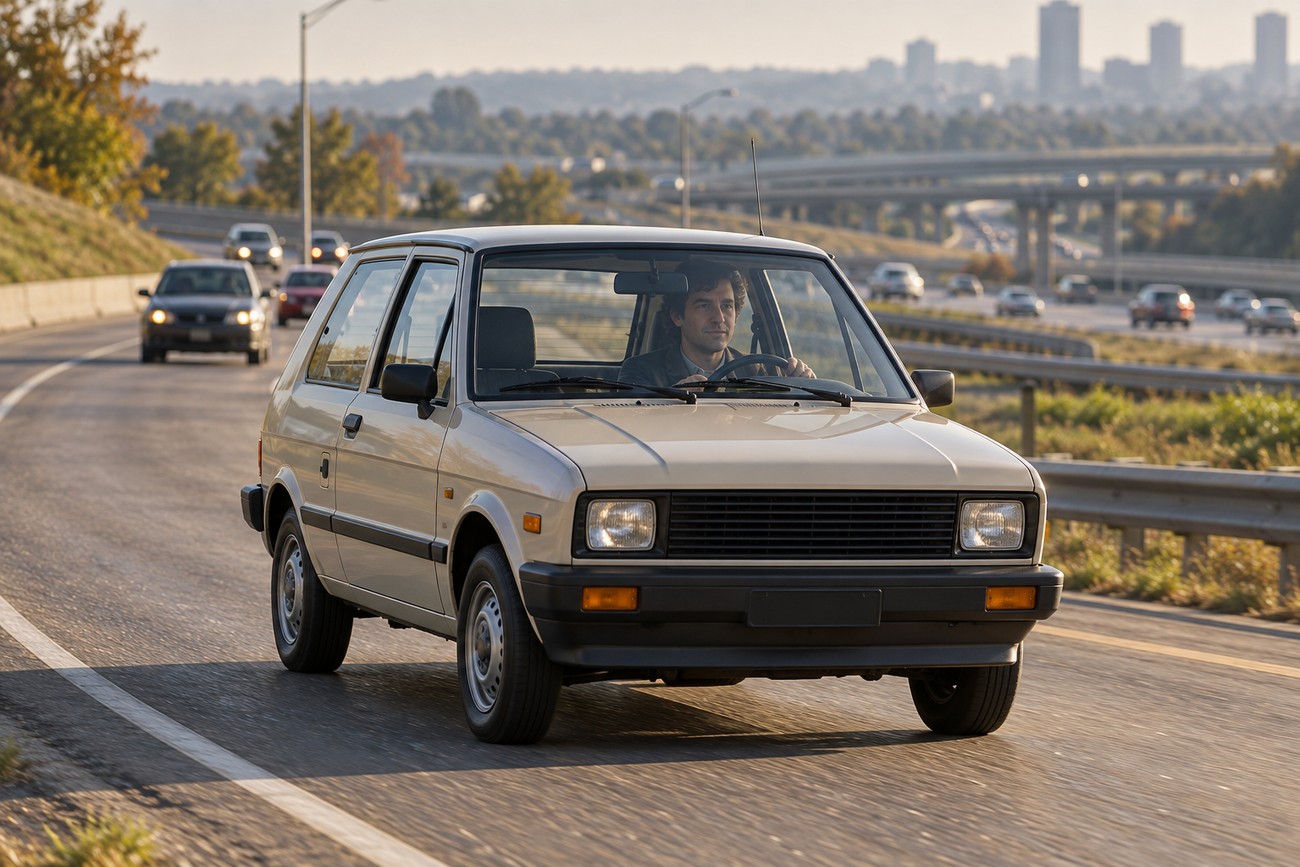
The familiar base GV used a 1.1-liter gasoline engine producing approximately 54–55 hp, paired with a four-speed manual transmission. Commonly cited specifications put its acceleration from 0–100 km/h at approximately 17 seconds, with a top speed around 135–145 km/h. Those figures describe transportation that requires patience, rather than a car that could comfortably handle a freeway entrance.
In town, the modest output was less damaging to the experience. The light body allowed the engine to feel adequate at low speeds, and the manual gearbox kept the driver involved. On a highway, however, the limitations became obvious: merging required planning, overtaking took commitment, and hills or a full load exposed the narrow performance margin.
Some versions used a 1.3-liter engine, a five-speed manual transmission, or a three-speed automatic. They could offer a different balance of acceleration, cruising behavior, or convenience, but those variations do not turn the Yugo into a fast car. They do make blanket statements about “the Yugo” less accurate than the popular jokes suggest.
The transmission itself can be part of the specification story. A five-speed car may be more useful at sustained speed than the common four-speed, while an automatic changes the driving experience without solving the underlying concerns about refinement and durability. A buyer evaluating a survivor should confirm the engine and gearbox rather than rely on a badge, memory, or a photograph.
Why It Earned the Worst-Car Label
The Yugo’s reputation grew from a combination of real defects and unusually visible compromises. Owners commonly described rattling suspension components, a noisy body, and a cabin filled with engine noise and squeaks. A small car can be forgiven for lacking luxury, but persistent noise makes every loose part feel like evidence of a larger failure.
Gear selection could become difficult as the car aged, with some older cars and convertible versions attracting particularly unfavorable comments. Door handles, locks, and starters also appear repeatedly in owner complaints. None of these items is dramatic in isolation; together, they turn an inexpensive car into a machine that demands attention at inconvenient moments.
Weak acceleration was especially frustrating on highways. The problem was not merely a disappointing stopwatch figure. It reduced flexibility when joining fast traffic, climbing grades, or passing a slower vehicle, and the engine noise required to make progress made the car feel more strained than the speedometer suggested.
Individual cars could also differ substantially. One Yugo might remain usable with regular attention, while another developed a catalogue of rattles and minor failures. That inconsistency made the ownership experience difficult to generalize and helped the worst examples define the reputation of the entire line.
The Ownership Problems Behind the Jokes
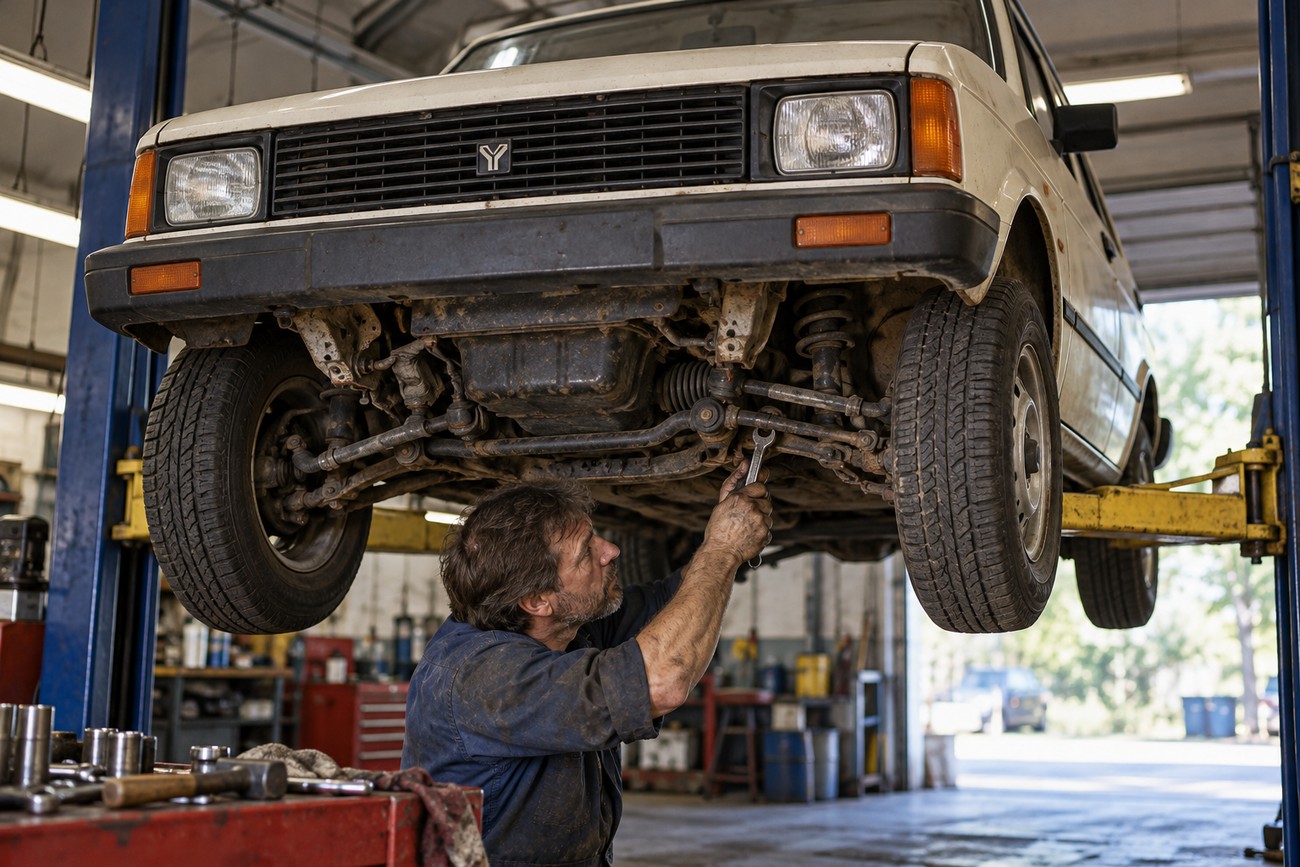
Simple construction reduced electronic complexity, but it did not prevent mechanical wear. Bushings, linkages, locks, starters, suspension parts, and gearbox components still needed adjustment, lubrication, replacement, or careful diagnosis. A car can be easy to understand and still be troublesome if its parts wear quickly or its previous owners postpone basic service.
Maintenance became part of the reputation in two ways. Some cars had genuine build-quality problems, while others were neglected because their low purchase price encouraged owners to treat them as disposable. Delayed repairs then accumulated, making the vehicle seem worse than it might have been when maintained properly.
Parts uncertainty adds another layer to ownership. The Yugo’s relationship to the Zastava Koral and its Fiat-related engineering can help with research, but it does not guarantee direct interchangeability. Different years, versions, and markets may use components that look similar while requiring different fittings or installation methods.
Noise and vibration are easy to underestimate during a short inspection. A brief drive may reveal that the engine runs, but it may not show how tiring the car becomes after sustained travel. Weak sound insulation, body squeaks, and vibration affect daily usability even when the vehicle remains mechanically mobile.
Cheap to Buy, Expensive to Keep?
The most common buying mistake is treating the Yugo as an effortless cheap classic. The entry price can be attractive, especially when the car is complete and historically interesting, but frequent small repairs can consume the original savings. Ownership cost is shaped by condition, parts research, and the owner’s willingness to handle recurring defects.
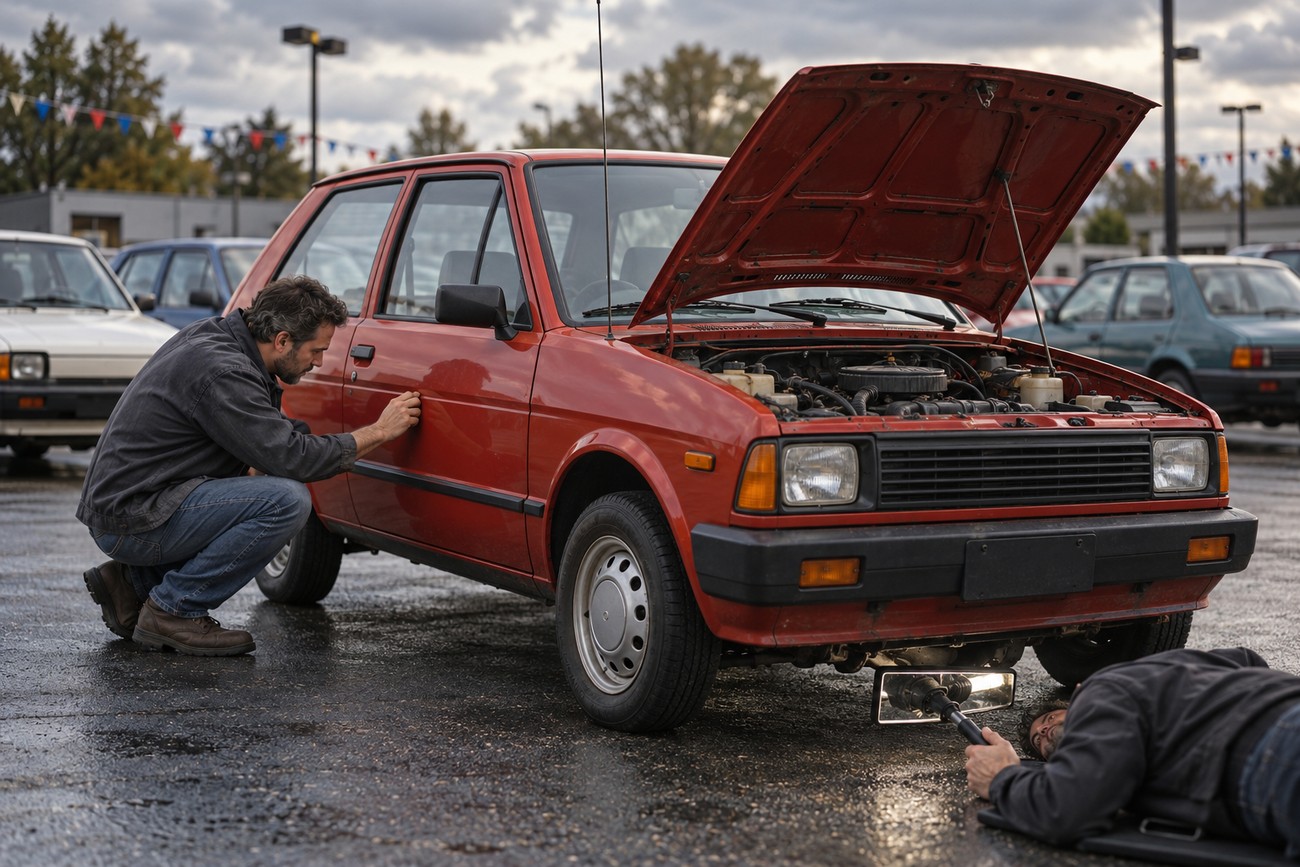
Inspection should begin with the body, suspension, and gearbox rather than the running engine alone. A motor that starts easily may still distract from worn suspension, difficult gear selection, poor doors and locks, or structural and cosmetic deterioration. The engine is important, but it is not automatically the most expensive or revealing part of the assessment.
- Check the body carefully for corrosion, previous repairs, and missing trim.
- Listen for suspension rattles and investigate movement or looseness rather than accepting noise as normal.
- Test every gear repeatedly, both when cold and after the car has warmed up.
- Operate the handles, locks, starter, and other small controls several times.
- Look for a documented service history and verify which engine and transmission the car actually has.
A documented history is unusually valuable because it separates an honestly maintained survivor from a car that has simply been kept running. A patient hobbyist may appreciate the Yugo’s mechanical simplicity and repairability. Someone seeking quiet, comfortable, routine highway transportation is likely to find the same simplicity less charming once the minor repairs begin to accumulate.
The best example is often the least dramatic one: a complete, dry, properly serviced car with evidence of regular care. An immaculate-looking project with missing parts can be harder to finish than a plain survivor that already has a functional gearbox and sorted suspension. On a rare economy car, completeness is practical value, not merely a cosmetic bonus.
Myth vs. Mechanical Reality: Was It Really the Worst?
There is no single official ranking proving that the Yugo was America’s worst car. The phrase is a durable media and internet label, reinforced by owner complaints, low expectations, and the pleasure of making a cheap import into a national joke. It should be treated as a reputation rather than a verified technical title.
That does not make the criticism unfair. The GV had meaningful weaknesses in assembly quality, refinement, highway performance, and component durability. Its low price also created a difficult expectation gap: buyers were purchasing a new car, yet many experiences resembled ownership of a machine that required constant tolerance and attention.
At the same time, poor maintenance and neglect could intensify failures. Cultural hostility toward a very cheap foreign import also shaped the story, while different engines, transmissions, and body versions prevent a one-size-fits-all judgment. A well-maintained example does not erase the model’s weaknesses, but a neglected example should not be used as the only technical evidence.
Period context matters as well. The GV should be judged against the budget subcompacts and safety expectations of its time, rather than directly equated with a modern small car. By that standard, the Yugo was seriously compromised and often frustrating. It was not demonstrably the absolute worst car in America; it was a particularly visible example of how low price, inconsistent quality, weak refinement, and neglected maintenance can combine into a lasting reputation.
Frequently asked questions
The Yugo’s reputation is useful only when the criteria behind it are made clear. Reliability, safety, performance, styling, value, and cultural impact produce different rankings, so the answers below separate those categories.
What is the absolute worst car ever made?
There is no universal answer because “worst” can mean several different things. A reliability ranking may focus on breakdowns, a safety ranking on crash protection, a performance ranking on speed and handling, and a value ranking on the gap between price and ownership cost. Cultural reputation adds another category that can overwhelm technical evidence.
The Yugo scores poorly in several practical areas, especially refinement, consistency, and durability, but that does not create a universal official ranking. A model with worse safety, more serious corrosion, or a more damaging design failure could rank lower under different criteria.
Was the Yugo an American car?
No. The Yugo was a Yugoslavian import marketed in the United States, specifically the U.S.-market export version of the Zastava Koral. Its engineering was related to Fiat 127/128 designs, but American sales and adaptation did not make it an American-built car.
This distinction matters because calling it an unreliable American car confuses origin with market. The Yugo was evaluated by American buyers under American expectations, while its manufacturing background, parts supply, and production practices belonged to a different industrial context.
What is considered the ugliest car of all time?
There is no objective answer to the ugliest-car question because styling is subjective. People may dislike proportions, trim, color, or a design’s cultural associations, but those judgments do not measure mechanical quality.
Ugly and unreliable are separate verdicts. A visually awkward car can be durable and easy to maintain, while a handsome car can suffer serious mechanical problems. The Yugo became a target partly because its appearance, price, and mechanical reputation reinforced one another, yet those are still different judgments.







