
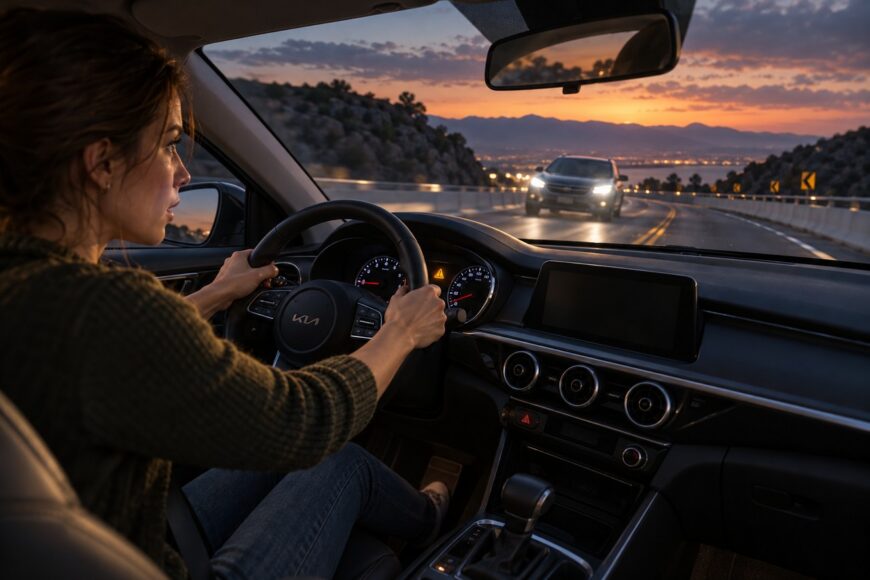
Seeing a wrong-way driver ahead of your Kia Forte is an immediate emergency. The correct response is to maintain control, reduce speed, create space, and avoid sudden steering that could place your car in another lane or path. Confusion increases when the Forte warning arrives late, stays silent, or sounds near a harmless road feature.
The Kia system is an ADAS driver-assistance warning, not a guarantee of collision prevention. Availability and behavior depend on the Forte’s model year, generation, market, trim, and safety package, so some versions may not have the relevant function. Your eyes and judgment remain the primary safety systems.
- What the Kia Forte Wrong-Way Warning Actually Means
- Does Your Kia Forte Have This Feature?
- What to Do When a Wrong-Way Driver Is Ahead
- Why the Warning Can Be Late or Disappear
- Why Your Forte May Beep When the Road Looks Clear
- Cleaning, Windshield Replacement, and ADAS Calibration
- Frequently asked questions
- How do I turn off Driver Attention Warning on a Kia Forte?
- What happens if I accidentally drive the wrong way?
- What should I do if someone is driving the wrong way on a one-way street?
- What is the most common problem with the Kia Forte?
What the Kia Forte Wrong-Way Warning Actually Means
A wrong-way warning identifies a possible opposing-traffic risk ahead and alerts the driver. Depending on the Forte version, the forward-facing system may rely on a camera near the windshield, radar, or a combination of sensors. The warning may appear visually in the instrument cluster or driver display, sound through the vehicle speakers, or use both forms of notification.
This alert is separate from lane-keeping assistance. Lane-related functions monitor the vehicle’s position relative to markings and may provide steering support, while a wrong-way or opposing-vehicle warning concerns a possible traffic conflict ahead. Automatic emergency braking is a separate function as well, with its own operating conditions and limitations.
A warning about an opposing vehicle does not itself steer or stop the Forte. Even where another collision-related ADAS function is fitted, the system may fail to recognize a rapidly appearing vehicle or may react too late for the available distance. Continue scanning the road, checking mirrors, and responding to the actual traffic situation.
Some alerts are deliberately conservative because the system must warn before a potential conflict becomes unavoidable. A sound near a barrier, crest, or unusual lane arrangement can therefore feel unnecessary. A single alert does not prove a fault, while a repeated pattern, warning message, or sudden change after repair deserves a proper inspection.
Does Your Kia Forte Have This Feature?
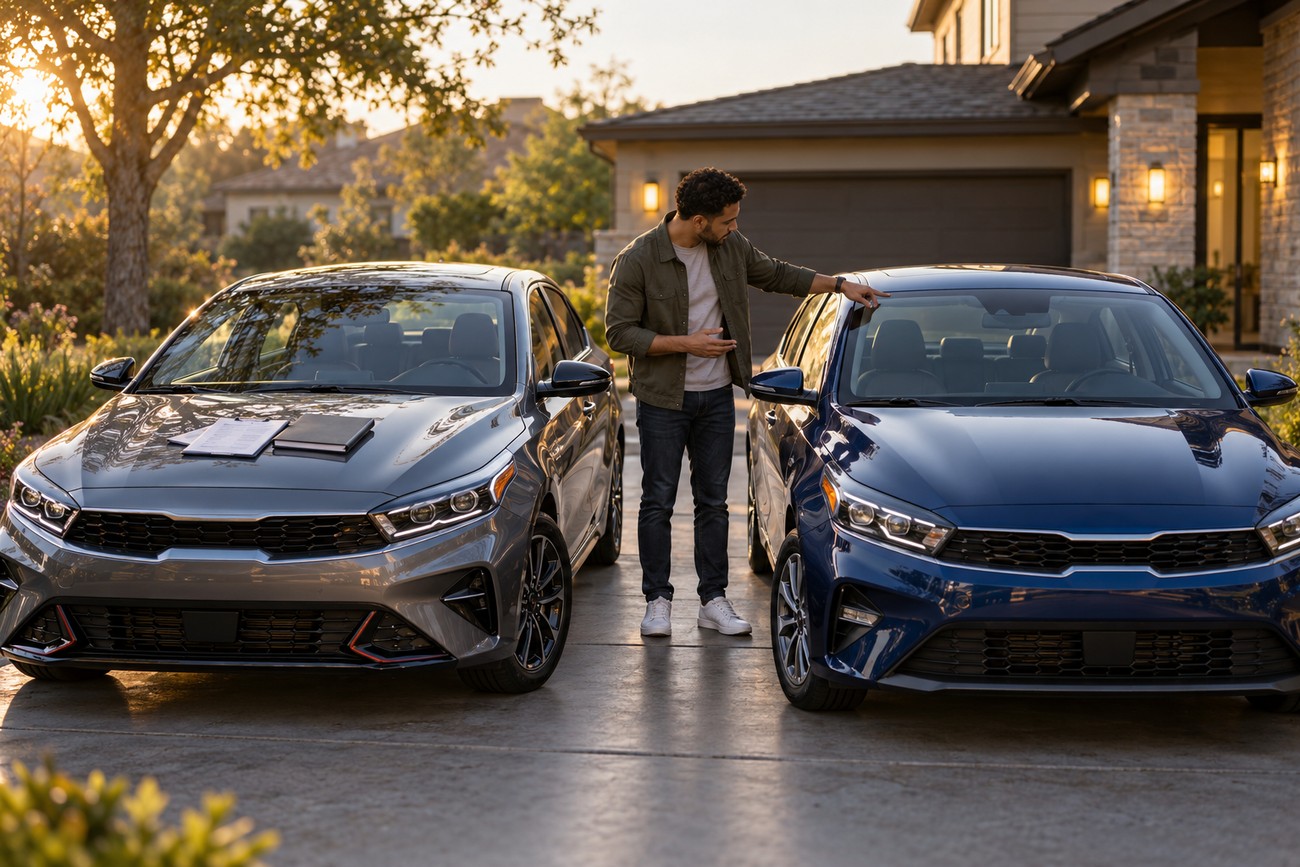
Two Forte vehicles with the same badge can have different driver-assistance equipment. Availability and behavior depend on model year, generation, market, trim, and safety package. Some versions may not have the relevant warning function at all, even if a sales listing describes the car broadly as having advanced safety technology.
Verify the equipment using the vehicle identification number, the original window sticker, and the owner’s manual for that specific vehicle. The vehicle settings and instrument-cluster menus can provide additional clues, although a menu entry alone may describe a related function rather than a dedicated wrong-way warning.
Names also vary between markets. A feature may appear as part of a forward-collision system, a highway-safety package, or another ADAS group rather than under a plain “wrong-way warning” label. Driver Attention Warning is a separate driver-monitoring function and should not be assumed to operate or disable the forward wrong-way warning.
Broad wording such as “collision avoidance” or “full safety suite” does not confirm how the Forte warns about opposing traffic. Ask for the exact equipment record when buying a used car, and compare it with the manual and VIN-based information. This prevents an absent feature from being mistaken for a failed one.
What to Do When a Wrong-Way Driver Is Ahead
Take the alert seriously if you also see a vehicle approaching in your path. Look at the road, reduce speed smoothly, and increase the distance available for the other driver’s movement. Keep both hands ready for controlled steering, and avoid abrupt swerving that could send the Forte into adjacent traffic, a barrier, or a pedestrian area.
Stay in a predictable position when possible. Do not accelerate toward the vehicle, attempt to confront its driver, or use an aggressive maneuver to force it away. If a safe escape area is clearly available, move there with care; otherwise, prioritize controlled braking and separation over a sudden lane change.
- Ease off the accelerator and apply steady braking.
- Keep scanning for traffic, shoulders, barriers, and escape space.
- Leave room for the opposing vehicle to pass or correct its path.
- Call emergency services when it is safe, especially if an immediate danger remains.
The Forte warning is supplemental and may be delayed, absent, or limited by weather, lighting, road geometry, and sensor condition. A silent instrument cluster does not make the road safe. If the alert conflicts with what you can see, treat the visible traffic situation as the priority.
Why the Warning Can Be Late or Disappear

The camera area near the windshield must have a clear view. Snow, dirt, condensation, fogging, or a sticker in front of the camera can reduce detection quality or cause the system to suspend operation. Heavy rain, fog, darkness, and unclear lane markings can also reduce performance, as Kia’s ADAS documentation commonly cautions.
Road geometry creates another limitation. Narrow or winding roads, sharp elevation changes, interchanges, barriers, reflective surfaces, and dense opposing traffic can make it difficult to separate a true conflict from nearby objects and lanes. A car may appear suddenly after a crest, while a barrier or reflected light may occupy the camera’s view in an unusual way.
Unclear markings are especially important because several forward systems use lane structure to interpret the scene. A road under construction, a temporary merge, or a junction with several crossing paths may not resemble the patterns used during system development. The Forte can therefore provide a late alert, an unexpected alert, or no alert.
After clearing the windshield, allow condensation to disappear and check whether the warning message clears. If the system repeatedly becomes unavailable in ordinary conditions, record the weather, lighting, road type, and message shown. That information helps a technician distinguish an environmental limitation from a sensor, software, or calibration issue.
Why Your Forte May Beep When the Road Looks Clear
An unexpected beep does not automatically mean that a sensor is defective. Reflective surfaces, abrupt changes in light, barriers, road crests, unusual markings, and complex traffic geometry can resemble an approaching conflict to a conservative warning system. Interchanges and dense opposing traffic are common places for the road scene to become difficult to interpret.
Consider whether the alert follows a repeatable pattern. A warning that occurs only beside a particular barrier or at one crest may reflect the road layout. An alert that appears on ordinary straight roads, continues after the glass is clean, or arrives with a persistent dashboard message should be assessed more carefully.
Drivers sometimes disable all audible warnings after several irritating events. That removes a notification that could be useful in a later situation, especially when the driver is looking toward a mirror, junction, or blind section of road. If the system allows separate alert settings, check which function was changed and restore the sound after troubleshooting.
Use the alert as information rather than proof that a collision exists. Reduce speed if the scene is unclear, confirm what is ahead visually, and avoid testing the system by deliberately approaching a road feature. A calm response protects you from both false confidence and unnecessary evasive action.
Cleaning, Windshield Replacement, and ADAS Calibration
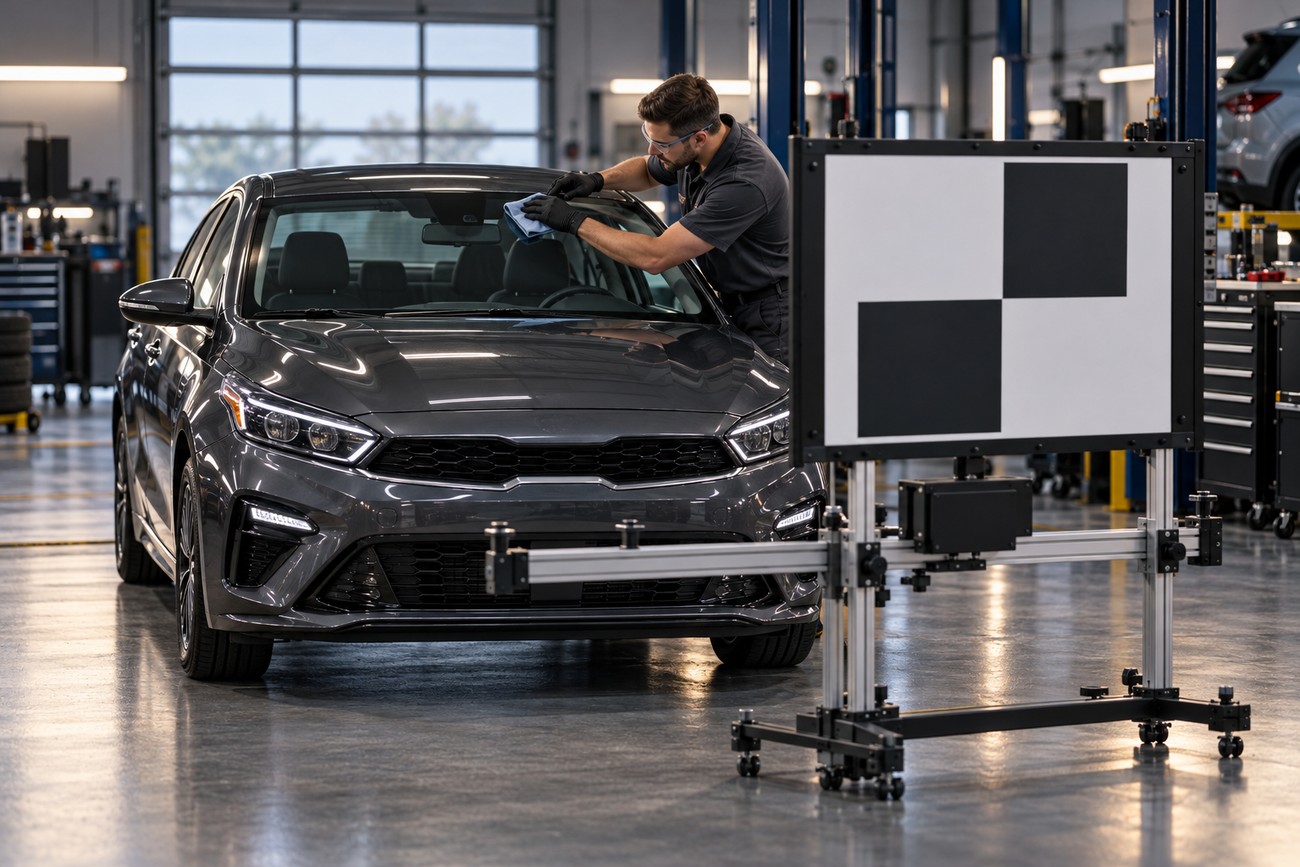
Start with simple checks. Clean the exterior and interior of the windshield around the camera area, remove snow or ice, and fully defog the glass. Check the instrument cluster for an ADAS warning, and note whether the problem occurs at a particular speed, in certain weather, or only on a specific type of road.
Ask whether the issue began after windshield removal, windshield replacement, an impact, or work near the front sensors. Removing or replacing the windshield can alter the camera’s position relative to the vehicle. The camera may then require ADAS calibration, and an incorrect angle or incomplete calibration can contribute to false, delayed, or missing warnings.
Technicians first correlate the complaint with windshield work, a camera-area obstruction, and calibration records before replacing sensors or switching the warning off.
Use a qualified service provider that can identify the installed system and perform the required calibration for that Forte. Repeatedly disabling the warning may hide the symptom without correcting the cause. A provider should also check for relevant software or ADAS control-module updates because system behavior can change after an update.
Keep the repair record, calibration result, and any diagnostic codes. If the alert began immediately after glass work, that timing is useful evidence even when the vehicle has no obvious physical damage. Do not assume that a clean windshield proves that the camera is aligned correctly.
Frequently asked questions
The answers below separate driver-monitoring settings, wrong-way incidents, reporting decisions, and broad reliability claims. Exact menu names and equipment remain dependent on the Forte’s year, market, trim, and installed safety package.
How do I turn off Driver Attention Warning on a Kia Forte?
Driver Attention Warning is a separate driver-monitoring function, so changing it should not be assumed to turn off a forward wrong-way or collision warning. The exact menu path and whether the setting remains disabled after the vehicle is restarted vary by model year, market, and trim.
Use the vehicle settings or driver-assistance menu described in the owner’s manual for your Forte. If the menu does not match the manual, or if several warnings change together, have the equipment identified before altering more settings. A warning that concerns opposing traffic should remain available unless a qualified technician advises otherwise.
What happens if I accidentally drive the wrong way?
Stop making corrective maneuvers as soon as you recognize the mistake. Reduce speed, move to a safe position without reversing blindly, and avoid crossing into a new path of traffic simply to correct the error quickly.
If anyone may be at risk, contact emergency services when safe and provide your location and direction of travel. Keep the vehicle stopped or controlled until the route is clear. The Forte warning may assist with awareness, yet it cannot make an unsafe maneuver safe.
What should I do if someone is driving the wrong way on a one-way street?
Keep your distance, slow down, and avoid trying to block, follow, or confront the vehicle. Leave room for it to pass and watch for pedestrians, parked cars, intersections, and other traffic. If you can stop in a safe place, do so without creating a secondary obstruction.
Contact emergency services when the danger is immediate or ongoing. When safe, give dispatchers the location, direction of travel, vehicle description, and any distinctive details. Do not use a phone while driving unless you can do so lawfully and without losing control of the Forte.
What is the most common problem with the Kia Forte?
There is no single universal fault that identifies every Kia Forte. An ADAS complaint must be checked against the vehicle’s model year, equipment, warning messages or codes, recent repairs, and service history.
For a wrong-way warning concern, first confirm that the vehicle is equipped with the function. Then check the camera area, operating conditions, windshield history, calibration records, and software status. A broad claim about a common Forte problem cannot establish the cause on a specific vehicle.







