
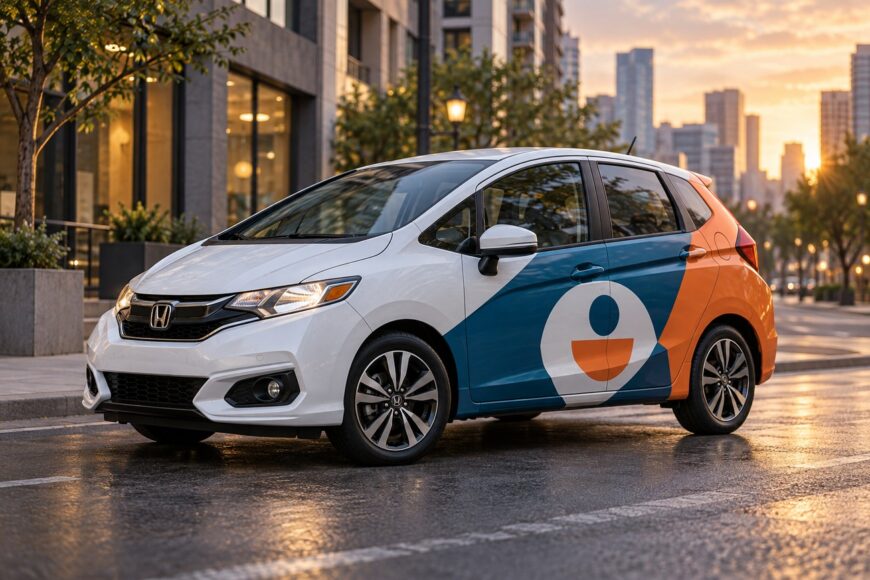
A Honda Fit looks like an affordable canvas for a mobile billboard, but its compact sides leave little room for a message people can read in traffic. A wrap can cover every panel and still fail if the business name disappears into a busy background or the contact details are too small.
The useful choice is between a bold partial wrap and full coverage that makes good use of the extra space. Either can work; either can become an expensive design that looks convincing only when the car is parked. Start with what a passing driver or pedestrian needs to recognize, then decide how much vinyl that message requires.
- Design for a glance, not a parked-car inspection
- Choose coverage that earns its space
- Protect the finish by getting installation right
- Keep the billboard working after it leaves the shop
- Frequently asked questions
- How much does it cost to vinyl wrap a Honda Fit?
- How much can you make from Wrapify with a Honda Fit?
- How much can you make from Wrapify?
Design for a glance, not a parked-car inspection
Give the Fit’s side panels a clear hierarchy: recognizable business name or mark, one short description of the service, and a contact route. A simple web address or easy-to-read phone number has a better chance than a menu of services in small type. Keep the main message away from door handles and panel breaks, where letters can become harder to read.
Test a lockup from 10–20 meters as a practical legibility check, not a guaranteed reading distance. Shrink it on a screen as well; details that vanish at thumbnail size are unlikely to improve in moving traffic. Check the side and rear views separately, since the hatch may suit a different arrangement from the doors.
Contrast depends on the car beneath the graphic. Pale lettering can disappear against white paint, while dark printed areas may look different under shade and glare. Ask for a lockup shown on the Fit’s actual body color, with handles, windows, and seams visible, rather than approving artwork on a flat white template.
Rain, road grime, and low light further reduce what people can take in. Put essential words on broad, uninterrupted panels, and let decorative shapes occupy the awkward spaces. Treat the car as a brief moving sign, not a printed flyer that someone can stop to study.
Choose coverage that earns its space
A partial wrap can concentrate color and a large mark across the doors and rear without covering every painted surface. A full wrap gives the design a continuous background and more control over the car’s overall appearance. That extra coverage is useful when it supports the message; it does not, by itself, make the advertisement more effective.
On a Fit, a well-designed partial wrap can offer better value than full coverage with weak graphics. Leave enough visual breathing room for the name to stand out. If the design needs a dense block of tiny claims to fill the available vinyl, reducing the coverage may improve both the result and the budget.
Small body area does not automatically mean simple installation. Mirrors, handles, and curved bumpers take time to fit neatly, even though they contribute little readable advertising space. A full wrap can also require more disassembly and more decisions about where printed panels meet.
There is no universal Honda Fit wrap price. Coverage, artwork complexity, materials, preparation, installation, and any removal work change the quote. Ask which difficult parts will be wrapped, left painted, or finished separately, so the proposed design matches the work you are paying for.
Protect the finish by getting installation right
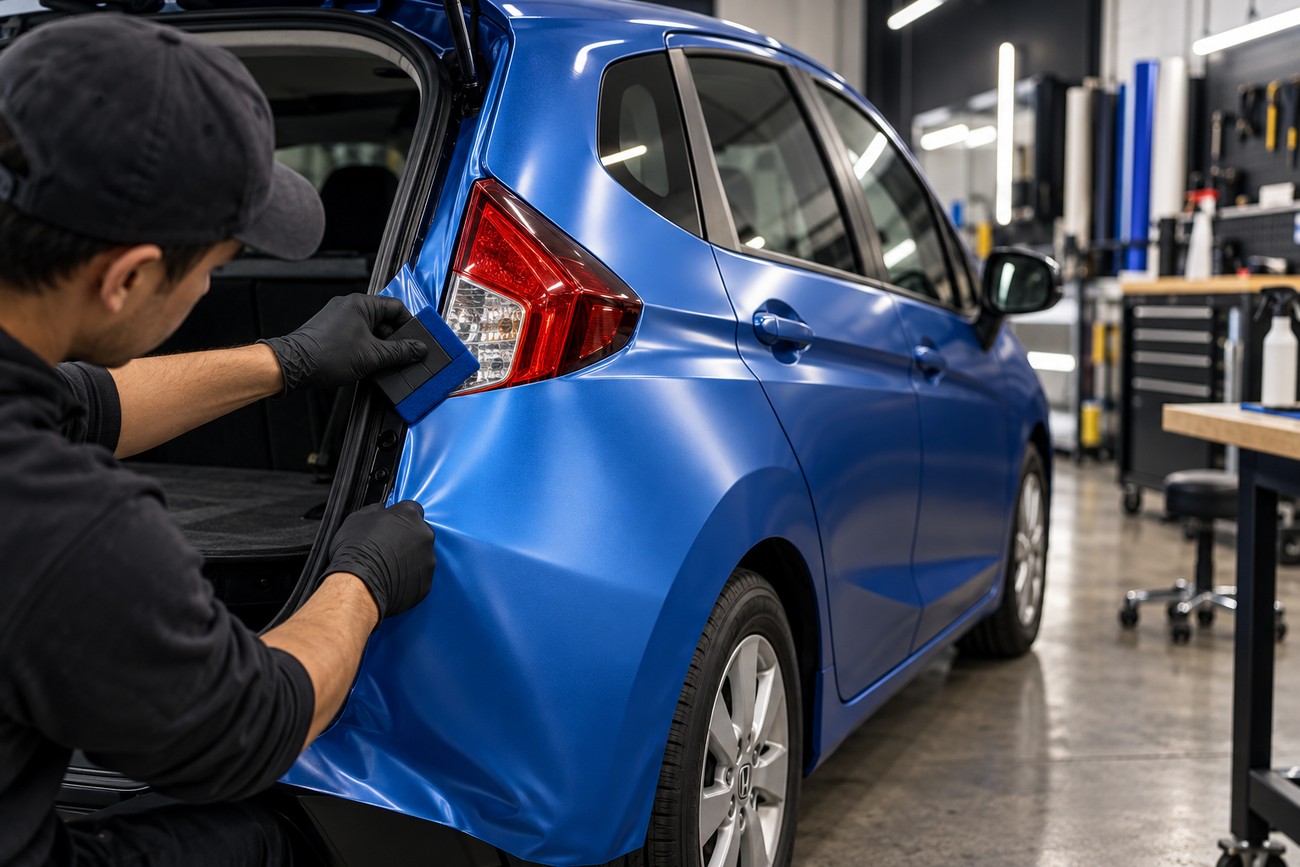
Before approving a wrap, have the installer assess chips, peeling clear coat, and repainted areas. Vinyl can follow the shape of small defects and make them more apparent under angled light. Fresh paint also needs the appropriate cure time before film is applied; ask the paint shop and installer to agree on that timing.
Clean, wax-free surfaces give adhesive a better chance to hold. The installer should remove contaminants, use film suited to the Fit’s curves, and follow the film manufacturer’s requirements for application temperature, edge finishing, and cutouts. Shortcuts here tend to show first around recesses, handles, mirrors, and bumpers.
After shaping film around a mirror or bumper, the installer needs to check its edges again: a panel can look smooth at handoff while tension remains concentrated where the vinyl turns out of sight.
Close inspection may still reveal seams or stretched print on complex contours. Advertising vinyl may reduce some minor surface scratching, but it is not a substitute for paint-protection film or reliable chip protection. Clean removal may be possible on sound paint under suitable conditions; aged film, heat exposure, weak or repainted clear coat, and adhesive quality can leave residue or damage the finish.
Keep the billboard working after it leaves the shop
Wash the wrap with methods suitable for the film, paying particular attention to grime around edges without directing harsh pressure beneath them. Inspect mirrors, bumpers, and cutouts after washes. A small lifting edge is easier to address promptly than a section that has collected dirt under the adhesive.
Sun exposure can age print and adhesive, while winter salt and road grime make a neglected wrap look tired sooner. Driving, washing, climate, and storage all affect appearance and service life. Commercial vinyl can last several years, but a warranty has conditions; read what it covers and what care it requires.
Judge the campaign by whether someone can recognize the business and act on the message. If you want to distinguish responses to the car from other advertising, give the wrap a dedicated, easy-to-read contact route. It still needs to be legible at a glance, so avoid a long tracking address.
Plan for replacement and removal when you approve the first quote. Older film and vulnerable paint can complicate removal, and a damaged printed panel may need matching material to repair cleanly. Check local vehicle-advertising and required-marking rules as well, particularly if the Fit belongs to a commercial fleet.
Frequently asked questions
Costs, driver-payment programs, and vehicle rules depend on details that a photo of a wrapped Fit cannot show. The practical next step is to check the terms of the specific job or campaign before making a budget.
How much does it cost to vinyl wrap a Honda Fit?
There is no reliable universal price. Request itemized quotes for the same panel coverage and artwork, specifying the printed film and finishing, surface preparation, installation, and any existing-wrap removal. Ask what the warranty covers and whether removal or replacement of damaged panels is included; otherwise, two headline prices may describe different jobs.
How much can you make from Wrapify with a Honda Fit?
There is no fixed amount for owning a wrapped Fit. Wrapify pays eligible drivers for qualifying campaigns, subject to available opportunities and current terms. Check whether your location and vehicle qualify, what driving is required, and whether a campaign is available before treating a possible payment as income.
How much can you make from Wrapify?
Earnings depend on the campaigns offered and the requirements you meet, so a general payout figure would be misleading. Review the current offer’s payment terms, campaign period, driving conditions, and any costs or obligations before accepting. Payment for carrying another advertiser’s campaign is separate from the value of promoting your own business on your Fit.







