
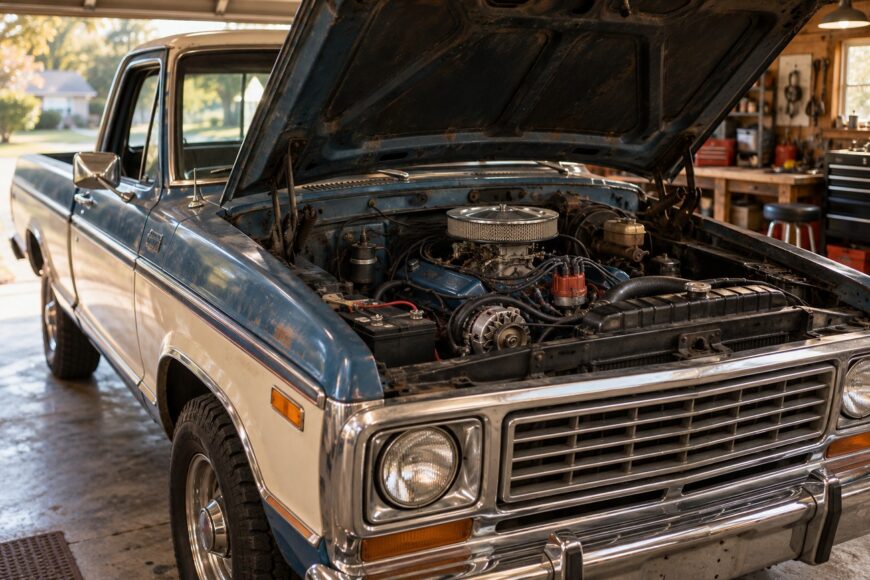
A 1970s Ford pickup lacks the computer systems that make modern trucks especially vulnerable to an electromagnetic pulse, but it is not electrically immune. A typical truck from that era often uses a carburetor, mechanical distributor, and simple 12-volt circuits instead of factory electronic fuel injection and an engine control unit.
The likely result ranges from no obvious effect to a no-spark condition, charging failure, relay problem, or damaged wiring. Pulse strength, distance, wiring length and orientation, connected external conductors, vehicle configuration, and component condition all matter. No general claim that every old Ford will survive is justified.
An EMP also does not have to destroy the entire vehicle to leave it unusable. A failed coil, regulator, ignition switch, or connection may stop the engine while the rest of the truck appears intact. In other cases, the truck may start and develop charging or ignition symptoms later.
- Why a 1970s Ford Pickup Is Less Vulnerable Than a Modern Truck
- Simple Electrical Systems Are Not EMP-Proof
- What Is Most Likely to Fail First?
- Starting Is Not the Same as Making It Home
- The Truck’s Condition and Modifications Matter More Than the Badge
- 1970s Ford Pickup vs. Modern Truck: EMP Exposure Factors
- How to Think About an EMP Failure Without OBD
- Common EMP Myths About Old Ford Trucks
- What Owners Can Do Before Relying on One
- Frequently asked questions
- What truck would have the best chance of surviving an EMP?
- What age vehicle will survive an EMP?
- What truck would survive an EMP?
- What vehicles are immune to EMP?
Why a 1970s Ford Pickup Is Less Vulnerable Than a Modern Truck
A typical 1970s Ford pickup often lacks factory EFI and an ECU. Its carburetor meters fuel mechanically, while a mechanical distributor commonly controls ignition timing and spark distribution. The starter, ignition, lighting, and charging systems generally operate through simple 12-volt circuits.
That architecture leaves fewer sensitive semiconductor devices for an EMP to damage. Modern trucks generally contain substantially more semiconductor electronics, electronic control modules, sensors, and interconnected wiring. A failure in one module or network can prevent several systems from operating even when the mechanical engine is sound.
EMP risk generally increases with sensitive semiconductor electronics and conductors that can pick up induced voltage. The shorter and simpler wiring found in a stock older pickup usually presents fewer paths for damaging voltage than the extensive harnesses and networks in a modern vehicle.
Those advantages describe lower vulnerability, not guaranteed survival. Some 1970s trucks received electronic ignition conversions, aftermarket alarms, radios, or other additions. Even a stock example still depends on electrically operated ignition, charging, switching, and starting components.
Simple Electrical Systems Are Not EMP-Proof

A mechanical distributor only removes one electronic control function. It does not protect the ignition coil, ignition switch, relays, voltage regulator, alternator or generator, or the wiring that connects them. An electromagnetic pulse can induce voltage in conductors, and simple wiring can still carry that stress into attached components.
The coil is particularly important because the starter can turn the engine normally while the ignition system produces no usable spark. Points and the condenser, or an electronic ignition conversion, may also be involved. A worn switch, weak ground, corroded connector, or damaged relay can create the same practical symptom.
The charging system presents another exposure. Depending on the truck and its previous repairs, it may use an alternator or generator with a regulator and associated diodes or control components. These parts contain electrical elements that may fail even though the engine itself remains mechanically unaffected.
Simple wiring usually reduces exposure compared with a modern vehicle, but it does not eliminate induced voltage. A metal body may provide some shielding, yet it cannot guarantee protection for internal circuits or long external lines. Antennas, added cables, and connected external devices can provide additional paths for interference.
What Is Most Likely to Fail First?
The classic complaint is simple: the starter turns, but there is no spark. The fault may be in the coil, points, condenser, electronic ignition conversion, ignition switch, relay, or the wiring between those parts. A weak ground or loose terminal can produce the same result without proving that the pulse damaged a particular component.
Charging components are another recurring weak point in electrical trouble. A regulator, alternator or generator component, diode, terminal, or ground may stop working while the starter and basic engine mechanics remain functional. The truck can therefore appear nearly normal until the battery loses its stored charge.
A cranking starter does not show that the ignition and charging systems survived. Separate the no-crank, crank-no-spark, and no-charge symptoms before condemning the engine or assuming the whole truck is destroyed.
An EMP may produce partial or repairable damage rather than permanently destroying the entire vehicle. One failed coil, relay, regulator, or connection can stop normal operation, while the carburetor, distributor housing, starter motor, and engine remain usable. Intermittent faults may be harder to find because a damaged component can work briefly and fail again under vibration or heat.
Starting Is Not the Same as Making It Home
A truck may start after an impulse and still have hidden charging or ignition damage. If the alternator, generator, or regulator is no longer charging, the engine can run temporarily on battery power. The available operating time depends on the battery, electrical load, and condition of the remaining circuits.
As voltage falls, the truck may begin to misfire, stall, or operate its ignition inconsistently. Headlights, instruments, relays, and other electrically dependent functions may also become unreliable. A successful restart therefore proves only that enough of the starting and ignition path is working at that moment.
Delayed symptoms can include poor charging, intermittent spark, stalling, and loss of essential electrical functions. A damaged regulator may allow overcharging rather than a complete loss of charge, creating a second risk for the battery and other components.
For that reason, a post-event inspection should include charging output and electrical stability, not only a quick engine start. A truck that runs across the driveway may still be unable to remain operational on a longer trip.
The Truck’s Condition and Modifications Matter More Than the Badge
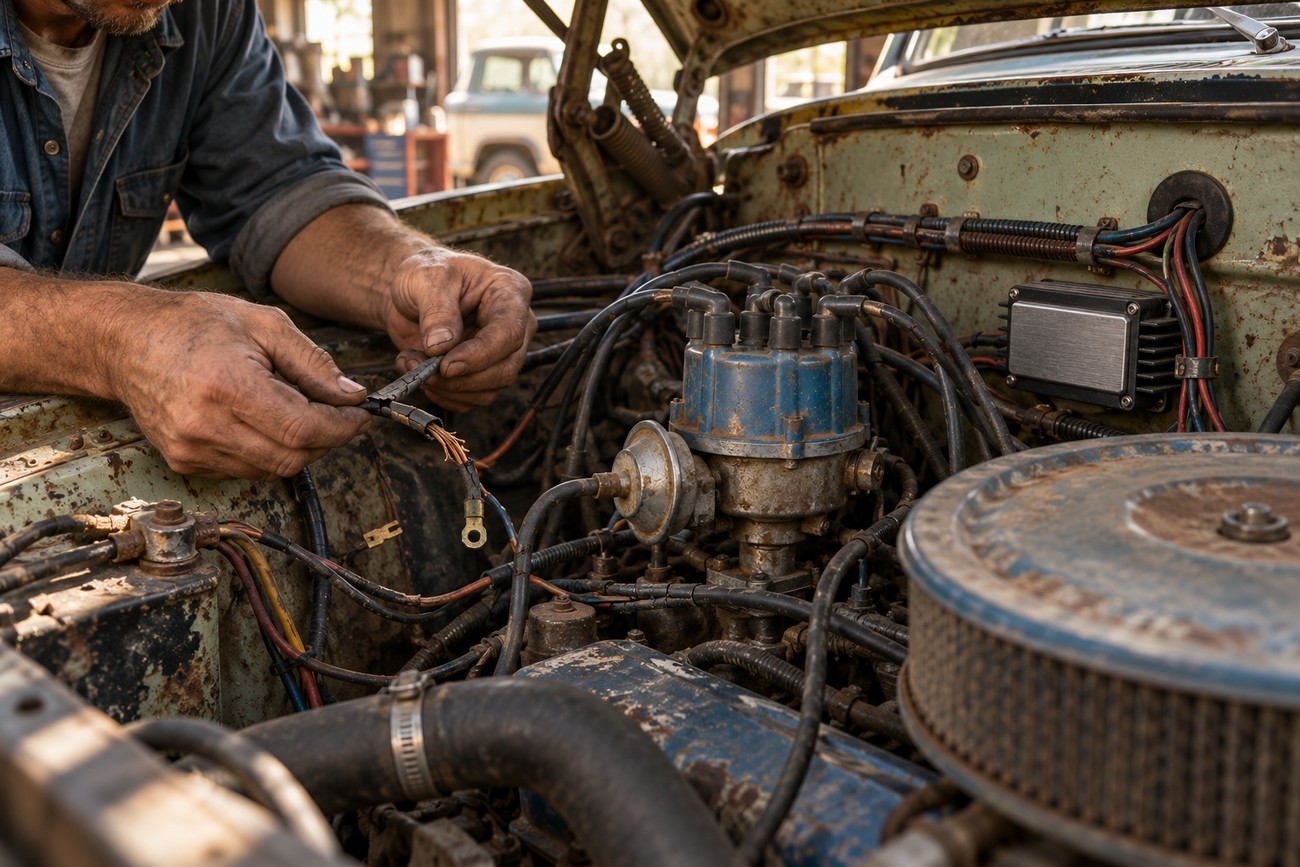
Model year alone is a poor predictor of EMP resilience. Age-related insulation damage, brittle wiring, corroded grounds, loose terminals, and oxidized connectors can make a simple electrical system unreliable before any unusual pulse occurs. A truck that has been stored poorly may have more practical electrical risk than its original design suggests.
Modifications change the picture further. An electronic ignition conversion adds semiconductor electronics, while an alarm, modern audio system, USB charger, or auxiliary wiring adds devices and conductors that were not part of the original design. Their presence does not guarantee failure, but it increases the number of possible fault paths.
A well-maintained stock truck and a neglected, heavily modified truck should not be treated as equivalent. The condition of the grounds, terminals, insulation, switches, and connectors can matter more than the Ford badge or the calendar year.
Long aftermarket wires deserve special attention because they can act as conductors that pick up induced voltage. Disconnecting unnecessary accessories may reduce ordinary parasitic loads and simplify diagnosis, although it cannot make the truck EMP-proof.
1970s Ford Pickup vs. Modern Truck: EMP Exposure Factors
This comparison describes typical configurations rather than guaranteed outcomes. Both vehicle types can be affected through wiring, charging, ignition, or connected external conductors.
| Area | Typical 1970s Ford pickup | Typical modern truck | Practical implication |
|---|---|---|---|
| Factory electronics | Often has no factory EFI or ECU and uses relatively few semiconductor devices. | Commonly relies on ECU-controlled systems, sensors, modules, and electronic networks. | The modern truck has more sensitive electronics that may be affected by induced voltage. |
| Ignition and engine control | Often uses a carburetor and mechanical distributor, with electrical power still required for the coil and related circuits. | Commonly depends on electronic ignition control, fuel injection, sensors, and module communication. | The older design may keep operating with fewer electronic controls, but its coil, switch, and wiring remain possible failure points. |
| Charging system | Often uses a relatively simple alternator or generator, regulator, wiring, and grounding arrangement. | Usually includes electronically managed charging and more interconnected control circuits. | Either vehicle can lose charging; the older truck may be easier to trace manually. |
| Wiring complexity | Typically has fewer circuits and shorter factory harnesses, although age and repairs can degrade them. | Generally has more extensive wiring, networks, sensors, and connected modules. | More conductors and electronics create more possible coupling and failure points. |
| Aftermarket exposure | May have added electronic ignition, alarms, radios, USB chargers, or long accessory wiring. | Often includes a larger number of factory and aftermarket electronic devices. | Actual configuration matters more than the model-year label. |
| Diagnostic difficulty | Usually lacks modern OBD fault reporting, so testing relies on manual electrical and ignition checks. | May provide fault codes, although module or network damage can complicate diagnosis. | The older truck has fewer systems to inspect but less automated information about the fault. |
How to Think About an EMP Failure Without OBD
Most 1970s Ford pickups lack modern OBD-based fault reporting. Begin with the battery, battery terminals, engine and chassis grounds, and visible connectors. Check for loose or corroded connections before replacing parts, because an old connection can fail independently of the pulse.
Next, separate the symptom into categories. A no-crank condition points toward battery power, cables, the starter circuit, a relay, or the ignition switch. A cranking-but-no-spark condition directs attention to the coil, points or electronic ignition conversion, distributor wiring, and related grounds. A running engine with no charging requires inspection of the alternator or generator, regulator, wiring, and charging connections.
- Verify battery condition and terminal security.
- Inspect engine, chassis, and body grounds.
- Check for spark while separating ignition faults from fuel faults.
- Trace power through the ignition switch, relay, coil, and distributor circuit.
- Measure charging output and inspect the regulator and charging wiring.
- Look for damaged insulation, overheated terminals, and intermittent connections.
Manual voltage, continuity, spark, and charging checks are more useful here than searching for a definitive EMP indicator. The first symptom does not prove which component was damaged or even prove that the pulse caused the failure. Old coils, regulators, grounds, and switches can fail because of age, heat, corrosion, or vibration.
Common EMP Myths About Old Ford Trucks
The first myth is that any old truck is immune. Older, simpler vehicles are generally more likely to remain functional than modern vehicles, but a 1970s Ford can still lose its coil, regulator, relay, switch, or wiring. Architecture improves the odds; it does not create universal protection.
The opposite myth claims that an EMP will destroy every vehicle. Vehicle response depends on pulse strength, distance, wiring orientation and length, connected external conductors, configuration, and component condition. A typical older pickup may be less vulnerable than a modern truck, while a heavily modified or poorly maintained example may have additional weaknesses.
A metal body may provide some shielding, but it does not guarantee protection for internal circuits or long external conductors. Antennas, accessory wires, and other connected lines can still pick up induced voltage and carry it toward vehicle components.
Reports that an old vehicle “survived” often describe a test pulse or an ordinary electrical surge rather than laboratory-confirmed HEMP survivability. A successful restart also does not prove that the charging system or ignition components escaped hidden damage.
What Owners Can Do Before Relying on One
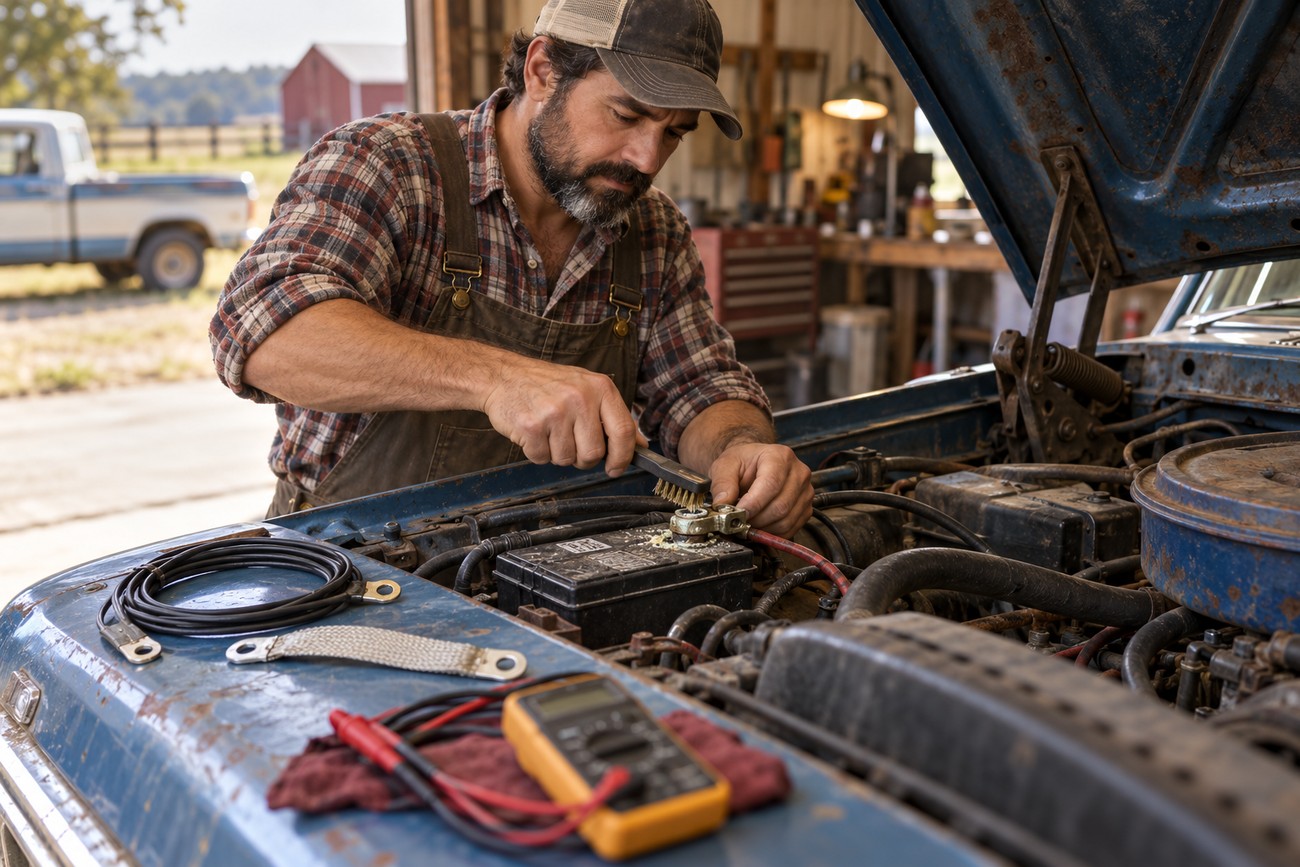
Start with ordinary electrical maintenance. Clean and secure the battery terminals, engine and chassis grounds, connectors, and major power connections. Inspect insulation for brittleness, abrasion, heat damage, and previous repairs that may fail under vibration or electrical stress.
Test the truck as a complete starting and charging system. Confirm that it cranks, produces a strong and consistent spark, runs without abnormal ignition symptoms, and charges the battery correctly. A clean engine start alone does not establish that the truck can continue operating.
Keep compatible replacement parts available if the truck is important to your plans. Useful spares may include a coil, regulator, relay, fuse, and the appropriate points, condenser, or electronic ignition component. Compatibility should be checked against the actual distributor, charging system, and previous modifications.
Stored parts should be tested before storage and periodically verified afterward. A spare that is corroded, incorrect, or already defective will not help during an electrical failure. These measures reduce ordinary breakdown risk and improve repairability, but they do not guarantee EMP protection.
Frequently asked questions
The questions below address vehicle design, age, and the meaning of “survival.” A simple electrical system generally offers lower vulnerability than a modern, highly integrated one. However, component condition, modifications, wiring, and the specific pulse still affect the outcome.
What truck would have the best chance of surviving an EMP?
A truck with a carburetor, minimally modified electrical system, mechanical ignition, short and sound wiring, and verified grounds would generally be a better candidate than a vehicle dependent on many electronic modules. The important selection criteria are architecture and condition, rather than a particular badge.
No model is guaranteed. The coil, regulator, relays, switches, wiring, and connected external conductors can still be affected, and aftermarket electronics can change the risk substantially.
What age vehicle will survive an EMP?
There is no calendar age that guarantees survival. Electrical architecture, wiring layout, component condition, and exposure determine risk more directly than the vehicle’s age.
A newer vehicle with simple, well-maintained systems may be a better candidate than an older truck packed with aftermarket electronics and brittle wiring. Conversely, a typical 1970s pickup often has fewer factory semiconductor electronics than a modern truck, which generally reduces its vulnerability.
What truck would survive an EMP?
A simple, well-maintained truck has a better chance of remaining usable than a modern vehicle with extensive electronic control modules and interconnected networks. A carbureted configuration with mechanical ignition and limited accessories reduces the number of sensitive components that need to keep working.
“Survive” can mean several things: starting once, continuing to run, retaining charging capability, and remaining repairable are different outcomes. A truck may meet the first test and fail the next one because of hidden charging or ignition damage.
What vehicles are immune to EMP?
No ordinary vehicle can be assumed to be immune to every EMP scenario. Even a vehicle with little semiconductor electronics can be affected through induced voltage in wiring, charging components, ignition parts, relays, switches, or connected external conductors.
Older and simpler vehicles are generally less vulnerable than modern vehicles, but immunity depends on the pulse, distance, wiring, configuration, shielding, and condition. Claims based only on a small test pulse or an ordinary electrical surge do not establish immunity to a confirmed HEMP event.







