
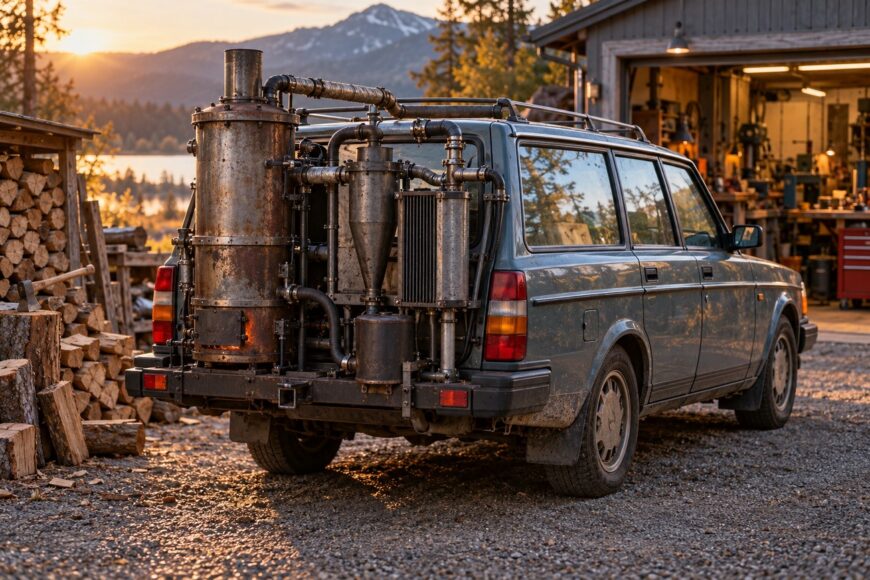
A Volvo 240 is large, durable, and mechanically familiar. A wood-gas system attached to one is none of those things: the gasifier, cooler, filters, piping, fuel storage, and heat shielding can occupy much of the rear of the car and still demand constant attention. The result is a striking mismatch between a dependable old sedan and a bulky fuel system that behaves more like a small industrial installation than a bolt-on accessory.
The attraction is understandable. Wood gas offers a degree of fuel independence and revives engineering associated with wartime shortages, when petrol was scarce and vehicles had to operate on locally available material. The price is lower performance, lengthy preparation, toxic gas, difficult packaging, and regular cleaning. A wood-gas Volvo 240 is best treated as a specialized engineering project or emergency experiment rather than an easy alternative-fuel conversion.
- Why Wood Gas Came Back—and Why the Volvo 240 Gets Attention
- What Wood Gas Does to Volvo 240 Performance
- The Conversion Is a Whole Fuel System, Not Just a Gasifier
- Why Wood-Gas Builds Lose Power, Clog, and Stall
- The Hidden Costs: CO, Packaging, Emissions, and Fuel Logistics
- What Living With a Wood-Gas Volvo 240 Actually Requires
- Frequently asked questions
- How long can a Volvo 240 run on one load of wood?
- What should happen if the wood-gas system stops producing usable gas while driving?
Why Wood Gas Came Back—and Why the Volvo 240 Gets Attention
Wood gas is produced by heating wood in a gasifier with a controlled supply of air. The process converts solid fuel into a combustible mixture that can be drawn into an internal-combustion engine. Its energy content is low, and the gas must be cooled and cleaned before it reaches the intake, but it can be made from wood or chips instead of refined liquid fuel.
That principle became important during the fuel shortages of the Second World War. In parts of Europe, gasifiers allowed trucks, tractors, buses, and passenger cars to keep moving when petrol was restricted or unavailable. The historical context matters: the system was a response to scarcity, not a claim that wood gas offered better performance or easier ownership.
Older Volvo 240s attract enthusiast interest because their chassis is robust and their petrol drivetrains are comparatively straightforward. A simple, naturally aspirated engine generally presents fewer control problems than a modern powertrain dependent on dense electronic management, turbocharging, and tightly integrated emissions systems. Some enthusiasts therefore consider an older 240 a workable platform for experimentation.
That suitability remains community opinion, not an official Volvo recommendation. The 240 range included different engines, fuel systems, transmissions, and equipment levels, so one car may be far easier to adapt than another. The sound condition of the engine, the available space, the intended use, and the quality of the entire gas path matter more than the badge on the grille.
What Wood Gas Does to Volvo 240 Performance
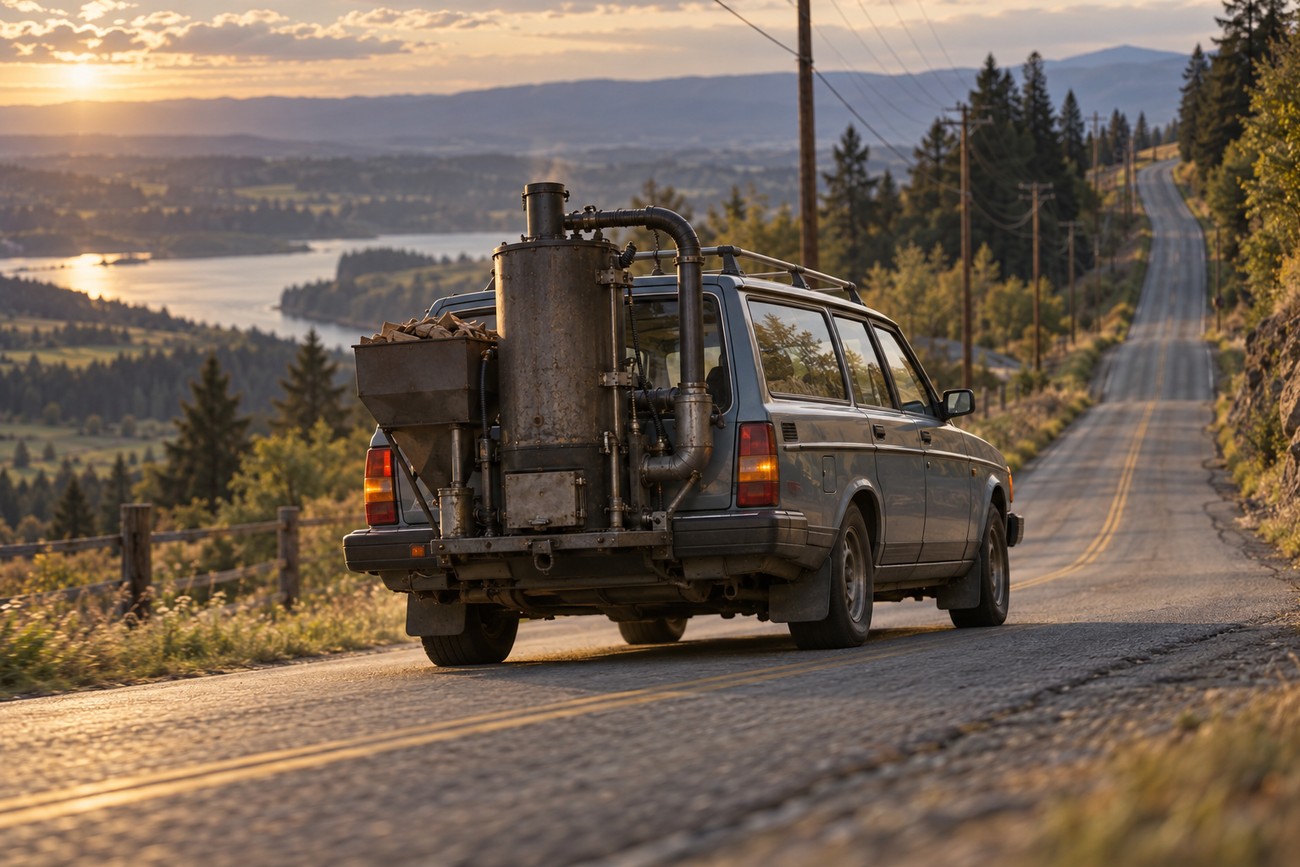
Wood gas has a heating value of approximately 4–6 MJ/m³, substantially lower in energy density than petrol or propane. The engine must therefore draw a larger volume of gas and air to produce the same useful work. The driver notices this first as softer throttle response, slower acceleration, and a car that needs more room to build speed.
Enthusiast reports commonly describe approximately 30–50% less power than on petrol, with greater losses possible when tuning is poor or the gasifier and filters impose excessive restriction. This is a practical range from converted vehicles, not a guaranteed Volvo 240 specification. There is no universal speed or power figure because results depend on vehicle mass, generator loading, fuel quality, gas temperature, and ignition and mixture tuning.
Hill climbing exposes the limitation quickly. A car that feels acceptable on level ground may lose momentum on a grade, especially with passengers, luggage, or a partially obstructed filter. The engine often needs a more open throttle at the same road speed because the gas contains less usable energy, so ordinary petrol driving habits produce disappointing results.
Petrol-like performance is therefore the wrong baseline. A well-matched installation may make the car usable, but it does not remove the energy penalty of the fuel. Poorly controlled gas production, wet fuel, leaks, or retarded ignition can make the loss much greater and turn ordinary driving into a sequence of gear changes, long climbs, and cautious route planning.
The Conversion Is a Whole Fuel System, Not Just a Gasifier
A workable installation needs more than a vessel that heats wood. It needs gas generation, cooling, filtration, a sealed route to the engine intake, suitable air and gas control, and a safe way to manage heat and condensate. The layout must also coexist with the Volvo’s engine bay, exhaust system, fuel tank, suspension, luggage area, and rear visibility.
Gas temperature is a central concern. Hot gas carries moisture and combustion by-products that are harder to remove, while poorly conditioned gas promotes condensate in the pipework and filters. Cooling and stable thermal conditions improve filtration, but they also create hot surfaces, drain points, and components that require inspection rather than casual concealment under a trunk floor.
Ignition settings require attention as well. Wood gas burns more slowly than petrol, so a more advanced ignition setting is often required. Leaving the engine on an unchanged petrol setting can contribute to weak response and inefficient combustion, while indiscriminate adjustment can create its own problems. The correct approach is to assess the complete system and engine behavior rather than copy a single setting from another car.
Mixture adjustment only becomes meaningful after the gas path is sealed, cooled, and reasonably clean. Chasing the carburetor while condensate or an air leak is entering the system can make a sound engine appear badly tuned.
Small air leaks can destabilize the mixture and increase fire risk. The same is true of leaks around hot gas equipment, where an apparently minor sealing defect can introduce oxygen into an unwanted part of the system or release carbon-monoxide-containing gas into the vehicle’s surroundings. Any conversion needs controlled heat, reliable containment, and inspection access; improvised routing through the passenger compartment is an unacceptable compromise.
Why Wood-Gas Builds Lose Power, Clog, and Stall
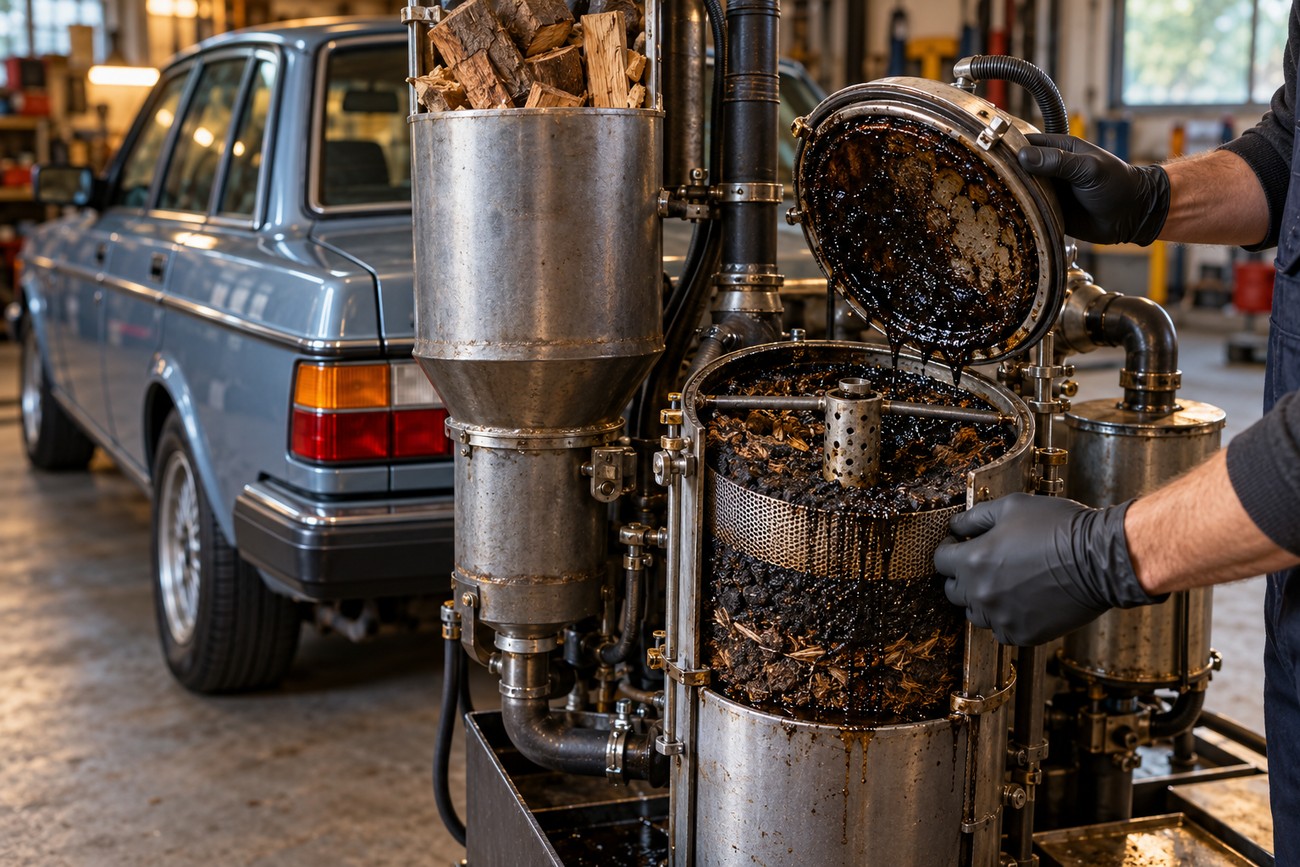
The most common complaints are practical: the car runs, but struggles badly on a hill; it takes too long to become usable; and the engine coughs or stalls when the gas quality changes. These symptoms often reflect the fuel system rather than a mysterious defect in the Volvo engine. Wood gas production is sensitive to fuel condition, airflow, temperature, and restriction.
Fuel should be consistently dry. Wet wood sharply increases tar, condensate, and blockage problems, and it makes the gas stream less stable. A load that looks dry on the outside may still contain uneven moisture, so mixed fuel can produce an engine that alternates between weak running, intake coughing, and sudden loss of power.
Particle size also matters. Material that is too fine increases flow resistance and tar risk, while material that is too coarse can make gasification unstable. This is one of the less obvious reasons that random workshop scraps are poor fuel: the issue is not only the species of wood, but also consistent preparation and predictable movement of gases through the fuel bed.
Ash, tar, soot, and condensate accumulate in the generator, filters, coolers, and associated pipework. Regular removal is part of operation, not evidence of an unusual failure. If a system becomes progressively weaker after several trips, a restricted filter or tar-loaded passage is a more credible starting point than assuming that the Volvo’s basic engine has suddenly lost its mechanical health.
The Hidden Costs: CO, Packaging, Emissions, and Fuel Logistics
Carbon monoxide is a normal component of wood gas and remains dangerous even when the system appears smokeless. It has no dependable warning odor, so a clean-looking exhaust or quiet generator does not establish that the installation is safe. Gas paths, joints, filters, and the body around the equipment require a level of sealing and ventilation discipline that ordinary petrol plumbing does not.
Heat introduces another layer of risk. A wood-gas installation can expose the car to hot surfaces, leaks of hot gas, and backfires if the mixture or intake arrangement is unstable. Air entering the wrong part of the system can raise the risk of ignition, while a poorly protected component may damage nearby wiring, paint, trim, or luggage. Safe design also needs a controlled way to stop the gas supply and a clear plan for parking or shutting down the hot equipment.
Packaging is less glamorous than the historical photographs suggest. The generator and gas-cleaning equipment are bulky, affecting luggage space, vehicle weight, and rear visibility. Extra mass can alter how the car behaves, while a tall or awkward installation can obstruct access to the engine bay or make routine checks difficult. A conversion that technically fits may still be unsuitable for normal family use.
Wood gas is not automatically clean. Carbon monoxide and particulate emissions remain serious concerns when combustion or filtration is imperfect, and visible smoke or soot around the car is a practical sign of poor control rather than historical authenticity. The fuel also needs a supply chain: wood or chips must be stored, dried, and sorted before a trip, then protected from moisture while waiting for use.
That logistics burden separates wartime necessity from modern environmental claims. A local solid fuel may replace purchased petrol, but the whole chain includes preparation, heat losses, gas cleaning, engine inefficiency, and emissions. Wood gas can be an ingenious response to fuel scarcity without being a low-impact transport solution in every modern setting.
What Living With a Wood-Gas Volvo 240 Actually Requires
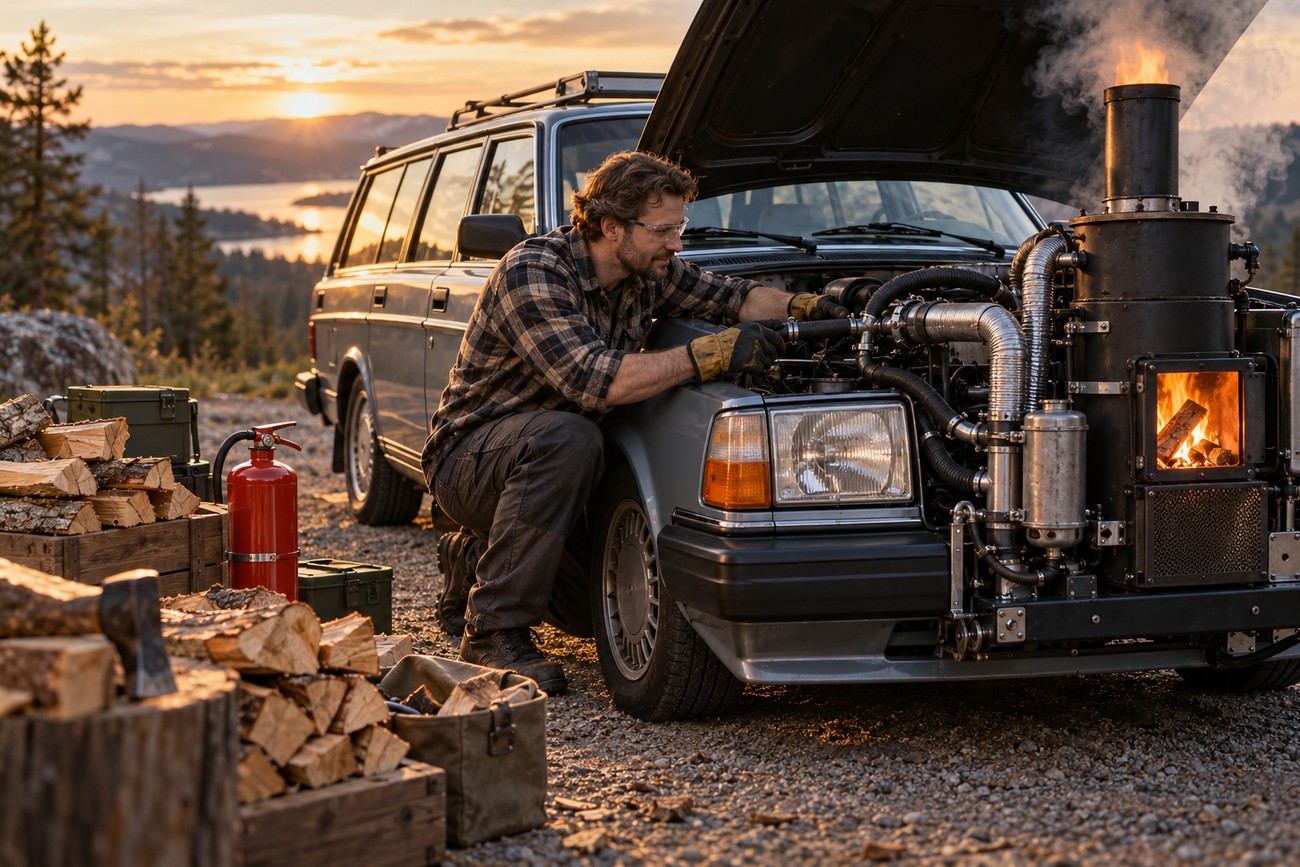
Operation begins before the car moves. The fuel must be prepared, the installation inspected, and the gasifier brought up to a stable operating condition. Start-up requires ignition and warm-up before the gas becomes useful for driving, so a short errand can involve a disproportionate amount of preparation compared with turning a petrol key.
Once moving, the driver has to manage reduced power and changing gas quality. Route choice matters, especially where hills, traffic, or heavy loads are involved. The car may need more throttle at a normal cruising speed, and an interruption in gas production can quickly become a drivability problem rather than a minor inconvenience.
Refueling is a workshop task rather than a quick stop at a pump. Fuel needs consistent preparation, and the system needs repeated inspection and cleaning instead of a fit-and-forget maintenance schedule. After a trip, ash, tar, condensate, and soot may require attention, while filters and seals need checking before the next run.
Urban use is consequently awkward. Preparation comes before the trip, and cleaning follows it; the equipment occupies useful space and can make parking, loading, and visibility worse. A Volvo 240 may be mechanically accommodating, but its behavior will not resemble normal petrol operation.
The decision test is straightforward. This project suits someone with workshop access, patience for fuel preparation, tolerance for reduced performance, and a willingness to treat safety inspections as routine work. It does not suit a driver seeking convenient daily transport. A wood-gas Volvo 240 is best assessed as a specialized enthusiast project whose historical value and fuel independence must be weighed against its mechanical, operational, and safety compromises.
Frequently asked questions
Wood-gas conversions vary too much for universal performance or operating figures. The answers below focus on the variables that determine whether a Volvo 240 conversion remains usable and how to respond when the system stops behaving normally.
How long can a Volvo 240 run on one load of wood?
There is no universal runtime figure for a wood-gas Volvo 240. It depends on generator size, the amount and preparation of fuel, particle consistency, vehicle demand, road speed, terrain, payload, and how efficiently the gasifier converts the available wood.
A large fuel load does not guarantee a long drive if the wood is wet, the gas path is restricted, or the engine is working hard. Measuring one enthusiast installation cannot establish a range for another car because generator loading and fuel quality change the result substantially. Runtime should therefore be established conservatively for the individual vehicle, with reserve capacity and a safe stopping plan.
What should happen if the wood-gas system stops producing usable gas while driving?
The priority is a controlled transition away from engine demand: reduce load, use the vehicle’s brakes, and move to a safe place without attempting an improvised roadside repair around hot equipment. The engine may lose power abruptly, so stopping distance, traffic, and the condition of the shoulder matter more than preserving momentum.
Once stopped, treat the installation as hot and potentially contaminated with carbon monoxide. Do not open, disconnect, or probe components casually, and do not continue operating on an unstable mixture merely to reach a destination. Inspection should wait until the equipment is safe to approach, with attention to fuel condition, restriction, condensate, sealing, and the system’s shutdown procedure rather than a quick adjustment made under pressure.







