
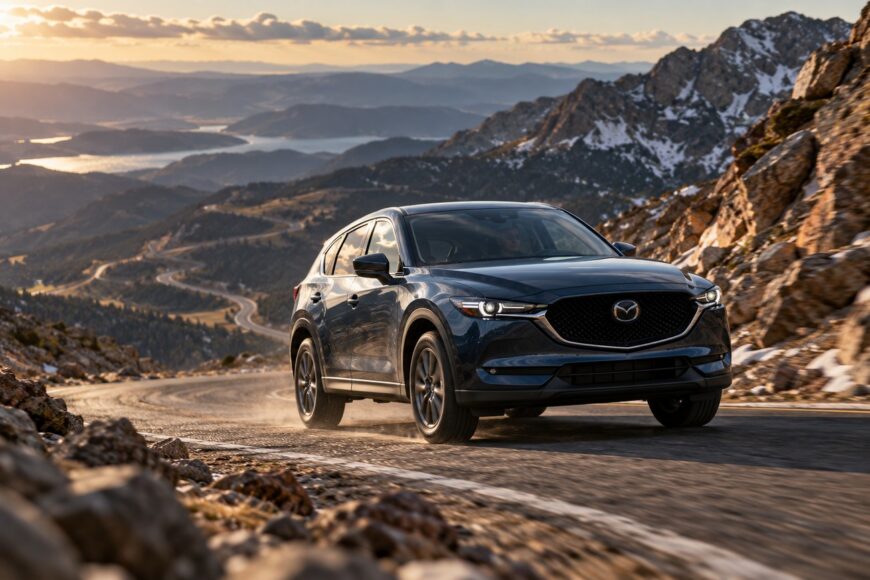
Yes. A turbocharged Mazda CX-5 will lose some performance on Pikes Peak, although it should compensate for altitude far better than a naturally aspirated CX-5. The turbocharger can maintain a useful supply of compressed air as atmospheric pressure falls, but it cannot recreate sea-level conditions at the summit.
The practical issue is sustained climbing performance rather than a guaranteed percentage of preserved horsepower. Fuel grade, intake temperature, engine protection strategies, transmission behavior, vehicle load, and maintenance all influence how the CX-5 feels during the climb. A healthy 2.5T should remain capable, but its response may become softer and available pull may decline as altitude and heat accumulate.
- The Short Answer: Yes, but Not Like a Naturally Aspirated CX-5
- What the CX-5 Turbo Is Actually Rated to Make
- Why Boost Does Not Preserve Sea-Level Power
- What the Driver Will Feel on the Climb
- The Bigger Risk May Be Heat, Not the Summit Number
- Fuel Choice Can Change the Result Before Altitude Does
- How to Prepare a Stock CX-5 Turbo for Pikes Peak
- What We Can and Cannot Claim About Power Loss
- Frequently asked questions
- What are the most common turbo-related problems to check on a Mazda CX-5 before a mountain trip?
- How long can a Mazda CX-5 turbo engine last under normal maintenance?
- What is the most common reason a CX-5 feels weak after a hard climb?
The Short Answer: Yes, but Not Like a Naturally Aspirated CX-5
Pikes Peak rises from approximately 9,390 ft at the start to approximately 14,110 ft at the finish. At the summit, air density is approximately 58% of sea-level density. That thinner air contains less oxygen per intake stroke, creating a fundamental challenge for any combustion engine.
A naturally aspirated CX-5 depends directly on atmospheric pressure to fill its cylinders, so its power falls substantially as the road climbs. The 2.5T uses a turbocharger to compress the available air and therefore compensates for altitude better than a naturally aspirated engine. The turbocharger cannot eliminate the effect because it still begins with lower inlet pressure and must work harder to achieve the required charge-air pressure.
Air density is a physical condition, while horsepower is the result of the complete engine, turbocharger, calibration, fuel, temperature, and drivetrain system. The summit’s approximately 58% air-density figure must not be treated as a direct CX-5 power figure. There is no fixed, universal percentage of power loss established for a stock CX-5 2.5T at Pikes Peak.
The driver may notice the loss before the vehicle becomes incapable of climbing. Throttle response can feel softer, torque may arrive later, and the six-speed automatic may shift more frequently on steep grades. Those effects can feel pronounced at low road speed, where every change in available torque is easier to notice.
What the CX-5 Turbo Is Actually Rated to Make
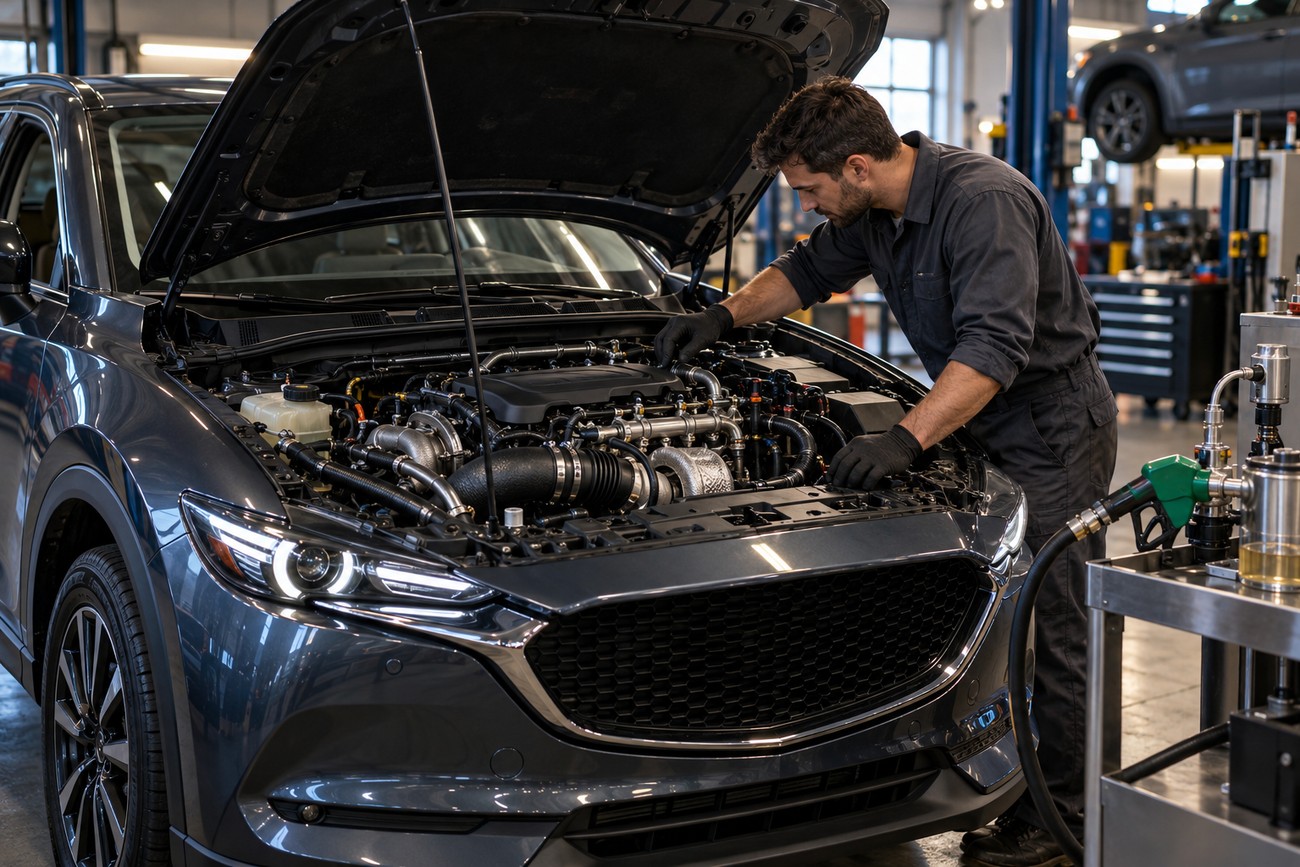
Mazda rates the CX-5 2.5T at 256 hp and 320 lb-ft on 93 AKI fuel. On 87 AKI fuel, the published rating is 227 hp and 310 lb-ft. These are different fuel conditions, so the figures should not be treated as contradictory ratings for one identical test setup.
The engine has a displacement of 2,488.5 cm³, a 10.5:1 compression ratio, and direct injection. That combination supports strong low- and mid-range torque, which is useful on a mountain road where the engine spends long periods under load. It also makes fuel quality and knock control relevant when the turbocharger is producing substantial cylinder pressure.
Mazda’s output figures apply to specified test conditions and fuel grades. They do not represent guaranteed output at approximately 14,110 ft, where barometric pressure, intake conditions, and engine protection strategies differ from the rating environment.
Using 87 AKI while expecting the 93-AKI rating creates a false baseline before the climb begins. The engine may still perform normally, but its calibration can use more conservative control under load. The result can be less available torque and a stronger impression that altitude has taken power away.
Why Boost Does Not Preserve Sea-Level Power
At altitude, the turbocharger receives less inlet pressure from the atmosphere. To deliver the same pressure into the engine, it must create a greater pressure ratio. That increases compressor work and raises the thermal and mechanical demands placed on the turbocharger and charge-air system.
A boost gauge can create a misleading impression. The same relative boost reading at sea level and at high altitude does not guarantee the same absolute mass of air entering the cylinders. The turbo may show substantial boost while the engine still receives less oxygen than it would under the same reading at sea level.
The engine control system can also alter the result. Barometric pressure, intake temperature, detonation, and turbocharger protection can influence boost and output. If temperatures rise or knock control detects a problem, the system may reduce ignition advance, limit boost, or otherwise protect the engine.
For that reason, a stable boost number alone cannot prove that sea-level power has been preserved. A meaningful evaluation would also consider barometric pressure, intake temperature, ignition timing, and knock corrections. The engine may be operating correctly even when it produces less usable acceleration than it does at lower elevation.
What the Driver Will Feel on the Climb

The first symptom is usually a softer response rather than an abrupt loss of power. Turbo torque may build later, and the driver may need more accelerator pedal to maintain the same pace. On a steep grade, that difference becomes more apparent because the engine has little opportunity to recover speed once the vehicle begins to slow.
Long climbs can also produce frequent shifts from the six-speed automatic transmission. The transmission may move between ratios as the engine works near its available torque range, especially when the road steepens or the vehicle is carrying passengers and luggage. Repeated shifting does not automatically indicate a fault, although an unusually harsh or confused pattern deserves inspection.
Steep grades, low vehicle speed, and continuous load amplify subjective power loss. A moderate reduction in engine output can feel severe when the CX-5 is climbing slowly with the accelerator open for an extended period. The same vehicle may feel acceptable on a level road at altitude because the required tractive effort is much lower.
AWD can improve traction and torque delivery on loose, wet, or uneven pavement. It cannot create additional oxygen or engine power. If the tires already have adequate grip, the limiting factor remains the engine’s available torque and the drivetrain’s ability to manage the sustained load.
The Bigger Risk May Be Heat, Not the Summit Number
The duration of the climb matters as much as the maximum elevation. A long, sustained pull can heat the engine compartment, intake system, turbocharger, oil, coolant, and transmission before the vehicle reaches the summit. Thermal saturation may reduce repeat performance even when the first acceleration run felt strong.
Hot under-hood air can increase intake temperature and reduce the density of the air entering the engine. The control system may then intervene to protect the engine or turbocharger. Drivers can experience this as reduced repeat pull, slower response, or a vehicle that feels stronger after a cooling period.
Oil and coolant condition become especially important under repeated high load. The turbocharger faces higher thermal and mechanical loads when it produces pressure at altitude, while the engine and transmission must continue converting that output into climbing force. A vehicle with marginal maintenance may expose its weaknesses during the climb rather than at the summit itself.
Post-climb temperature behavior and repeatability reveal more than one acceleration run. A vehicle that feels strong once and then loses response after repeated pulls may be showing heat-management limits rather than a simple altitude effect.
Pikes Peak does not automatically damage a healthy CX-5 engine. Risk depends on maintenance, ambient conditions, vehicle load, driving style, and the protective control strategies working in the background. Allowing temperatures to stabilize when conditions demand it is more useful than treating maximum throttle as the only way to maintain momentum.
Fuel Choice Can Change the Result Before Altitude Does
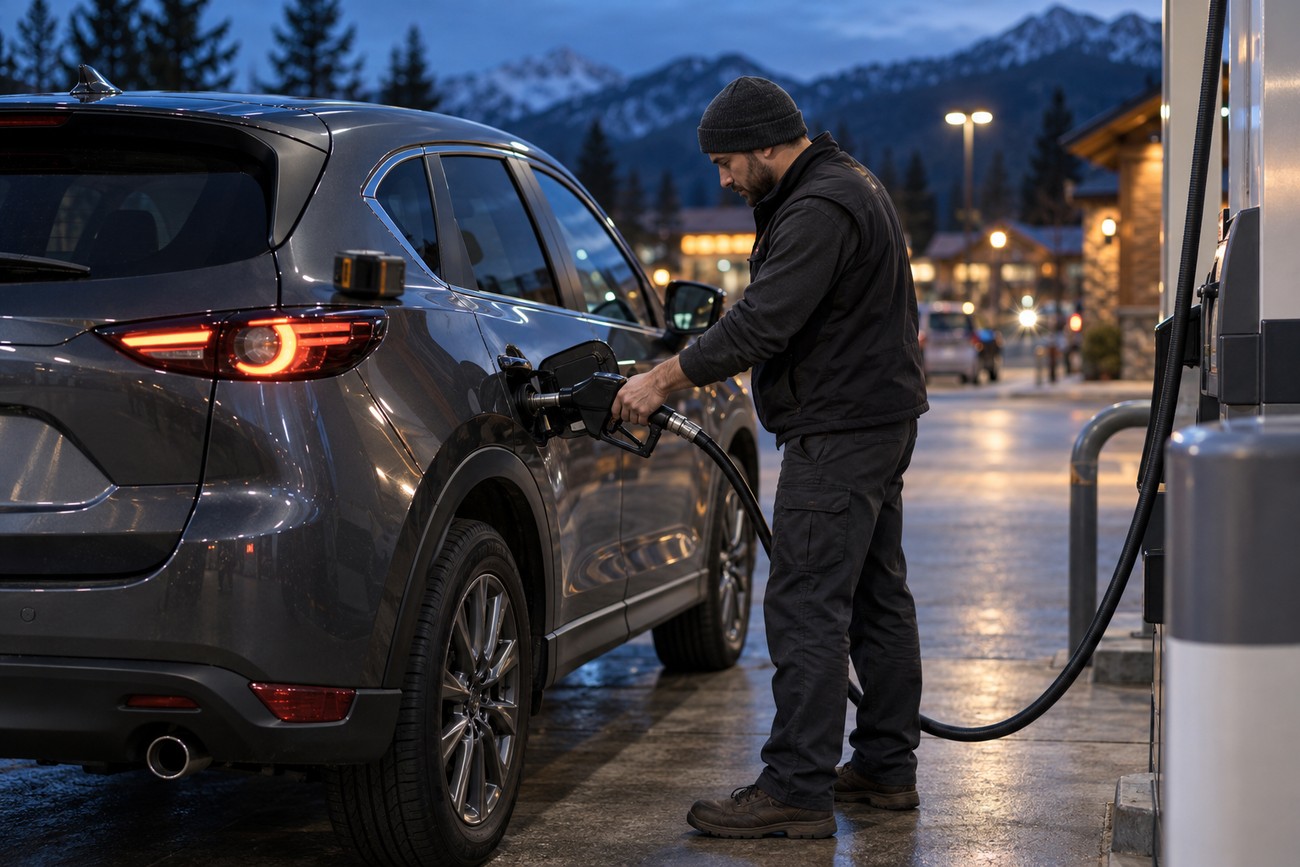
Mazda associates 256 hp and 320 lb-ft with 93 AKI fuel. The published figures for 87 AKI are 227 hp and 310 lb-ft. The difference reflects different fuel conditions rather than two unrelated engines or an error in the specification.
Lower-octane fuel is more susceptible to knock under high cylinder pressure. The CX-5’s control system can respond by reducing ignition advance and adjusting engine operation. That protection is valuable, but it can reduce the sharpness of the response during a long, demanding climb.
The practical mistake is to fill with 87 AKI while judging the vehicle against the 93-AKI rating. Altitude adds another variable, so the driver may attribute all of the weaker response to thin air. Fuel quality, intake temperature, and knock corrections can contribute at the same time.
Use the fuel grade appropriate for the output you expect, while recognizing that even 93 AKI cannot guarantee the sea-level rating at the summit. Fuel removes one source of avoidable performance variation; it does not cancel the pressure and thermal conditions of the mountain.
How to Prepare a Stock CX-5 Turbo for Pikes Peak
Preparation should begin with inspection rather than aftermarket boost increases. Check the air filter, intercooler, charge piping, spark plugs, coolant, oil, warning lights, and transmission behavior. A dirty filter, loose charge pipe, intercooler issue, worn plug, or engine fault can mimic normal altitude-related power loss.
Inspect the charge-air system for loose connections or signs of leakage, and confirm that the engine has no stored or pending fault codes. Check coolant and oil condition before the trip, since a long climb gives little margin for a pre-existing cooling or lubrication problem.
Pay attention to how the transmission behaves during a road test under load. Frequent shifts can be normal on a steep grade, while slipping, abnormal flares, harsh engagement, or unexplained overheating require diagnosis before a mountain trip. Tire condition and load distribution also affect the amount of torque needed to maintain progress.
Uncalibrated aftermarket boost increases can compromise turbocharger and engine protection. Raising boost without a calibration that accounts for barometric pressure, intake temperature, knock, and turbocharger limits may create more heat and risk without delivering dependable mountain performance. Preparation can improve reliability and consistency, but it cannot guarantee sea-level power at approximately 14,110 ft.
What We Can and Cannot Claim About Power Loss
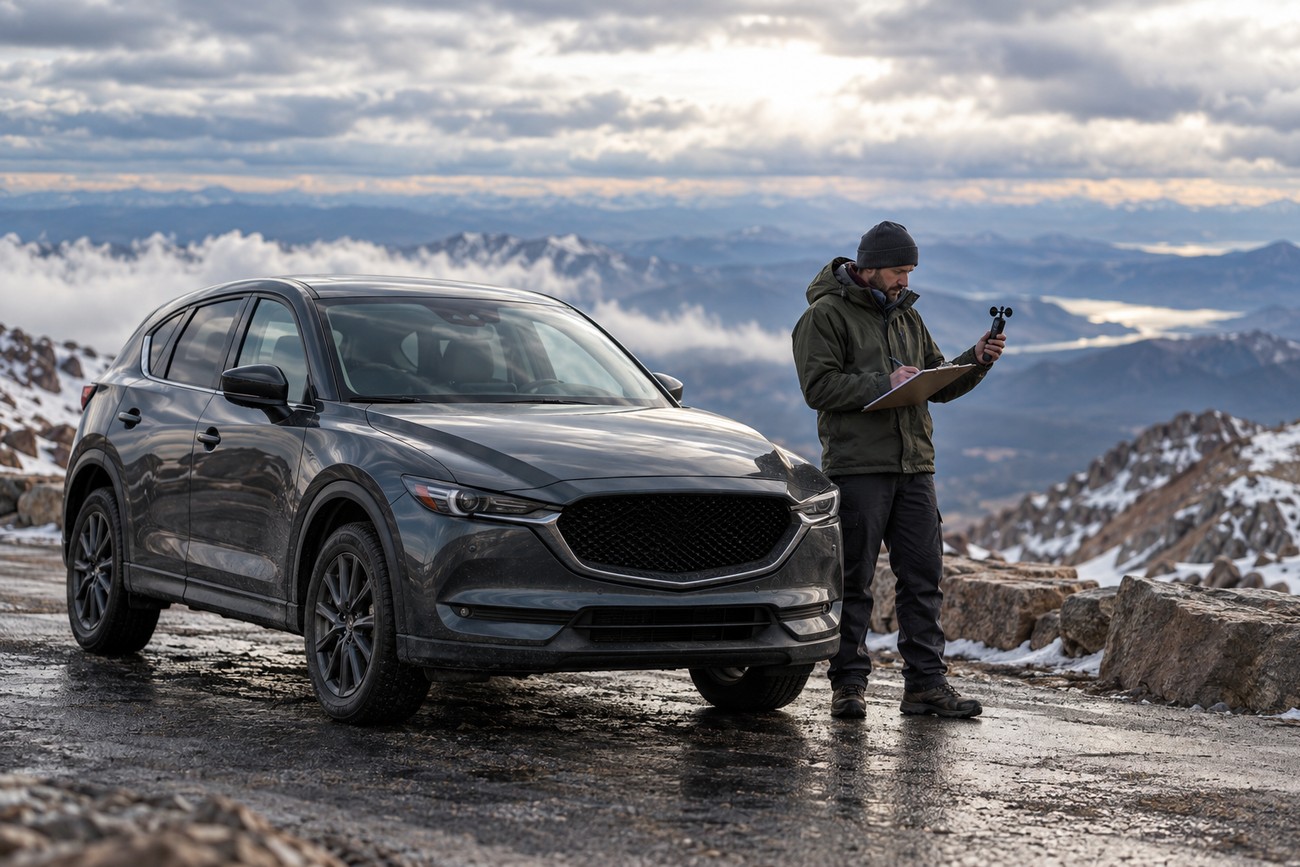
Approximately 58% refers to summit air density relative to sea level. It is not a measured CX-5 2.5T horsepower figure. Similarly, an approximate 42% atmospheric power-loss estimate describes air-density physics, not verified stock CX-5 2.5T power loss at the Pikes Peak summit.
The turbocharger changes the relationship between air density and engine output by compressing the intake charge. Its effectiveness depends on compressor operating conditions, temperature, control limits, fuel, and the engine’s ability to sustain the required load. That makes a simple percentage unreliable for a production vehicle.
Independent summit measurements for a stock CX-5 2.5T are limited. Owner reports of softer response, later torque buildup, and reduced repeat pull are useful indications of driver experience, but they cannot establish one universal horsepower figure.
A credible comparison would log boost, barometric pressure, intake temperature, ignition timing, and knock corrections under comparable conditions. Without those measurements, the defensible conclusion is limited: the turbocharged CX-5 should retain more usable performance than a naturally aspirated model, while still losing some performance as altitude and heat increase.
Frequently asked questions
The most useful diagnosis separates normal altitude effects from faults that reduce boost or ignition control at any elevation.
What are the most common turbo-related problems to check on a Mazda CX-5 before a mountain trip?
Begin with the symptoms. A sudden loss of boost, hissing under acceleration, or inconsistent response points toward a charge-pipe or intercooler connection. Misfire, rough running, or hesitation suggests that spark plugs, ignition components, or stored engine faults deserve priority. A gradual reduction in response after repeated pulls is more consistent with heat soak or protective control intervention, although the basic air and ignition checks still apply.
Inspect the air filter, charge piping, intercooler connections, spark plugs, oil, coolant, and warning-light history. A turbo-related fault should be confirmed with diagnostic data rather than blamed on altitude alone. The distinction matters because a healthy engine can feel softer in thin air, while a leak or ignition fault can make the vehicle weak everywhere.
How long can a Mazda CX-5 turbo engine last under normal maintenance?
There is no single mileage or failure point that applies to every CX-5 turbo. Service history, oil discipline, thermal management, fuel quality, vehicle load, and driving style have more practical value than an unsupported universal lifespan claim.
Regular oil service with the correct specification, prompt attention to warning signs, and sensible cooldown behavior help reduce avoidable stress. Frequent high-load driving, neglected oil, repeated overheating, or unresolved boost and ignition faults can shorten component life. A well-maintained engine used within its intended operating limits has a stronger ownership outlook than one judged only by an odometer figure.
What is the most common reason a CX-5 feels weak after a hard climb?
Heat soak and protective control intervention are common priorities after a hard, sustained climb. Hot intake air, rising coolant or oil temperatures, and knock control can temporarily reduce response or repeat pull. Allow the vehicle to cool, then check whether the symptom returns under lighter load.
If the weakness remains, inspect the air filter, charge piping, intercooler connections, spark plugs, fluid condition, and diagnostic codes. A persistent fault should not be dismissed as normal mountain performance. Comparing boost, intake temperature, ignition timing, and knock corrections provides a clearer diagnosis than relying on the driver’s impression alone.







