
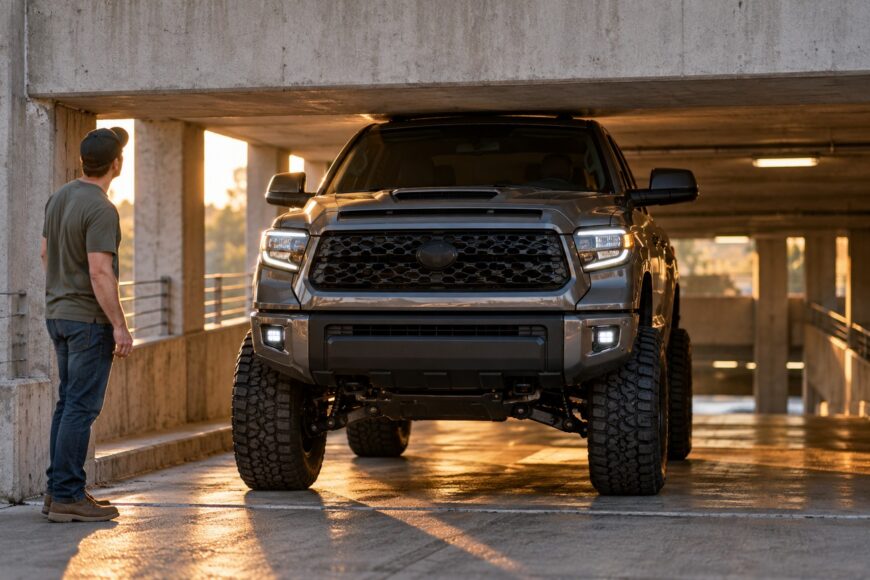
A lifted Toyota Tundra may fit some parking garages, but the lift size or a “7 ft” sign cannot answer the question by itself. A 2026 Tundra is listed at approximately 78 inches tall in some specifications, while owners report approximately 82 inches for some 3-inch-lift setups with 285/65R20 tires. A garage marked 7 feet offers approximately 84 inches of nominal clearance, leaving little room for uncertainty.
The real measurement is the truck’s highest installed point compared with the lowest physical obstruction along the complete route. Larger tires, racks, antennas, light bars, beams, pipes, ramp transitions, and internal signs can change the result. A truck that clears the entrance may still contact a lower obstruction inside or at a change in grade.
- The Short Answer: A Lifted Tundra May Fit—Until It Doesn’t
- Why the Lift Number Does Not Tell You the Truck’s Height
- Garage Clearance Is Measured at the Lowest Obstacle
- Tundra Height Scenarios: Stock, Lifted, and Large-Tire Setups
- How to Check a Parking Garage Before You Commit
- Common Fitment Mistakes and Garage Myths
- Frequently asked questions
- How much does it cost to get a Toyota Tundra lifted?
- Which Tundra should I stay away from if garage clearance matters?
The Short Answer: A Lifted Tundra May Fit—Until It Doesn’t
A lifted Tundra can fit a parking garage when its measured height remains comfortably below every obstruction on the route. That depends on the exact trim, tire size, suspension design, wheel package, accessories, load, and tire pressure. Two trucks described as having the same lift can have different overall heights.
Some published specifications place a 2026 Tundra at approximately 78 inches tall. Owners report approximately 82 inches for some 3-inch-lift and 285/65R20 setups, although that is an approximate owner-reported measurement rather than a universal specification. At that height, a 7-foot sign represents only about 2 inches of nominal clearance.
The posted number applies to the area covered by the sign and may not describe every point beyond the gate. Low beams, suspended pipes, sprinkler lines, repairs, and directional signs can reduce the available space. Different floors of the same garage may also have different clearance conditions.
Route geometry adds another variable. A truck can pass beneath a level opening yet approach the ceiling at a ramp transition, where the vehicle changes angle. For reliable use, compare the truck’s actual height with the lowest obstruction and retain a practical margin for measurement error and suspension movement.
Why the Lift Number Does Not Tell You the Truck’s Height
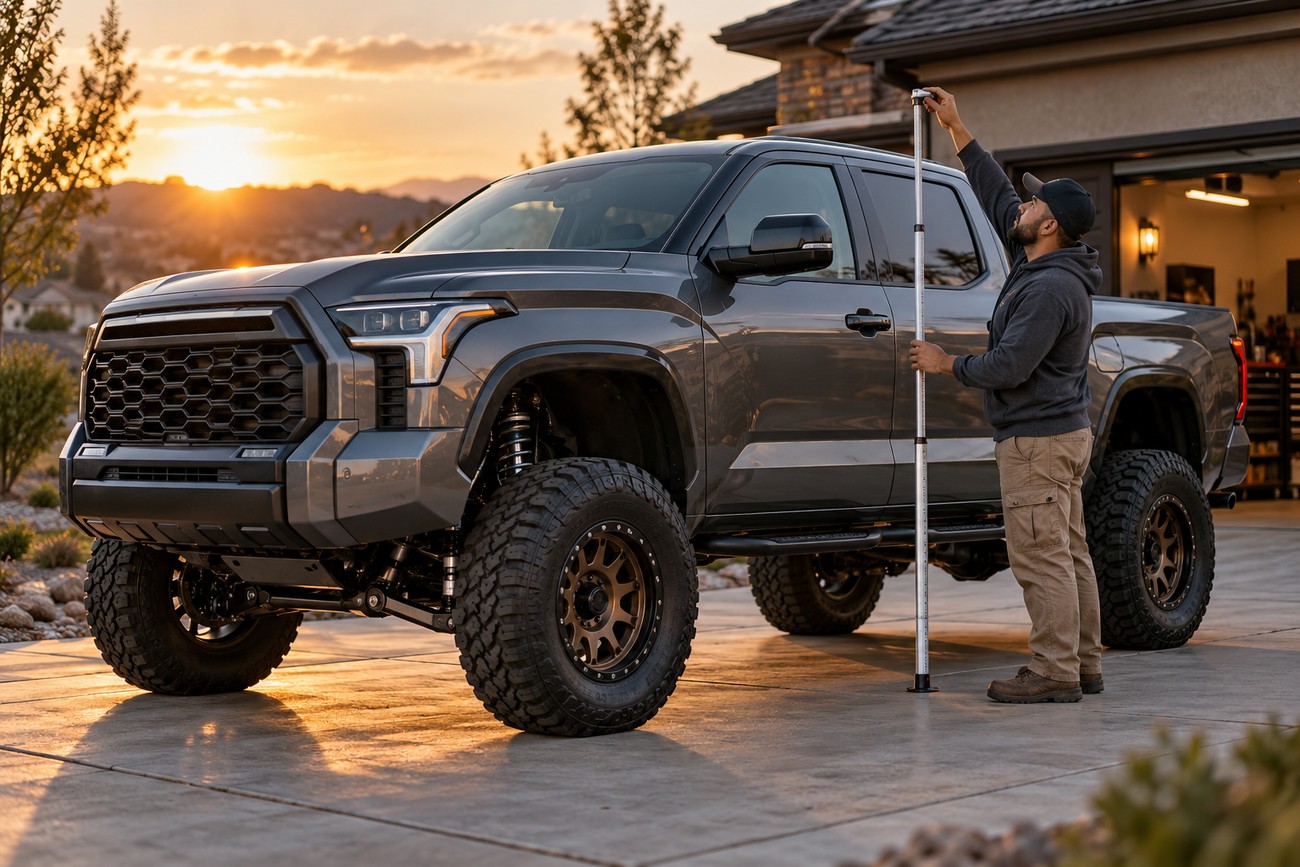
A 3-inch lift does not necessarily make the complete vehicle exactly 3 inches taller. The suspension may raise the chassis by one amount, while tire diameter changes the distance from the wheel center to the ground by another. The final height also depends on how the vehicle settles under its own weight.
Larger tires can add meaningful height without any additional suspension lift. Tire size, wheel design, inflation pressure, tread shape, and the specific suspension kit all affect the measurement. A fully loaded truck may sit lower at the suspension, while movement over a ramp or uneven surface can bring the roof or accessory closer to an overhead obstruction.
Toyota specifications vary by trim, wheel and tire package, drivetrain, and market. One Canadian specification for some configurations lists approximately 75.8 inches, compared with approximately 78 inches in another 2026 specification. These figures describe particular configurations and should not be treated as a universal height for every Tundra.
Measure the truck as it is actually equipped. The highest point may be a roof rack, antenna, light bar, flag, or another accessory rather than the roof sheet metal. A catalog dimension measured on a different trim or tire package is useful for comparison, but it cannot replace a physical measurement.
Garage Clearance Is Measured at the Lowest Obstacle
A garage marked 7 feet provides approximately 84 inches of nominal clearance at the marked location. An approximately 82-inch truck therefore has only about 2 inches of stated clearance before accounting for measurement uncertainty, suspension movement, an uneven ramp, or a lower object farther inside.
The entrance sign does not necessarily describe beams, pipes, sprinklers, hanging signs, or repair structures along the route. A low point may appear after a turn or on a different floor. The clearance beside a column or near the edge of a travel lane may also differ from the open space in the center.
In the United States, a 98-inch minimum vertical clearance applies to applicable ADA-accessible routes. That figure does not mean every garage entrance, parking aisle, or floor has 98 inches of clearance. Approximately 84 inches is sometimes cited for parking structures, but there is no universal rule requiring every garage or jurisdiction to provide that height everywhere.
For a lifted truck, treat a posted limit as an initial screening value. The decision should come from the lowest physical obstruction on the intended route, measured or confirmed as accurately as possible. A small nominal margin is poor protection against an incorrect vehicle measurement or an obstruction that the entrance sign does not cover.
Tundra Height Scenarios: Stock, Lifted, and Large-Tire Setups
These examples show why garage fitment must be judged by the complete build. The heights are approximate where stated, and none guarantees passage through a particular facility.
| Representative setup | Approximate height information | Garage-fit risk |
|---|---|---|
| Stock-height Tundra, published specification | Approximately 78 inches in some specifications | Often more compatible with standard garages, subject to trim, market, tires, and local obstructions |
| Some Canadian-market configurations | Approximately 75.8 inches | May provide more nominal clearance, but the exact vehicle and route still require verification |
| 3-inch lift with 285/65R20 tires | Approximately 82 inches in some owner-reported measurements | Marginal under an 84-inch sign; selected garages may work, while low internal obstacles remain a risk |
| 3-inch lift with 325/60R20 tires | Exact height varies by the complete build | May fit only selected garages and can be marginal in some low-clearance car washes |
The large-tire setup deserves particular caution because tire diameter can change the result more than a buyer expects. A truck may look only modestly taller in photographs while losing useful overhead margin in a garage. Owner reports are helpful for identifying possible outcomes, yet they are tied to individual vehicles and measurement methods.
Accessories can move a truck from acceptable to unsuitable without changing the suspension. A rack, antenna, or light bar may become the first point of contact. Measure the finished vehicle after all intended equipment is installed.
How to Check a Parking Garage Before You Commit
Start with the truck, not the garage sign. Park on a level surface, use normal tire pressure, and load the vehicle as you typically drive it. Measure from the ground to the highest installed point, including racks, antennas, lights, flags, and other equipment.
Then trace the entire route: entrance, barrier, ramps, turns, each intended floor, internal obstructions, and exit. Compare the vehicle measurement with the lowest physical obstruction rather than the largest number displayed at the gate. If the facility cannot confirm a low point, treat that uncertainty as a fitment risk.
Inspect the route from the driver’s position where possible. A beam near the side of the lane, a hanging sign after a turn, or a pipe beside a column may be missed when checking only the center of the entrance. The Tundra is approximately 80.2 inches wide without mirrors, so columns and tight turns can make a route impractical even when vertical clearance is sufficient.
Allow for conditions that change during use. Tire pressure, cargo, passengers, suspension movement, and the exact driving path can alter the available margin. A controlled test on the actual route is more meaningful than a single pass through a different garage, but even one successful pass does not prove reliable clearance under every condition.
Common Fitment Mistakes and Garage Myths
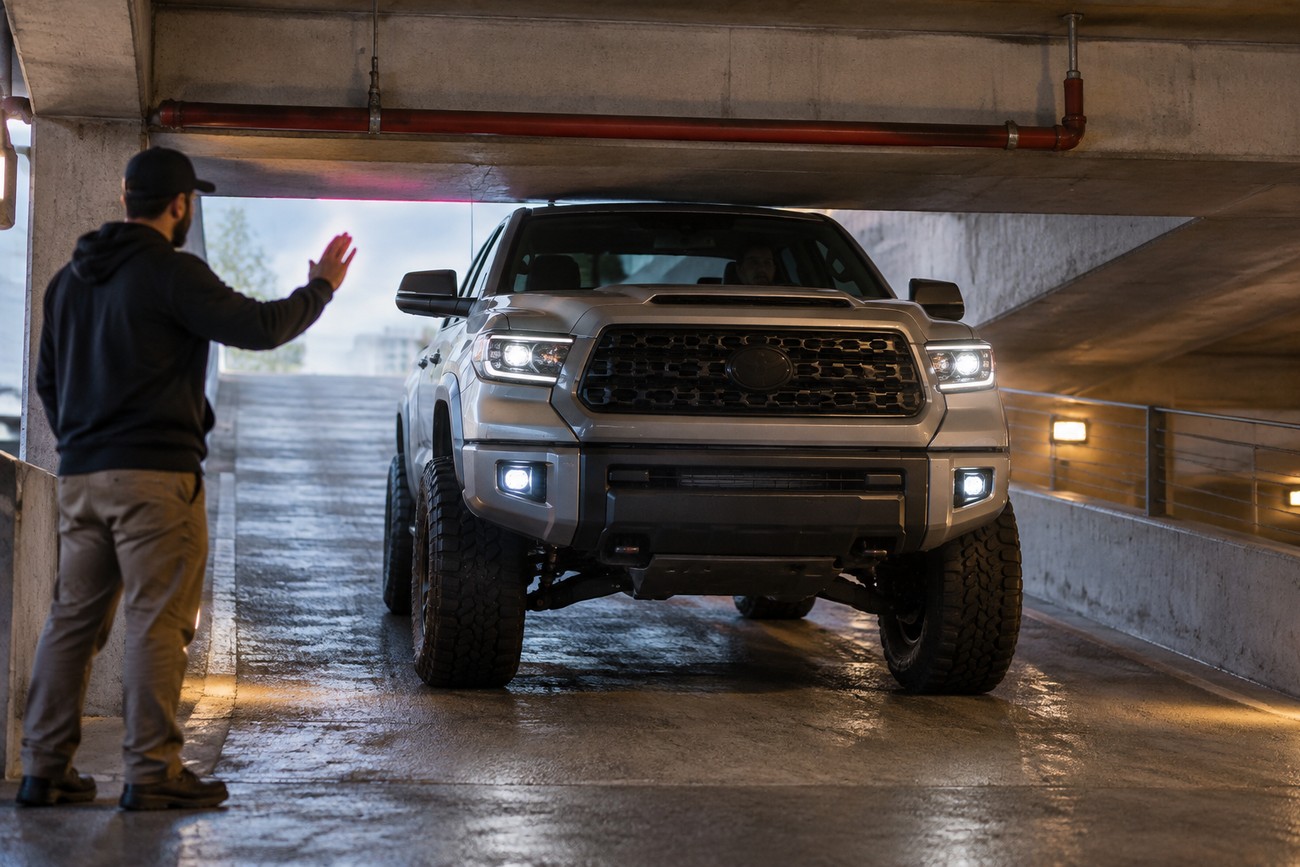
The first mistake is treating “3-inch lift” as the truck’s final height increase. That label describes a suspension change or kit intent, while the complete vehicle also includes tire radius, wheel choice, suspension settling, and accessories. Measure the finished build instead of adding the lift number to a catalog dimension.
The idea that every Tundra remains below 7 feet is also unreliable. Stock-height examples may be approximately 78 inches, and some market specifications are approximately 75.8 inches, but larger tires and equipment can move a lifted truck close to an 84-inch sign. A 3-inch lift with 325/60R20 tires may fit only selected garages and can be marginal in some low-clearance facilities.
A 7-foot sign does not guarantee passage for an approximately 82-inch truck. The sign gives approximately 84 inches of nominal clearance at its stated location, while measurement error, local obstructions, and ramp geometry can consume the remaining space.
Finally, one successful drive is limited evidence. Loading, tire pressure, suspension movement, and trajectory may differ the next time. Treat a single pass as an observation, not as proof that the route is consistently safe.
Frequently asked questions
How much does it cost to get a Toyota Tundra lifted?
There is no reliable universal price because the project may include a suspension lift kit, larger wheels and tires, installation labor, alignment, and fitment-related work. The tire and wheel package can also require additional clearance or supporting parts, depending on the build.
For budgeting, price the complete finished setup rather than the lift kit alone. Ask for a separate estimate for installation, alignment, tire mounting, and any work needed to make the selected wheels and tires function correctly.
Which Tundra should I stay away from if garage clearance matters?
A single trim or model year cannot be labeled universally unsuitable. Garage risk is driven more by the complete build: suspension, tires, wheels, roof equipment, antennas, lights, load, and the actual route through the facility.
Evaluate the specific truck you intend to buy. Obtain its measured height at the highest installed point, then compare it with the lowest point on your regular garage route. A stock-height truck may be the safer choice where clearance is tight, while a carefully measured lifted truck may still work in a taller facility.
Width and maneuvering space also matter. A Tundra is approximately 80.2 inches wide without mirrors, so a truck can clear the roof while remaining difficult to steer around columns, barriers, and tight turns. Choose based on the complete vehicle and route rather than a blanket warning about one Tundra version.







