
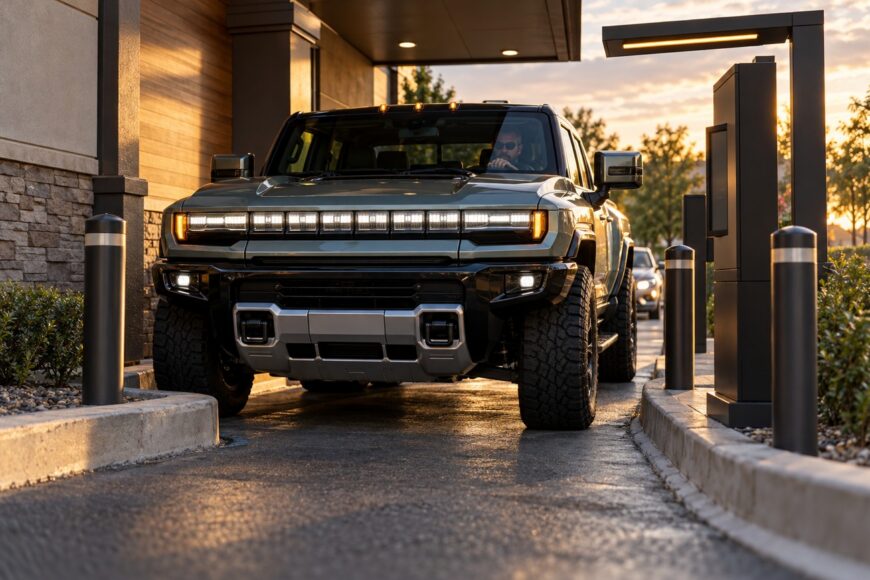
A Hummer EV may fit some drive-thrus, but physical fit is not the same as comfortable or low-risk use. Its body is approximately 2.20 m wide without mirrors, and its length varies from about 5.0 to 5.5 m by version. That combination leaves less room for correction when a lane is narrow or bends sharply.
The decisive issue is usually the route’s geometry. Clearing the entrance does not prove that the vehicle will complete an S-shaped queue, pass the menu structure, align with the service window, and leave without contacting a curb, barrier, mirror, or wheel arch. Height and off-road equipment attract attention, yet width and maneuvering margin usually determine the outcome.
- The short answer: Sometimes, but not always comfortably
- Hummer EV dimensions that matter at a drive-thru
- Why width and lane geometry matter more than ground clearance
- What rear-axle steering helps with—and what it cannot fix
- Common mistakes and hidden stress points
- A practical go/no-go check before entering
- Frequently asked questions
- Why are Hummer EVs not selling?
- What should you do if a Hummer EV enters a drive-thru but the next turn looks too tight?
The short answer: Sometimes, but not always comfortably
A Hummer EV can physically pass through some drive-thru lanes, especially at locations with generous entry and exit space. That answer cannot be applied to every restaurant or bank because commercial lanes vary widely in width, turning angles, barriers, and overhead structures.
The first test is the entrance, but it is only one part of the route. A vehicle may clear the opening and still run out of room at the first tight bend, near the ordering post, or beside the service window. The Hummer EV’s approximately 2.20 m body width leaves limited lateral margin before mirrors and other protruding parts are considered.
Length adds another complication. Depending on the version, the Hummer EV is approximately 5.0 to 5.5 m long, so the rear of the vehicle may track differently through a turn than the front appears to. A longer version can also need more room to straighten at the window or on the exit.
In practical terms, a wide, open drive-thru may be manageable at low speed. A tightly designed urban lane can become stressful even when the vehicle technically fits. The absence of a universal manufacturer guarantee means the location, rather than the vehicle name alone, determines whether entry is sensible.
Hummer EV dimensions that matter at a drive-thru
The SUV and pickup versions are close in width, while their height and length vary by configuration. The figures below are approximate and describe the vehicle without mirrors where stated.
| Version or measurement | Approximate dimension | Drive-thru implication |
|---|---|---|
| Hummer EV SUV width | 2,197 mm without mirrors | Leaves limited side clearance in lanes designed around ordinary passenger vehicles. |
| Hummer EV pickup width | Approximately 2,201–2,202 mm without mirrors | Creates a similar width challenge, with mirrors and body protrusions requiring additional room. |
| Hummer EV SUV height | Approximately 1,976 mm | Requires attention to the posted or apparent height of canopies and other overhead structures. |
| Hummer EV pickup height | Approximately 2,060 mm | Can reduce overhead clearance at some covered lanes, depending on the site. |
| Overall length | Approximately 5.0–5.5 m, depending on version | Influences turning space, queue bends, window alignment, and the exit path. |
Width affects nearly every close approach. The bare body measurement does not include the practical space needed around the mirrors, wheel arches, and other projecting surfaces. A driver who judges the lane against the body alone can underestimate the room required to avoid a post or curb.
Height matters at the canopy and any low overhead structure. It is less often the main restriction than width, yet a driver should still assess the pickup and SUV separately because their approximate heights differ. The route should be treated as a three-dimensional space, especially where the canopy slopes or the lane changes level.
Length becomes most important at bends and at the window. The front may be correctly positioned while the rear remains close to an inside barrier or curb. Longer versions can also need a wider exit arc, even when the vehicle entered without difficulty.
Why width and lane geometry matter more than ground clearance
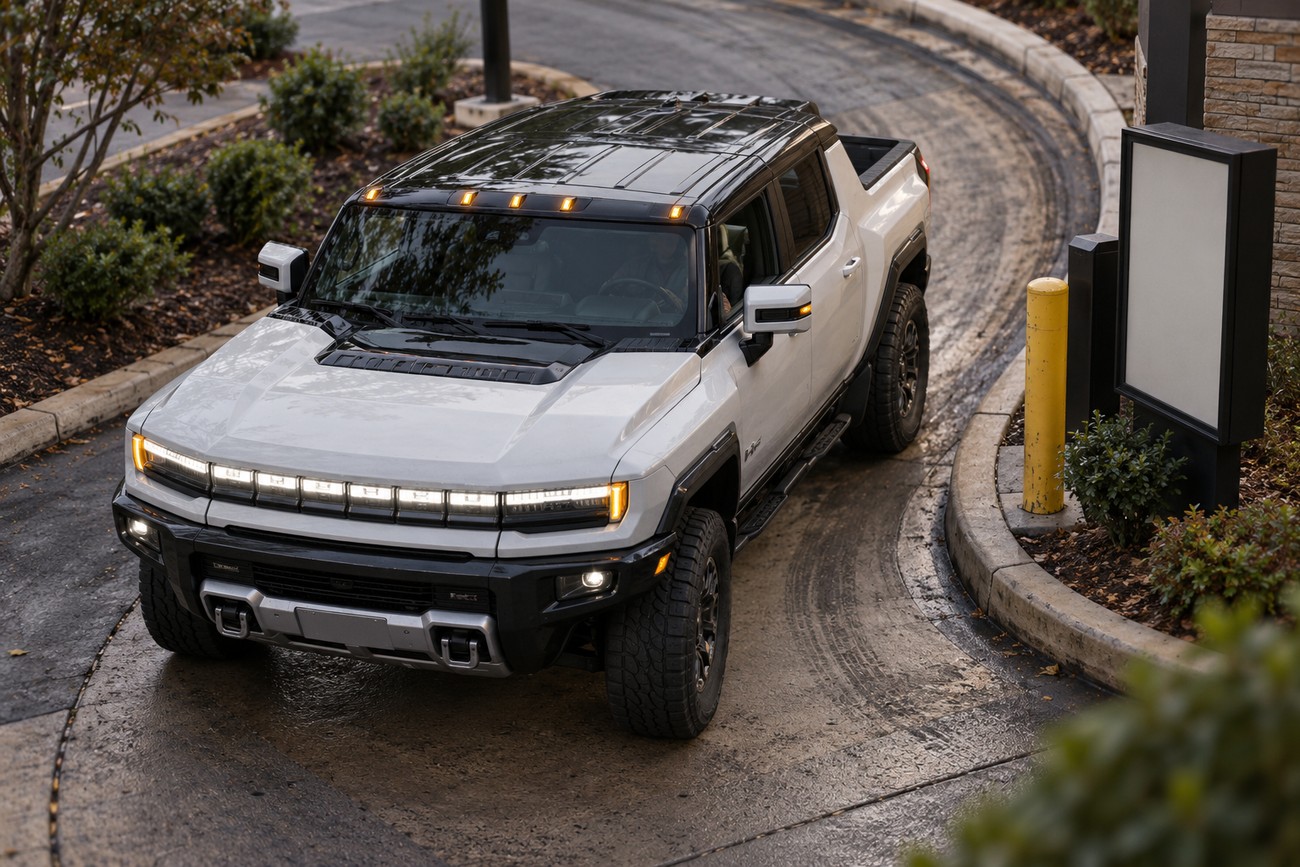
A drive-thru is built around repeated low-speed turns and close clearances. The Hummer EV’s approximately 2.20 m body width can consume much of the available space before the driver accounts for mirrors, wheel arches, menu posts, curbs, and protective barriers. This is why width is often the primary practical obstacle.
Entry angle changes the problem. Approaching a lane diagonally can make the front corner appear clear while bringing the opposite side closer to a curb or post. S-shaped queues create a second difficulty: the vehicle may need to move from one side of the lane to the other while its long body is still completing the previous turn.
The service window can be the most demanding point. Its position may force the driver to keep close to a curb or barrier while also reaching the payment or collection area. A lane can look open from the street and feel much tighter once the vehicle reaches that final alignment.
Extract Mode raises ground clearance by approximately 6 inches. That function is useful for off-road obstacles, yet it does not reduce width or improve drive-thru clearance. Raising the vehicle can also make the driver focus on the wrong dimension when the real concern is lateral space.
The longer versions deserve extra care at the exit as well as the entrance. A turn that works for the front axle can still leave the rear corner close to a barrier. Slow steering inputs, frequent mirror checks, and a willingness to stop are more useful here than relying on the vehicle’s off-road capability.
What rear-axle steering helps with—and what it cannot fix
The Hummer EV has rear-axle steering, which changes the way the rear wheels follow the front during low-speed turns. This can improve maneuverability and reduce the effort needed to negotiate a tight corner. It may make the vehicle feel more responsive in a confined space.
That assistance affects the turning path; it does not change the vehicle’s approximately 2.2 m body width. Mirrors, wheel arches, and barriers remain in the same physical relationship to the lane. Rear steering also cannot widen the space beside the vehicle or remove the need to judge the window approach.
The system is most useful when the route has enough clearance for the vehicle to complete the turn. It can help the driver position a large vehicle more accurately, especially at low speed. It cannot guarantee passage through every drive-thru, since the tightest point may be a straight section beside a post rather than the turn itself.
Drivers should therefore treat rear-axle steering as a maneuvering aid. It can make a suitable lane easier to use, while an unsuitable lane remains unsuitable because its physical boundaries have not moved.
Common mistakes and hidden stress points
Off-road ability is an easy feature to overapply. Large tires, substantial ground clearance, and terrain modes help with surfaces and obstacles outside a drive-thru. They do not make a vehicle compact, and they provide little benefit when the limiting object is a menu post, curb, canopy support, or narrow service lane.
Checking only the body width is another common mistake. The published width figures are approximately 2,197 mm for the SUV and approximately 2,201–2,202 mm for the pickup, without mirrors. The practical clearance must include the mirrors, projecting bodywork, and room for small steering corrections.
Drivers can also enter too quickly after judging the lane from the street. The full route may include an angled entrance, a tight S-curve, a raised curb, a barrier, a low canopy, and a window positioned at an awkward distance. Each feature can be manageable alone while the combined path leaves little margin.
Mass adds a separate burden. Depending on the version and source, the Hummer EV weighs approximately 4.0–4.2 tonnes. That mass does not automatically prevent a low-speed maneuver, though it can make close-quarters driving feel more consequential and discourage quick corrections when the lane becomes uncomfortable.
High clearance and large wheels can also reduce the driver’s sense of precise placement in a dense urban setting. A lane may be technically passable while offering such a small safety margin that the driver must proceed slowly, repeatedly check both sides, and accept significant stress. Choosing another lane or service option can be the more controlled decision.
A practical go/no-go check before entering
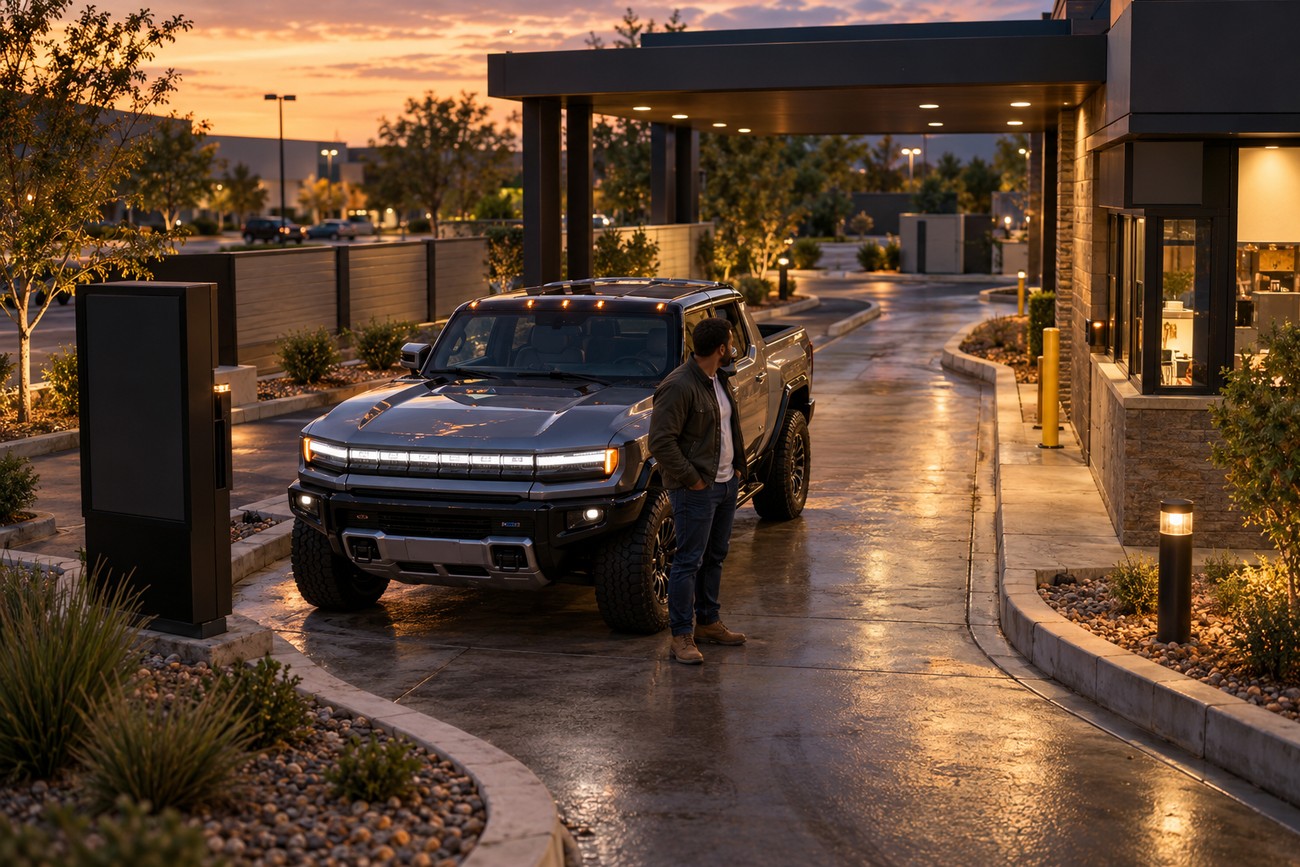
Inspect the entire route before committing the Hummer EV. Look at the entrance angle, the first bend, the queue shape, the menu structure, the canopy, the service-window position, the curbs, the barriers, and the exit. The tightest point determines usability more than the apparent width at the entrance.
- Pause far enough back to view the full path, including any section hidden by the queue.
- Identify the narrowest bend and the closest fixed objects on both sides.
- Check overhead clearance for the specific SUV or pickup version, particularly under a covered lane.
- Allow space for mirrors and bodywork instead of judging clearance against the doors alone.
- Consider how the vehicle will align with the window and how it will leave after service.
- Choose another option if the path is partly hidden or the clearance cannot be judged confidently.
Judge the inside of the S-curve and the window approach before judging the lane from the street. Those later points often reveal the real clearance problem after the entrance has already appeared manageable.
If the vehicle has already entered and the next turn looks too tight, stop when it is safe to do so. Assess the full path, check both sides, and avoid forcing the turn or continuing toward the window simply because the queue is moving.
Backing out may be awkward, so it should be done slowly and with assistance from a passenger or staff member where appropriate. A location-specific decision is safer than relying on the Hummer EV’s off-road systems or rear-axle steering. No supplied official data establishes universal compatibility with commercial drive-thru lanes.
Frequently asked questions
Why are Hummer EVs not selling?
The supplied evidence does not include sales figures and cannot prove a single reason for sales performance. It does show a broader practical trade-off: a vehicle approximately 2.20 m wide, approximately 5.0–5.5 m long depending on version, and weighing approximately 4.0–4.2 tonnes can be harder to use in ordinary urban spaces.
Drive-thru difficulty is one visible example of that trade-off. Parking structures, narrow streets, tight loading areas, and service lanes can demand more attention and provide less margin than they do for a typical passenger vehicle. Those observations explain a usability consideration, rather than establishing a sales conclusion.
What should you do if a Hummer EV enters a drive-thru but the next turn looks too tight?
Stop at the safest available point and assess the next turn, the inside barrier, the outer curb, and the route toward the service window. Do not force the steering angle or continue toward the window merely to remain in the queue.
If clearance remains uncertain, ask for assistance, reposition only when the path is clear, or back out carefully and use another service option. Rear-axle steering may help with the turn, yet it cannot remove the vehicle’s physical width or guarantee that the barrier and mirrors will clear.







