
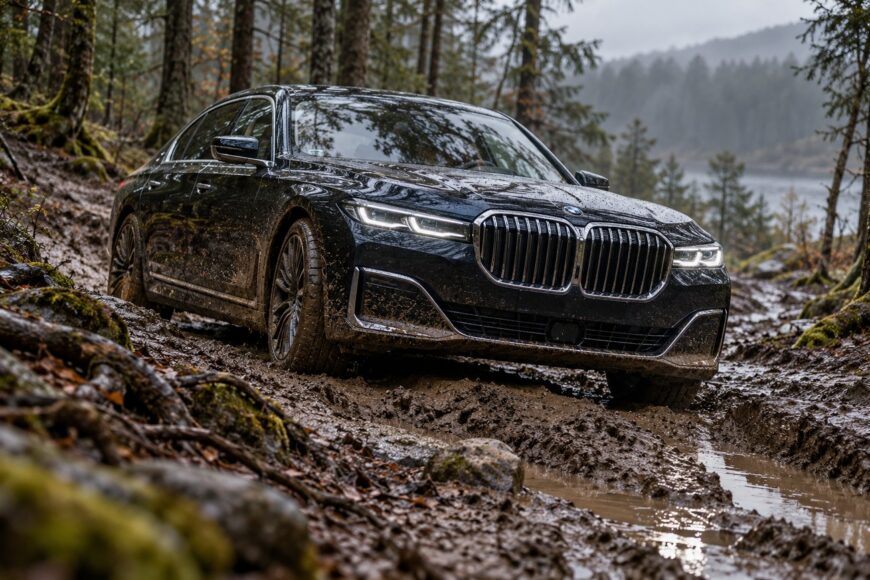
A powerful BMW 7 Series can move across slippery ground, yet its luxury-sedan geometry can turn a muddy trail into a recovery problem quickly. drive may find traction where a rear-drive sedan would struggle, but torque cannot create clearance or shorten the wheelbase.
The outcome depends on mud depth, hidden obstacles, slope, tires, load, and whether you have a clear way back. A 7 Series may cross a firm, shallow section carefully, but it is not designed for sustained muddy off-road travel.
- The 7 Series Is Limited by Geometry Before Traction
- Why Mud Turns a Heavy Luxury Sedan into a Liability
- What drive and Air Suspension Can—and Cannot—Do
- Muddy Trail Conditions: Go, Turn Back, or Recover
- How to Attempt a Muddy Section—and Check the Car Afterwards
- Frequently asked questions
- What is the average lifespan of a BMW 7 Series?
- What should you do if a BMW 7 Series gets stuck in mud?
- What year BMW X7 should you stay away from?
- Which BMW is best for off-road?
The 7 Series Is Limited by Geometry Before Traction
Ground clearance varies by generation and configuration. Reported unloaded figures for the BMW 7 Series are approximately 135–147 mm, with some sources rounding that range to about 5.8–6.0 inches. The exact figure should be tied to the specific vehicle identification number and version rather than treated as a universal 7 Series specification.
The current-generation car is approximately 5.39 meters long with a 3.215-meter wheelbase. That length helps the sedan feel stable and spacious on pavement, but it increases the chance of grounding on a crest, in a deep rut, or at a sudden break in the trail. A compact crossover may clear the same change in terrain because its wheels and underbody follow a more favorable path.
Published clearance is measured with the vehicle unloaded. Passengers, luggage, suspension movement, and mud packed beneath the car reduce the usable margin. The center of the underbody can touch before the tires lose traction, leaving the car supported on its underside and making recovery much harder.
Long bodywork also complicates tight forest routes. The front and rear overhangs can contact raised edges, while the long wheelbase limits the ability to crest a rut without dragging the middle of the car. Once the trail requires repeated diagonal crossings, the sedan’s dimensions become a greater restriction than engine output.
Why Mud Turns a Heavy Luxury Sedan into a Liability
The i7 50 drive weighs approximately 2.7–2.8 tonnes. Greater mass increases ground pressure, so wet clay, grass, and soft soil can collapse beneath the tires sooner than expected. It also makes the vehicle harder to recover and increases the loads placed on the tires, suspension, wheels, and underbody.
Large low-profile road wheels provide limited sidewall movement over sharp ruts and hidden stones. They are less tolerant of impacts than higher-profile, off-road-oriented tires, and a wheel can be damaged even if the car continues moving. Road tires may also dig into wet ground rather than spreading the load across a more suitable contact patch.
Body damage can occur before the vehicle stops. Low bumpers, side skirts, plastic shields, wiring, sensors, and lower suspension components are exposed to mud, stones, and rut edges. On an i7, the battery enclosure and other lower high-voltage-related components require particular care because a hidden impact can create a costly inspection and repair issue.
Air suspension and road-focused suspension tuning do not provide the protection or geometry of a dedicated off-road vehicle. Mud can also pack into wheel arches and around braking hardware, while grime on cameras and sensors may trigger warnings or reduce the reliability of parking and driver-assistance functions.
What drive and Air Suspension Can—and Cannot—Do
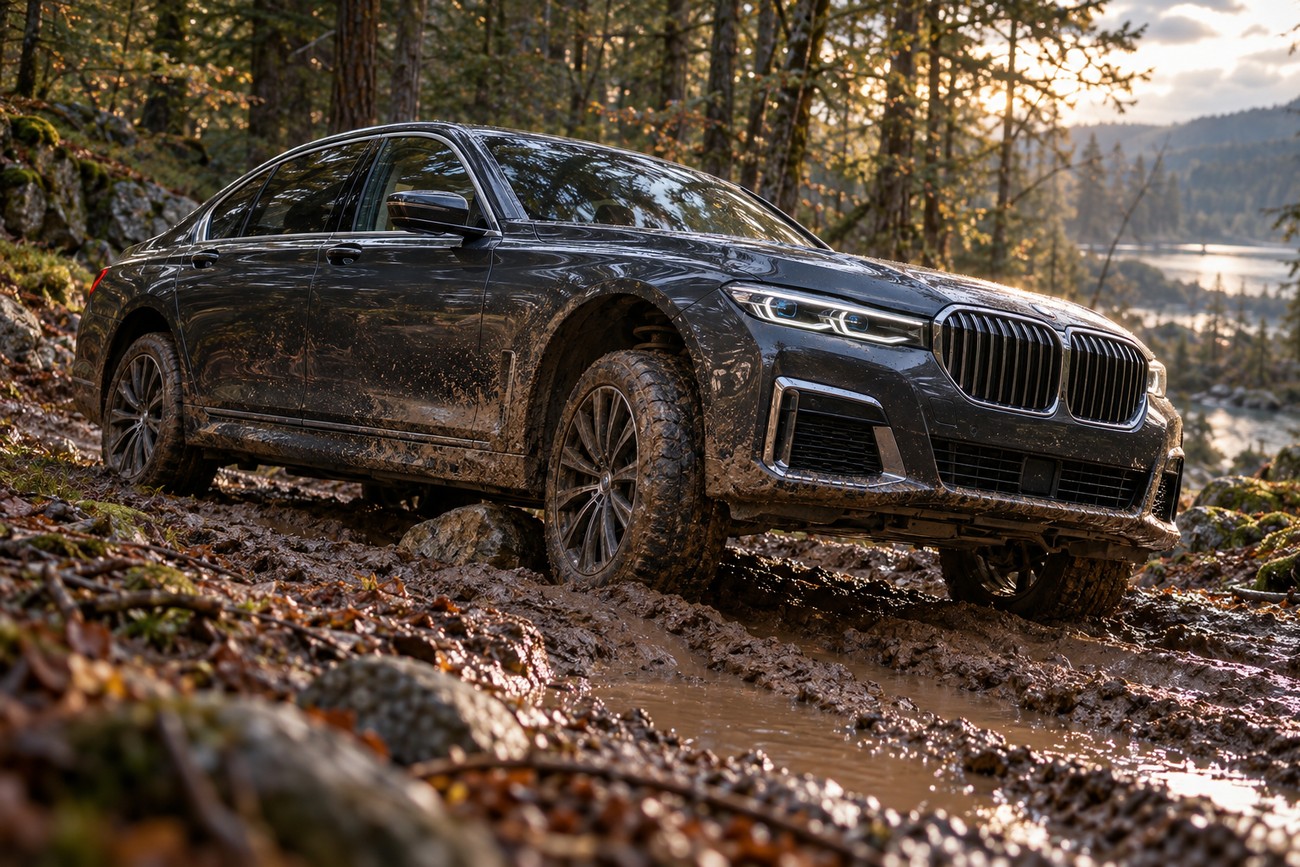
drive can help distribute drive torque on slippery ground. That assistance is useful when pulling away on wet grass or maintaining movement on a firm, uneven surface, but it does not increase ground clearance, approach angle, departure angle, underbody strength, or tire sidewall protection.
Air suspension may raise the body on some versions, creating additional temporary clearance. The adjustment remains limited by the design of the vehicle and does not protect the bumpers, sills, battery cases, or suspension components from a deep rut or hidden rock.
Stability-system settings also require restraint. Full deactivation is not universally beneficial, and the correct mode depends on the generation and the owner’s manual. On a side slope, reducing electronic assistance without understanding its behavior can make a heavy sedan harder to control.
Stationary wheelspin is a warning sign, not a recovery strategy. Continued spinning deepens the ruts and can overheat drivetrain components and electronic clutches. Once the wheels are digging rather than moving the car, backing out and reassessing is usually less damaging than applying more throttle.
Muddy Trail Conditions: Go, Turn Back, or Recover
There is no universal safe mud depth. Water, viscosity, slope, speed, hidden obstacles, tires, vehicle load, and the available escape route all matter. Use the matrix as a decision guide rather than a clearance guarantee.
| Trail condition | Main risk | Practical decision |
|---|---|---|
| Firm wet ground | Reduced grip, especially on road tires | Proceed slowly if the route is visible, level, and offers a clear retreat. |
| Shallow soft mud | The heavy car may break through the surface and begin sinking | Proceed only with a firm line, smooth momentum, and recovery equipment ready. |
| Deep ruts | The long wheelbase can ground the center of the car; low bodywork may strike the edges | Turn back unless the ruts are fully inspected and the underbody clearly has room. |
| Steep or cross-sloped mud | Loss of lateral control and a difficult recovery for a heavy sedan | Avoid. Do not rely on drive or blindly disable stability systems. |
| Mud hiding rocks or water | Impacts, underbody damage, battery-enclosure damage, or unexpected depth | Stop and inspect the route on foot if safe; otherwise retreat. |
Wet grass and clay deserve particular caution because they can look shallow while offering little support. A sedan may initially maintain forward motion and then sink abruptly when the surface layer fails. The absence of immediate wheelspin does not prove that the underbody is clear.
A second vehicle, suitable recovery equipment, and accessible recovery points change the risk calculation. Without them, a minor mistake can become a difficult extraction, especially with a heavy i7. The safest turn-around point is usually before the car needs assistance, while the route behind remains usable.
Keep the vehicle straight in established ruts and avoid sudden steering inputs. A long, heavy body can slide sideways on a slick cross-slope, and correcting that movement may require more space than a narrow trail provides.
How to Attempt a Muddy Section—and Check the Car Afterwards
Begin by inspecting the section rather than committing the car to it. Check the apparent depth, firmness of the surface, slope, exit, and likely position of hidden rocks or holes. Choose the firmest visible line and confirm that you can reverse or turn around before entering.
Use a smooth, controlled pace with minimal steering input. Avoid abrupt throttle changes and prolonged wheelspin, because spinning tires remove the surface that supports the car and increase drivetrain heat. If forward progress stops, lift off, reassess, and recover rather than digging deeper.
Tire pressure deserves caution. Excessive pressure reduces a road tire’s ability to conform to uneven ground and can reduce grip, while excessive deflation raises the risk of debeading and rim damage. Any pressure change should remain within the tire maker’s stated limits and be restored for normal road driving.
Turning around before the car is fully stuck preserves the recovery route, keeps attachment points accessible, and reduces the load on recovery equipment. Those factors matter more than relying on drive or continued throttle.
After a muddy section, inspect the underbody, wheel arches, brakes, sensors, connectors, boots, radiators, and suspension components. On the i7, include the battery enclosure and other lower high-voltage-related components in the inspection. Damage to shields, wiring, or lower components may not cause an immediate loss of mobility.
Mud and water can temporarily alter braking performance, particularly after deep puddles or crossings. Test the brakes gently at low speed, watch for unusual vibration or pulling, and clean the cameras and parking sensors before relying on driver-assistance functions.
Frequently asked questions
Ownership and recovery decisions depend on the specific vehicle, its condition, and the trail. These answers address the practical issues that mileage folklore and drivetrain badges often miss.
What is the average lifespan of a BMW 7 Series?
There is no responsible single lifespan figure for a BMW 7 Series. Service history, suspension condition, drivetrain complexity, body condition, and, on an i7, the inspection history of the high-voltage system matter more than a generic mileage threshold.
A well-maintained car can remain usable for many years, but repairs to air suspension, all-wheel-drive hardware, electronic systems, and high-voltage components can materially affect ownership costs. A pre-purchase inspection should focus on those systems rather than relying on an advertised age or mileage alone.
What should you do if a BMW 7 Series gets stuck in mud?
Stop wheelspin first, select a safe recovery plan, and avoid escalating throttle. Check whether the car is resting on its underbody, clear mud around the tires if safe, and reassess the route and recovery points.
Use suitable recovery equipment and a second vehicle where possible. Do not attach equipment to unapproved trim or suspension parts, and do not force the car forward if the recovery path could damage the battery enclosure, underbody, or bodywork.
What year BMW X7 should you stay away from?
No single X7 model year can responsibly be labeled one to avoid without considering maintenance records, configuration, recalls, accident history, and inspection results. A neglected example with incomplete service documentation may be a poorer purchase than a higher-mileage vehicle with clear records and a sound inspection.
For off-road use, evaluate the actual tires, clearance, suspension condition, underbody protection, and recovery equipment. The model year alone does not establish whether a particular X7 is ready for repeated muddy travel.
Which BMW is best for off-road?
A BMW SUV designed with more suitable clearance, suspension travel, tires, and underbody protection is generally a better starting point for repeated off-road use than a 7 Series sedan. The right choice still depends on the trail, because road-focused luxury SUVs may remain vulnerable in deep mud, rocks, and severe ruts.
For occasional rough access roads, a suitable BMW SUV with inspected tires and recovery equipment may be adequate. For sustained difficult terrain, compare the vehicle’s published geometry, protection, and recovery provisions rather than choosing solely by engine power or the drive badge.







