
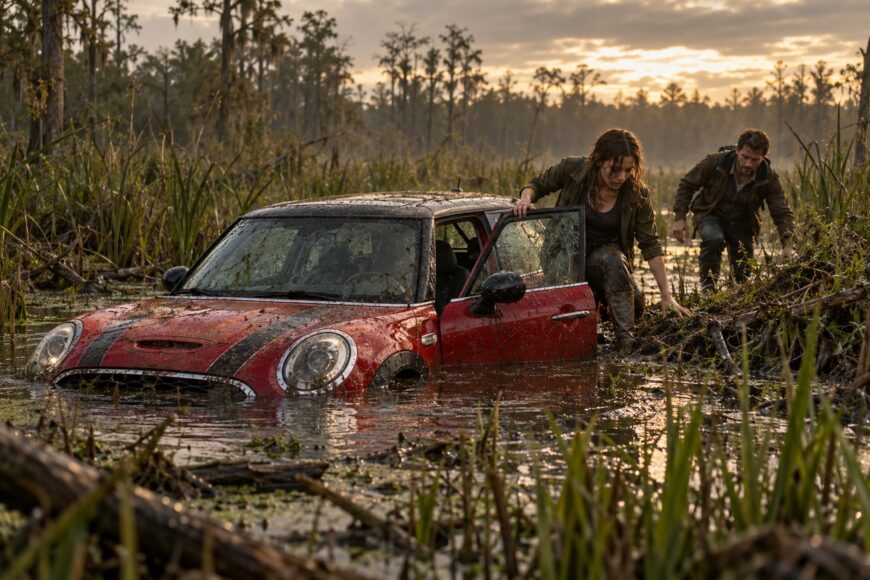
A MINI bogged down on soft ground may need a careful recovery. A MINI taking on water demands an immediate decision about how to get everyone out. Treat rising water, a shifting vehicle, or an uncertain route to firm ground as a threat to people first, regardless of whether the car can be saved.
Spinning the wheels can dig a low-clearance MINI into the mud until its underbody is held in place. Trying to start the engine again after it stalls in water can cause serious mechanical or electrical damage. Stop, assess the water and ground from a safe position, and get help suited to the conditions.
- If the MINI is sinking, get people out first
- Stop the engine and assess whether the car is only stuck
- Recover a grounded MINI without a damaging pull
- Arrange transport that fits the damage and the MINI model
- After extraction, document water exposure before repairs
- Shortcuts that make swamp damage worse
- Frequently asked questions
- How long does it take a flooded MINI interior to dry?
- When can I collect belongings from a recovered Cooper SE?
- What should you do if your car sinks in water?
- What is the most common problem with a MINI Cooper?
- How long does it take for water to dry out of a car?
If the MINI is sinking, get people out first
If water is rising into the cabin or the vehicle is shifting, leave promptly through an accessible door or window. Help other occupants out, move toward firm ground, and call emergency services. Do not wait inside for a tow or delay your exit to gather belongings or take photographs.
Check where you will step before leaving. Deep mud can give way beneath you, and floodwater can conceal holes, debris, or a current. If there is no visibly safe route, or someone cannot get out, tell emergency services your location and the occupants’ situation so trained responders can assist.
Once everyone is clear, stay away from the vehicle if the ground remains unstable. A car that looks stationary can settle further, and its position may make the surrounding mud unsafe to approach. Leave any extraction decision to responders or a recovery operator who can assess the site.
Floodwater may be contaminated. For necessary contact after reaching safety, use suitable gloves and protection for your eyes and breathing, and wash exposed skin thoroughly afterward. Seek medical advice if someone has been injured or has had significant exposure to contaminated water.
Stop the engine and assess whether the car is only stuck
With everyone safe, distinguish a grounded car with a dry cabin from one exposed to water. Stop spinning the wheels, and do not drive farther into the swamp to test whether the MINI can push through. A stalled or water-exposed engine should stay off while its condition is assessed.
If the carpet is wet or water entered the cabin, do not start the engine until the vehicle has been diagnosed and repaired. Repeated starts can worsen damage if water has reached the intake. Water exposure can also affect electrical systems even when the engine initially appears normal.
Look from firm ground rather than wading around the car. A low-clearance MINI can settle onto soft mud while its wheels remain visible; in that situation, extra throttle digs the wheels deeper without releasing the underbody. Rising water or unstable footing ends any attempt at owner-led recovery.
For current MINI models, the stated guidance is for calm water no deeper than 25 cm, driven at no more than walking pace, up to 5 km/h. That is not a safe swamp-crossing depth. Soft ground, uneven depth, and water displaced by the car make a swamp far less predictable than a calm-water crossing.
Recover a grounded MINI without a damaging pull

Consider recovery work near the car only if the cabin is dry, the vehicle is stable, and everyone can remain on firm ground. If reaching the wheels requires stepping into uncertain mud or water, stop and call a professional operator. A stuck car is replaceable; a person trapped beside it may be difficult to reach.
Where access is safe, clearing mud ahead of the wheels and reducing the mud holding the underbody can make a controlled extraction possible. Suitable traction aids and a straight, prepared path may help, but do not crawl beneath the car or work where it could settle. More wheelspin will not free an underbody anchored in soft ground.
Before increasing winch force, a recovery operator can clear mud holding the underbody and align the pull. Pulling harder against that buried resistance can load the attachment without moving the car.
Use only the specified towing eye as directed in the handbook for that MINI model. It is intended for a controlled pull, not for lifting the car or taking a sideways jerk. Never attach a strap to the bumper, suspension, or an unidentified metal part; if the correct point or its use is uncertain, leave rigging to the operator.
Any pull should be gradual and as straight as the recovery setup allows. Keep everyone well clear of the cable or strap and its line of pull, because a failed attachment or line can snap back. A sudden tug can damage the towing eye, body, or drivetrain while leaving the MINI stuck.
Arrange transport that fits the damage and the MINI model
Tell the recovery operator the MINI’s model and powertrain, where it is, what the ground is like, whether water entered the cabin, and whether the car can roll. Mention any uncertainty about the towing eye or access to the vehicle. These details help the operator bring suitable equipment rather than improvising at the swamp’s edge.
If water reached the sills or floor, request platform transport rather than assuming a partial lift is suitable. A car that has been extracted may still have water in its intake, wiring, or interior, so extraction does not make it ready to drive. The operator should assess how to load it without relying on the engine.
For the electric Cooper SE, follow the handbook requirement for flatbed transport instead of ordinary rope towing. Do not dismantle high-voltage components or immediately reconnect a flooded 12-volt battery. Keep clear of damaged electrical components and let qualified personnel determine how the car can be handled.
Model-specific instructions matter, particularly if wheels will not turn or the car cannot be reached from a straight approach. Give the operator the handbook information you have, and let qualified responders or recovery personnel decide on equipment and attachment. Do not turn a difficult loading job into a roadside repair attempt.
After extraction, document water exposure before repairs
When the area and vehicle are safe to approach, photograph the waterline, cabin, engine bay, and scene before cleaning. Record visible mud and water inside the car as well as its condition after extraction. Do not re-enter an unstable vehicle to obtain evidence.
Contact your insurer before attempting to revive a flooded MINI, in line with NHTSA advice. Ask how inspection, recovery, and documentation should proceed; coverage and costs depend on your policy. Arrange a professional assessment rather than testing whether the engine will start.
The inspection should include the air-filter housing, intake, and connected components. Water in the filter housing or intake raises the risk of hydrolock. A filter that looks dry from above does not establish that the housing or downstream intake stayed dry.
Ask for checks beneath carpets and panels, within insulation and electrical connectors, and in concealed areas such as the boot and beneath the dashboard. Moisture can remain there after exposed surfaces look dry, allowing corrosion or electrical faults to develop later. There is no fixed drying time that proves a flooded MINI safe to start.
Shortcuts that make swamp damage worse
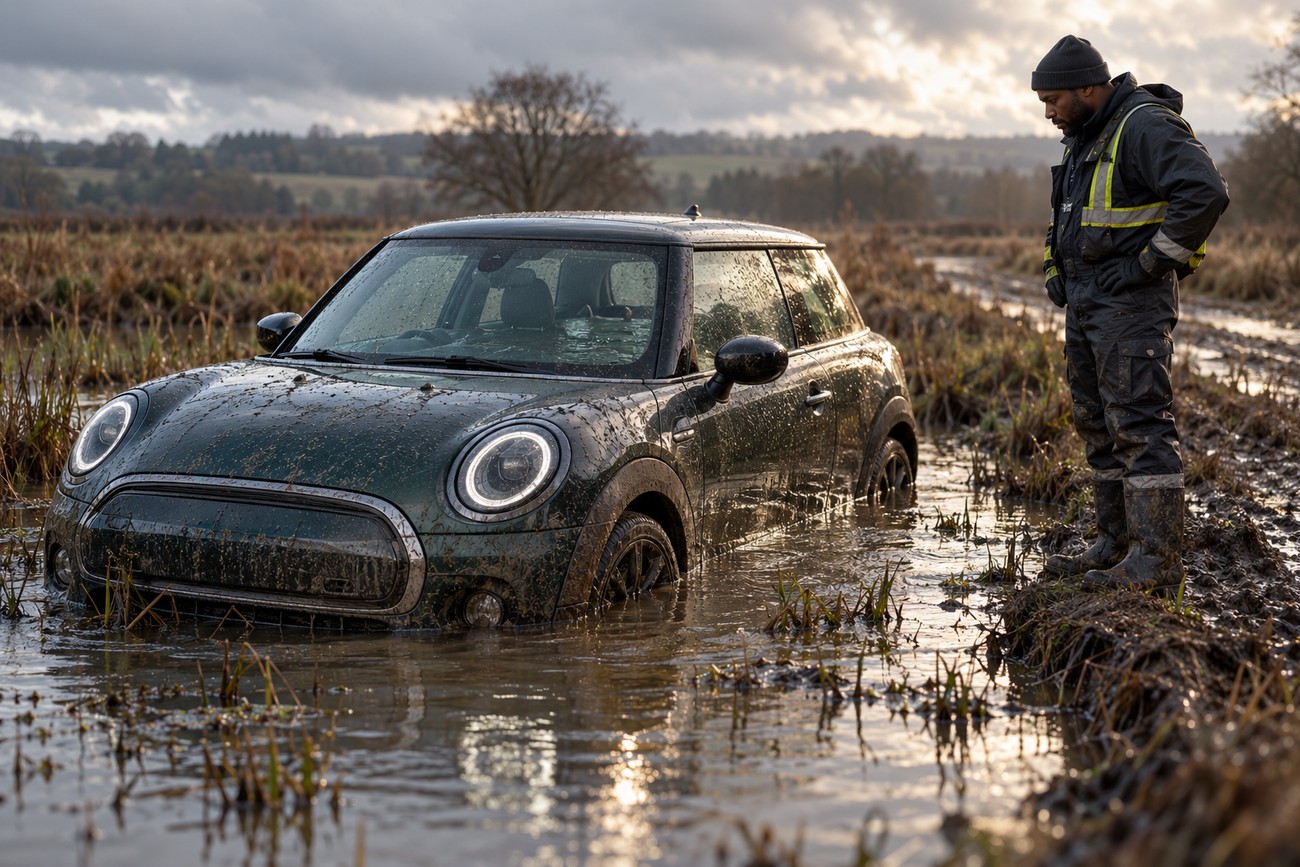
Speeding up to “power through” water can push a wave toward the intake and reduce your control. MINI’s guidance for current models applies to calm water no deeper than 25 cm at no more than walking pace, up to 5 km/h. Soft ground and displaced water make that limit unsuitable as a swamp-depth rule.
A stalled wet car should not be given repeated starting attempts. If the carpet is wet or water entered the cabin, do not start the engine until the vehicle has been diagnosed and repaired. Drying visible surfaces or checking one easily reached part cannot rule out hidden water.
Nor is any sturdy-looking metal part a recovery point. Use the specified towing eye only as directed; it is not for lifting or sideways pulls, and the bumper and suspension are unsuitable strap attachments. Improvised rigging can fail or cause damage before the car moves.
Generic advice to rope-tow an electric car is especially risky here: the Cooper SE handbook requires flatbed transport. Confirm the model when requesting help so the operator plans for loading and transport rather than assuming an ordinary tow will do.
Frequently asked questions
These answers address decisions that can remain after everyone is safe and the MINI has been recovered. They cannot replace an inspection of a water-exposed vehicle or an assessment of an unsafe site.
How long does it take a flooded MINI interior to dry?
There is no reliable universal drying time for a flooded MINI interior. Insulation beneath the carpet and electrical connectors can retain moisture after seats and visible carpet feel dry. Inspection of those concealed areas, followed by any necessary cleaning and repair, matters more than the number of days the car has stood.
When can I collect belongings from a recovered Cooper SE?
Wait until responders or qualified personnel confirm that the Cooper SE and its surroundings are safe to approach. Collecting personal items is a separate decision from whether the car is ready for transport. If access is restricted, ask the recovery operator or storage facility how belongings can be retrieved without touching damaged electrical components.
What should you do if your car sinks in water?
Get occupants out if there is a safe exit, move to firm ground, and call emergency services. If you cannot get out safely, give dispatchers your location, the number of occupants, and whether water is entering the cabin. Leave the car and belongings to responders; do not return to it while the ground or water remains hazardous.
What is the most common problem with a MINI Cooper?
There is no single reliable “most common” problem across every MINI model, age, and maintenance history. For a Cooper that has been in swamp water, the immediate concern is water exposure to the intake, cabin, and electrical components. A technician needs the model details and an inspection to identify the damage in that particular car.
How long does it take for water to dry out of a car?
Water can disappear from visible surfaces while remaining in padding, enclosed body areas, or connectors, so time alone cannot show that a car is dry. If water entered the cabin, arrange an inspection rather than using a calendar date to decide when to restart it. Ask the technician what was checked and what drying or repairs are still needed.







