
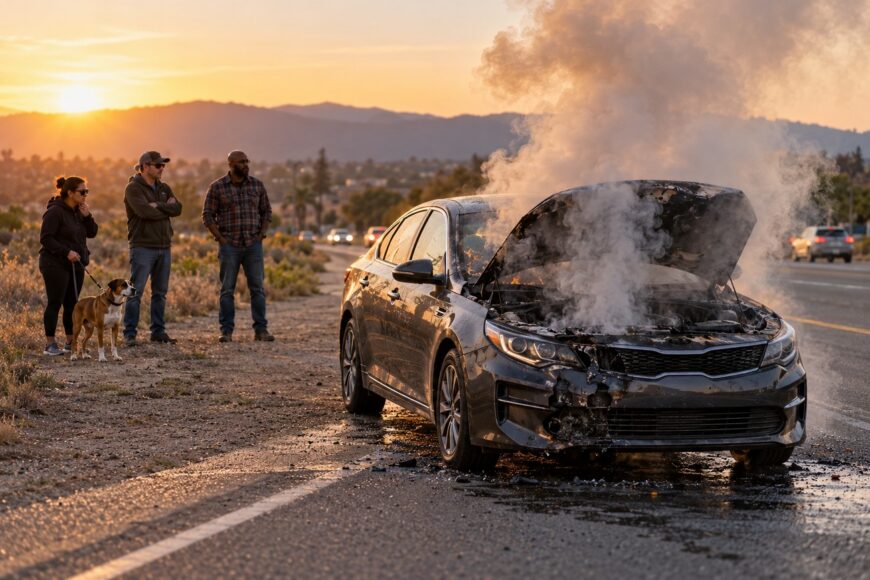
A Kia Optima showing smoke, a burning smell, warning lights, or flames is not a vehicle to drive home or investigate casually. Stop as soon as it is safe, switch off the engine, get everyone out, and move away from the vehicle and traffic. Call 911 or the local emergency number.
A strong crash-safety rating, such as Top Safety Pick+, concerns protection in a collision. It does not eliminate a separate fire risk linked to certain vehicles, engines, or recall campaigns. Treat visible smoke, unusual noise, overheating, and fluid leaks as reasons to stop and arrange professional help.
- If Your Kia Optima Is Smoking or on Fire, Act Now
- Warning Signs You Should Not Drive Through
- Why Some Kia Optima Models Have Fire-Related Recall History
- Mistakes That Can Turn a Warning Into an Emergency
- What to Do After the Fire, Smoke, or Overheating Event
- How to Reduce Risk Before the Next Drive
- Frequently asked questions
- What information should I give 911 when a Kia Optima catches fire?
- What is the most common problem with a Kia Optima?
- What to do if your vehicle catches on fire?
- What can cause my car to catch fire?
If Your Kia Optima Is Smoking or on Fire, Act Now
Choose the safest stopping place available, preferably away from traffic, buildings, dry vegetation, and other vehicles. Turn off the engine if you can do so without delay or exposure to smoke. Do not remain inside to collect belongings or inspect the engine bay.
Evacuate every occupant, including children and pets, and move well away from the vehicle. Stay upwind when possible, because smoke can contain irritating or toxic substances. Keep other people away, and do not return for documents, luggage, or personal items.
- Stop safely and switch off the engine.
- Help everyone leave the vehicle immediately.
- Move away from traffic, smoke, and the vehicle itself.
- Call 911 or the local emergency number and report the exact location.
- Follow emergency-dispatch instructions, and do not approach the Optima again unless responders say it is safe.
Use an extinguisher only for a small, incipient fire when you have a clear escape route and can operate it without moving toward danger. A small extinguisher is not suitable for a developed engine fire, spreading flames, heavy smoke, or a fire blocking an exit.
Do not abruptly open a hood over an actively smoking or burning engine. Added oxygen can cause a flare-up, and the hood, engine components, and escaping gases may cause severe burns. Certain recall notices also warned that affected Optimas could catch fire while parked with the engine off, so a stationary vehicle still requires caution.
Warning Signs You Should Not Drive Through
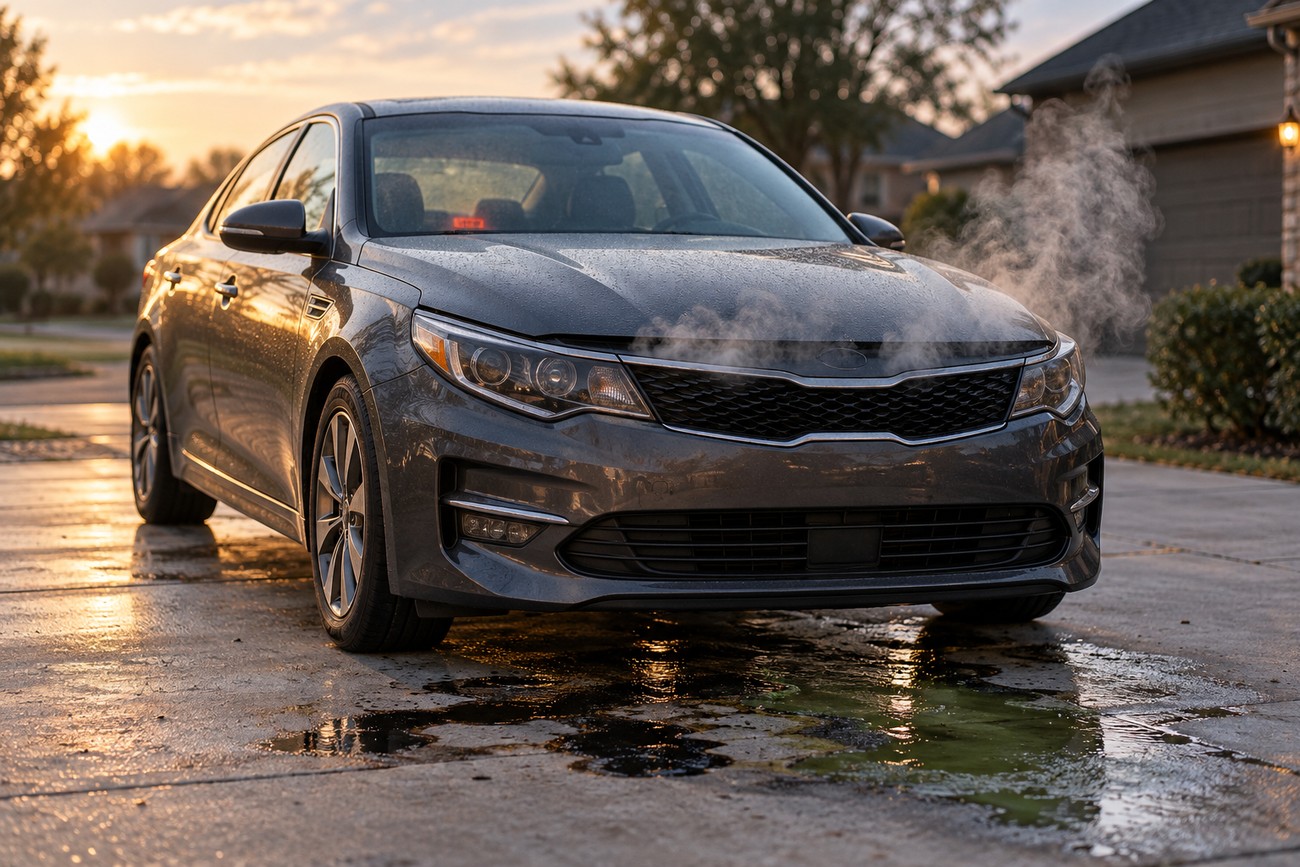
Reported warning signs include a burning or fuel odor, smoke under the hood, unusual engine noise, flashing warning lights, overheating, and visible fluid leaks. One symptom does not prove a particular recall defect, but it is enough to justify stopping and arranging a professional inspection.
Oil, coolant, and brake fluid can reach hot engine or electrical components when they leak. Fresh spots near the engine, a changing fluid level, or fluid on the underside of the hood should not be dismissed as cosmetic. Continuing to drive can turn a minor leak or electrical fault into a larger failure.
Do not reset warning codes and continue toward home or a repair shop after smoke, a burning smell, or flashing warning lights. Stop in a safe location, shut the vehicle down, and use a tow service or emergency assistance. A tow is usually a lower-risk choice than testing whether the symptom disappears.
Owner-forum reports describe sudden smoke or odors, but these accounts are anecdotal and cannot establish the cause of an individual fire. They can still help you recognize a pattern that deserves prompt diagnosis. Ask the technician to investigate the underlying fault rather than simply clearing codes.
Why Some Kia Optima Models Have Fire-Related Recall History
NHTSA documented fire-related recalls affecting certain Kia Optima vehicles with 2.4-liter Theta II and 2.0-liter Nu engines. The documented risk does not apply automatically to every Optima. Eligibility varies by vehicle identification number, model year, market, engine, and campaign.
Depending on the campaign, recall remedies included inspection for fuel or oil leaks and possible engine replacement. A separate recall involved possible brake-fluid leakage from the ABS hydraulic unit, creating an engine-compartment fire risk. These are different systems, so a completed engine-related action does not necessarily address every other possible source of fire.
For applicable engine-risk populations, a knock-detection software update and warranty coverage of up to 5 years or 150,000 miles were cited. The exact terms and availability depend on the relevant campaign and market. A software update can address a specified monitored condition, but it does not eliminate unrelated fuel, fluid, wiring, ABS, or heat-damage risks.
Check the current recall status using the VIN through Kia or the relevant national recall authority. If a warning sign is present, do not wait for a recall appointment before stopping the vehicle. Recall eligibility and immediate safety decisions are separate matters.
Mistakes That Can Turn a Warning Into an Emergency
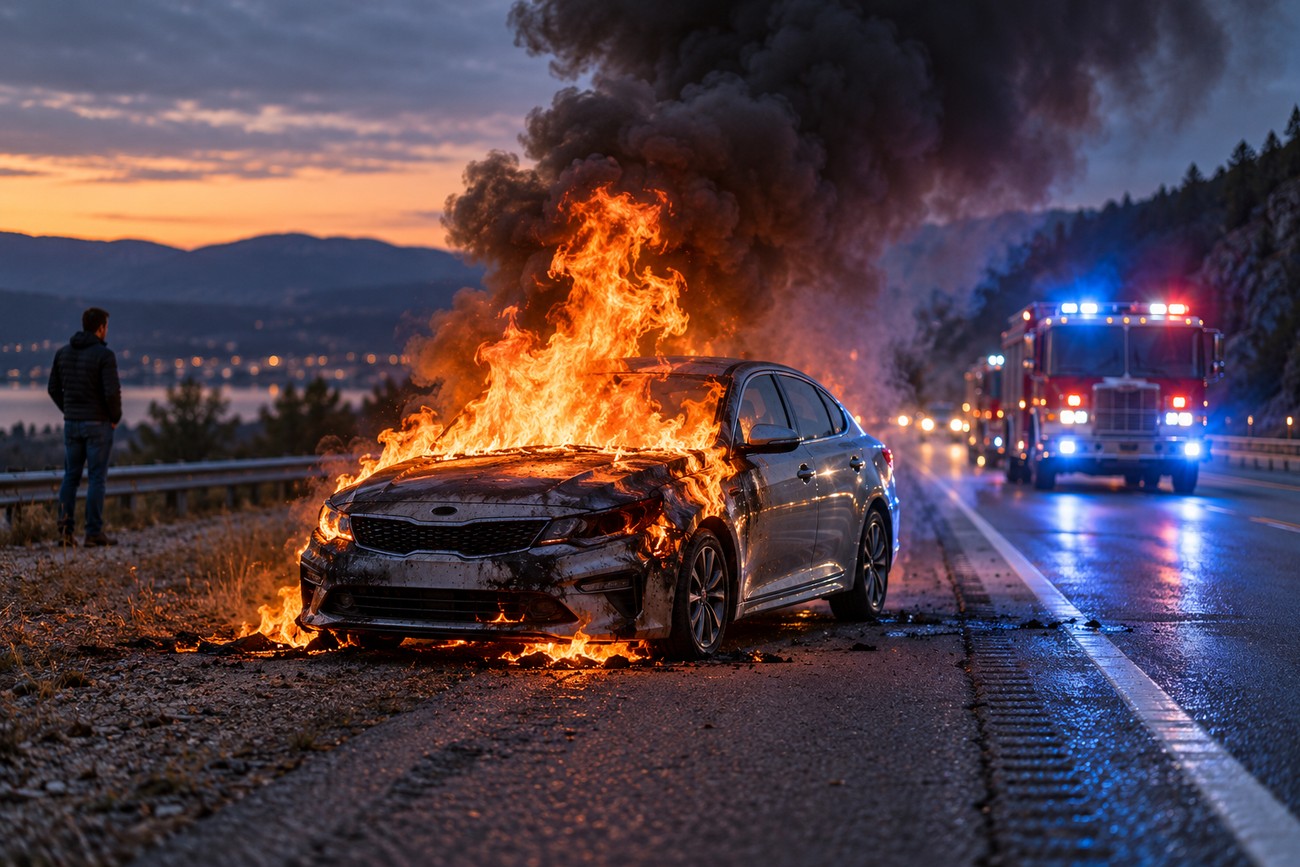
The most dangerous response is continuing to drive after a burning smell, smoke, overheating, or a flashing warning light. A vehicle may still move normally while a leak, overheated component, or electrical fault is worsening. Stopping early gives occupants more time and reduces the chance of a developed fire.
Opening the hood abruptly can expose you to flames, hot gases, and a sudden flare-up. A household extinguisher also has limited reach and capacity. If flames are spreading or smoke is heavy, evacuate and wait for firefighters rather than trying to protect the vehicle.
Small oil, coolant, or brake-fluid spots deserve investigation even when the vehicle has not yet overheated. After a smoke event, a code reset or fuse replacement alone does not establish that the wiring, fuel system, ABS components, seals, and fluid circuits are safe. Request a cause-focused inspection before authorizing a return to service.
A strong crash-test rating and a fire-related recall history can both be true. Crash protection describes what may happen in a collision; it does not guarantee that a separate mechanical or electrical fire risk is absent. Reports of recurring odors after recall work are anecdotal, so they should lead to documented reinspection rather than a conclusion that every recall remedy failed.
What to Do After the Fire, Smoke, or Overheating Event
After a fire or severe overheating event, do not restart or move the Optima unless emergency personnel direct you to do so. Arrange towing and notify your insurer promptly. A fire-damaged vehicle may have hidden heat or electrical damage even when the visible engine damage appears limited.
From a safe distance, preserve photographs or video of smoke, flames, warning lights, fluid traces, and the surrounding scene. Keep dashboard information, service records, recall paperwork, tow documents, and repair estimates. These records can help an insurer, dealer, or independent investigator establish what happened.
Trace heat and contamination through wiring, connectors, fuse boxes, ABS components, and electronic modules instead of accepting only a visual engine check or diagnostic-code reset.
Request a comprehensive inspection of the fuel system, engine, ABS hydraulic unit, wiring harnesses, fuse box, electronic modules, seals, and heat damage. The inspection should also address the E-CVVT area, cooling hoses, cylinder-head area, and any mechanical damage relevant to the symptoms.
If an odor or visible leak remains after official repair, document it and refer the vehicle back for a root-cause inspection. Avoid authorizing a superficial repair that only clears codes or replaces a fuse. The vehicle should return to service only after the cause and any secondary damage have been assessed.
How to Reduce Risk Before the Next Drive
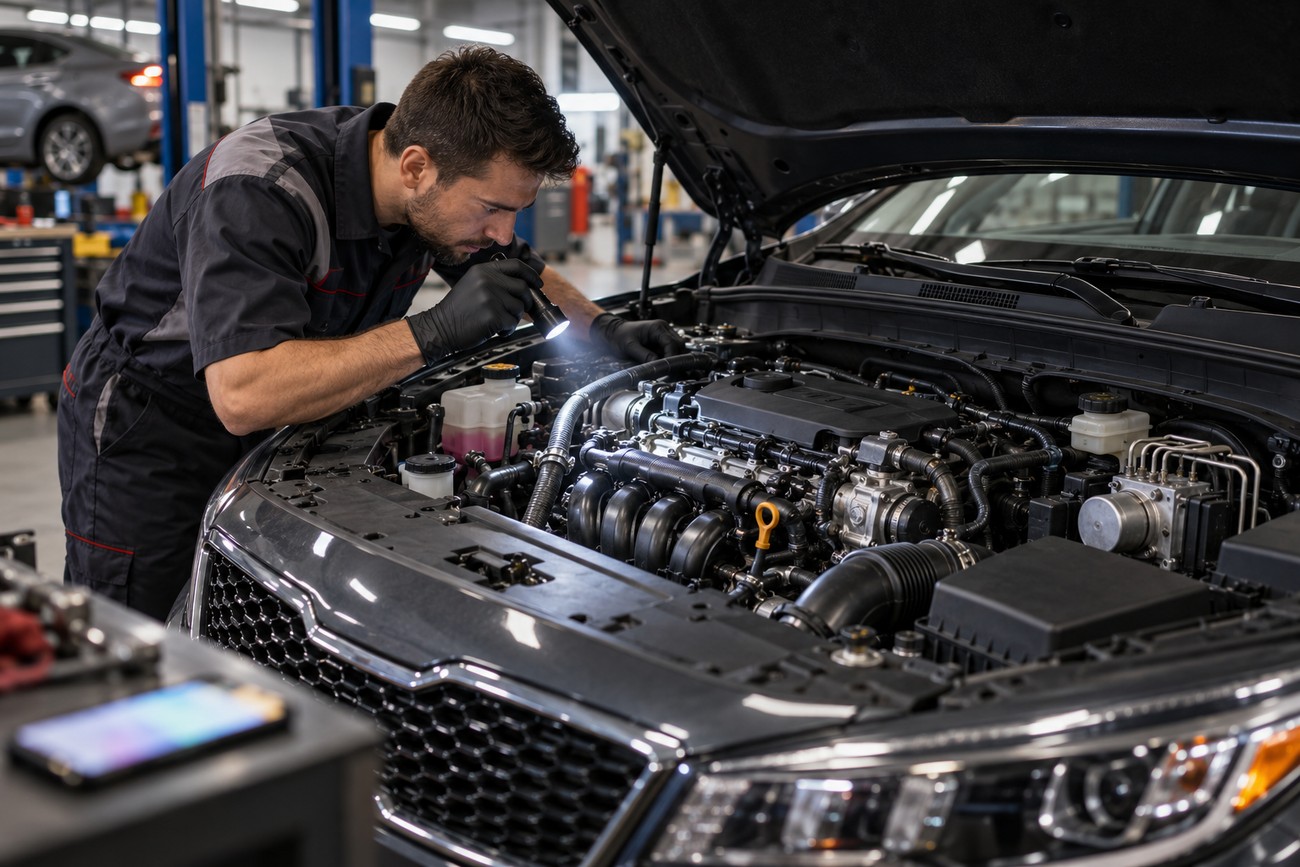
Check current recall status by VIN through Kia or the relevant national recall authority before driving an Optima with a recall concern. Follow Kia service guidance and complete applicable safety campaigns. Routine maintenance supports early detection, but it does not substitute for an official recall remedy.
During regular checks, look for fresh oil, coolant, or brake-fluid traces around the E-CVVT area, cooling hoses, cylinder-head area, and ABS hydraulic unit. Check coolant and brake-fluid levels as specified in the maintenance guidance. A falling level or new residue warrants professional diagnosis.
A vehicle-rated dry-chemical or carbon-dioxide extinguisher may be kept in the cabin where it is accessible and secured. Learn its operating instructions before an emergency. It is a limited tool for a small, incipient fire with a clear escape route, not a reason to approach a developed fire.
Promptly repair leaks, overheating, warning-light faults, and unusual engine noise. Keep records of inspections and recall work, including the VIN and campaign details. Good maintenance reduces avoidable risk, while recall completion addresses only the conditions covered by that specific campaign.
Frequently asked questions
What information should I give 911 when a Kia Optima catches fire?
Give the exact location, the direction of travel if the vehicle is on a road, and the visible condition of the Optima. State whether there are flames, smoke, or explosions, and identify nearby vehicles, buildings, fuel sources, dry vegetation, or other hazards.
Tell the dispatcher how many occupants are involved and whether anyone is trapped, injured, or unable to move away. Stay on the line if instructed, follow evacuation guidance, and do not approach the vehicle to provide additional details.
What is the most common problem with a Kia Optima?
There is no single problem that applies to every Kia Optima generation. Fire-risk assessment depends on the model year, engine, market, maintenance history, symptoms, and VIN.
For certain vehicles with 2.4-liter Theta II and 2.0-liter Nu engines, NHTSA documented fire-related recalls. That history does not prove that every Optima has the same defect. The VIN and the vehicle’s current symptoms are needed to identify applicable campaigns and safe next steps.
What to do if your vehicle catches on fire?
Stop safely, switch off the engine, evacuate everyone, move away from the vehicle and traffic, and call 911 or the local emergency number. Do not return to retrieve belongings, restart the vehicle, or move it for convenience before emergency responders and the insurer or qualified recovery service provide appropriate direction.
Use an extinguisher only against a small, incipient fire when there is a clear escape route. Do not open a heavily smoking hood or fight a developed vehicle fire; added oxygen, heat, and changing fire conditions can make the situation more dangerous.
What can cause my car to catch fire?
Possible causes include leaking fuel, oil, coolant, or brake fluid reaching hot components, electrical faults, damaged wiring, overheated engine parts, and defects involving specific systems or recall populations. No single cause is the most likely for every Kia Optima.
Determining the cause requires a qualified inspection of the engine, fuel system, ABS hydraulic unit, wiring, fuse box, electronic modules, seals, and heat damage. Preserve evidence when safe, and do not restart or authorize repairs before the vehicle’s condition and recall history have been properly documented.







