
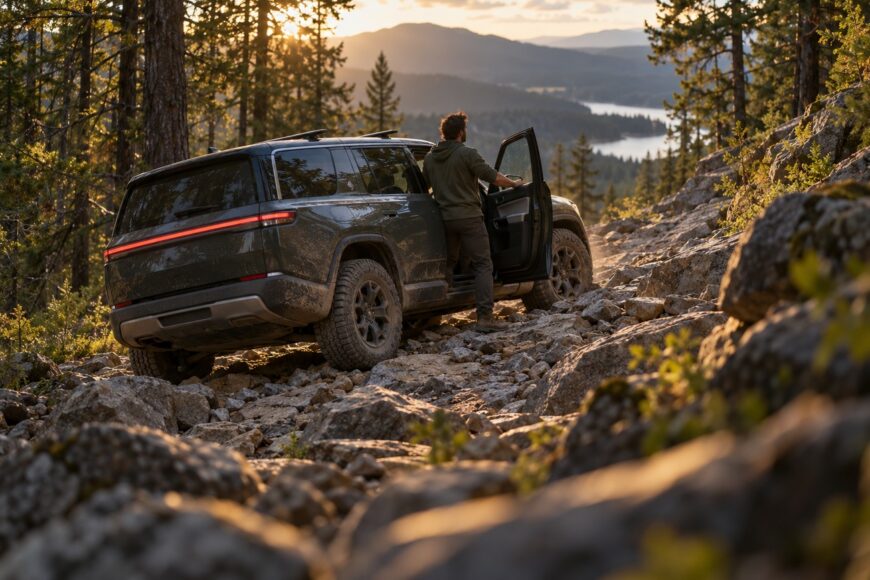
A large EPA-rated range figure does not guarantee a safe return from a slow, steep, sandy, snowy, or isolated trail. An R1S can use energy at a rate that road-based range estimates do not reveal, especially when the route includes loose ground, repeated climbs, cold weather, low tire pressure, or extended heating.
The critical decision comes before the vehicle stops: turn around while you still have options, or continue until the R1S becomes a heavy vehicle that is difficult to recover, impossible to charge with ordinary equipment, and outside reliable mobile coverage. Once traction is gone, recovery depends as much on access, equipment, and communication as on the remaining battery percentage.
- Why Trail Range Is Not the Number on the Window Sticker
- When to Turn Around Before the R1S Becomes the Emergency
- What to Do When the R1S Stops Moving
- Why Recovery and On-Trail Charging Are Harder Than They Sound
- Frequently asked questions
- What happens if your Rivian battery dies?
- How do I reboot my Rivian R1S?
- What are the most common issues with Rivian R1S?
Why Trail Range Is Not the Number on the Window Sticker
R1S range varies with the battery, motors, and wheel size. Early configurations were rated at roughly 260+ to 320+ miles, while current versions are advertised at up to a 410-mile EPA estimate, depending on configuration. Those figures describe standardized road testing rather than slow travel over technical terrain.
Loose ground makes the vehicle work harder to maintain movement. Climbs require energy that a flat road does not, and repeated low-speed corrections can keep the motors working even when the vehicle covers little distance. Low tire pressure may improve flotation or traction on a trail, but it also increases rolling resistance. Cold temperatures and cabin heating further increase consumption.
The displayed arrival estimate can therefore look optimistic on a remote route. Large wheels and off-road tires may change consumption, while sand, snow, and a series of short climbs can make the remaining range fall faster than expected. A driver who plans only for the outbound distance may discover that the return route needs substantially more energy than the trip to the turnaround point.
Regeneration can recover some energy on a descent, but it cannot erase the energy spent climbing or overcoming trail resistance. A downhill section is not a reliable battery reserve. Treat the EPA figure as a road reference, then build a separate trail plan around terrain, temperature, tire pressure, the return route, and time spent waiting for assistance.
When to Turn Around Before the R1S Becomes the Emergency
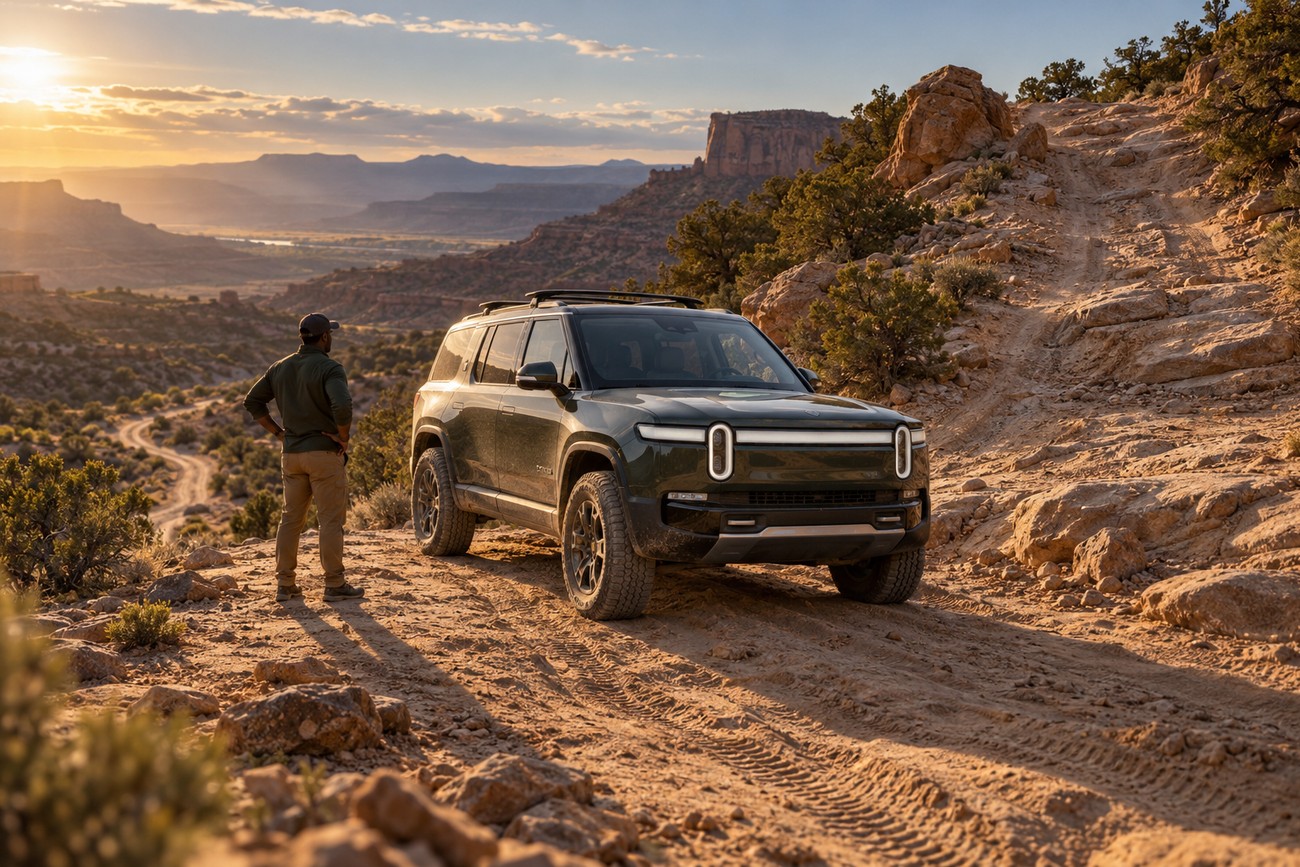
Use the return reserve as a decision boundary, not as the distance you hope to reach. It must cover the way back, an obstacle bypass, a slow extraction, and time waiting for help. If the range estimate begins falling sharply on climbs, sand, snow, or while retracing the route, regard that change as a turnaround signal rather than something to solve with a few hard accelerations.
Once energy is limited, smooth driving is safer and more effective than repeated bursts of acceleration. Reduce unnecessary electrical loads where practical, avoid wheelspin, and choose a line that keeps momentum without forcing aggressive inputs. The aim is to reduce avoidable consumption while preserving control, rather than trying to recover a shrinking estimate through risky driving.
Navigation should continue to work even when the network does not. Save an offline map, record route coordinates and useful turnaround points, and carry a satellite messenger for areas without mobile coverage. Do not assume the vehicle app or a remote service channel will be available when the R1S is deep in a canyon or behind a ridge.
Reduced tire pressure can help on a trail, but it creates a second requirement: carry a suitable compressor and restore pressure before returning to firm roads. Before departure, also confirm that your insurer or roadside-assistance provider will recover a vehicle from a closed or unpaved route and deliver it to a suitable facility. A plan that covers only ordinary roadside towing is incomplete.
What to Do When the R1S Stops Moving
Stop in the safest position available, apply the parking brake if the vehicle permits it, and keep occupants clear of unstable ground, traffic, water, and recovery lines. Secure the vehicle before inspecting it. Check whether the display shows a traction-battery depletion message, a 12-volt warning, a thermal limitation, or a separate drive-system fault. A loss of propulsion does not by itself prove that both battery systems have failed.
Conserve the remaining communication options. Note your coordinates, elevation if available, route access, obstacles, vehicle orientation, and the equipment a recovery crew will need. Contact a provider that can reach the actual trail, rather than assuming a standard roadside truck can enter it. Tell the dispatcher that the R1S must be transported on a flatbed and may require winching.
Rivian’s emergency guidance requires transport on a flatbed; towing with two wheels on the ground is prohibited. Do not attach a rope to an arbitrary suspension or body component and attempt to drag the vehicle. An R1S is heavy, and a locked electronic drivetrain or parking brake can make improvised movement unsafe and potentially damaging.
Recovery crews should secure the vehicle and confirm the parking-brake and loading conditions before applying a winch. Pulling first and diagnosing later can turn a manageable extraction into damage to the vehicle or recovery equipment.
For winch loading, Rivian identifies the front lower control arms or the rear tow hitch assembly as attachment areas. Loading speed should not exceed 5 mph (8 km/h). If the traction battery is depleted or the electronic parking brake will not release, the rear wheels may need to be lifted for loading after the vehicle has been securely restrained.
Reports of simultaneous traction-battery and 12-volt failure require independent confirmation and should not be treated as the normal outcome. If the 12-volt system is also unavailable, electronic locks, access, parking-brake release, and loading procedures may become separate problems. Stop repeated reset attempts when the vehicle gives no usable response and provide the recovery team with the exact symptoms.
Why Recovery and On-Trail Charging Are Harder Than They Sound
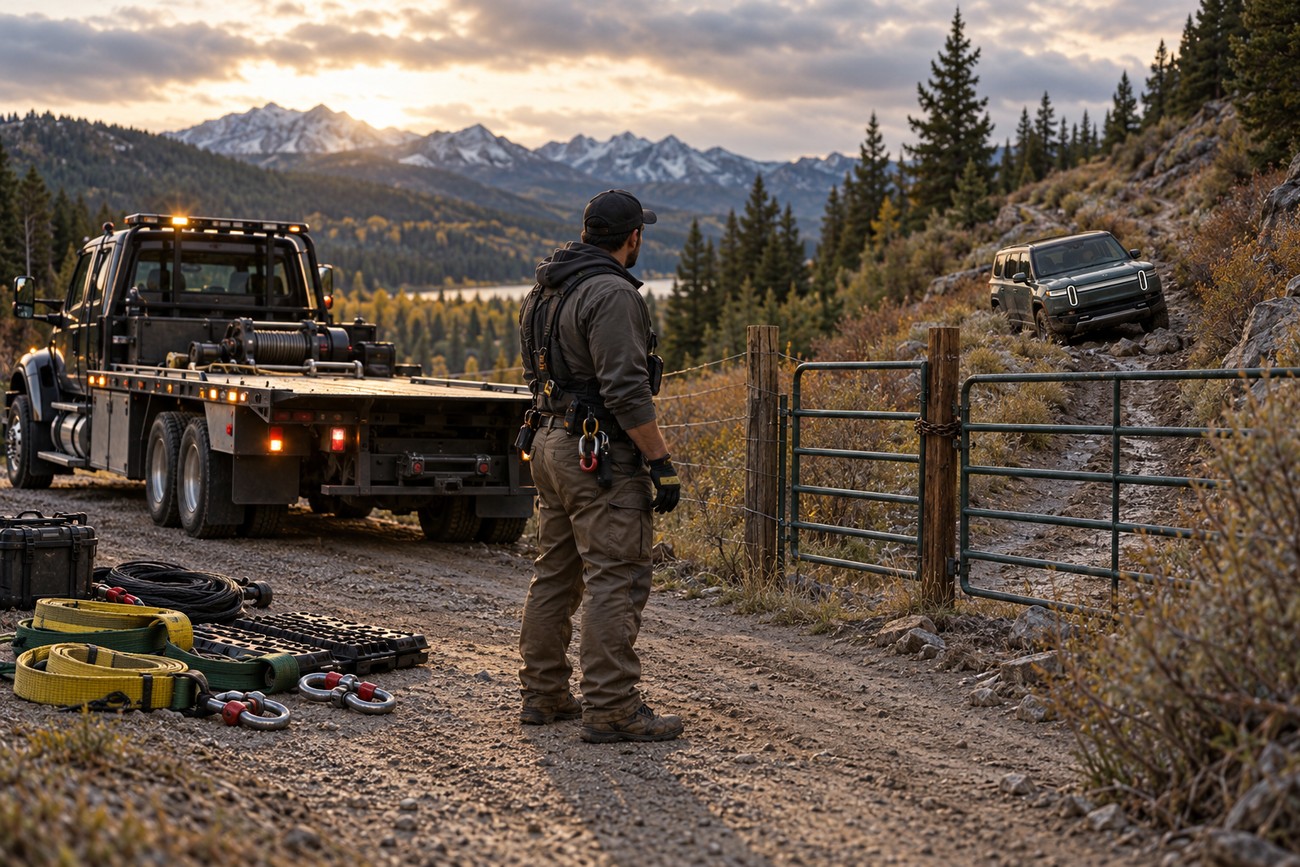
The recovery problem is logistical as well as mechanical. The provider needs a route wide and stable enough for its equipment, a flatbed with suitable capacity, winching gear, securement points, and a destination that can accept the vehicle. Narrow gates, soft shoulders, steep approaches, and locked trail access can prevent a normal tow truck from reaching an otherwise visible R1S.
Confirm coverage before the trip, including recovery from closed or unpaved roads and delivery to an appropriate service facility. Ask what happens if the first contractor cannot enter the route. For transport exceeding 50 miles (80 km), Rivian recommends Vehicle Shipping Mode to preserve remaining energy, where the vehicle can be placed in that mode safely and as directed by Rivian.
On-trail charging is rarely a simple backup. The standard home charging unit is rated at 11.5 kW and can provide approximately up to 25 miles of range per hour under suitable conditions, but it still needs an appropriate electrical supply. A portable power bank cannot charge the R1S. A generator or specialized mobile charger requires separately verified power, grounding, connector, charging-equipment, and safety compatibility.
Some marketing and review sources cite DC fast-charging peaks around 210–220 kW, but that is not a guaranteed field result. Actual speed varies with the vehicle version, battery temperature, state of charge, and station. Charging plans should therefore identify a compatible source and a safe access route, rather than relying on a headline charging figure or an untested generator.
Frequently asked questions
Remote failures can involve the high-voltage traction system, the 12-volt system, software, or the recovery conditions around the vehicle. The safest response depends on which function is unavailable and whether the vehicle can be secured and loaded.
What happens if your Rivian battery dies?
When the traction battery is depleted, the R1S loses propulsion and may be unable to drive to a charger. Other functions can also become restricted, especially if the 12-volt system is low: electronic access, parking-brake release, display functions, and loading controls may not respond normally.
Do not assume that a reset will restore energy to an empty traction battery. Secure the vehicle, conserve communications, and request a flatbed recovery provider. Tell the provider whether the doors, displays, and electronic parking brake respond, because those details determine how the vehicle must be restrained and loaded.
How do I reboot my Rivian R1S?
First follow the instructions shown by the vehicle and the current owner’s manual for the relevant fault. If the display remains usable, record the warning and contact Rivian support before trying an unfamiliar reset sequence. Keep the vehicle stationary and secured during any procedure.
A reboot may clear a temporary software symptom, but it cannot restore a physically empty traction battery or solve a mechanical recovery problem. If the 12-volt system appears unavailable, repeated attempts can consume the remaining power without improving access. Move to a recovery plan when the prescribed instructions do not produce a clear response.
What are the most common issues with Rivian R1S?
For remote-trail use, the recurring practical issues are range estimates that do not reflect technical terrain, sharply rising consumption in sand, snow, and climbs, low tire pressure without a compressor, and limited communications. Recovery can also be difficult because the vehicle requires a flatbed and may need controlled winching rather than ordinary towing.
Charging assumptions create another weak point. Home charging equipment, a generator, or a portable power source is not automatically suitable for remote use. Verify the electrical supply, grounding, connector, charging equipment, and safety conditions before departure, and plan for recovery if the trail prevents a mobile charger or flatbed from reaching the vehicle.







