
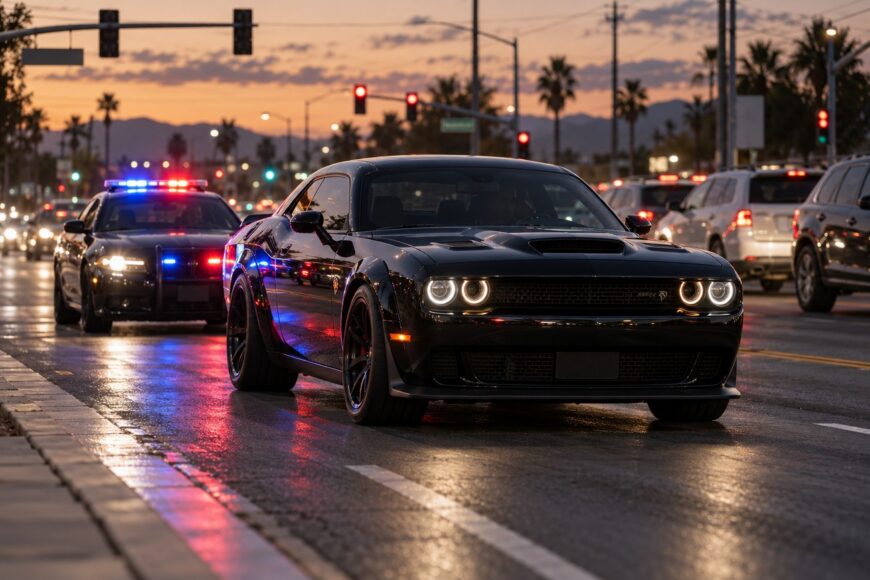
A Dodge Challenger Hellcat combines a supercharged 6.2-liter HEMI V8 with the kind of acceleration that can make a routine traffic stop feel serious within seconds. Specific Dodge versions are rated at up to 717 horsepower, and one officially described version is listed at 11.2 seconds for the quarter mile and 320 km/h in top speed.
Those figures do not decide what happens after a police stop signal. Immediate safety, the driver’s response, local law, and the agency’s pursuit policy matter more than horsepower. A police department may stop a chase because the risk to the public has become unacceptable while continuing to identify the vehicle and investigate the incident afterward.
- What a Hellcat Can—and Cannot—Do in a Police Chase
- What to Do When Police Signal You to Stop
- Why Police May Chase—or Stop Chasing
- Why Ending the Chase Does Not End the Case
- The Hellcat-Specific Risks Drivers Commonly Misjudge
- Hellcat Police-Chase Myths, Corrected
- Frequently asked questions
- What happens if a police officer hits your car during a chase?
- What car is known as the Hellcat Killer?
- What should you do if an unmarked police vehicle signals you to stop?
What a Hellcat Can—and Cannot—Do in a Police Chase
The Hellcat is a Dodge Challenger with a supercharged 6.2-liter HEMI V8. Specific versions are rated at up to 717 horsepower, while other references may cite 707 horsepower for different versions. These figures describe particular configurations and conditions, rather than every Hellcat in every setting.
Dodge lists an 11.2-second quarter-mile time and a 320 km/h top speed for one officially described version. A marketing top speed is a controlled performance specification, not a practical escape strategy. Public roads add traffic, changing surfaces, intersections, visibility limits, and other drivers whose actions cannot be predicted.
Acceleration also depends on tire grip. Cold or worn tires can increase wheelspin and rear-axle instability, while braking distance grows approximately in proportion to the square of speed. A driver who doubles their speed does not simply need twice the stopping distance; the physical margin for avoiding a collision becomes substantially smaller.
Police response does not depend on one patrol car matching the Challenger’s speed. Radio coordination, dispatch information, cameras, license-plate data, and additional units can matter more than a vehicle’s headline specifications. Even if a pursuing officer does not continue directly behind the car, the incident may still generate information for a later investigation.
What to Do When Police Signal You to Stop
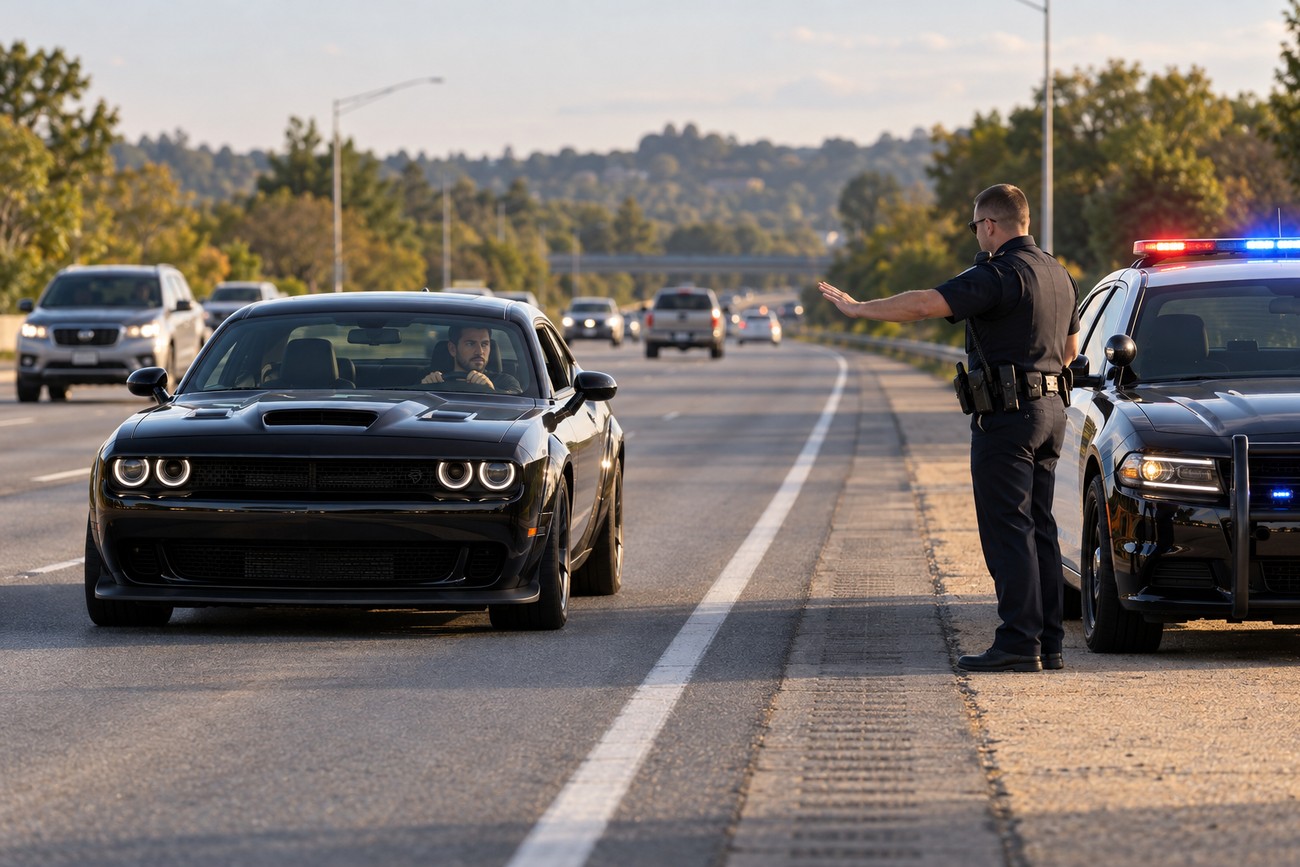
A police stop signal may be given by voice, emergency lights, or a siren. Once the signal is reasonably clear, reduce speed smoothly, avoid sudden lane changes, and look for a safe, visible place to stop. The objective is to end the interaction without creating a new hazard for other road users.
Do not respond by accelerating, weaving through traffic, or testing whether the officer will continue. Under model policy language, intentional acceleration, evasive maneuvers, or refusal to stop after a reasonable time can qualify as fleeing in a vehicle. Exact legal standards vary by jurisdiction, so the facts, timing, and surrounding conditions may all matter.
Safe deceleration and stopping differ materially from acceleration or maneuvering to evade. If an immediate stop would create a collision risk, continue only as far as reasonably necessary to reach a safer, well-lit location while maintaining a controlled speed. Use ordinary caution, keep the vehicle visible, and follow lawful instructions once stopped.
The vehicle’s performance does not provide a legal buffer. A brief attempt to gain distance can change how officers interpret the driver’s conduct, increase danger to bystanders, and create evidence relevant to a fleeing allegation. If the stop appears mistaken, that issue can generally be addressed through the appropriate legal process after the roadside danger has ended.
Why Police May Chase—or Stop Chasing
Pursuit rules depend on the state and the individual law-enforcement agency. Many policies do not authorize a pursuit for every traffic violation, especially where the suspected offense presents no immediate threat of death or serious bodily harm. Agencies commonly require officers to weigh the seriousness of the suspected conduct against the risks created by continuing at speed.
Some policies require a connection to a violent crime or an immediate threat of serious harm before a pursuit is authorized. Others use different thresholds, reporting requirements, or supervisory controls. A rule from one city or state cannot safely be assumed to apply in another jurisdiction.
The central calculation is necessity against public risk. The need for immediate apprehension must outweigh the danger to pedestrians, passengers, and other drivers. Traffic density, road design, weather, visibility, the identity of the suspect, and the available information can all affect that decision.
A pursuit may be terminated when continuing is more dangerous than temporarily leaving the suspect at large. That decision is a safety measure, not an indication that the driver has legally prevailed. Officers may continue sharing the vehicle’s description, direction of travel, and identifying information with other units.
For that reason, a driver should never treat a policy decision to discontinue a chase as permission to continue driving aggressively. The incident may be reviewed later, and the original stop, vehicle movements, recorded communications, and witness accounts may still be relevant.
Why Ending the Chase Does Not End the Case
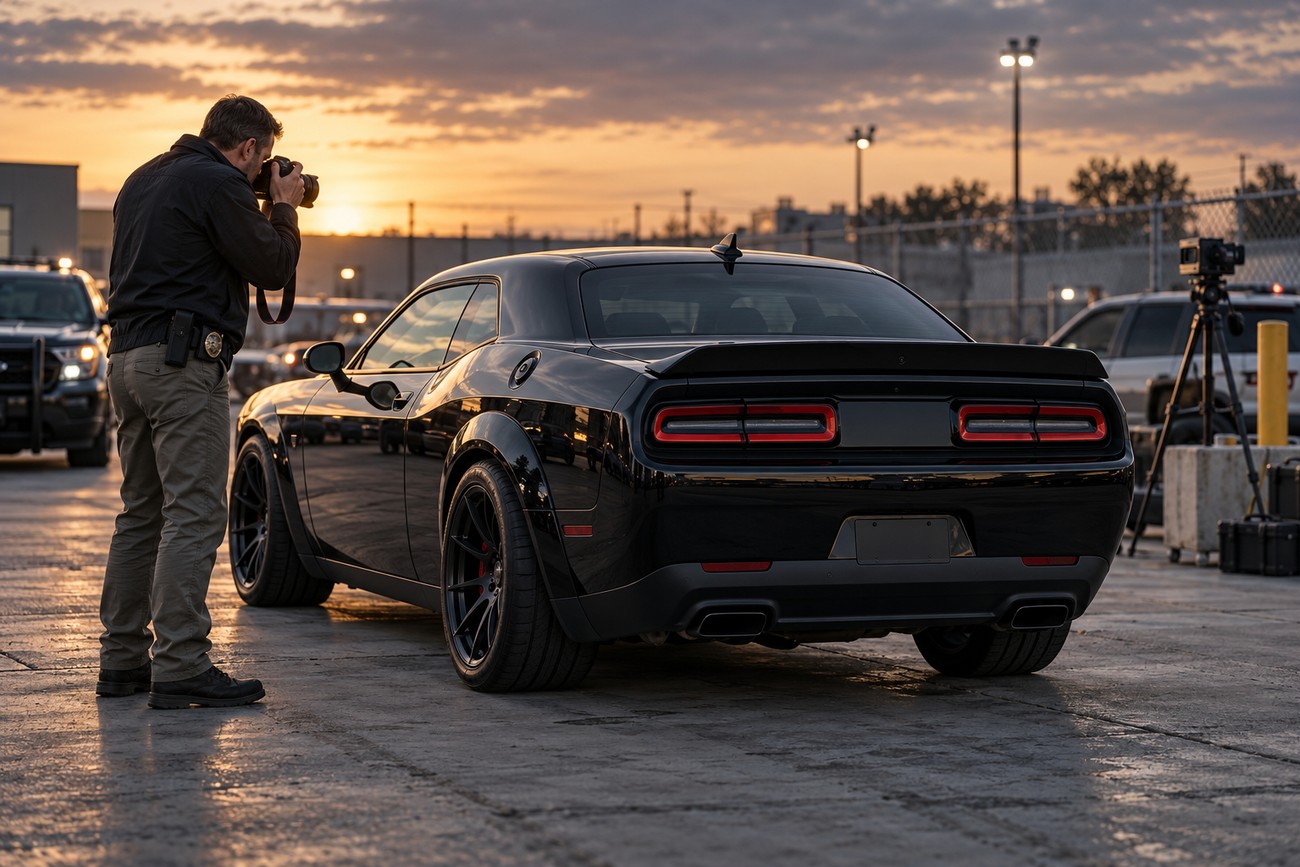
A discontinued pursuit does not necessarily end the investigation or prevent a later arrest. Police can rely on radio communication, cameras, license-plate information, and multiple units rather than one patrol car remaining in direct contact with the vehicle.
Vehicle identification can also be easier than a driver expects. A Hellcat’s sound, rare model, distinctive styling, color, modifications, and license-plate information may help witnesses or cameras connect separate observations. The more unusual the vehicle, the more useful a general description may become.
Trying to conceal the car can create additional legal exposure, depending on the jurisdiction and the conduct involved. Moving it into a hidden location, changing its appearance, interfering with evidence, or giving false information may create new questions beyond the original traffic stop.
The safest course after a stop signal is therefore controlled compliance, followed by obtaining legal advice if the encounter raises concerns. A vehicle’s power may change how quickly events develop, but it does not erase recorded evidence, dispatch records, or later investigative work.
The Hellcat-Specific Risks Drivers Commonly Misjudge
The Hellcat’s abrupt torque can provoke wheelspin and an unexpected loss of rear-axle grip. That risk becomes more pronounced when tires are cold, worn, underinflated, mismatched, or operating on a surface with limited traction. A powerful rear-wheel-drive layout does not override the tire’s available grip.
Drivers can also misread a brief loss of traction as evidence that the car still has unused performance available. In reality, a sliding rear axle reduces steering authority and makes the vehicle’s path less predictable. Traffic, curbs, roadside objects, and oncoming vehicles leave little room for recovery.
A sudden rear-end slide is usually a tire-temperature, tire-condition, and available-grip problem before it is a power advantage. Treating it as a demonstration of performance can turn a recoverable moment into a collision.
Braking distance grows approximately in proportion to the square of speed. The brakes may be capable, but their performance still depends on tire grip, pavement, temperature, load, and driver reaction. Avoid disabling electronic systems or making abrupt control changes during a police encounter; smooth inputs and a controlled stop reduce risk.
Hellcat Police-Chase Myths, Corrected
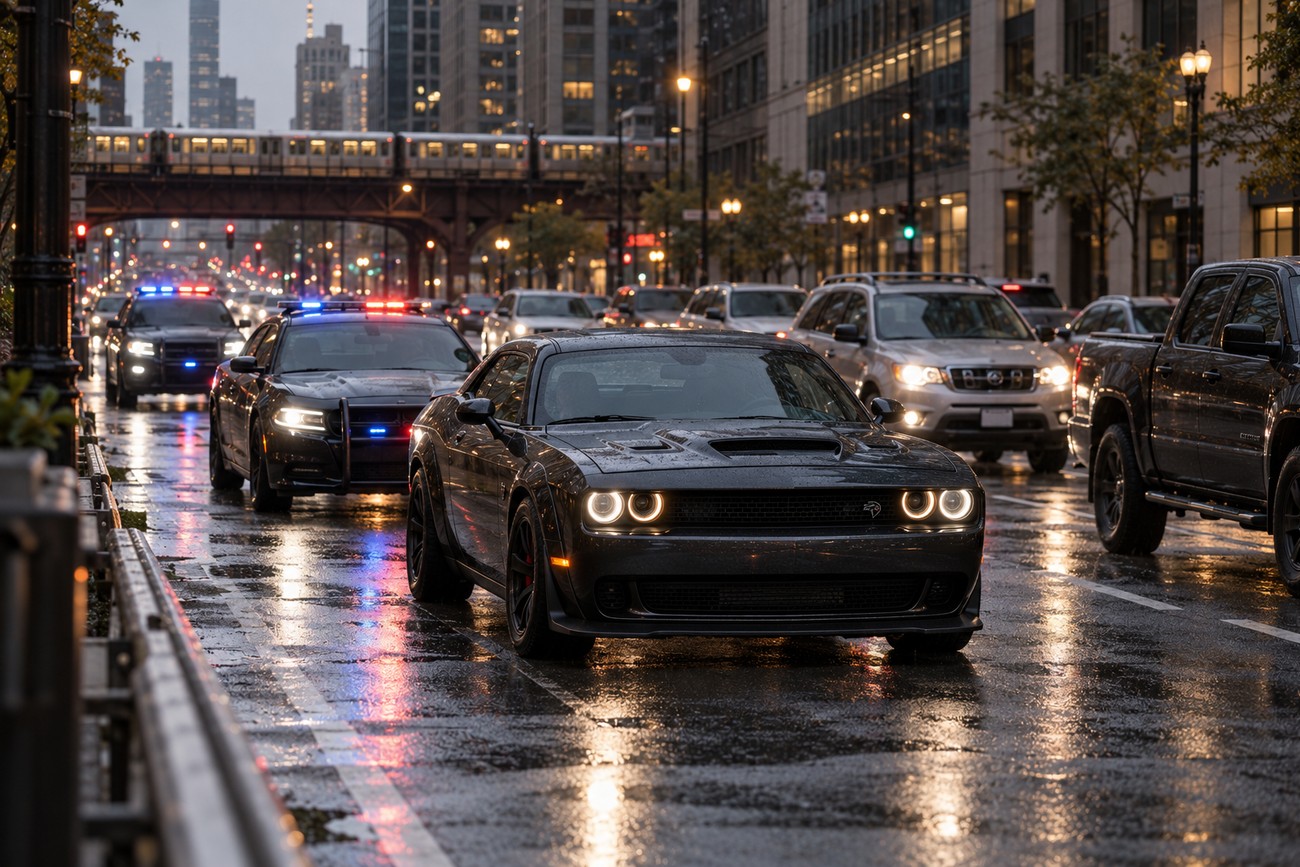
Myth: A 320 km/h top speed guarantees escape. Reality: The figure applies to one officially described version and configuration under specified conditions. It does not overcome radio coordination, cameras, license-plate data, traffic, road limitations, or additional units.
Myth: Police must pursue every driver who does not stop. Reality: Many pursuit policies restrict pursuit based on public danger and the seriousness of the suspected offense. Some require a suspected violent crime or an immediate threat of serious harm, while others apply different standards.
Myth: If police stop chasing, the matter is closed. Reality: Ending a pursuit reflects a risk assessment and does not necessarily eliminate later investigation or arrest. Vehicle data, witness accounts, recorded communications, and camera footage may remain available.
Myth: A forum story proves which car can defeat police. Reality: Forum stories are anecdotes, not reliable statistics. Informal labels such as “Hellcat Killer” are inconsistent and do not predict safety, legality, or the outcome of a police pursuit.
Frequently asked questions
What happens if a police officer hits your car during a chase?
Responsibility is evaluated from the documented facts, applicable local law, and agency policy; fault is not automatically assigned to either driver. Investigators may examine vehicle positions, speed, signals, radio traffic, video, witness accounts, road conditions, and whether the pursuit was authorized and conducted according to policy.
After a crash, prioritize medical assistance, scene safety, and lawful instructions. Preserve photographs, insurance information, and other records when it is safe to do so, and consider prompt advice from a qualified lawyer because collision claims, immunity rules, and agency procedures vary by jurisdiction.
What car is known as the Hellcat Killer?
“Hellcat Killer” is an informal, non-universal nickname rather than an official vehicle classification. Different communities may apply it to different cars based on drag-race results, modifications, or personal claims, so the label has no consistent technical meaning.
A drag-race reputation also does not predict safety, legality, or the outcome of a police pursuit. Road conditions, traffic, tires, braking, driver judgment, radio coordination, and the seriousness of the suspected offense matter far more than an informal comparison between performance cars.
What should you do if an unmarked police vehicle signals you to stop?
Prioritize a safe, visible stop rather than accelerating away. Reduce speed smoothly, use turn signals where appropriate, and proceed only far enough to reach a reasonably safe, well-lit location if stopping immediately would create a danger. Keep the doors locked until you are confident about the interaction, and follow lawful instructions.
If you are uncertain whether the vehicle is legitimate, use lawful verification steps, such as calling the local emergency or police number from a safe location, rather than evasive driving. Do not treat uncertainty as permission to flee; document the encounter afterward and seek legal advice if the officer’s identity or conduct remains in dispute.







