
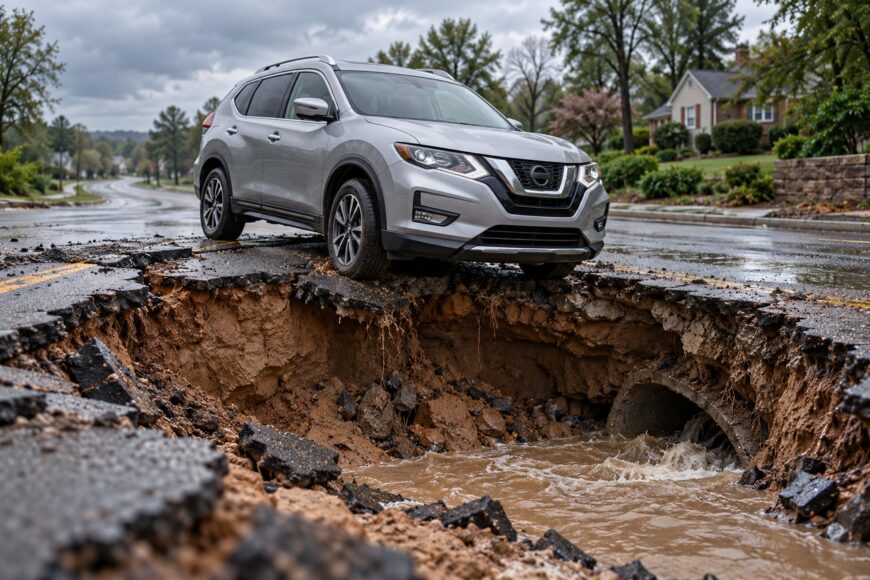
A modern Nissan Rogue can feel well protected on a rough road, yet a collapsing road surface changes the problem completely. Ground clearance helps the vehicle pass over ordinary uneven pavement; it does not preserve support when the pavement, soil, or drainage structure beneath a tire has disappeared. A sinkhole can catch the front end, leave one wheel unsupported, or place the body across a breaking edge before the driver has time to react.
The commonly cited 8.2 inches of clearance may be useful on normal roads and light trails, but it is not a safety threshold for a sinkhole. Cameras, sensors, and careful low-speed driving also have limits when rain, standing water, shadows, or a concealed void hide the failure. Once the Rogue has entered a compromised area, the priorities become protecting occupants, avoiding further collapse, and getting a qualified assessment before attempting movement.
- What a Sinkhole Can Do to a Nissan Rogue
- Why 8.2 Inches of Clearance Is Not Sinkhole Protection
- The Moment the Road Looks Wrong: What to Do Before the Wheels Drop
- If a Wheel or the Nose Has Already Dropped
- Hidden Damage After Recovery: What a Visual Check Misses
- Should You Drive the Rogue After a Sinkhole Incident?
- The Myths That Make a Rogue More Vulnerable
- Frequently asked questions
- How quickly can a sinkhole collapse under a car?
- What is the most common problem with a Nissan Rogue after a sinkhole incident?
- What should you do if your car falls into a sinkhole?
What a Sinkhole Can Do to a Nissan Rogue
A pothole is usually a localized break or depression in the road surface. A surface depression may indicate settlement, poor drainage, or erosion without having a large open cavity beneath it. A sinkhole or undermined roadway is more serious because the visible opening may be only the exposed part of a larger void. The surface can look passable while its remaining layer has little strength to carry a vehicle.
Visible depth is therefore only one part of the hazard. The diameter of the opening, the amount of washout below the pavement, the direction of water flow, and the load-bearing condition of the edge can determine what happens next. A small-looking break may have weakened pavement extending well beyond its visible boundary. A Rogue can drop farther than the opening appears to allow, or the edge can fail as the vehicle’s weight transfers onto it.
The vehicle may not fall straight down. One front wheel can enter first, leaving the Rogue nose-down, while the opposite side remains on pavement. It can also become diagonally supported, with the suspension on one corner compressed and the body resting against an irregular edge. That loading can twist the body and place unusual forces on rocker panels, suspension points, the subframe, exhaust components, and underbody structures even when the cabin remains upright.
A real-world incident involving a Nissan Qashqai/Rogue Sport-type vehicle illustrates the limitation of speed as a safeguard: the driver entered a clearly marked depression slowly, yet the vehicle partially went nose-down. The lesson is not that every marked depression will swallow a car. It is that low speed cannot restore a road foundation that has already lost support, and a slow approach may still end with the front axle or body contacting the broken edge.
Why 8.2 Inches of Clearance Is Not Sinkhole Protection
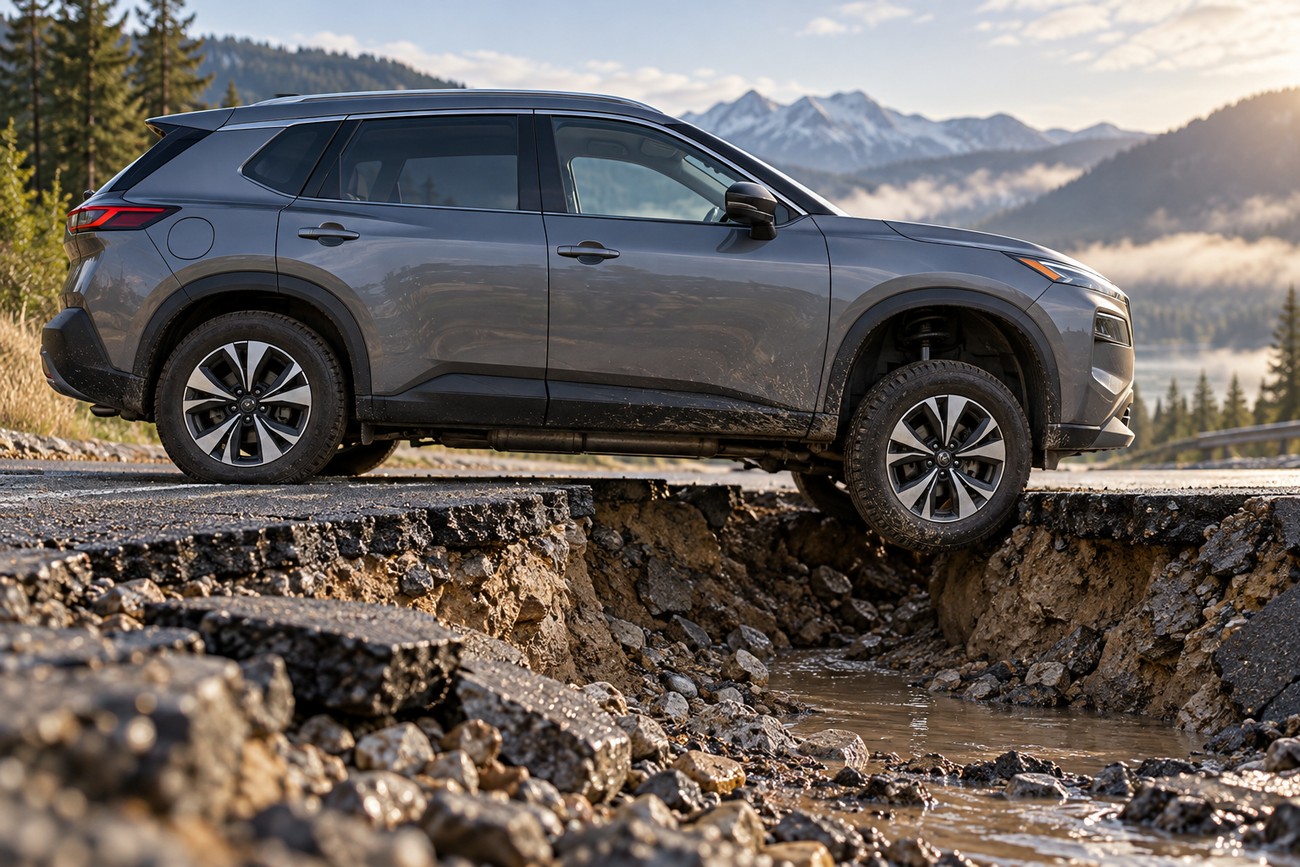
Current Nissan Rogue configurations are commonly cited as having 8.2 inches of ground clearance. That figure describes the space between the vehicle’s underside and the ground under specified conditions. It can help with ordinary uneven roads, shallow ruts, and light off-road conditions, where the surface remains broadly continuous and the tires still have a stable path.
A sinkhole removes the assumption behind that measurement. Clearance cannot bridge an unsupported section of pavement, prevent a tire from losing its footing, or stop a broken edge from contacting the vehicle. If the supporting surface fails beneath a wheel, the relevant question is no longer whether the underside is high enough to pass over a bump. The vehicle’s weight, wheel position, and the strength of the remaining ground become decisive.
The Rogue is an everyday-road crossover with light off-road capability, rather than an extreme off-road vehicle designed for major ground collapses. Its geometry is appropriate for normal travel and limited rough-surface use. A Rock Creek version may have trail-oriented styling, equipment, and tires, but that does not provide serious underbody protection comparable to a purpose-built extreme off-road vehicle.
Descriptions that say 8.2 inches is “enough” for bumps should be read as marketing-oriented applicability claims, not as a safety standard. They may be reasonable for ordinary road irregularities, provided the road remains supported. They say nothing about hidden voids, washed-out shoulders, or a pavement slab that breaks under a concentrated wheel load.
The Moment the Road Looks Wrong: What to Do Before the Wheels Drop
Approach any suspicious surface as a possible loss-of-support problem rather than an ordinary bump. Rain and standing water can conceal the depth of a depression, while shadows can hide a broken edge or make intact pavement look continuous. Broken asphalt, fresh cracks, unusual settlement, and water flowing into or out of the road deserve the same caution as an obvious opening.
Warning signs, cones, barriers, and closed-road markings should be treated as no-entry signals. Do not drive around a barrier simply because the open lane appears wide enough for the Rogue. The visible road may be the part that has not failed yet, while the shoulder or the apparently convenient bypass is already undermined.
Driver-assistance cameras and sensors supplement direct visual control. Their performance can be reduced by heavy weather, dirt, snow, glare, or poor visibility around the sensor surfaces, and a sudden opening may not present as a recognizable obstacle in time. A clear image on a center display is not proof that the ground beneath the vehicle is stable.
If you have enough distance, reduce speed smoothly and stop only where the surface beneath the vehicle is clearly stable. Avoid abrupt braking, sudden steering, or a last-second swerve toward a shoulder whose condition you cannot judge. Stopping on an unstable edge can transfer load to the very section that is about to fail, so the safest position depends on the ground under the vehicle, surrounding traffic, and the available escape path.
Once a doubtful section is identified, create distance rather than testing it with a wheel. Turn around only from a stable area and only if doing so does not require crossing the damaged zone. If other drivers are approaching, use hazard lights when appropriate and contact the relevant road authority or emergency service so the hazard can be marked and closed.
If a Wheel or the Nose Has Already Dropped
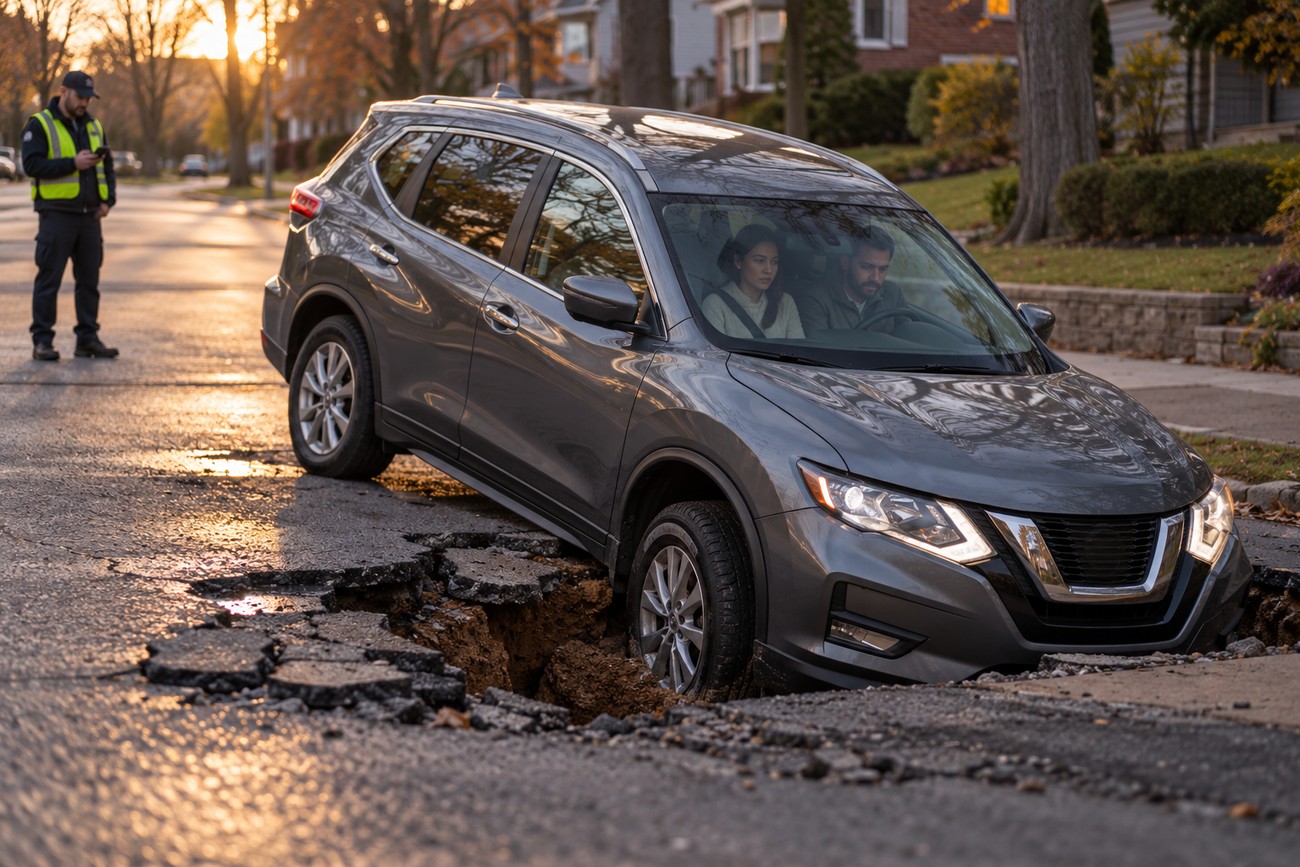
Protect occupants first. Keep everyone inside the vehicle if the cabin remains secure and evacuation would require stepping onto unstable ground, unless smoke, fire, rising water, traffic, or another immediate danger makes leaving necessary. Call emergency services or roadside responders, give the precise location, describe which wheels or parts of the vehicle have lost support, and explain whether the road is still carrying traffic.
Keep people away from the opening and from the vehicle’s unsupported side. The remaining pavement may be undermined even when the Rogue appears relatively level, and the edge can change as weight shifts. Do not send someone ahead to “check” the ground on foot by standing near the break or placing weight on the shoulder.
Do not assume that a partially dropped wheel can be pulled free safely under the Rogue’s own power. Hard acceleration can spin the supported tires and shift the vehicle toward the void. Abrupt steering, rocking back and forth, or repeatedly changing gear can move the load onto a weakened edge and enlarge the collapse.
The recovery plan has to account for the ground as well as the vehicle. A winch line, tow strap, or truck may apply forces that are safe on firm pavement but dangerous when the anchor point or the vehicle is sitting on an undermined edge.
A full stop is not automatically harmless either. If the remaining pavement is unstable, the vehicle’s position and the changing load may continue to worsen the failure. That does not mean occupants should attempt a dramatic escape maneuver; it means movement decisions should be based on an assessment by emergency responders or a qualified recovery operator who can evaluate the ground, the vehicle’s support, and the safest extraction direction.
Do not use a jack, place boards under the tires, or ask bystanders to push the Rogue unless a qualified responder has confirmed that the method and ground are safe. Improvised recovery can cause a sudden slide, damage the vehicle further, or put people in the collapse zone. Wait for controlled equipment and a recovery plan suited to the actual support conditions.
Hidden Damage After Recovery: What a Visual Check Misses
A Rogue that starts, rolls, and appears straight may still be unsafe after a wheel or section of the body has lost support. The impact may have been absorbed by components below the sight line rather than by an obvious body panel. A quick walk around the vehicle cannot confirm that the suspension geometry, steering, subframe, or body mounting points remain correctly positioned.
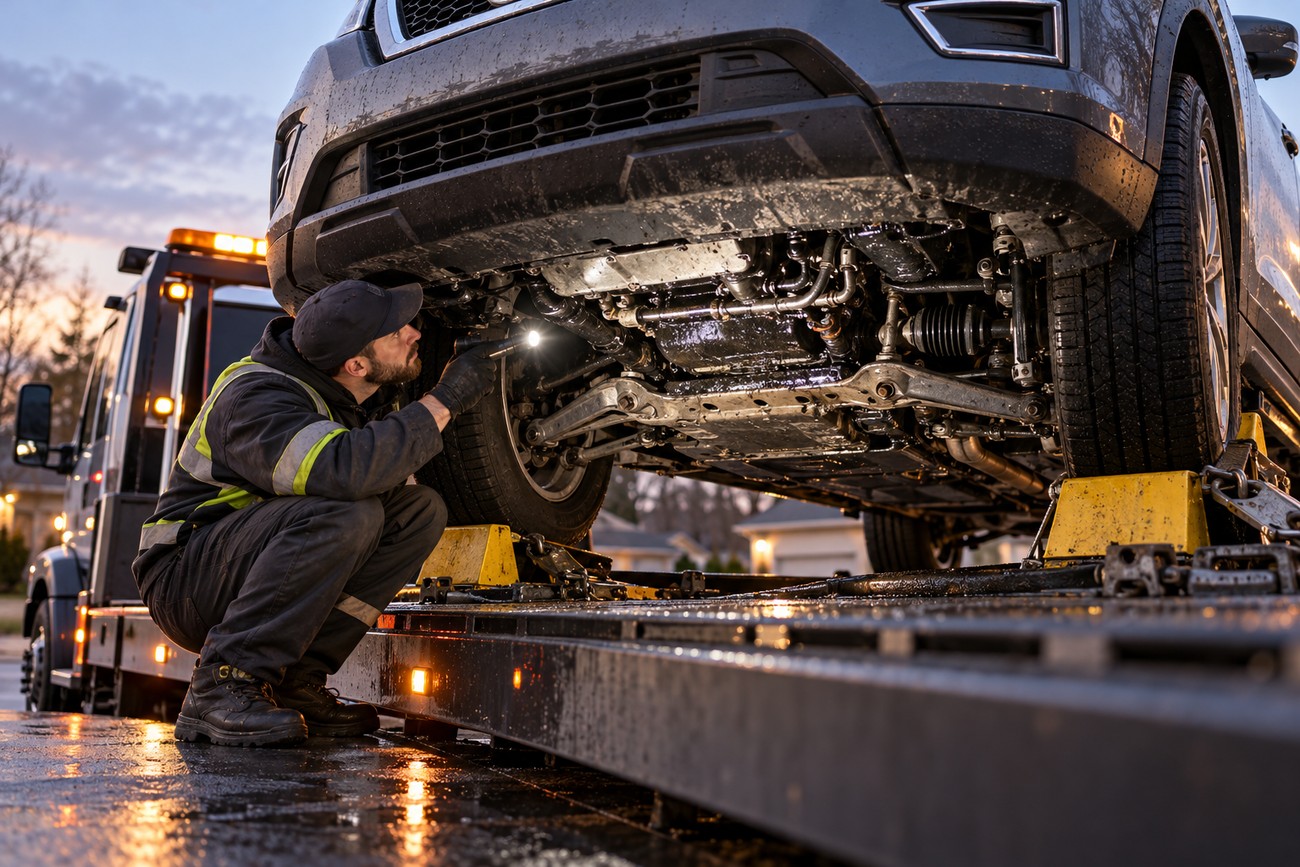
Inspection should include the rocker panels, underbody, subframe, exhaust, suspension arms and attachment points, steering components, wheels, tires, and body mounting points. The technician should also look for crushed shields, displaced brackets, stretched wiring, fluid leaks, and contact marks showing where the vehicle rested on the edge. Damage may be concentrated on one corner or hidden behind a wheel and therefore missed during a casual examination.
Electrical and safety systems can be affected without visible exterior damage. Wiring for wheel-speed or other chassis sensors may be stretched or severed, producing ABS or ESP faults after the vehicle is moved. A tire can have internal damage, and a wheel can be bent enough to create vibration even if it holds air during the first inspection.
Strong crash-test results are valuable evidence about specified collision impacts, restraint performance, and crash structure. They do not certify survival of a ground collapse, where the vehicle may be supported unevenly and subjected to twisting, vertical loading, or concentrated forces at the underbody. Collision protection and resistance to a failing roadbed are different engineering questions.
After recovery, warning signs can appear immediately or later. Steering pull, a changed steering-wheel position, vibration, clunks, fluid leaks, warning lights, and ABS or ESP faults all justify stopping further use and arranging inspection. Delayed noises or an alignment that changes after a short drive can indicate that a component moved under load or that a tire and wheel problem was initially missed.
Should You Drive the Rogue After a Sinkhole Incident?
Do not drive the Rogue merely because the engine runs. A vehicle with a dropped wheel, unknown underbody contact, damaged steering, a leaking fluid, a warning light, tire damage, or unstable support should be recovered and inspected by professionals. The fact that the doors open and the transmission selects a gear does not establish that the steering, suspension, subframe, or brakes are safe.
A short drive may be reasonable only after the vehicle has remained on stable ground and a qualified assessment finds no sign of compromised support or damage. Even then, a post-recovery inspection should include wheel and tire condition, steering, suspension, alignment, the underbody, and relevant sensor wiring. A body-panel check alone is too narrow for a vehicle that has been loaded diagonally or rested on a broken road edge.
Flatbed recovery is often the safer choice when the wheel position is abnormal, the tire is damaged, the vehicle scrapes, the steering feels different, or the source of a leak is unknown. The recovery operator may need to use controlled lifting or winching rather than pulling the Rogue forward. Tell the operator that the incident involved a sinkhole or undermined road so the ground assessment is treated as part of the recovery.
Document the event before the scene changes, if doing so is safe:
- Photograph the road opening, barriers, signs, water, vehicle position, tire marks, and visible contact damage from a safe distance.
- Record the location, direction of travel, weather, road conditions, and approximate sequence of events.
- Notify the insurer and the relevant road authority promptly, following local reporting requirements.
- Keep recovery records, inspection findings, towing details, and repair estimates.
- Authorize repairs only after the inspection identifies the affected structural, mechanical, and electrical components.
Insurance coverage and responsibility vary by policy, exclusions, jurisdiction, ownership of the road, and the documented condition of the site. Photographs and official reports can help establish what happened, but they do not guarantee reimbursement. Avoid making a final liability assumption before the insurer, road authority, or another responsible party has reviewed the evidence.
The Myths That Make a Rogue More Vulnerable
The first myth is that 8.2 inches of clearance is enough to survive a sinkhole. Ground clearance helps the Rogue pass over ordinary uneven surfaces when the road remains supported. It cannot prevent a tire from entering a void or stop the pavement edge from breaking beneath the vehicle.
The second myth is that a crossover is equivalent to an extreme off-road truck. The Rogue’s design supports everyday roads and light off-road conditions. Even trail-oriented Rock Creek equipment and tires do not create the serious underbody protection, recovery geometry, or ground-clearance architecture associated with a purpose-built extreme off-road vehicle.
The third myth is that driving slowly prevents a drop. Low speed reduces kinetic energy and may give the driver more time to react, which is useful on a stable surface. It cannot restore a roadbed that has already collapsed beneath a tire, and a slow entry can still leave the vehicle nose-down or diagonally supported.
The fourth myth is that cameras and safety systems will detect the hazard. These systems assist the driver, but heavy weather, dirt, snow, shadows, standing water, and an abrupt or irregular opening can reduce their usefulness. Direct observation of the road, barriers, changing pavement, and surrounding conditions remains essential.
None of these points makes the Rogue inherently unsafe on normal roads. They define the boundary between ordinary driving assistance and a ground-collapse hazard. Treating a doubtful surface as a road-closure problem, rather than as a challenge for vehicle capability, gives the driver a better chance of avoiding both the opening and a dangerous improvised recovery.
Frequently asked questions
How quickly can a sinkhole collapse under a car?
There is no reliable universal countdown. A visible opening may remain unchanged for some time, or it may enlarge quickly if water is flowing beneath the pavement, the edge is cracking, or traffic and vehicle weight are loading an already weakened section. The size of the opening alone cannot show how much unsupported material lies below it.
Water movement is an especially important warning sign because it can continue removing soil after the first break appears. A changing edge, new cracks, sinking pavement, or a car that shifts without the driver moving it should be treated as an active hazard. Keep people away, avoid testing the edge, and let responders assess whether the vehicle and surrounding road can safely remain in place.
What is the most common problem with a Nissan Rogue after a sinkhole incident?
There is no single sinkhole-specific Nissan Rogue failure mode established by the available information. The damage depends on which wheel or body section lost support, how far the vehicle dropped, whether the underbody contacted the edge, and whether the vehicle was pulled or driven during recovery.
Suspension and alignment changes, underbody or subframe damage, rocker-panel contact, exhaust damage, tire and wheel problems, and ABS or ESP sensor faults are all possible areas for diagnosis. That is different from ordinary model-year reliability discussions. A post-incident inspection should identify the actual load path and symptoms instead of assuming that a known general issue explains the damage.
What should you do if your car falls into a sinkhole?
Protect occupants, call emergency services or roadside responders, and describe the vehicle’s position and the condition of the road. Keep bystanders away from the opening and from the unsupported edge. Evacuate only when remaining in the vehicle presents a greater immediate danger, such as fire, rising water, or traffic exposure.
Do not spin the tires, rock the car, sharply steer, or attach improvised recovery equipment. Tell responders which wheels have lost support and whether the vehicle is leaking or contacting the pavement. Extraction should follow an assessment of the ground and vehicle support, because a method that moves the car can also trigger further collapse.







