
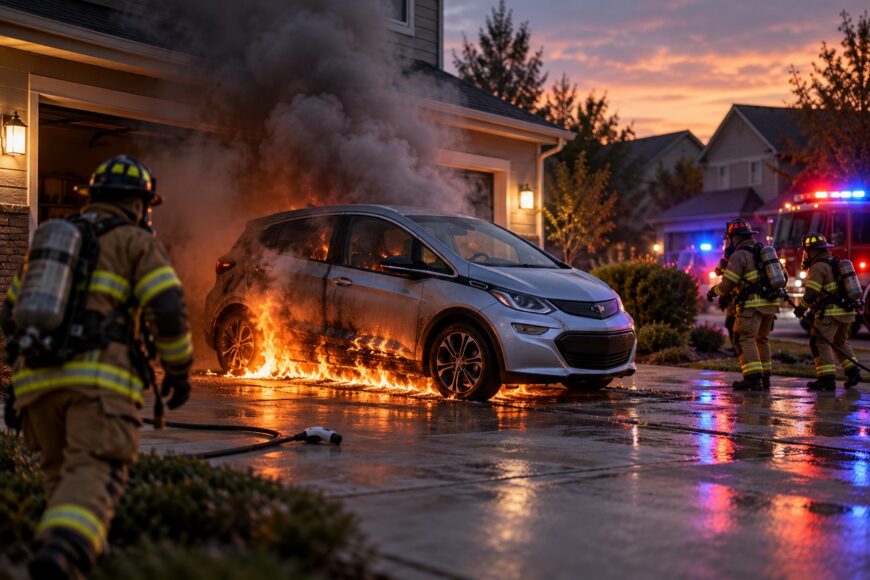
A Chevrolet Bolt battery fire can start while the vehicle is parked or charging, not only while driving. That makes the risk especially serious for owners who charge overnight in a garage or leave the car beside a home.
If a Bolt is burning, move away, keep other people clear, and call emergency services. Tell responders that the vehicle is an electric vehicle with a high-voltage battery. Before the recall remedy is completed, owners also need to follow temporary charging and parking guidance rather than treating the car as fully cleared.
The reported problem involved a specific battery-cell manufacturing defect. It led to temporary operating restrictions and later hardware remedies, so a software notification or recall announcement alone did not always mean that the original risk had been eliminated.
- Why Chevrolet Bolt battery fires became a recall issue
- What to do if a Chevy Bolt battery catches fire
- How to use and store an affected Bolt before the repair
- Why a software update did not always end the problem
- The mistakes and myths that made Bolt owners less safe
- Frequently asked questions
- How likely is it for a lithium-ion battery to catch fire?
- What can cause a car battery to catch fire besides the Chevrolet Bolt defect?
- How can I check whether my specific Chevrolet Bolt is covered by the battery recall?
Why Chevrolet Bolt battery fires became a recall issue
GM linked the risk to a rare combination of two defects in the same battery cell: a damaged anode tab combined with a folded separator. That explanation matters because it points to a targeted manufacturing problem rather than evidence that every electric vehicle, or every Bolt battery, is inherently unsafe.
Public reports cited 5, 8, 10+, and later 14 confirmed fires. These figures reflected different investigation stages and publication dates. A later count therefore did not necessarily contradict an earlier report; it showed that the investigation and confirmation process had continued.
The risk was associated with vehicles that were parked or charging, as well as vehicles in use. Some reports described affected vehicles as fully or almost fully charged, but the available reporting does not support saying that every fire occurred only at 100% charge.
The practical concern was the ordinary ownership routine: charging at home, leaving the vehicle unattended, and storing it near a building. That is why the temporary response focused on charge level and parking location, not only on what drivers should do on the road.
What to do if a Chevy Bolt battery catches fire
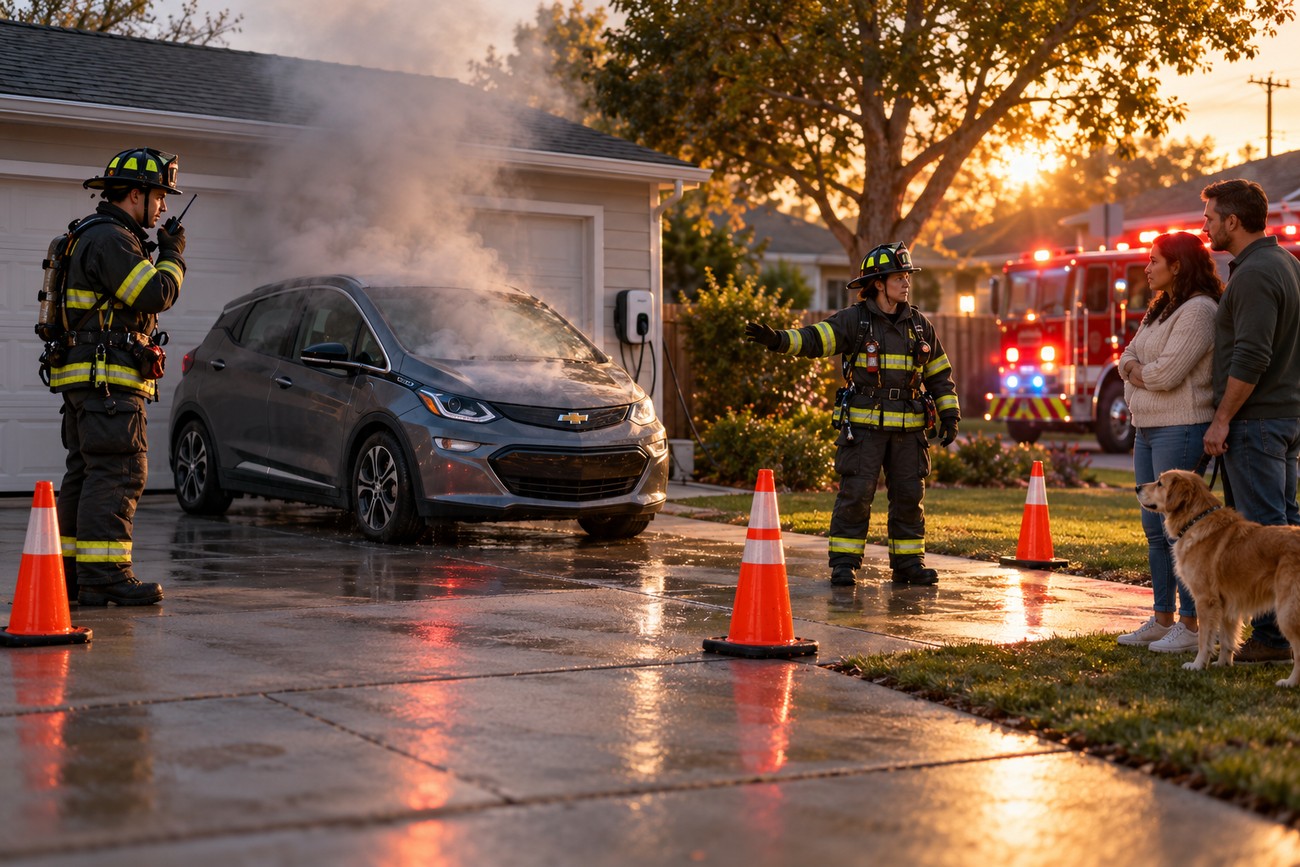
Move away from the vehicle immediately and keep passengers, bystanders, and pets away from it. Call emergency services and identify the vehicle as an electric vehicle with a high-voltage battery. Give responders the vehicle’s location and explain whether it is inside a garage, near a structure, or connected to charging equipment.
Do not re-enter the Bolt to retrieve belongings, disconnect equipment, or move the vehicle yourself. Do not attempt to manage the fire with household tools or by opening the vehicle. A high-voltage battery fire requires trained emergency responders and may present hazards even after visible flames have reduced.
A fire in a garage or beside a home requires immediate evacuation from the building and the surrounding area. Close doors only if you can do so while leaving safely; do not delay evacuation to protect property. Keep clear of smoke and wait for emergency personnel to give further instructions.
One reported case involved fire spreading to a home, and official reports mentioned 2 people injured. Those reports do not establish the outcome of every Bolt fire, but they show why the vehicle’s location can affect people and property beyond the car itself.
Routine charging advice is different from emergency response. The 90% limit, outdoor parking, and other temporary measures applied while the risk remained unresolved; they were never a substitute for leaving a burning vehicle and calling emergency services.
How to use and store an affected Bolt before the repair
Temporary owner guidance called for limiting charging to 90% until the applicable remedy was completed. Owners were also advised to charge after each use, avoid allowing the battery to become deeply discharged, and, in some guidance, retain at least 70 miles/113 km of remaining range.
Affected vehicles were advised to be parked outside, not in a garage or beside a home, while the risk remained unresolved. This changed the practical charging routine: the issue was not simply whether the car could be plugged in, but where it would remain while charging and afterward.
The 90% software limit was a temporary control, not proof that the underlying battery defect had been repaired. Outdoor parking and confirmation of the applicable hardware remedy still mattered.
These steps were intended to reduce risk, not guarantee safety. The 90% limit was a temporary risk-reduction measure, not a universal battery-health recommendation for all Bolt owners or all electric vehicles.
Why a software update did not always end the problem
Software restrictions were an interim response because they could change charging or operating behavior without replacing the affected battery hardware. That distinction was easy to miss when an owner received an update and the vehicle continued to operate normally.
The initial U. S. recall covered 68,667 Chevrolet Bolt vehicles, with an approximate worldwide figure of about 69,000 vehicles. The recall was later expanded to a broader Bolt population, and the applicable remedy depended on the vehicle, battery, and stage of the campaign.
Later remedies included replacement of battery modules or the battery. That progression explains why a software update should not automatically be treated as confirmation that defective hardware has been removed. Owners needed to verify the remedy recorded for their specific vehicle.
Reported expenses associated with the recall were about $1.9 billion. That figure describes reported recall-related costs and does not mean that every owner received the same repair, replacement, or timing of remedy.
The mistakes and myths that made Bolt owners less safe
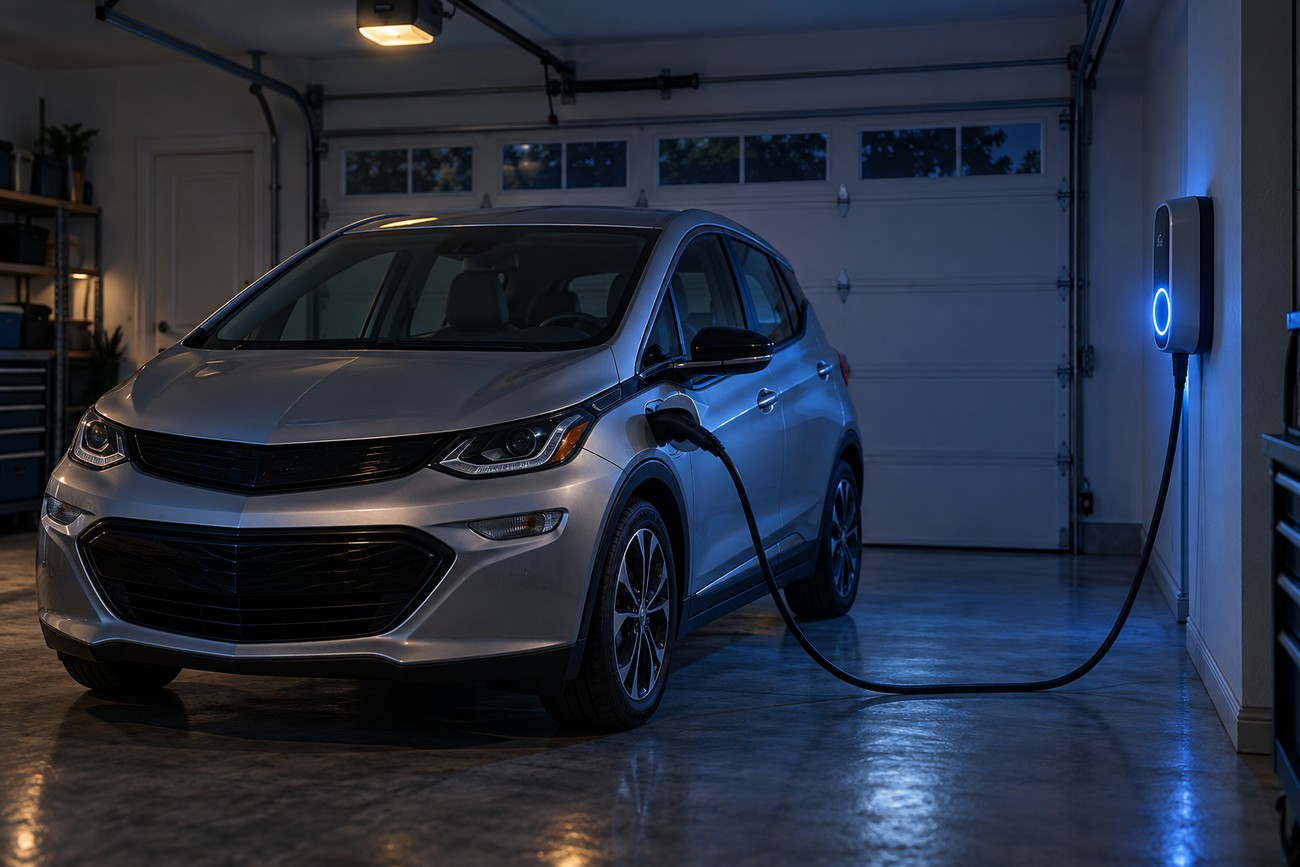
One unsafe pre-remedy scenario was charging an affected Bolt to 100% and leaving it unattended for a long period. Overnight charging in a garage also conflicted with the recommendation to park affected vehicles outside. These routines were understandable for daily use, but they did not match the temporary safety guidance.
Another mistake was ignoring the 90% limit, the instruction to charge after use, or the guidance to avoid deep discharge. Treating those measures as optional “overcaution” removed the risk reduction they were intended to provide while the defect remained unresolved.
A software update was not necessarily a replacement for defective battery modules or the battery. Owners who assumed that one update solved everything could resume normal storage before the applicable hardware remedy had been confirmed.
A recall announcement also did not mean that normal storage was automatically safe immediately. The reported risk was linked to a specific manufacturing-defect combination, rather than an unexplained failure of every Bolt battery, but the public response and available remedies evolved as the investigation progressed.
Frequently asked questions
How likely is it for a lithium-ion battery to catch fire?
A reported Bolt fire count is not a universal fire rate for all lithium-ion batteries or every Chevrolet Bolt. The cited counts of 5, 8, 10+, and later 14 described stages of a specific recall investigation and changed as reports were reviewed and confirmed.
Risk also depends on battery design, manufacturing quality, damage, charging conditions, and the vehicle’s recall status. The Bolt case identified a particular cell-defect combination; it should not be used to calculate the probability of a fire in an unrelated battery system.
What can cause a car battery to catch fire besides the Chevrolet Bolt defect?
Possible causes can include crash damage, electrical faults, internal battery damage, or charging-related failures. Those are general mechanisms and should be investigated separately from the documented Bolt explanation.
GM linked the Bolt recall risk to a damaged anode tab combined with a folded separator in the same battery cell. General causes should not be presented as proof that they caused the reported Bolt incidents.
How can I check whether my specific Chevrolet Bolt is covered by the battery recall?
Use the vehicle identification number, or VIN, to search the manufacturer’s official recall information and the relevant government recall database for the market where the vehicle is registered. Check the vehicle’s model year, open recall status, and the remedy listed for that VIN.
If the record is unclear, contact an authorized Chevrolet dealer and ask whether the applicable battery inspection, software action, module replacement, or battery replacement has been completed. Keep the repair paperwork, because a completed software action and a completed hardware remedy are different records.







