
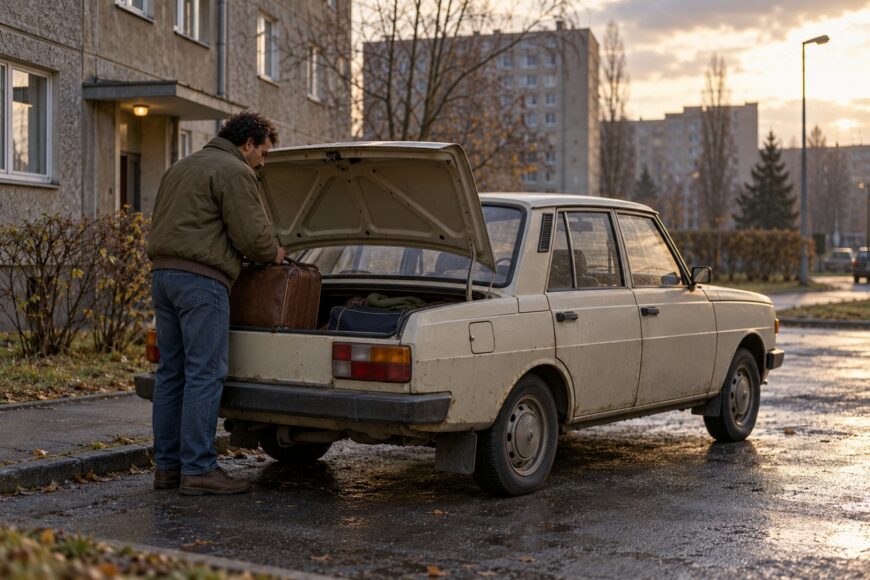
The Wartburg 353 was a mass-market family car with a mechanical habit that feels specialist today: its three-cylinder two-stroke engine needs correctly dosed fuel and oil. For an East German household, it offered useful space and several body styles. For a present-day owner, every trip also involves accepting the sound, exhaust smoke, and maintenance routine that come with the engine.
That distinction matters when choosing between a 353 and the later Wartburg 1.3. The two-stroke car preserves the design that made the model distinctive, along with its mixture discipline and harder-to-find parts. The four-stroke 1.3 removes some of those demands, though it is a different mechanical proposition rather than a simple upgrade.
- Why the Wartburg 353 Mattered in East Germany
- The Three-Cylinder Two-Stroke Formula
- On the Road: Character, Performance, and Compromises
- The Ownership Reality: Fuel, Oil, Rust, and Parts
- Wartburg 1.3: More Than a Stronger 353
- Is a Wartburg 353 Worth Owning Today?
- Frequently asked questions
- How much horsepower does the Wartburg 353 have?
- Was the Wartburg 353 a good car in its time?
- Who made Wartburg cars?
- What happened to Wartburg cars after the 353?
Why the Wartburg 353 Mattered in East Germany
Produced in two-stroke form from approximately 1966 to 1988, the Wartburg 353 served ordinary transport needs across the socialist bloc. Approximately one million cars were built. Its significance lies partly in that scale: this was a working family vehicle, not an exotic design made in small numbers.
The sedan carried passengers and luggage, the estate offered a more adaptable load area, and the pickup extended the basic vehicle into light-duty work. Those choices helped the 353 meet different needs without abandoning a shared mechanical layout. Modern catalogs sometimes place it approximately in the C-class, but that label does little to describe what buyers could choose at the time.
Front-wheel drive was paired with frame-based chassis construction, an unusual combination to anyone expecting a modern unibody family car. The layout gave Wartburg a platform for those varied bodies, while the frame introduced structural areas that still matter when assessing a surviving example. Exterior shape alone tells only part of the car’s story.
The Three-Cylinder Two-Stroke Formula
The 353’s main engine was a water-cooled three-cylinder two-stroke of about 993 cc. Output ranged from about 45–57 hp, varying by year and version, and drive reached the front wheels through a four-speed manual transmission. Its operating principle is central to the ownership experience: the engine completes a power cycle with each crankshaft revolution and has no conventional four-stroke valve train.
That relative simplicity leaves fewer valve-gear components to maintain and can make a rebuild straightforward for someone familiar with the design. It does not make the engine indifferent to setup. Fuel-and-oil dosing must be accurate because the oil in the fuel supplies essential lubrication; too little oil, or unsuitable oil, can accelerate cylinder and piston wear.
A sound three-cylinder installation can feel smoother and more even than the two-cylinder, air-cooled engine in a Trabant. It still has a recognizable two-stroke note and a response unlike a contemporary four-stroke family car. Carburetion, ignition, and exhaust condition affect how cleanly it runs, so a rough-running example should not be dismissed as merely showing “two-stroke character.”
Specifications for fuel and lubrication also deserve more attention than broad advice found online. AI-80 and AI-92 petrol are listed as acceptable grades, but the correct mixture and service settings should be checked against documentation relevant to the installed engine. Changes made over decades can matter more than a generic specification quoted for the model name.
On the Road: Character, Performance, and Compromises
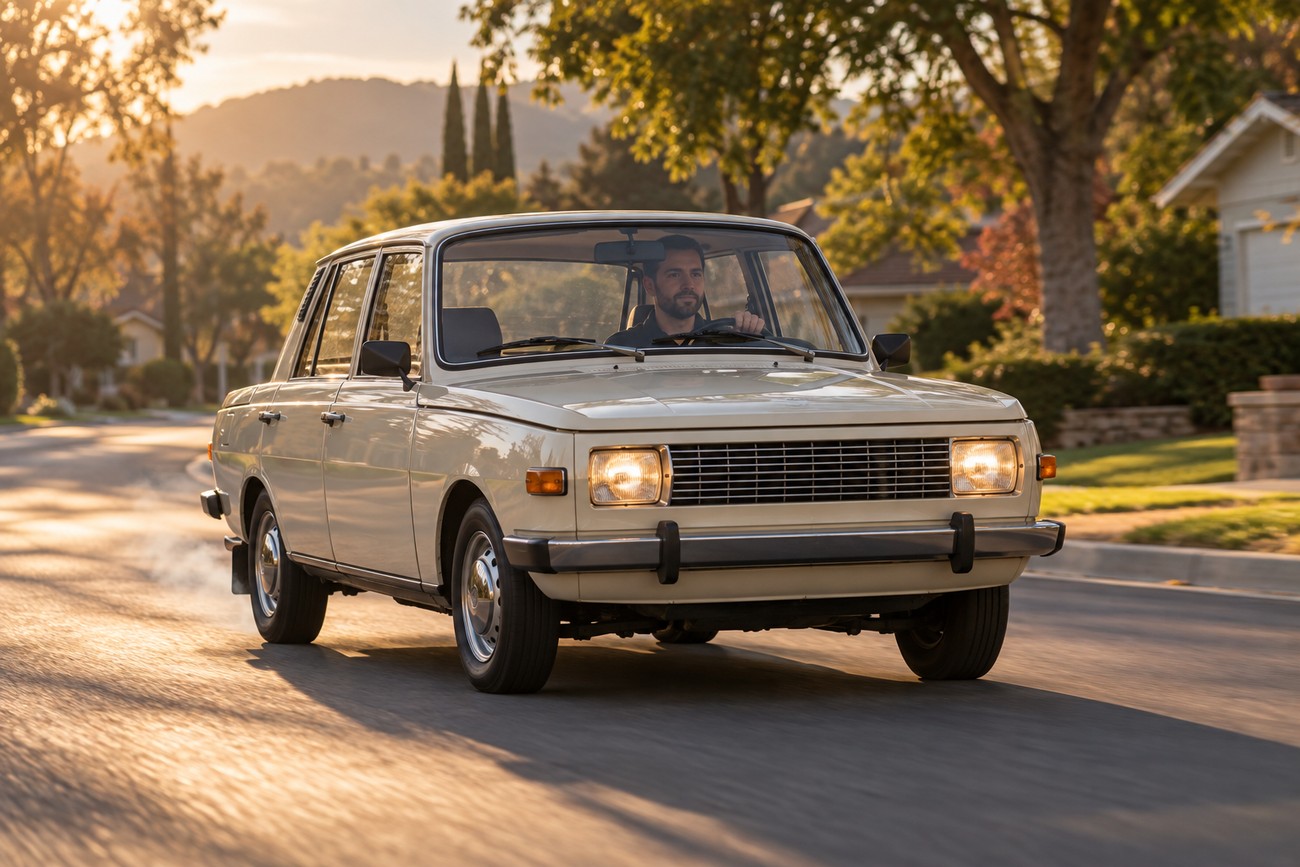
The 353’s engine makes its presence known from the first acceleration. Its sound and delivery can recall a motorcycle or moped more readily than a modern family sedan, although the water-cooled three-cylinder is more refined than that comparison might suggest. It rewards measured driving rather than hurried progress.
Catalog figures put acceleration from 0 to 100 km/h at approximately 20–26 seconds for different 1.0-liter versions. That range is useful for setting expectations, but it says little about the condition of an individual car. An engine that pulls unevenly, overheats, or needs constant adjustment merits investigation rather than an allowance for age.
Front-wheel drive and the frame-based chassis give the Wartburg road manners unlike those of a current C-class car. Period braking and stability require more anticipation, even where a car has front disc brakes. Leave space, approach bends at a sensible speed, and judge the car on the roads and traffic in which it will actually be used.
Inside, simple trim, limited sound insulation, and noticeable noise and vibration make longer journeys more tiring than the cabin’s size suggests. These were acceptable compromises for many period buyers seeking practical transport. A current owner should experience them before assuming that family-car proportions translate into modern family-car comfort.
The Ownership Reality: Fuel, Oil, Rust, and Parts
Typical stated mixed-cycle consumption for the 1.0-liter two-stroke is about 9.9–10 l/100 km; urban use may be higher. Claims that the model routinely uses around 7 l/100 km give a misleading basis for a purchase decision. Oil is an additional running cost, and its handling remains part of refueling rather than an occasional service item.
Exhaust smoke and emissions are practical considerations, especially for regular urban use. A properly maintained engine is preferable to a poorly tuned one, but maintenance cannot turn a two-stroke into a modern emissions-controlled car. Local rules and the expectations of people sharing a garage or parking area may affect how comfortably the 353 fits into daily life.
Two-stroke engine and transmission parts can take more effort to source than their apparent mechanical simplicity suggests. Owner clubs, specialist suppliers, and donor vehicles may help, but availability varies by component and location. A car that runs today can still be a poor choice if a needed repair depends on a part the buyer has no realistic route to obtain.
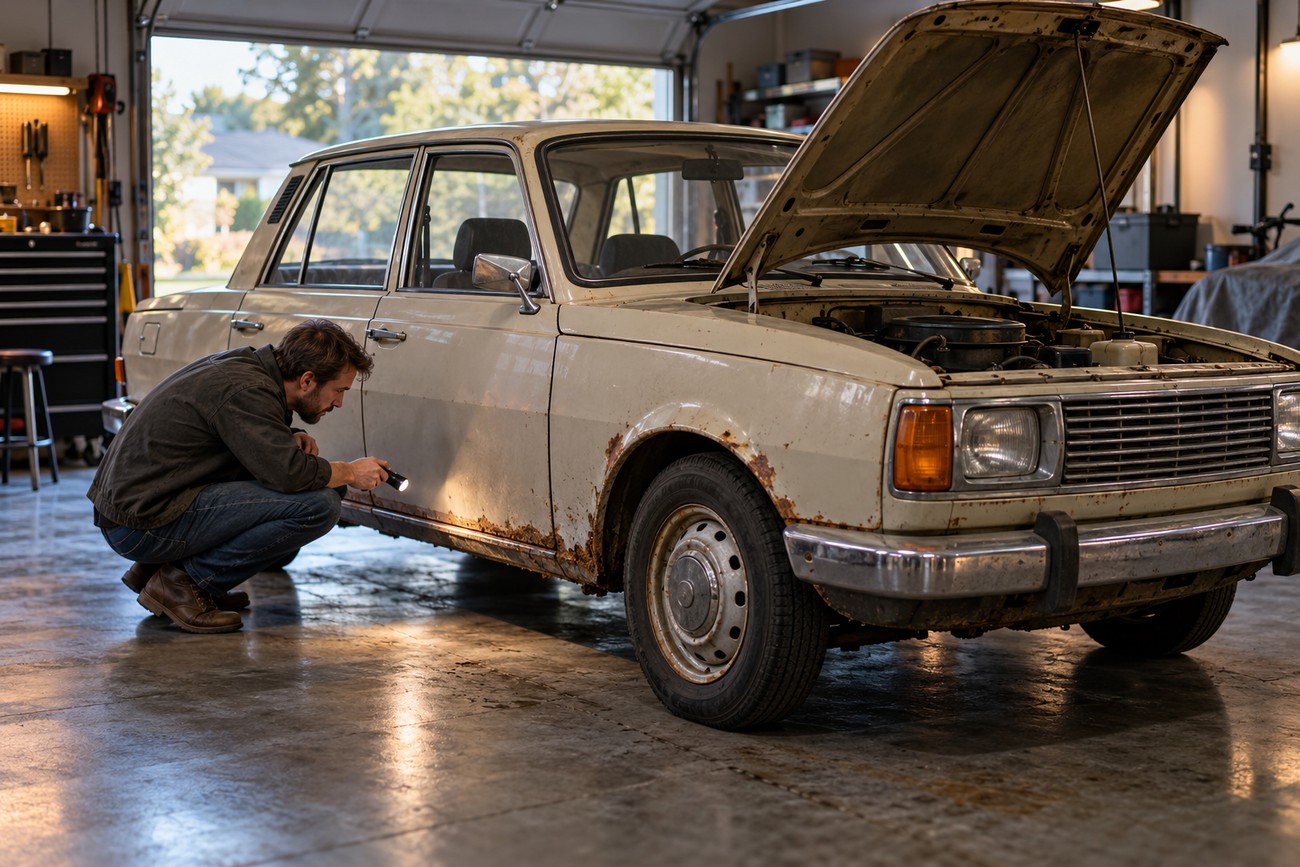
Corrosion deserves a separate inspection of the frame and hidden structural areas, not a glance at paint and exterior panels. Repairs there can be more consequential than cosmetic rust. The sensible buying order is to establish structural condition and mechanical completeness first, then decide how much work the visible body deserves.
Wartburg 1.3: More Than a Stronger 353
The late-1980s Wartburg 1.3 adopted a licensed Volkswagen four-stroke engine of about 1.3 liters and about 58 hp. Its power figure is close to that of the strongest two-stroke versions, so horsepower alone understates the change. The different engine removes the fuel-and-oil mixing routine and changes the car’s sound and response.
Fitting the four-stroke required modifications to the frame and transmission. That makes the 1.3 more than a 353 fitted with a stronger engine; the change had consequences for the vehicle around the power unit. Buyers should identify which version they are viewing before assuming mechanical parts or maintenance advice transfer between them.
Historically, the 1.3 marks Wartburg’s move away from the two-stroke design before production ended. It may suit someone who wants a later four-stroke car, while an original 353 better represents the engineering formula associated with the name. Neither choice is settled by the small difference in quoted peak power.
Is a Wartburg 353 Worth Owning Today?
A good two-stroke 353 can be a rewarding classic for an owner prepared to learn its specific requirements. The engine is mechanically simple, and an experienced specialist can rebuild it without the valve-gear work a four-stroke demands. That advantage is most useful when the owner also has access to correct parts, documentation, and someone who understands the setup.
Its costs and risks should be weighed together. Fuel and oil consumption, structural corrosion, and a possible parts search can outweigh the appeal of straightforward engine construction. A prospective daily driver faces a different calculation from an enthusiast using a sound car occasionally and keeping time available for maintenance.
Modifications deserve restraint. Carburetor or exhaust changes intended to improve performance can upset a two-stroke engine’s thermal conditions and shorten its life if the whole system is not properly understood. An original, well-tuned car offers a clearer starting point for diagnosis and for judging its historical character.
Owner clubs can provide leads on parts, technical documents, and model-specific setup knowledge. Collector interest also differs between original two-stroke cars and the later 1.3, so condition and intended use matter more than a blanket claim that either is the “best” Wartburg. The right example is the one whose structure, mechanical state, and support network match the buyer’s tolerance for specialist ownership.
Frequently asked questions
The figures and names below refer to two related but mechanically distinct Wartburgs. Identifying the engine first helps make sense of power claims, historical assessments, and what happened after the original 353.
How much horsepower does the Wartburg 353 have?
The Wartburg 353’s approximately 993 cc two-stroke engine produced about 45–57 hp, depending on year and version. The later Wartburg 1.3 had a different, four-stroke engine producing about 58 hp, so its figure should not be treated as a specification for every 353.
Was the Wartburg 353 a good car in its time?
It was a practical mass-market car by the standards of its setting, with sedan, estate, and pickup bodies serving different transport needs. That period judgment does not erase its present-day drawbacks: fuel and oil use, exhaust emissions, cabin noise, and parts sourcing make it a more demanding choice now.
Who made Wartburg cars?
Wartburg cars were made by Automobilwerk Eisenach in East Germany. Wartburg was the marque, while 353 identified this particular model; “Wartburg” therefore covers more than the two-stroke 353 alone.
What happened to Wartburg cars after the 353?
The two-stroke 353 gave way to the Volkswagen-engined Wartburg 1.3. Production subsequently ended as the East German automotive system changed and the market for its cars shifted. The 1.3 was Wartburg’s final transition away from two-stroke power, rather than the start of a lasting new model range.







