
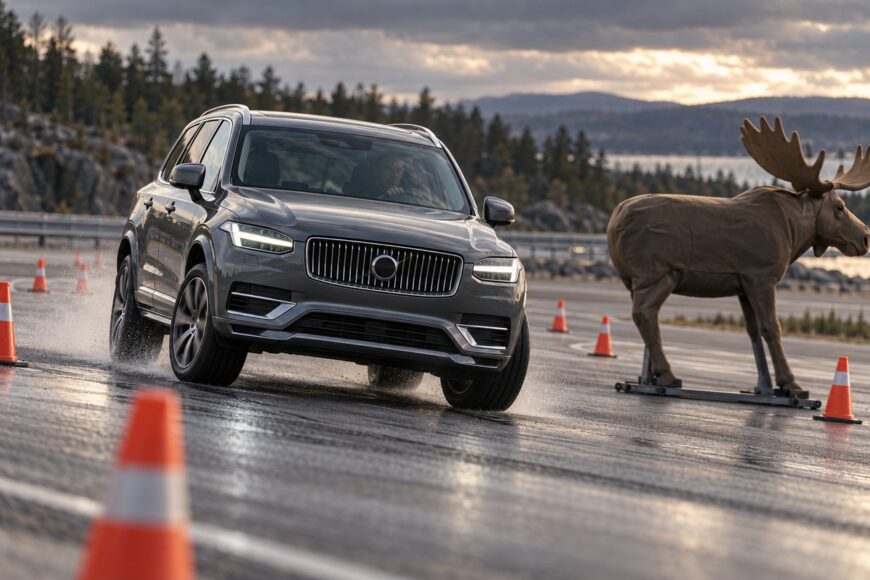
A large animal appears ahead, and the driver has only a moment to choose between braking and steering around it. The Volvo XC90’s safety reputation may offer reassurance, but its size, speed, available road space, and the animal’s movement all affect what happens next.
A controlled “moose test” can show how a vehicle handles a sudden evasive maneuver. It cannot recreate every encounter with a moving animal, and the evidence available here does not establish a specific XC90 moose-test speed or result. A separate reported obstacle-avoidance result is useful context, provided it is kept separate from a moose test and a real animal strike.
- What an XC90 moose-test result would—and would not—prove
- What the available XC90 avoidance evidence actually shows
- Moose test, obstacle avoidance, and animal strike: what each tells you
- Can XC90 safety technology spot a real moose?
- Where the XC90’s size and weight work against it
- How to assess a 2022 XC90 without borrowing another version’s results
- Frequently asked questions
- How much weight can a Volvo XC90 carry?
- How can I check whether my XC90 has large-animal detection?
- What should I check after an XC90 hits a large animal?
What an XC90 moose-test result would—and would not—prove
A moose test is a controlled evasive maneuver around an obstacle. It primarily probes how the vehicle changes direction, maintains stability, and responds through its electronic stability control system. For an XC90 driver, that makes it relevant to a sudden swerve, though the test remains a repeatable exercise under defined conditions.
A real animal can move into the vehicle’s path or change direction while the driver reacts. Road surface, visibility, other traffic, and available space can also differ sharply from test conditions. A clean run through a controlled maneuver would therefore say something about handling, rather than promise that a driver can avoid a moose.
The test also does not measure what happens if the XC90 strikes the animal. Occupant protection depends on the nature of the impact and on safety systems working together. Evasive handling, crash protection, and collision-warning technology answer related but separate questions.
No specific XC90 moose-test speed, ranking, or pass/fail outcome is established by the supplied evidence, including for a 2022 model. A claimed figure needs an identifiable test, vehicle, and procedure before it can support a comparison.
What the available XC90 avoidance evidence actually shows
A newer-generation XC90 reportedly avoided a collision with an obstacle at 20 and 40 km/h. That is evidence of avoidance in the reported test conditions. The available account does not identify the exercise as a moose test or establish the tested vehicle as a 2022 XC90.
For a driver, the result supports a narrow point: the vehicle avoided the obstacle in those runs. It does not, on its own, show how much of that outcome came from braking, steering, driver input, or assistance systems. Those distinctions matter before using the result to judge how the XC90 behaves in an emergency swerve.
An animal presents another uncertainty because its position can change during the approach. The obstacle result cannot establish reliable avoidance of a moving moose, especially where sight distance or room to maneuver differs from the test. Nor does it describe the consequences of an impact.
Keep the reported 20 and 40 km/h result attached to the obstacle-avoidance test. Treating those speeds as a documented XC90 moose-test performance would turn one finding into a different claim.
Moose test, obstacle avoidance, and animal strike: what each tells you
These scenarios answer different safety questions, so their results should be read separately.
| Scenario | What it measures or shows | XC90 evidence available | What it cannot establish |
|---|---|---|---|
| Controlled moose test | Handling, stability, and electronic stability control during a defined evasive maneuver. | No specific XC90 speed, ranking, or pass/fail outcome is established by the supplied evidence. | Reliable avoidance of a moving animal or protection in an impact. |
| Reported obstacle-avoidance test | Whether the vehicle avoided an obstacle in the reported conditions. | A newer-generation XC90 reportedly avoided a collision at 20 and 40 km/h; its model year and configuration are unspecified. | A moose-test result, a result for a particular 2022 XC90, or a guarantee of animal avoidance. |
| Real large-animal strike | The consequences of an actual collision for occupants and the vehicle. | No specific animal-strike outcome is established by the supplied evidence. | A general result for every impact speed, angle, animal, or XC90 configuration. |
Can XC90 safety technology spot a real moose?
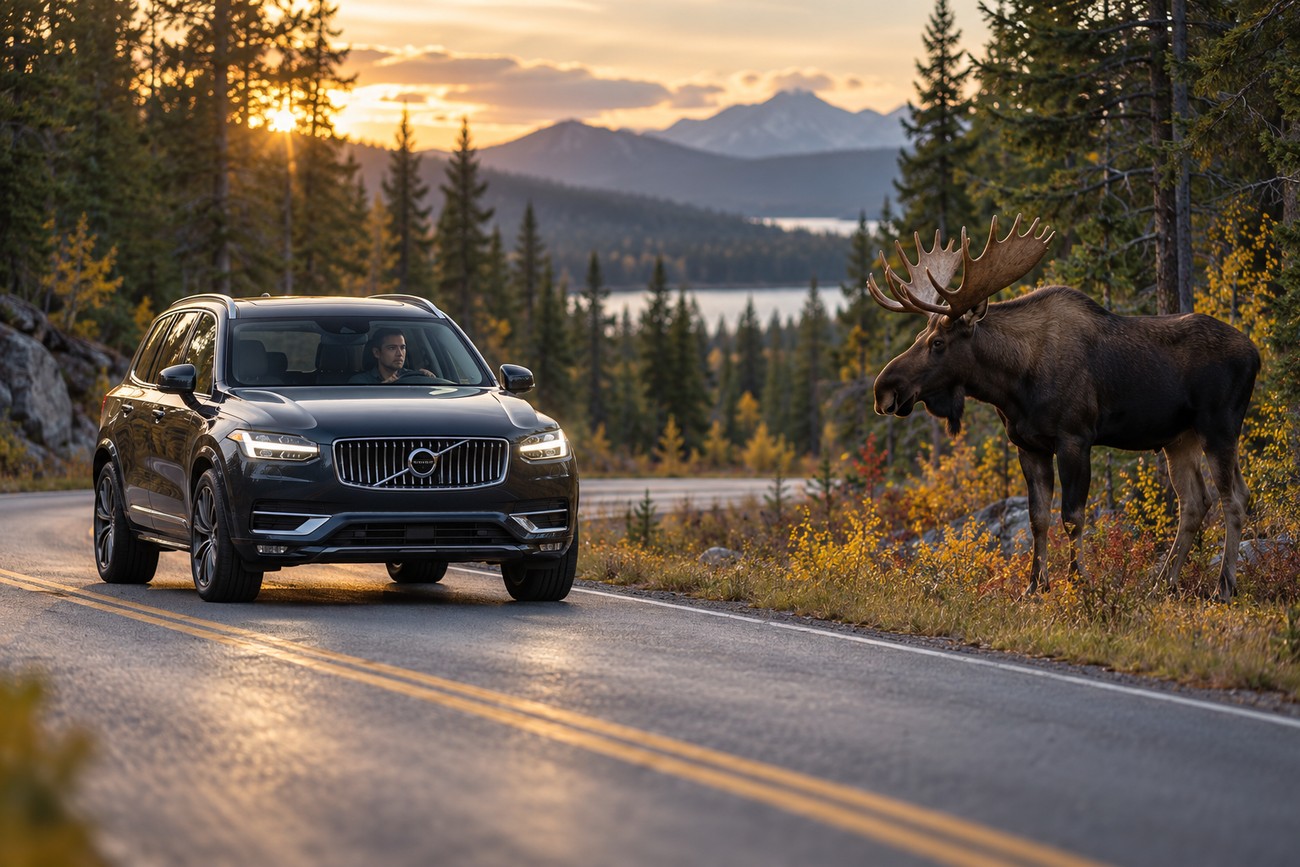
Volvo and dealer materials describe systems that can detect large animals. Detection is the first part of a possible response: the system must identify a hazard under the prevailing conditions, then any warning or mitigation feature must operate within its design limits. A driver should not treat the description as a promise that every animal will be recognized in time.
Equipment can vary by vehicle and market. For a particular XC90, check its owner’s manual and equipment details to confirm which features are fitted and what limitations the documentation gives. A feature mentioned in material for another model year or market is not proof that it is present on your car.
Warning the driver and mitigating a collision are also different from preventing one. Volvo says its collision-warning and mitigation systems reduce collision risk; they do not guarantee prevention of every crash. You still need to watch the road and leave room to respond to a hazard.
That distinction matters most when an animal appears suddenly. A warning may give a driver useful time, while mitigation may lessen the consequences if a collision cannot be avoided. Neither outcome can be inferred from a controlled maneuver result alone.
Where the XC90’s size and weight work against it
The XC90 is a large SUV, and a sudden swerve asks it to change direction quickly while staying within the available road space. Its mass brings inertia to both steering and braking. Electronic stability control can help manage the vehicle’s response, but it cannot create more road or remove the need for grip.
Certain current XC90 specifications list an operating weight of 2,080 kg. That figure is an example for those specifications, not a universal XC90 weight and not a payload rating. Passengers, luggage, tires, road conditions, and the exact version all matter when assessing an individual vehicle.
Weight has everyday consequences beyond an emergency maneuver. Moving and stopping a heavy SUV place demands on fuel or energy use, tires, and brakes. Official consumption figures are useful for comparing specified versions under test conditions, while city driving and individual use may produce different results.
Occupant protection deserves the same measured reading. Volvo safety materials describe the body structure and interior systems working together; no individual system is intended to withstand collision forces on its own. A strong body and advanced electronics can reduce risk or harm without making a large-animal collision harmless.
How to assess a 2022 XC90 without borrowing another version’s results
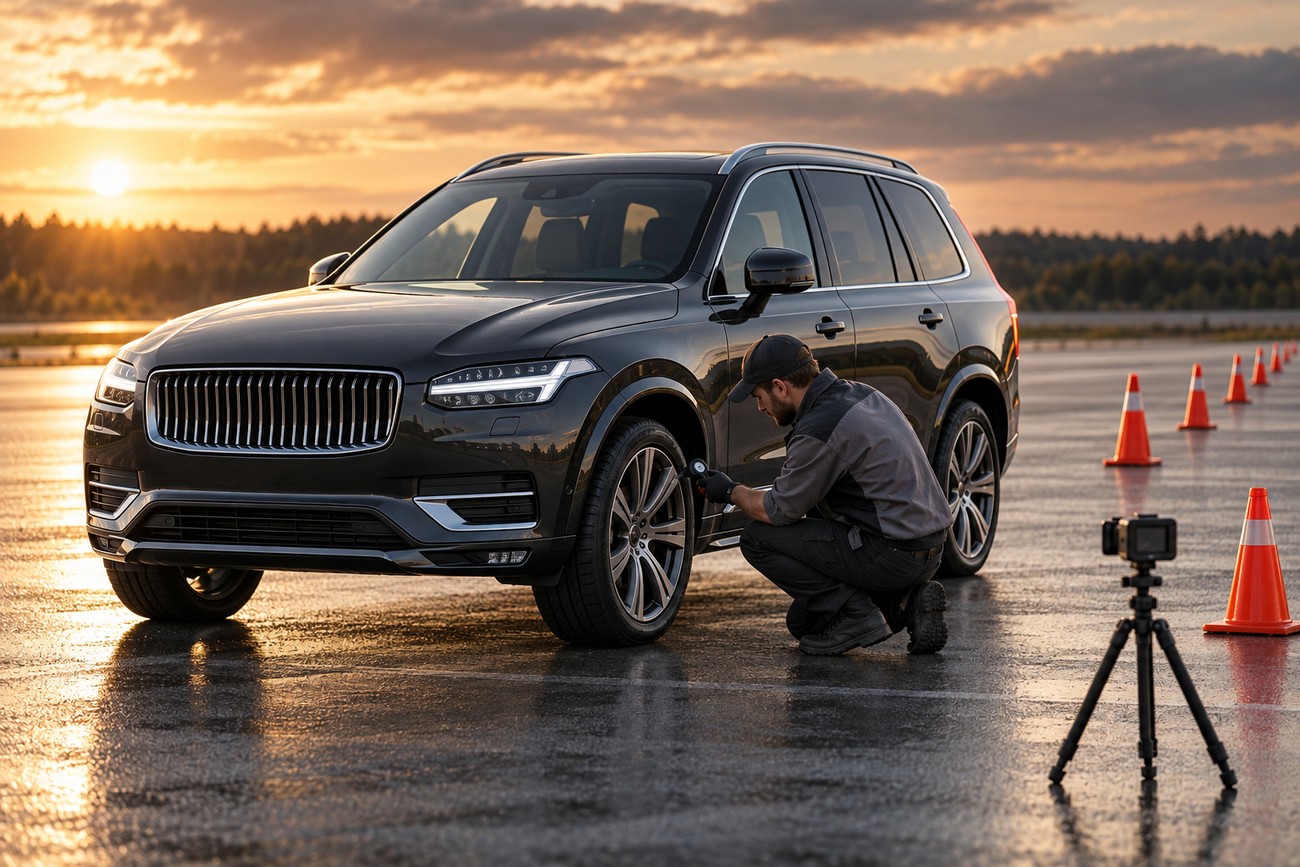
Start with the original footage or report behind any claimed 2022 XC90 moose-test result. Confirm the model year and variant, then check the tires, test procedure, and recorded speed. A short clip or headline may leave out conditions needed to understand what was measured.
Configuration matters because a result belongs to the vehicle and procedure tested. The reported avoidance of an obstacle at 20 and 40 km/h concerns an unspecified newer-generation XC90. It cannot be assigned to a particular 2022 car or presented as that car’s measured moose-test result.
A change in tires or test procedure can make two reported evasive-maneuver speeds misleading to compare, even when the vehicles share a model name. Check those details before treating a higher speed as evidence of better handling.
The supplied evidence establishes no specific 2022 XC90 moose-test speed, ranking, or pass/fail outcome. If a claim lacks enough detail to identify the test and vehicle, leave it unverified rather than filling the gap with an obstacle-avoidance result.
For a fuller assessment, consider evasive handling alongside crash protection and the equipment fitted to the individual XC90. Verify large-animal detection and other assistance features against that vehicle’s documentation and market specification. No single controlled result settles how it will respond in every road encounter.
Frequently asked questions
How much weight can a Volvo XC90 carry?
Find the payload or maximum permitted loaded-weight information on the individual vehicle’s labels and in its documentation, then account for the people and cargo you plan to carry. Specifications differ, so use the figures that apply to your XC90 rather than a number taken from another version.
The 2,080 kg operating weight listed for certain current XC90 specifications is not a carrying-capacity figure and does not apply to every XC90. Do not use it to infer your vehicle’s payload.
How can I check whether my XC90 has large-animal detection?
Check the owner’s manual for your vehicle and market, then compare its equipment details and relevant in-car settings. The manual should also explain the conditions and limitations that apply to any fitted feature.
If the equipment listing or settings are unclear, ask a Volvo service or sales representative to verify the vehicle’s specification. Descriptions of large-animal detection in general Volvo or dealer material do not establish that every XC90 has the same system.
What should I check after an XC90 hits a large animal?
First check occupants for injuries, move to a safe location if possible, and contact emergency services or the appropriate local authorities as the situation requires. Avoid approaching an injured animal. Document the scene and visible vehicle damage when it is safe to do so.
Arrange a professional inspection before relying on the vehicle again, particularly if there may be damage to the steering, brakes, tires, lights, sensors, or occupant-protection systems. Even when the XC90 can still move, hidden damage may affect how it responds to the next hazard.







