
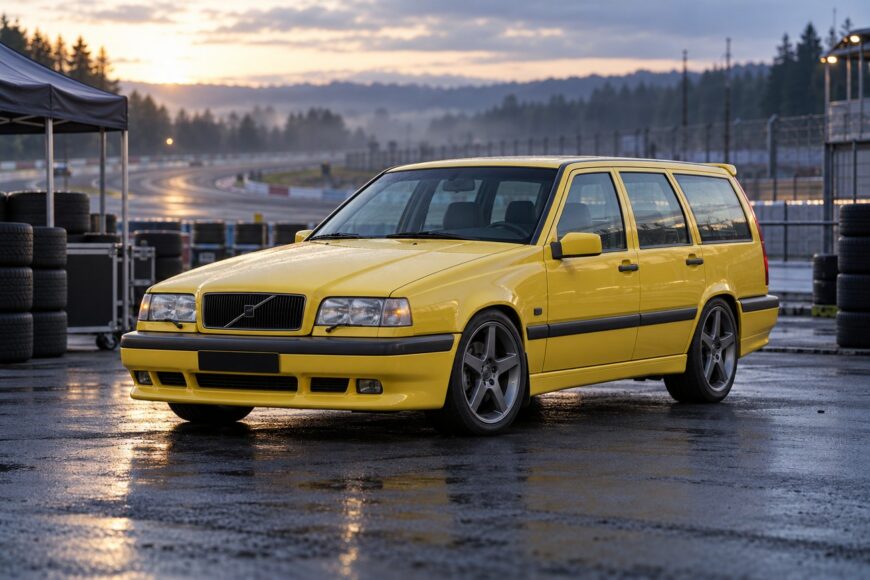
The Volvo 850 T-5R looked like a practical family wagon that had wandered out of a paint shop wearing highlighter yellow. Underneath was a turbocharged five-cylinder, front-wheel-drive chassis with enough performance to make the estate body part of the joke and part of the appeal. Its image was reinforced by Volvo’s touring-car racing successes in the mid-1990s, giving the car a cultural reach far beyond its production numbers.
That legend needs careful handling. The T-5R is an important performance Volvo, yet it remains a heavy 1990s front-wheel-drive car, with age-related faults, torque steer, and increasingly scarce special parts. Some cars advertised as T-5Rs are ordinary 850 Turbos with cosmetic conversions, while genuine examples can be expensive to preserve. The badge, color, and racing association are useful clues; they are not a substitute for inspection.
- Why the Yellow Wagon Became a Performance Icon
- What the 2.3-Liter Turbo Five-Cylinder Actually Delivers
- More Than a Yellow 850: Chassis, Wheels, and Specification Myths
- Wagon or Sedan, Manual or Automatic: Choosing the Character
- How to Avoid Buying a T-5R That Only Looks Like One
- Living With the Legend: Speed, Costs, and the Reality of Age
- Frequently asked questions
- How many Volvo 850 T-5Rs are left?
- How much is a Volvo 850 T-5R worth today?
- What is the top speed of a Volvo 850 R?
- Was the Volvo 850 T-5R the best Volvo wagon ever made?
Why the Yellow Wagon Became a Performance Icon
The 850 T-5R was a limited version of the 850 produced from 1994 to 1996. It was offered as both a sedan and an estate/wagon, with front-wheel drive and a 2.3-liter turbocharged inline-five-cylinder engine. That combination gave Volvo a performance flagship with a distinctly practical shape, rather than a low-slung sports car designed around image alone.
The wagon created the strongest visual contradiction. Its upright tail, broad cargo area, and family-car proportions suggested school runs and hardware-store errands, while the bright yellow paint, large wheels, and turbocharged performance announced something more mischievous. The sedan was arguably the cleaner performance shape, but the estate made the concept memorable: it turned usable space into part of the car’s identity.
Volvo’s touring-car racing program added another layer to the story. The road car was connected in spirit and timing to Volvo’s mid-1990s touring-car successes, and that association helped establish the T-5R as a performance landmark. It should not be treated as a pure homologation special, however. Racing success helped build the legend, while the road car remained a highly equipped, road-oriented version of the 850.
Popular sources often cite 2,500 cars, but published totals and body-style distributions vary by market. That uncertainty matters to buyers because production rarity is frequently used to justify a premium. A careful seller should distinguish between a commonly repeated estimate, a documented individual car, and a reliable factory breakdown.
What the 2.3-Liter Turbo Five-Cylinder Actually Delivers
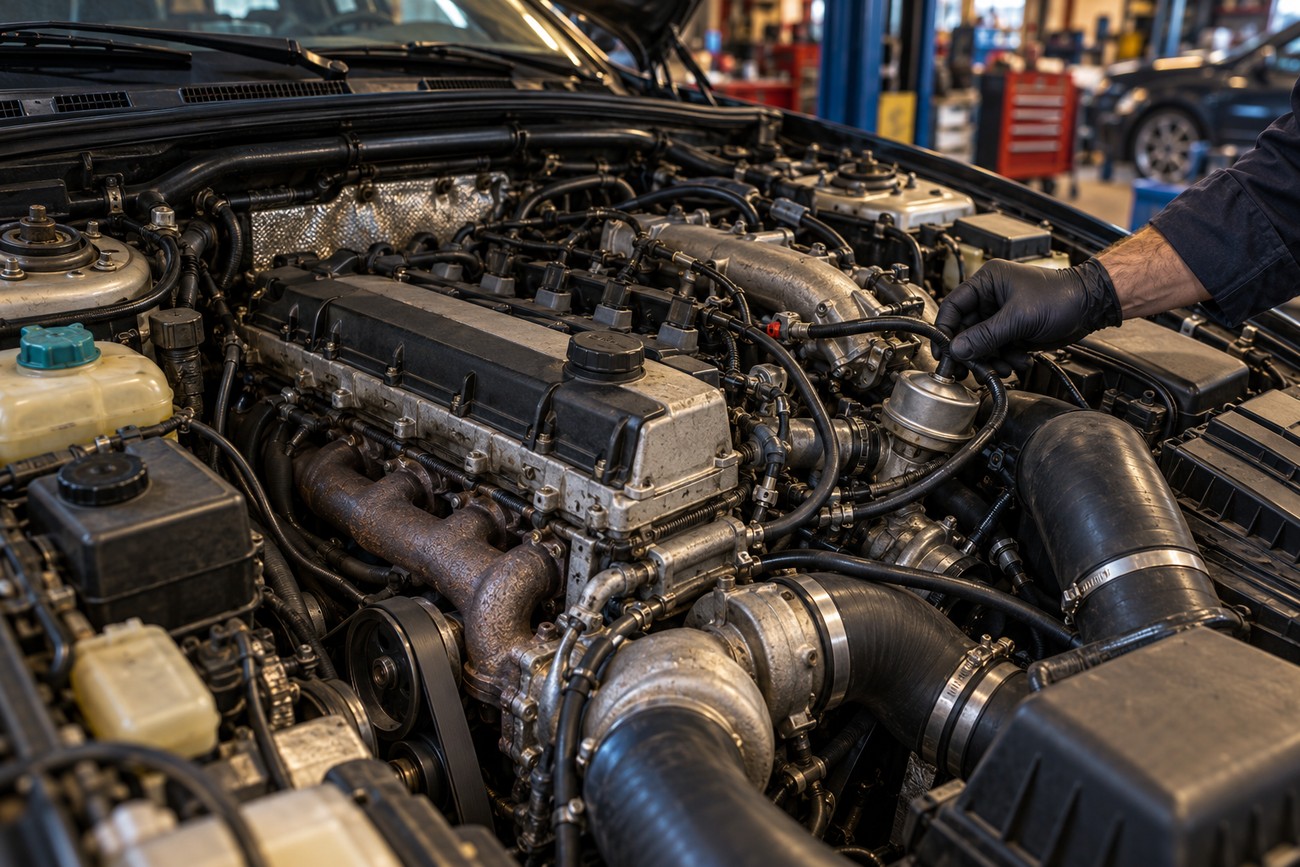
The engine is a 2.3-liter turbocharged inline-five-cylinder, and its character is central to the T-5R experience. U. S. specifications are commonly stated as 240 hp and 221 lb-ft. Some European manual specifications are reported at approximately 225–243 hp, reflecting market differences and temporary overboost rather than one universal output figure.
Car and Driver reported 10.9 psi of boost for the T-5R versus 9.6 psi for the standard Turbo. The extra pressure helped the car deliver its famous punch, although the full-power overboost window was limited to approximately seven seconds in that account. This is an important detail for anyone expecting uninterrupted modern turbo performance: the strongest surge is a short event, followed by a more ordinary continuation of the engine’s power delivery.
The wagon is commonly quoted at approximately 6.9–7.0 seconds from 0–100 km/h, with a top speed generally reported at approximately 240–245 km/h. Those figures were serious in the mid-1990s, especially for a family estate. They still need context. Wagon weight figures commonly fall around 1,451–1,579 kg, depending on specification and source, so the T-5R achieves its pace through turbocharged torque rather than lightness.
That mass is felt over the front axle. Apply the throttle aggressively and the front tires have to steer the car while transmitting substantial engine torque, producing noticeable torque steer. The sensation can be entertaining on a straight road and tiring on a rough urban street. The car gathers speed quickly, but its steering response and low-speed balance do not resemble those of a lightweight rear-wheel-drive sports car.
The result is a fast, distinctive grand tourer with a useful cargo area, rather than a precision instrument. A good driver learns to manage the throttle, especially on imperfect surfaces, and leaves room for the chassis to settle. The T-5R rewards commitment in a straight line more readily than frantic inputs in a tight corner.
More Than a Yellow 850: Chassis, Wheels, and Specification Myths
The T-5R package involved more than paint and a badge. Specifications refer to revised suspension settings and 17-inch Pirelli P Zero Asimmetrico tires, along with the turbocharged engine and distinctive interior and exterior equipment. These details matter because a genuine car should make sense as a complete package rather than as a collection of separately sourced visual parts.
Regional variation complicates research. Equipment, gearbox, and performance details can differ between markets and between sedan and wagon versions. The often-repeated 250-hp claim is therefore not a universal specification. Market-specific figures in the available material range from approximately 225–243 hp in some European specifications, while 240 hp is commonly stated for U. S. cars.
The later 850 R is related to the T-5R, yet it should not be treated as the same model with a different letter. Volvo changed the range and specification over time, and buyers who group every high-performance 850 together can misread equipment, engine details, and market value. The correct comparison starts with the car’s model year, market, transmission, body style, and documentation.
Color alone also proves little. Yellow is the defining visual cue, but paint can be changed, panels can be replaced, and replica trim can make a standard Turbo look convincing. Original wheels, interior trim, suspension equipment, and matching records provide a much stronger basis for judging authenticity than a single dramatic feature.
Wagon or Sedan, Manual or Automatic: Choosing the Character
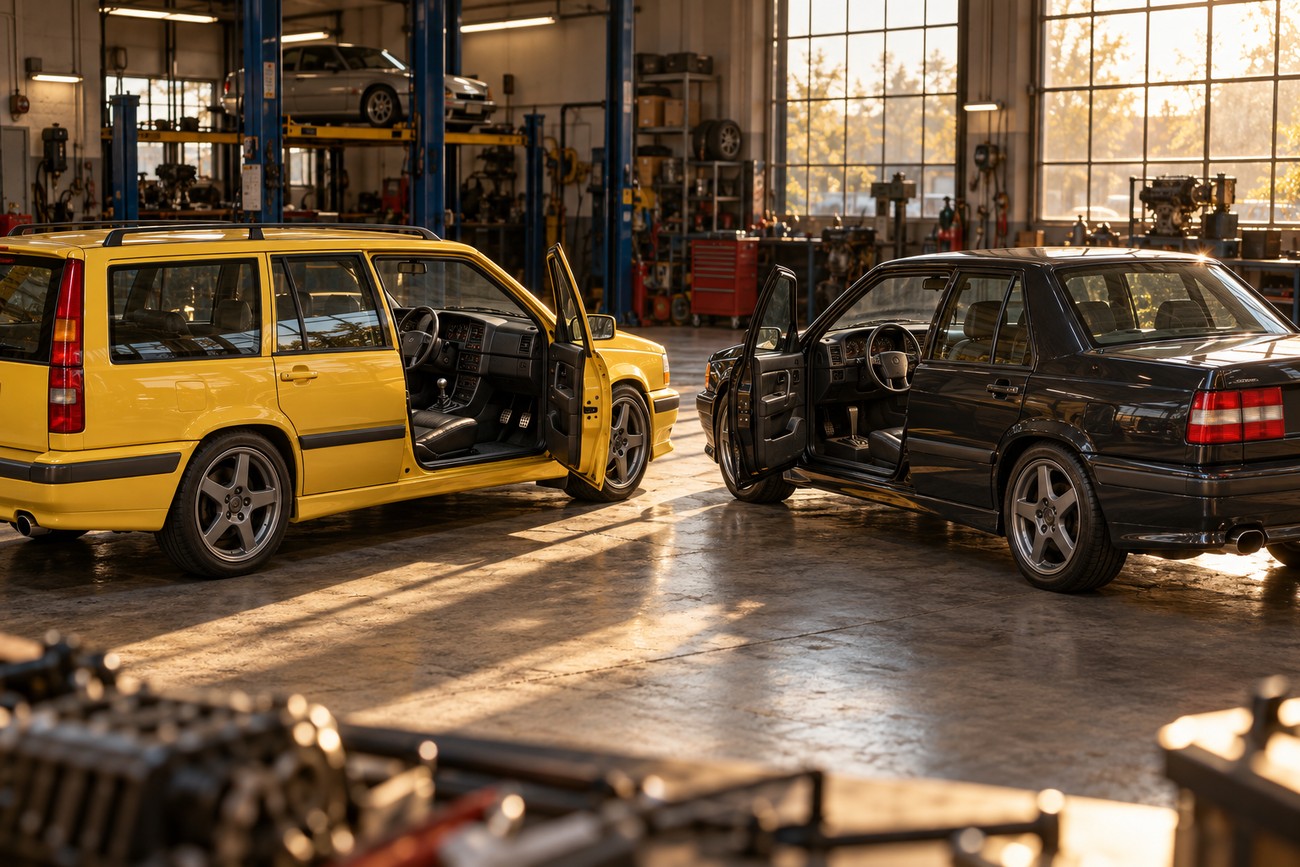
Both sedan and wagon body styles were available, and each expresses the T-5R idea differently. The sedan generally looks more focused and carries less visual contradiction, while the wagon makes the car’s performance story impossible to separate from its practicality. The estate’s commonly quoted 0–100 km/h time of approximately 6.9–7.0 seconds is enough to make its family-car shape feel deliberately absurd in the best sense.
The wagon’s additional mass and larger rear structure influence its responses, even when the engine performance is similar. It can feel substantial during direction changes and under hard braking, with the front tires doing much of the work. Front-wheel drive also produces noticeable torque steer under hard acceleration, so the most satisfying driving is usually clean and progressive rather than an attempt to overpower the steering wheel.
Transmission choice deserves more attention than the usual assumption that the manual must be faster. The T-5R used either a four-speed automatic or a five-speed manual, and Car and Driver found the automatic highly competitive with the available manual. That does not make every automatic car the preferred choice, but it shows that gearing, launch behavior, and test conditions mattered more than a simple gearbox hierarchy.
A manual can offer greater involvement and more direct control, while the automatic may suit the car’s broad, fast-road character and make its performance easier to access in traffic. The four-speed unit also brings an additional inspection concern on an old, heavy, turbocharged front-wheel-drive car. Buyers should choose the transmission they genuinely want, then assess its condition rather than paying a premium for the label alone.
How to Avoid Buying a T-5R That Only Looks Like One
Start with identity before discussing price. A genuine T-5R should be supported by the VIN, documentation, body details, wheels, interior, and mechanical specification taken together. A badge can be replaced, a yellow car can be repainted, and an ordinary 850 Turbo can receive enough trim to look convincing in photographs.
Inspect the yellow paint carefully. Look for consistent color and finish across the body, evidence of repaired panels, overspray, mismatched gaps, and signs that the car was converted after damage or neglect. Original wheels and preserved interior trim add collector appeal, but their presence still does not replace documentation. Conversely, a car with some replaced parts may remain mechanically worthwhile if its history is clear and its condition is honestly represented.
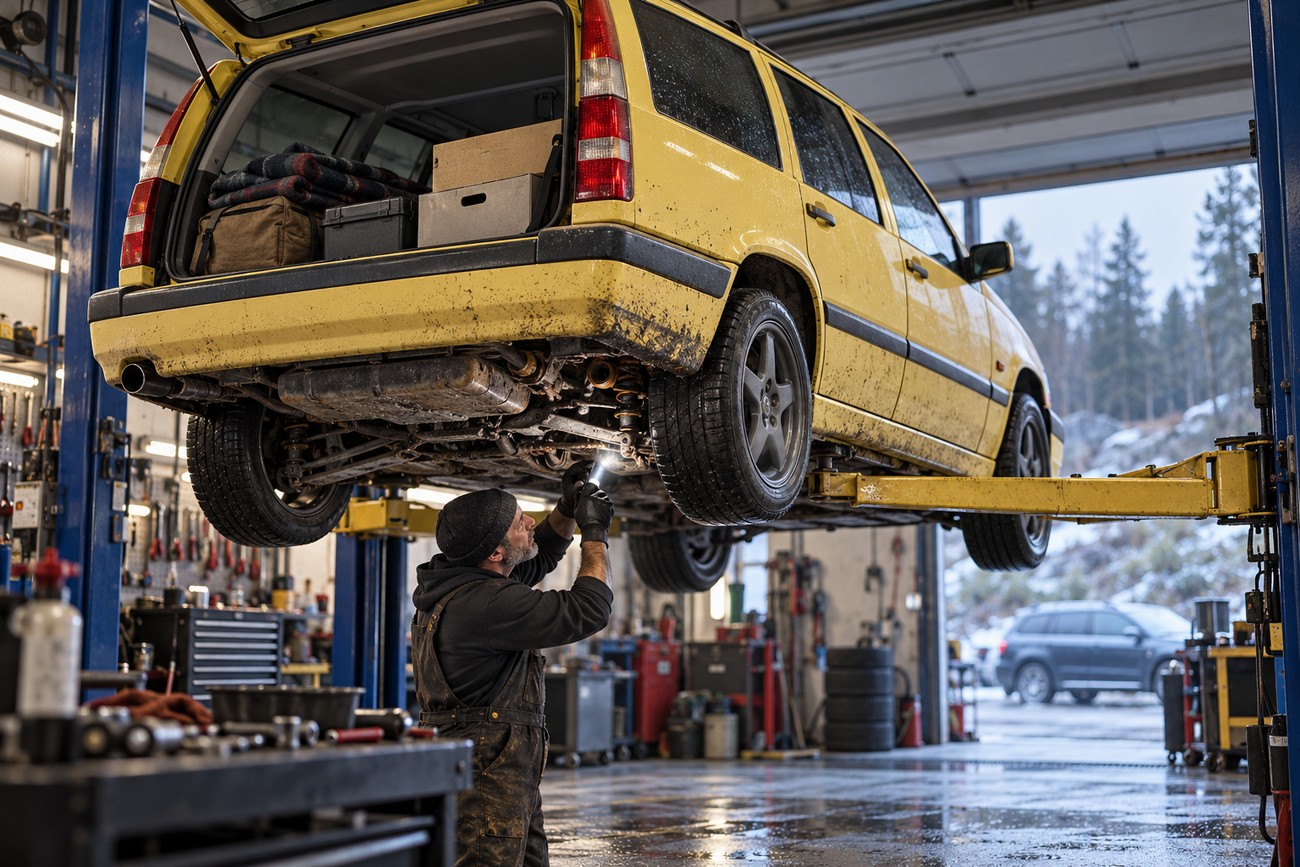
Corrosion and hidden accident repairs deserve the same attention as the engine. Examine structural areas, suspension mounting points, seams, underbody sections, and signs of uneven previous work. A clean-looking yellow exterior can conceal old repairs, and the visual drama of the model encourages buyers to inspect the paint while overlooking what lies beneath it.
Authenticity is a connected risk assessment: identity, gearbox behavior, corrosion, and hidden repairs should be checked together. VIN, paint, or a badge can support the case, but none of them proves the whole car.
Pay particular attention to the automatic transmission if fitted. Delayed engagement, harsh shifts, slipping, or inconsistent behavior can turn an attractive purchase into a major repair project. The age of the platform also brings sensors, wiring, and small electrical faults that may be difficult to diagnose by replacing parts at random.
Rare T-5R-specific trim and body parts can be harder and more expensive to source than components for a standard 850. Before buying, identify which pieces are missing, damaged, or non-original, and establish whether replacements are realistically available in your market. The best inspection is performed before a collector premium is paid, not after the car arrives and its weaknesses become your responsibility.
Living With the Legend: Speed, Costs, and the Reality of Age
The T-5R still makes sense as a usable performance wagon. It offers genuine straight-line pace, useful carrying capacity, and a driving position that feels more substantial than delicate. The five-cylinder engine gives the car a distinctive sound and a broad sense of occasion, even when the road ahead is an ordinary commute.
Daily ownership also exposes the age of the design. Steering responses can feel heavy, torque steer interrupts hard acceleration, and the chassis does not provide the polished refinement of a modern performance wagon. The strongest sensation may arrive during the limited overboost window rather than as a continuous flow of contemporary turbocharged power.
Parts availability is part of the ownership calculation. Routine 850 components may be manageable, while rare trim, body panels, interior pieces, and correct wheels can take longer to find and cost more. Collector interest has pushed good examples above ordinary 850 models in the market, so the purchase price may reflect originality and reputation before the mechanical work is fully understood.
The most useful judgment is also the least romantic: the condition of the individual car matters more than the badge. A healthy ordinary 850 can be a safer ownership proposition than a neglected T-5R with a convincing color and incomplete history. For the special model to deserve its premium, originality, documentation, body condition, transmission health, and sensible maintenance history should align.
Frequently asked questions
How many Volvo 850 T-5Rs are left?
No authoritative global survivor count has been established. Published production totals often cite 2,500 cars, but market and body-style distributions vary, and the number built is separate from the number still registered, running, or preserved.
Registry figures, club lists, and online advertisements can show where known cars are, yet they cannot reliably account for unregistered projects, exported cars, dismantled examples, or duplicates in sales listings. A claimed survivor number should therefore be treated as an estimate unless it comes from a clearly defined registry methodology.
How much is a Volvo 850 T-5R worth today?
Value depends heavily on originality, rust, documentation, gearbox condition, body style, and running condition. A documented, structurally sound car with original paint, wheels, interior, and correct equipment belongs in a different market tier from a converted 850 Turbo or a neglected project, even when both appear yellow in photographs.
The wagon often attracts stronger emotional and collector interest, while transmission preference can divide buyers. A higher asking price is justified by evidence of condition and provenance, not by the production story alone. Inspection and repair costs should be included before deciding whether a particular example is affordable.
What is the top speed of a Volvo 850 R?
The 850 R is a related but distinct model, so the T-5R’s approximately 240–245 km/h top-speed figure should not automatically be assigned to every 850 R. Published performance depends on market, body style, gearbox, and specification.
The safest approach is to verify the exact model and equipment of the car being considered. Confusing the T-5R with the later 850 R can lead to incorrect assumptions about power, suspension, transmission, and collector value.
Was the Volvo 850 T-5R the best Volvo wagon ever made?
The T-5R may be the most iconic performance Volvo wagon, especially for buyers who value its yellow color, five-cylinder turbo engine, touring-car associations, and period character. “Best” depends on the criteria: later Volvos can offer greater comfort, technology, refinement, or everyday reliability.
For a classic-car buyer, the T-5R’s strongest case is its combination of practicality and cultural significance. Its weaknesses are equally clear: age, front-wheel-drive torque steer, heavy responses, and scarce special parts. The best example is the one whose condition and originality match the buyer’s priorities.







