
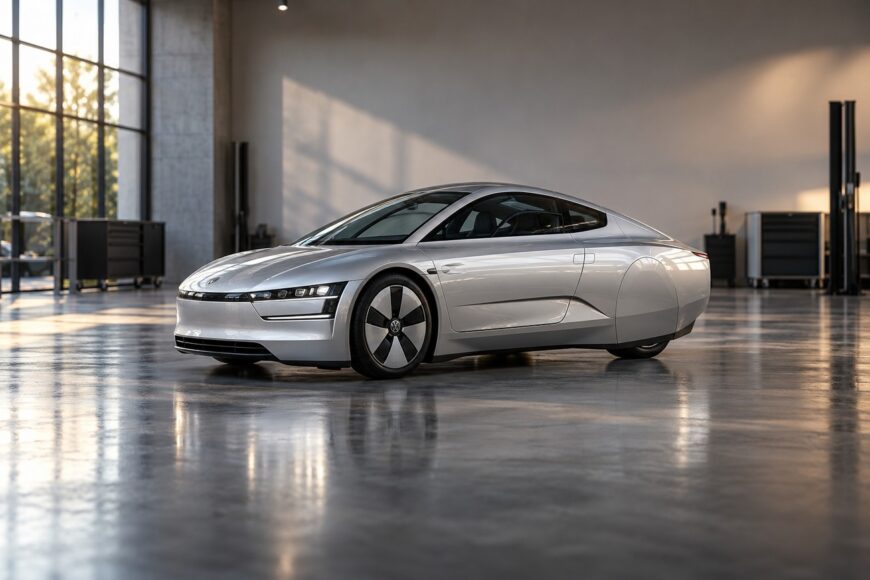
Volkswagen built the XL1 as a limited-production car, yet finding one for sale is harder than simply having enough money to buy it. Production ended years ago, and the small number allocated to retail customers is scattered among private collections, specialist dealers, and occasional listings.
The famous 0.9 L/100 km figure also needs careful interpretation. It comes from the NEDC test cycle and depends on a charged battery, while the car’s rarity, carbon-fiber structure, limited practicality, and specialist service needs can matter more to ownership than its laboratory economy.
A sound purchase therefore requires two separate judgments: whether an XL1 is genuinely available, and whether the specific example has verifiable battery, structural, service, and registration credentials.
- Can You Actually Buy a Volkswagen XL1 Today?
- What the XL1’s 0.9 L/100 km Claim Really Means
- How Much Does a Volkswagen XL1 Cost?
- What to Inspect Before Buying a Volkswagen XL1
- Is the XL1 Practical Enough to Own and Drive?
- Frequently asked questions
- How much is a VW XL1 worth?
- What should you do if an XL1 seller cannot provide battery-health data?
- What is the rarest Volkswagen ever made?
- What car gets 300 MPG?
Can You Actually Buy a Volkswagen XL1 Today?
Yes, but only through the secondary market. Volkswagen produced the XL1 from 2014 to 2016, and the model is no longer available new from the manufacturer.
Total production was about 250 cars. Approximately 200 cars were intended for retail customers; the remainder were special or demonstration cars. That distinction matters because the total production figure does not represent the number of cars that private buyers can realistically purchase today.
Availability is exceptionally thin. A mobile.de snapshot showed four cars listed simultaneously, which gives a useful sense of the market: listings appear in small numbers, disappear quickly, and may be located far from the buyer’s country.
The search process resembles a collector-car purchase more than a normal used-car transaction. You may need to monitor several markets, verify the car’s ownership and service history remotely, arrange specialist inspections, and confirm registration before committing to a viewing or deposit.
What the XL1’s 0.9 L/100 km Claim Really Means
The XL1 is a plug-in diesel hybrid. Its powertrain combines a 0.8-liter two-cylinder TDI producing 35 kW/48 hp and 120 Nm with a 20 kW electric motor, a 5.5 kWh lithium-ion battery, rear-wheel drive, and a 7-speed DSG.
Volkswagen quoted about 50 km of electric range. If the battery is charged regularly and many trips remain within that range, the diesel engine may run infrequently. Once the battery is depleted, the result depends much more on the small diesel engine, driving conditions, temperature, speed, and traffic.
The official 0.9 L/100 km fuel-consumption figure and 21 g/km CO₂ figure come from the NEDC test cycle. They are laboratory values rather than universal real-world results, so treating 0.9 L/100 km as the expected consumption on every journey will produce an unrealistic ownership budget.
Much of the XL1’s efficiency comes from its entire design. The car weighs 795 kg, uses a carbon-fiber-reinforced-plastic monocoque, and has a drag coefficient of Cw=0.189. Those measures reduce the energy required to move the car, while the two-seat layout, low body, and specialized construction impose compromises that ordinary hybrid buyers may find difficult to accept.
How Much Does a Volkswagen XL1 Cost?

The often-quoted reported starting price for the XL1 was around €111,000. That figure describes the model’s original market positioning and should not be confused with a current guaranteed value.
In the supplied German listing snapshot, asking prices were approximately €109,900–€144,225. These are advertised prices, not verified completed-sale prices. A rare car can remain listed at an ambitious figure for a long period, especially when the seller and buyer operate in different countries.
The spread does not create a dependable price scale. Condition, originality, documented servicing, battery evidence, accident history, equipment, and the quality of the paperwork can make one car materially easier to buy and own than another carrying a similar price.
Buyer geography also affects value. Transport, inspection, import formalities, registration, taxation, insurance, and access to specialist support can change the effective cost substantially. Rarity helps establish interest, while the individual car and its documentation determine practical liquidity.
What to Inspect Before Buying a Volkswagen XL1
Begin with the traction battery and charging system. Request available battery-health data, charging history, diagnostic reports, the original charging equipment, and evidence that the car accepts and completes a charge correctly. Open, verified data on long-term battery degradation, replacement cost, and original carbon-fiber body-panel availability remains limited, so assumptions can become expensive.
The inspection should also cover DSG operation, dealer service history, the 12-volt system, seals, brakes, cooling systems, and evidence of storage conditions. A low odometer reading does not automatically indicate better condition. Long periods of inactivity can matter for the battery, seals, brakes, and 12-volt system, even when the mileage appears unusually attractive.
Documented battery and storage history should take priority over headline mileage, followed by a specialist inspection of the CFRP monocoque before a low-mileage car is treated as the safer example.
Damage assessment requires particular care. The CFRP monocoque is evaluated differently from a conventional steel body, and a visible cosmetic repair may not reveal the full structural situation. Before purchase, establish who can inspect carbon-fiber damage, whether the inspection will be documented, and how any required repair could be supported with appropriate parts and methods.
Verify the exact specification by VIN and documents. One source or listing gives conflicting output figures, including 55 kW/75 hp versus a range of 48–71 hp. That inconsistency is a reason to check the individual vehicle rather than repeat a generic specification from an advertisement.
A pre-purchase agreement should identify the diagnostic information supplied, the condition of the battery and charging equipment, any known structural repairs, and the seller’s remedy if a material fault appears before delivery. Specialist diagnostics and a realistic parts-search timeline belong in the purchase plan, alongside registration and insurance checks in the destination country.
Is the XL1 Practical Enough to Own and Drive?
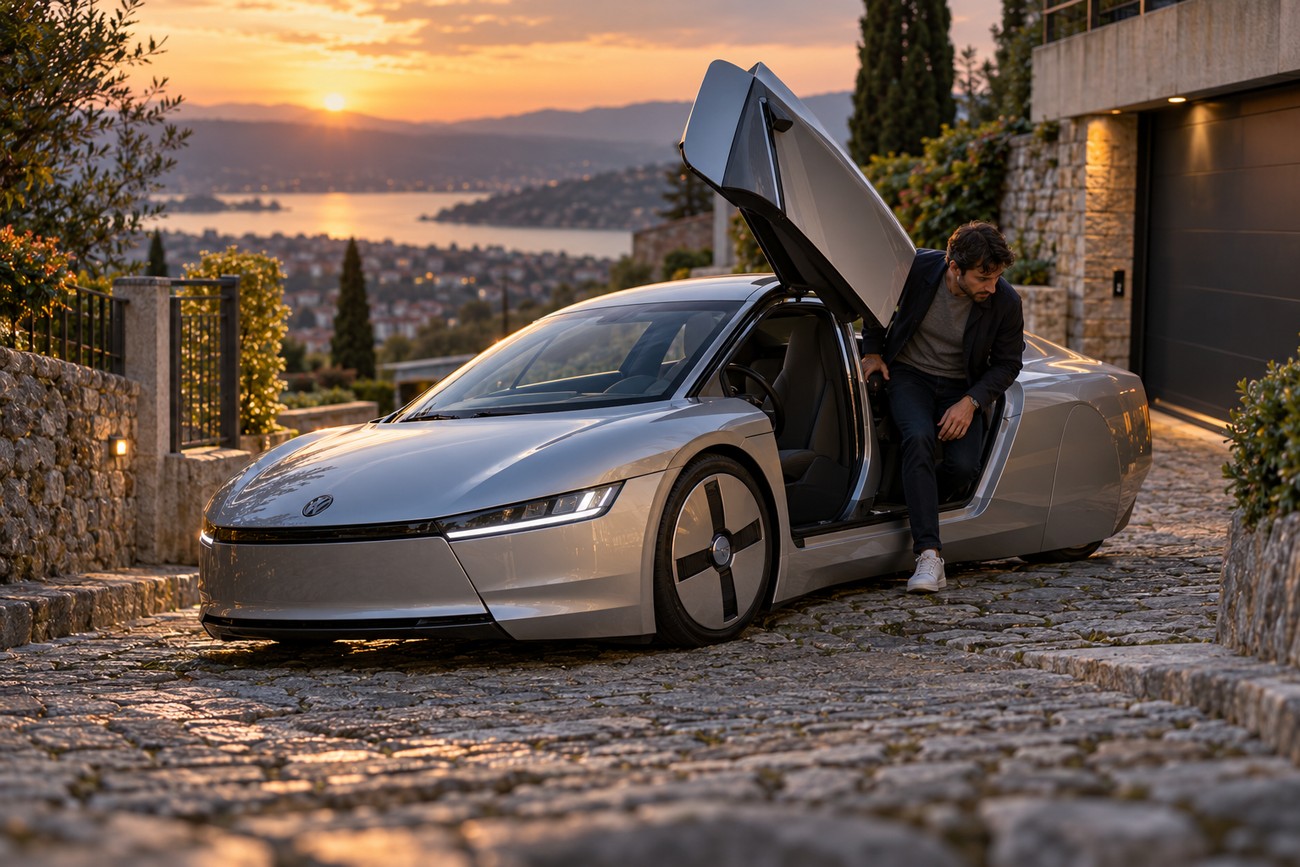
The XL1 is a highly specialized two-seat car. Its compact cabin and limited luggage capacity may work for a focused commute or a collector’s second car, but they offer little flexibility for passengers, cargo, or long trips.
Its body height is only 1,153 mm. That low profile supports aerodynamic efficiency, yet it makes entry and exit more demanding, can restrict outward visibility, and leaves less tolerance for steep ramps, rough roads, deep snow, and poorly maintained surfaces.
Performance is modest by modern performance-car standards. The diesel engine produces 35 kW/48 hp and 120 Nm, while system output reaches 51 kW during short-term boost. Evo reports 0–62 mph in 12.7 seconds and a 99 mph top speed; those figures come from a single source and should be treated accordingly.
The XL1’s appeal lies in its engineering discipline rather than outright speed or broad utility. Low mass, low drag, a small powertrain, and a restricted body allow exceptional test-cycle efficiency, while winter use, depleted-battery driving, road quality, access, visibility, and repair logistics expose the compromises behind that result.
Frequently asked questions
How much is a VW XL1 worth?
There is no single defensible market value without examining the specific car. In a thin market, an asking price should be treated as a seller’s position rather than proof of a completed transaction.
Documentation quality, originality, battery and service evidence, accident history, and buyer location can move the practical value substantially. Compare cars by condition and ownership risk, then account for transport, registration, taxation, insurance, and specialist support instead of relying on rarity alone.
What should you do if an XL1 seller cannot provide battery-health data?
Arrange independent diagnostics before treating the car as equivalent to a documented example. If that is impossible, obtain written terms covering the unknown battery risk, or price the uncertainty explicitly and be prepared to walk away.
A low odometer reading does not resolve the issue. Storage history, charging behavior, diagnostic results, and the condition of the 12-volt system may tell you more about near-term ownership risk than mileage alone.
What is the rarest Volkswagen ever made?
There is no universally accepted single answer because “rarest” can mean the lowest production, fewest surviving cars, or the smallest number sold to the public. The XL1 is certainly among Volkswagen’s rarest production road cars, with about 250 built, but special prototypes and one-off vehicles may be rarer still.
What car gets 300 MPG?
No conventional production car universally achieves 300 mpg in normal driving. Very high figures usually come from a test cycle, a plug-in hybrid driven with a charged battery, or a specialized efficiency record rather than continuous fuel-only operation.
The XL1’s 0.9 L/100 km claim is an NEDC result for a plug-in diesel hybrid. Its real fuel consumption depends heavily on charging frequency, trip length, speed, temperature, and how far the car travels after the battery’s electric assistance is used.







