
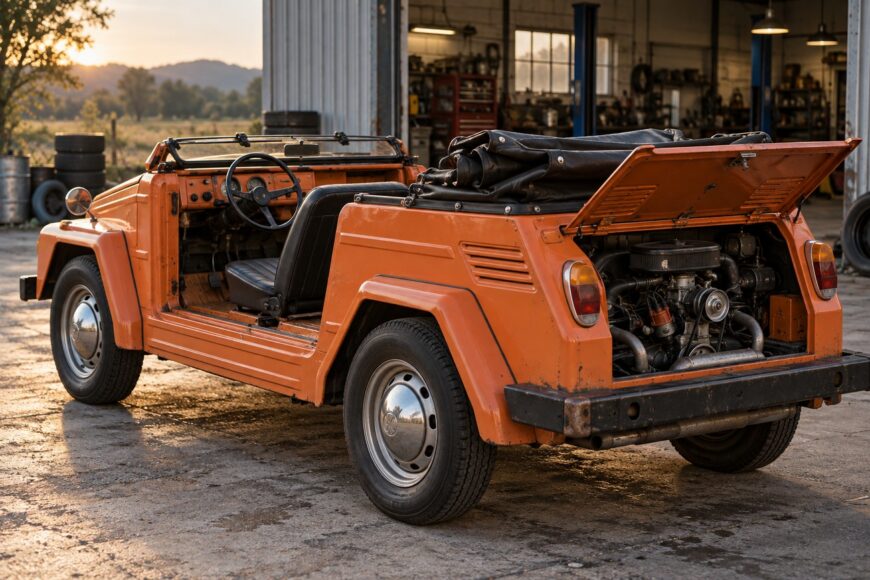
The Volkswagen Thing, officially the Type 181, looks like a stripped-down military vehicle, but its appeal is more complicated than the styling suggests. It is an open, lightweight utility car with removable doors, a folding soft top, and a rear-mounted flat-four. Beneath the simple bodywork are the same ownership hazards that define many old Volkswagens: hidden structural rust, water trapped in closed sections, tired transmissions, and parts that are less universal than they first appear.
The central distinction matters before you inspect or buy one. A standard Type 181 is rear-wheel drive, not factory four-wheel drive, and it does not have a standard locking differential or the level of traction associated with a full-size military off-roader. It can be entertaining on rough tracks and useful on loose surfaces, but its condition matters more than its image. A sound shell is the foundation of a good Thing; a shiny one with rotten structure can become an expensive fabrication project.
- What the Volkswagen Thing Type 181 Actually Is
- Volkswagen Type 181 Specifications at a Glance
- How the Type 181 Drives—and Where Its Limits Begin
- Rust, Water Ingress, and the Structural Inspection
- Engines, Gearboxes, and the Reality of Parts
- Buying a Type 181: What Condition Matters Most
- Frequently asked questions
- How many VW Type 181s were made?
- How much does a Volkswagen Type 181 typically cost?
- How should a VW Thing be dried after driving in rain?
What the Volkswagen Thing Type 181 Actually Is
The Type 181 is an open, rear-wheel-drive Volkswagen built around platform-frame construction with a reinforced body. Its layout is familiar to anyone who knows the Beetle family: a longitudinal rear-mounted flat-four engine drives through a four-speed manual transmission. The body adds practical features for utility use, including removable doors, a folding soft top, and a folding windshield.
Civilian production is commonly given as running from 1968/1969 into the 1980s, depending on the market. That spread is important because engines, brakes, electrical equipment, trim, and body details can differ between examples. A car sold as a Thing in one market may not match a Type 181 from another market in every mechanical or fitting detail.
The military styling came from the vehicle’s utilitarian background and intended service roles, not from a factory four-wheel-drive system. The standard car sends power to the rear wheels. It can use its light weight and rear-engine traction effectively, yet that does not turn it into a four-wheel-drive vehicle or guarantee performance on deep mud, steep broken ground, or loose climbs.
Volkswagen Type 181 Specifications at a Glance
The following figures are useful for identification, although year and market differences should be checked against the vehicle’s VIN and original specification.
| Specification | Type 181 reference |
|---|---|
| Length | Approximately 3,780 mm |
| Width | Approximately 1,640 mm |
| Height | Approximately 1,620 mm |
| Wheelbase | About 2.4 m; sources list 2,400 mm or 2,410 mm |
| Typical mass | Approximately 900–910 kg |
| Factory engines | 1,493 cc and 1,584 cc flat-fours |
| 1600 output | Some versions are listed at 44 hp; a later 1600 version is listed at 48 hp at 4,000 rpm and 100 N·m at 2,000 rpm |
| Transmission | Four-speed manual |
| Drivetrain | Rear-wheel drive; standard cars are not factory four-wheel drive |
| Brakes | Late versions commonly use drum brakes front and rear |
| Ground clearance | Often quoted near 210 mm, but dependent on market, tires, and load; not a universal confirmed factory figure |
How the Type 181 Drives—and Where Its Limits Begin
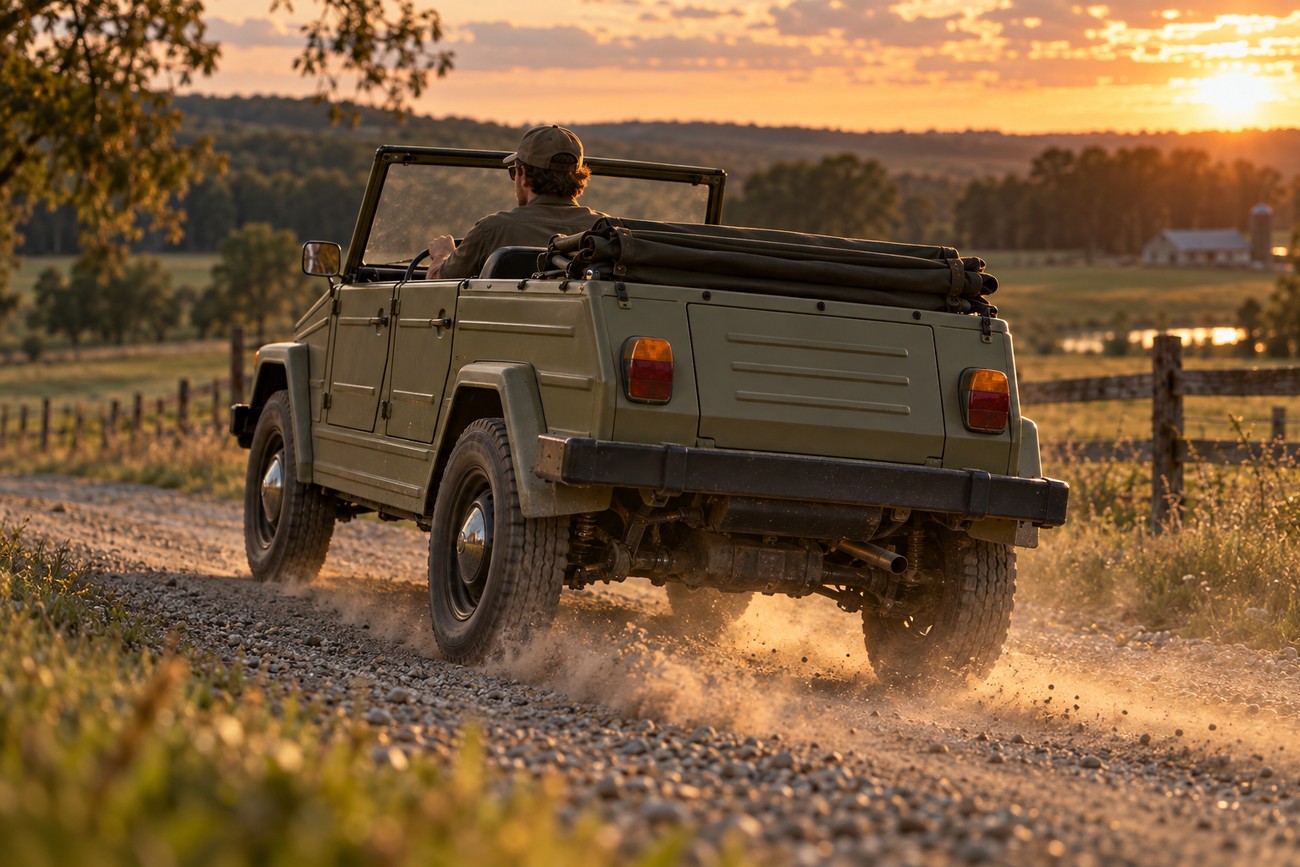
A Type 181 feels different from a conventional front-engine convertible because the engine sits longitudinally at the rear and the vehicle weighs approximately 900–910 kg. That combination can give the driven rear wheels useful traction on loose ground, while the modest mass makes the car relatively easy to place on a narrow track. The four-speed manual is simple to operate when properly adjusted and maintained.
The open body changes the experience as much as the drivetrain does. With a soft top, removable doors, and broad side openings, the car feels exposed and mechanical. Wind noise, drafts, and rain are part of the design compromise, not signs that every example has a missing panel. Suspension and braking hardware are basic by modern standards, so a driver must leave more room and judge the surface rather than relying on the car’s appearance.
Rear-wheel drive has clear limits. It may help the car maintain momentum on a firm gravel road, but it cannot replace four-wheel drive when one axle loses grip in mud or on a steep, uneven surface. The Type 181 also has no standard locking differential. Claims that treat every Thing as a military-grade off-roader should therefore be viewed with caution.
An LSD installation or a change to the gearing can alter traction or cruising behavior, but either modification belongs to the individual build rather than the factory specification. Before crediting a car for such equipment, verify what is actually installed. A modified Type 181 may be more capable in one use and less original, quieter, or easier to service in another.
Rust, Water Ingress, and the Structural Inspection
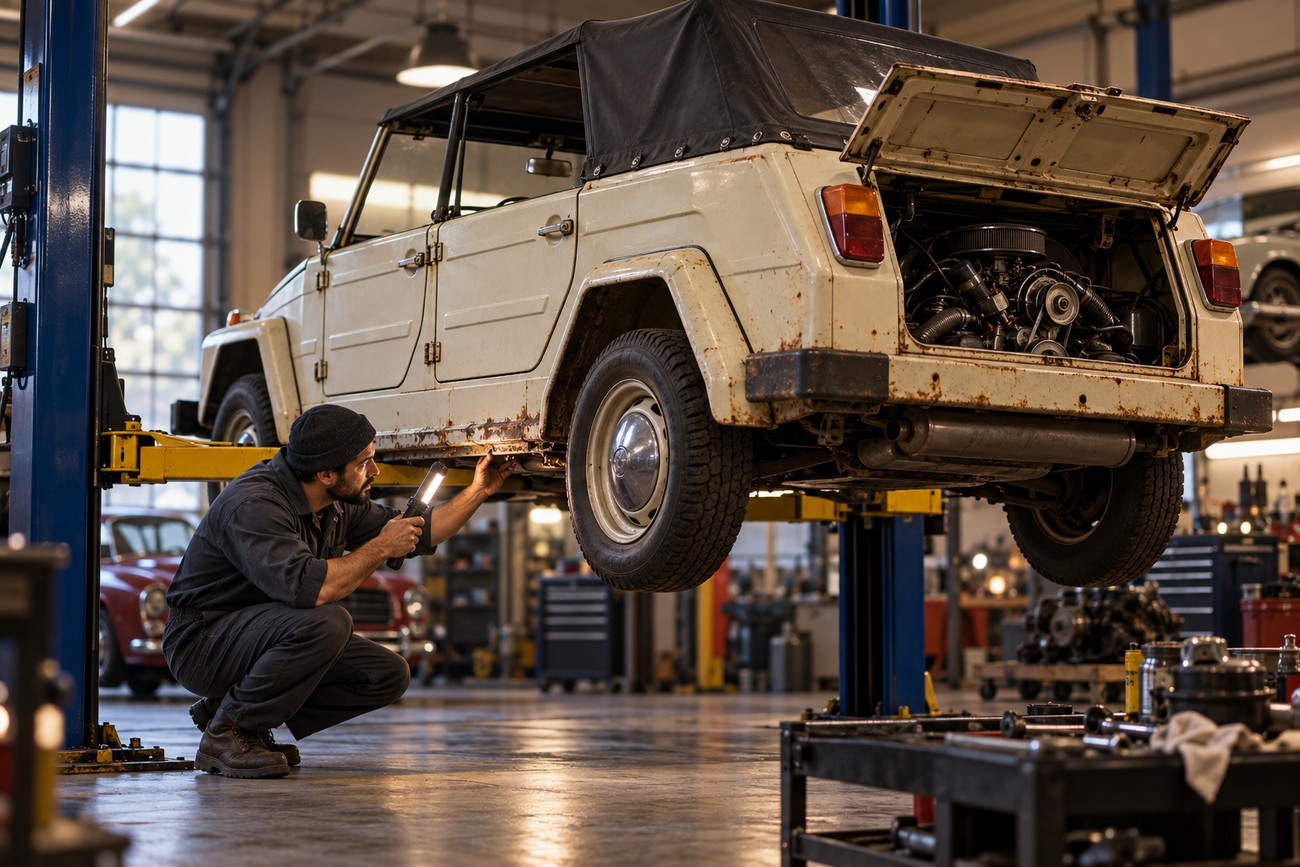
Structural inspection should come before judging the engine bay, paint, or interior. The sills, floors, platform-related structures, and lower windshield frame contribute to the car’s rigidity, so corrosion in these areas is more serious than bubbling on an outer fender. Look underneath, inside the cabin, and into accessible cavities rather than accepting a recent repaint as proof of sound metal.
The sills deserve particular attention because water can remain inside them. Blocked drains or incorrect plugs prevent water from escaping as intended and allow corrosion to develop from within. One missing or blocked drain can matter more than a few visible paint bubbles: the cavity may continue holding moisture after the exterior has dried.
Inspect the lower windshield frame and sill drains before trusting a tidy paint finish. Trapped water and hidden section loss can affect the car’s structure even when the visible bodywork looks carefully restored.
The windshield frame is a common diagnostic trap. A windshield that moves, protrudes, or appears to drop at the bottom may have a poor seal, but it can also indicate corrosion in the lower frame. That section is difficult to repair properly, and a superficial patch may leave weakened metal behind the glass and rubber.
Check the floors for repairs, thin sections, moisture staining, and poorly finished welds. Examine where the body meets the platform and where the sills connect with adjacent structural areas. Fresh paint and heavy filler can hide corrosion for a time; they cannot restore strength unless the damaged metal has been removed and replaced correctly.
The soft top and open side sections make water management an ongoing ownership task. A wet interior needs to be dried rather than simply covered, and the drains should remain open. If the cabin smells damp after a dry day, inspect the top, floor coverings, sill cavities, and windshield area before assuming the problem is minor.
Engines, Gearboxes, and the Reality of Parts
Factory engines include 1,493 cc and 1,584 cc flat-fours. Some 1600 versions are listed at 44 hp, while a later 1600 version is listed at 48 hp at 4,000 rpm and 100 N·m at 2,000 rpm. Those figures should not be applied to every 1600 Type 181, because the exact output depends on the version and market.
Light oil sweating is common on many older Volkswagen engines and does not by itself condemn a car. Substantial leaks are different. Check whether oil is collecting around the engine, whether it is reaching the clutch area, and whether the seller has cleaned the underside immediately before inspection. A clean engine can reflect good maintenance, but it can also conceal the evidence you need.
Test the gearbox on the road, not only with the car stationary. Select every gear when cold and warm, listen under load, and observe whether a gear jumps out during acceleration or engine braking. That behavior may indicate worn synchronizers or selector forks, and repairing the transmission can be more involved than replacing a routine service item.
Mechanical components related to the Beetle family can make some repairs more manageable, but the Type 181 is not simply a Beetle with a different roof. Body panels, door hardware, roof fittings, and windshield-frame parts are more specialized and may vary by market. Confirm the VIN, year, and version before ordering components; an apparently similar part may still require alteration or may not fit at all.
Buying a Type 181: What Condition Matters Most
Start with identity. Record the VIN, production year, market, engine number where relevant, and the equipment actually fitted to the car. This prevents broad Type 181 specifications from being treated as a guarantee for one particular example, especially where brakes, electrics, engine output, and body fittings differ.
Then inspect the structure in a strict order: sills, drains, floors, platform areas, lower windshield frame, and the quality of previous repairs. A strong engine bay and clean paint cannot compensate for a weakened shell. If access is limited, a specialist inspection before purchase is usually more useful than another look at the upholstery.
Road-test the car long enough to evaluate the gearbox under acceleration and engine braking. Check clutch engagement, steering response, brake behavior, oil leaks, and signs of water entry. Test the soft top and doors as working equipment, not as decoration, because damaged fittings and missing hardware can be difficult to source.
Value is driven primarily by structural condition, originality, completeness, and the cost of specialized parts. A partly dismantled car may appear inexpensive while carrying a large fabrication and sourcing bill. After purchase, keep the sill drains open, dry the soft-top interior after rain, and treat water control as routine maintenance rather than an occasional repair.
Frequently asked questions
These answers use the commonly cited figures carefully, because production totals, prices, and equipment can vary across markets and individual cars.
How many VW Type 181s were made?
The commonly cited production total is 90,883 vehicles. That figure covers different markets and Type 181/182 versions, so it should not be treated as the production total for U. S.-market Things alone.
How much does a Volkswagen Type 181 typically cost?
There is no single reliable typical price without specifying the market and the car’s condition. Structural rust, originality, completeness, and the availability of specialized body and roof parts usually matter more than fresh paint or a clean-looking engine.
A running car with a weak windshield frame or corroded sills can require substantially more work than its appearance suggests. Compare the cost of proper structural repairs and missing components before comparing asking prices.
How should a VW Thing be dried after driving in rain?
When it is safe, open the soft top and doors, remove standing moisture, and allow air to circulate through the cabin. Dry the seats, floor coverings, and corners where water can remain trapped, then check that the sill drains are open.
Do not close the car up while the interior is still damp. Repeated water retention can accelerate hidden corrosion, particularly inside the sills and around the lower windshield frame.







