
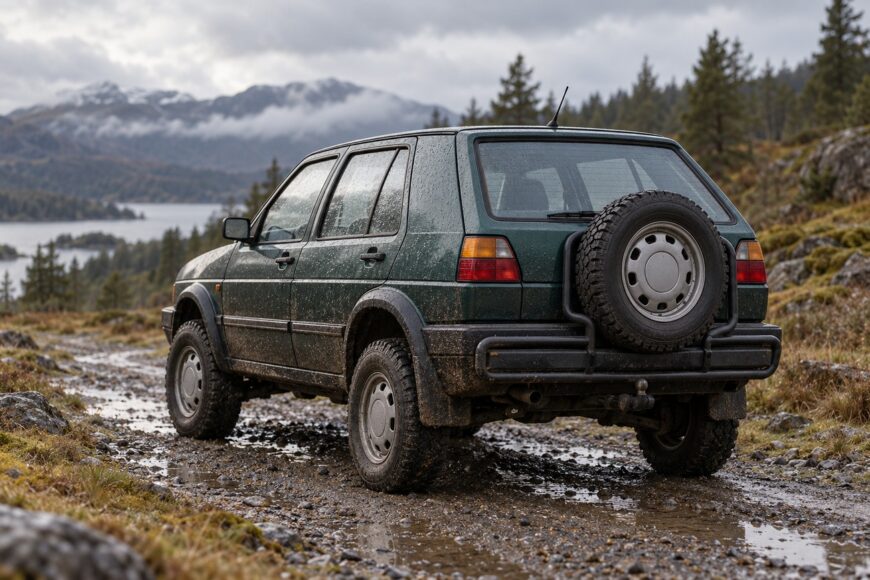
The Volkswagen Golf Country has the appeal of a familiar Golf II on taller suspension, with protective bars and a spare wheel on the tailgate. Owning one calls for more than a visual appraisal. Corrosion around its reinforcements, wear in the Syncro drivetrain, and scarce model-specific parts can make an apparently complete car difficult to put right.
Its usefulness on rough roads and its value as a collectible depend more on condition than on its adventurous appearance. Volkswagen built the Country as a raised, reinforced five-door Golf II with all-wheel drive. It remains a hatchback with clear limits off-road, and its short production run is a reason to inspect carefully rather than buy on rarity alone.
- What made the Golf Country different from a Golf II?
- Volkswagen Golf Country specifications at a glance
- How Syncro works—and what the lift does not do
- The driving trade-off: rough-road comfort versus speed and economy
- Where to inspect a Golf Country before buying
- Parts, tires, and restoration costs: the ownership traps
- Frequently asked questions
- How can I tell a factory Golf Country from a lifted Golf Syncro?
- How should I store a Golf Country that is driven only occasionally?
- What is the rarest model of Volkswagen Golf ever made?
- How many VW Golf Rallyes were made?
- What is the value of a VW Golf Rallye?
What made the Golf Country different from a Golf II?
Produced in 1990–1991, the Golf Country was a five-door Golf II derivative developed with Steyr-Daimler-Puch. Approximately 7,700–7,800 were built. That makes it an uncommon version of a familiar car, although its construction and drivetrain distinguish it from an ordinary Golf II.
The raised body sat on a reinforced mounting structure and carried protective bars at the front and rear. A tailgate-mounted spare freed space inside and reinforced the Country’s distinct appearance. These changes made it better suited to damaged roads and moderate off-road terrain; they did not turn it into a body-on-frame SUV.
That distinction matters when assessing an old example. The added structure creates mounting points and repair areas that a buyer would not inspect in quite the same way on a standard Golf II. A tidy interior and complete exterior fittings may be appealing, but they say little about the metal carrying the reinforcements.
Limited production attracts collectors and can make original equipment worth preserving. It does not guarantee investment value: structural repairs, Syncro work, and a narrow buyer pool can outweigh the appeal of rarity. A sound, correctly repaired car is a more useful starting point than a cheaper example bought for its story.
Volkswagen Golf Country specifications at a glance
These are indicative figures for the Golf Country. Specification and the condition of an individual car can affect the result.
| Item | Golf Country |
|---|---|
| Production | 1990–1991; approximately 7,700–7,800 built |
| Body | Golf II-based five-door lifted hatchback |
| Dimensions | Approximately 4,255 mm long, 1,705 mm wide, and 1,555 mm high; 2,480 mm wheelbase |
| Curb weight | Approximately 1,220 kg |
| Ground clearance | Approximately 180 mm |
| Overall height comparison | Volkswagen-reported height approximately 127 mm greater than a conventional four-door Golf II; this is not an additional ground-clearance figure |
| Engine | Petrol 1.8-liter; Country output is commonly cited at approximately 90–98 hp depending on specification |
| Gearbox | Five-speed manual |
| Drivetrain | Syncro all-wheel drive with a viscous coupling and rear differential |
| Indicative performance | 0–100 km/h in approximately 13.5 seconds; top speed approximately 160–163 km/h |
| Indicative mixed fuel use | Approximately 10–12 L/100 km; actual use varies |
How Syncro works—and what the lift does not do
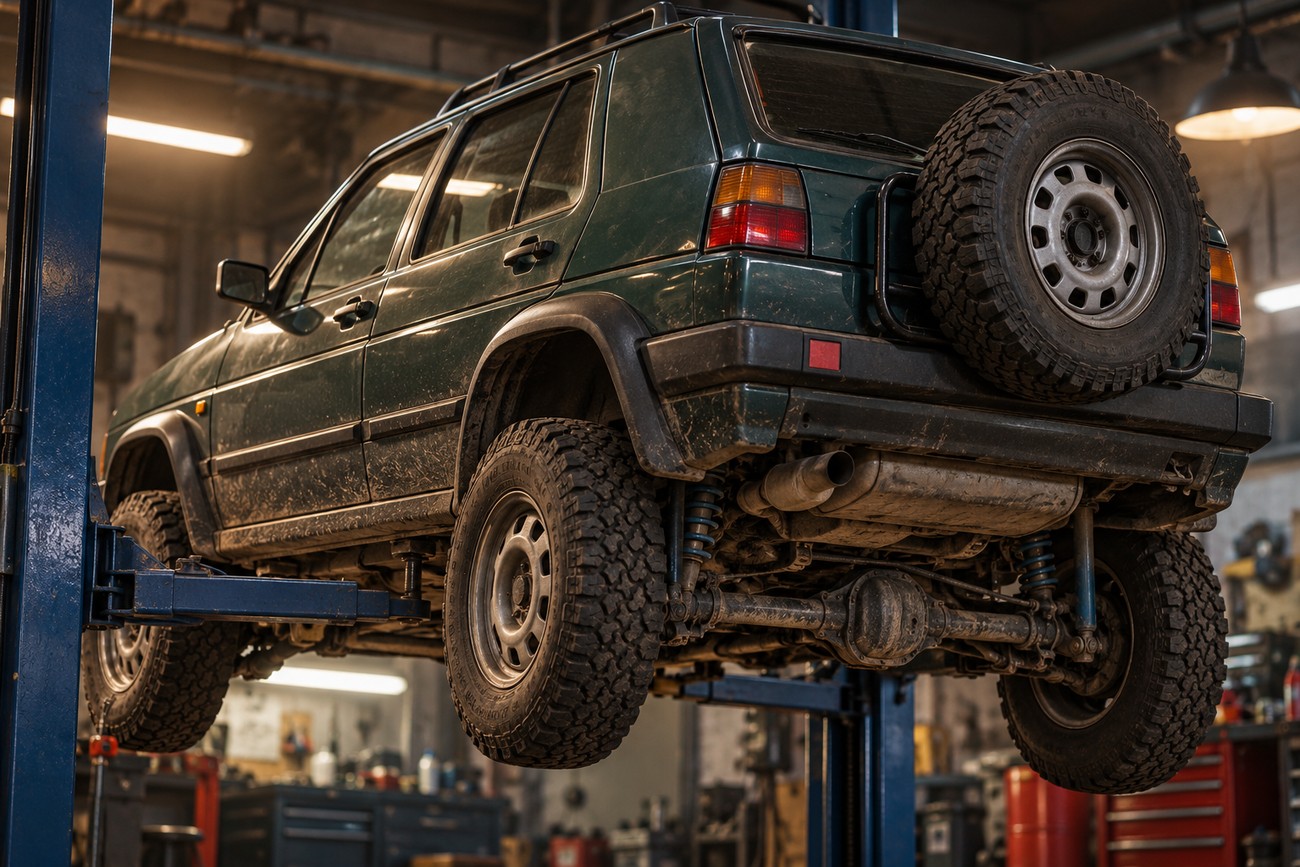
The Country’s five-speed manual gearbox works with Syncro all-wheel drive. A viscous coupling helps transmit drive through the rear driveline to the rear differential when traction conditions call for it. For a driver on loose or slippery ground, the benefit is added traction without having to select a separate four-wheel-drive mode.
Raised suspension and approximately 180 mm of ground clearance help the car clear ruts and uneven surfaces that would trouble a conventional Golf II. Volkswagen also reported an overall height approximately 127 mm greater than a conventional four-door Golf II. Overall height and ground clearance measure different things: the height difference must not be presented as 127 mm of extra clearance beneath the car.
On a broken track, the useful combination is clearance, suspension travel, and traction. Deep ruts, severe obstacles, and heavy off-road use remain outside the Country’s intended role. Its reinforced mounting structure does not provide the construction of a body-on-frame off-roader.
The protective bars deserve the same measured reading. They may protect exposed exterior areas, but their presence does not guarantee that the underside or the points where the structure attaches are sound. On an older car, corrosion or poor repairs can matter more than the apparent strength of the bars.
The driving trade-off: rough-road comfort versus speed and economy
The Country makes most sense where a conventional Golf II would repeatedly meet potholes, broken pavement, or rough access roads. Its raised suspension can take the edge off those journeys, while Syncro helps when the surface offers limited grip. The reward is easier progress over poor ground, rather than SUV-like isolation.
A petrol 1.8-liter engine, commonly cited at approximately 90–98 hp depending on specification, has to move the heavier Country and its driveline. Indicative figures are approximately 13.5 seconds from 0–100 km/h and a top speed of approximately 160–163 km/h. Those figures describe the model broadly, not a promise that a decades-old example will perform identically.
The higher body brings more roll than a conventional Golf II, particularly in quick changes of direction. Transmission noise and wind noise can also be more noticeable. During a test drive, distinguish the car’s generally less refined character from a new vibration, whine, or other noise that needs investigation.
Indicative mixed fuel use is approximately 10–12 L/100 km, relatively high for a 1.8-liter hatchback. City driving, tires, maintenance, and drivetrain drag can alter that substantially. An unusually reluctant car deserves a mechanical check rather than an assumption that every Country drives the same way.
Where to inspect a Golf Country before buying
Start with the structure before starting the engine. Inspect the sills, reinforcement mounting points, strut towers, rear longitudinal members, and spare-wheel mount for corrosion. Damage at a mounting point can compromise the part of the car that makes the Country distinctive; a good-running engine or rare trim cannot offset it.
Next, look for earlier welding and changes to the reinforced structure. Check whether repairs extend into sound surrounding metal, preserve secure mountings, and leave the car straight and properly assembled. Fresh coating can make a repair look neat while concealing what lies beneath it.
Only then move to a road test and driveline inspection. Listen for abnormal noise or vibration, and check the rear differential, viscous coupling, and propshaft for condition, leaks, and evidence of previous work. One symptom alone does not prove that the coupling has failed; tires and other driveline components also need checking.
Compare the vehicle’s documentation with its actual configuration, particularly if it has been modified or extensively repaired. Where the structure or Syncro system cannot be verified, arrange an assessment by someone familiar with these older drivetrains before committing to a purchase. The likely repair burden is more important than the fact that few were built.
Parts, tires, and restoration costs: the ownership traps
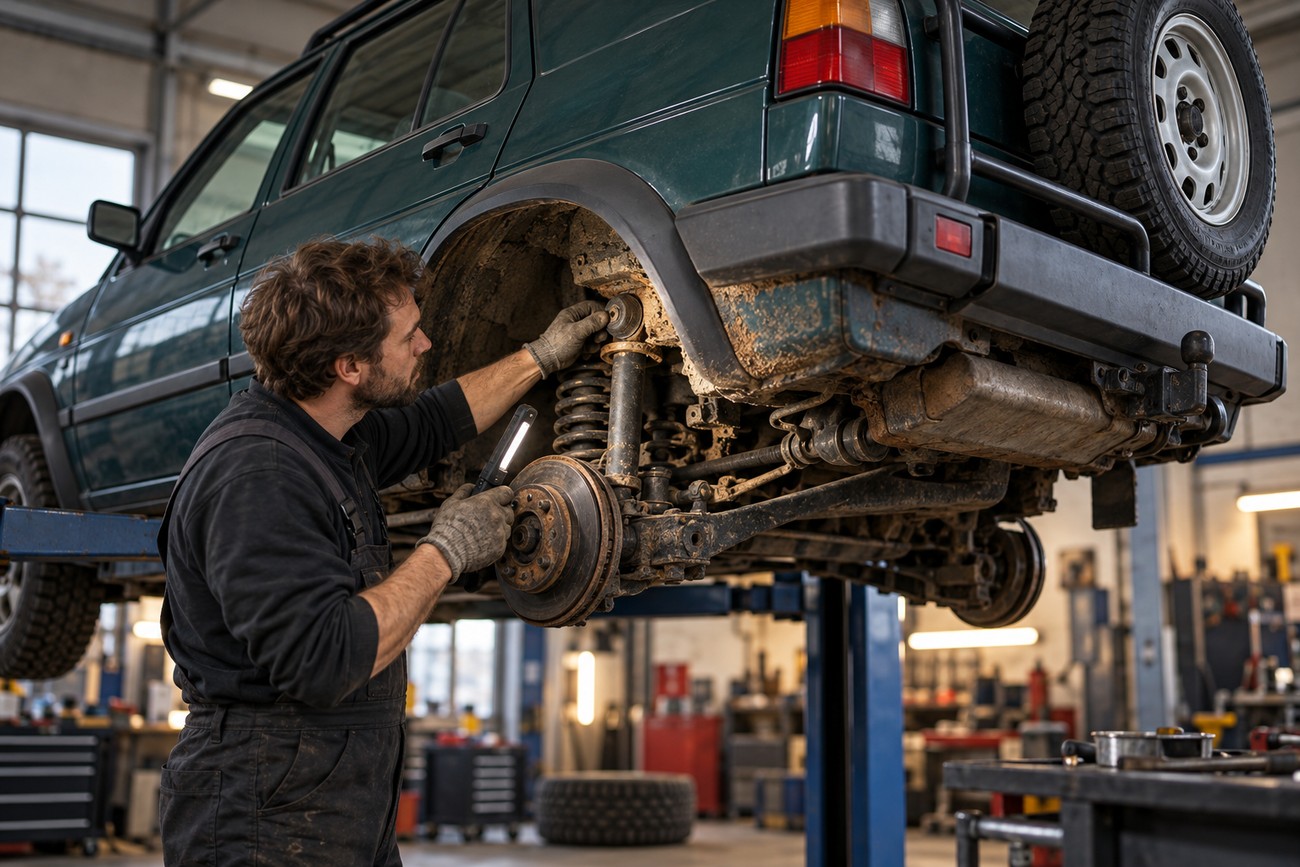
Routine engine and general Golf II service work is one part of Country ownership. Country-specific structural and suspension repairs, together with rear-driveline work, are a different proposition: some parts are scarce, and diagnosis may require a specialist. A low purchase price offers little comfort if a critical mounting or Syncro component needs difficult-to-source parts.
Parts availability is more nuanced than either “everything fits a Golf” or “nothing is available.” Certain components overlap with other Syncro or Passat applications, but compatibility must be verified for the particular car. Matching a part by appearance alone risks paying for a component that does not fit or work correctly.
Keep tire rolling dimensions and pressures consistent. Significant differences can place unwanted demands on the viscous-coupling drivetrain, while aggressive off-road tires can add strain without making the Country suitable for severe terrain. Tire selection is therefore a drivetrain decision as well as a traction choice.
Investigate leaks and maintain driveline fluids rather than waiting for noise to develop. Neglected service alone does not establish that a viscous coupling has failed, but it does leave more uncertainty for the next owner. Casual power upgrades bring a similar risk: extra output is of limited value if an aging engine, gearbox, or rear driveline first needs repair.
Frequently asked questions
Two Golfs with similar ride height can have different histories, and rarity claims need clear definitions. The checks below address identity, occasional use, and questions that often arise when the Country is compared with the Golf Rallye.
How can I tell a factory Golf Country from a lifted Golf Syncro?
Verify the car through its vehicle documentation and model-specific build evidence, then check that its equipment and construction are consistent with those records. Ride height, protective bars, and a tailgate spare can be changed or added, so appearance alone cannot establish factory identity. If the paperwork and the car disagree, resolve the discrepancy before valuing it as a Country.
How should I store a Golf Country that is driven only occasionally?
Keep it dry and ventilated, and check moisture-prone structural areas rather than assuming low mileage prevents corrosion. Maintain tire condition and pressures during storage. Before returning the car to regular use, arrange a proper check for leaks, fluid condition, and rear-driveline operation; a short drive around the block may not reveal a developing problem.
What is the rarest model of Volkswagen Golf ever made?
There is no useful single answer without defining whether concepts, prototypes, special editions, or regular production models count. One-off concept Golfs can be rarer than any showroom model, while production rankings require verified totals for the precise variant being compared. The Golf Country’s approximately 7,700–7,800 examples make it uncommon, but that figure alone does not establish it as the rarest Golf.
How many VW Golf Rallyes were made?
The Golf Rallye is commonly described as a homologation run of approximately 5,000 cars. That is a Rallye figure, not a Golf Country production figure, and individual claims about a car’s identity still need supporting documentation. Production totals do not establish how many sound, original examples survive.
What is the value of a VW Golf Rallye?
A Golf Rallye has no reliable single value without its market, condition, originality, documentation, and recent comparable sales. Structural corrosion, drivetrain condition, and the standard of past repairs can change what a buyer can reasonably pay. For an individual car, use verified sales of comparable Rallyes and allow for a specialist inspection rather than applying a rarity premium automatically.







