
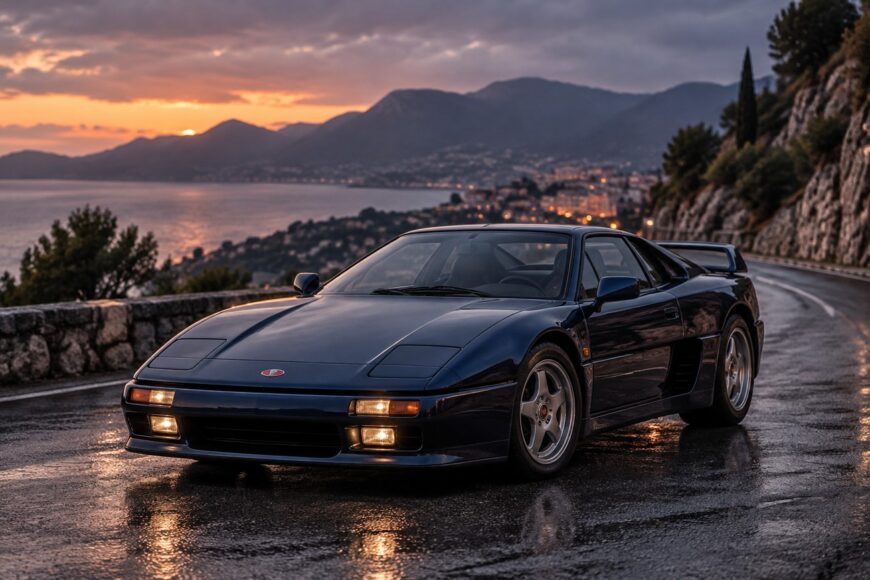
The Venturi 260 offers a rare French alternative to the period Porsche 911: compact, fast, turbocharged, and built around a mid-engine layout. Its appeal lies in having a character of its own rather than simply reproducing a familiar German formula.
That individuality carries a cost. Parts sourcing, specialist knowledge, composite-body repairs, and electrical diagnosis can turn ownership into a long-term project. The sensible choice is therefore distinctive mid-engine performance with careful support in place, rather than an assumed 911 substitute that can be maintained in the same way.
- Why the Venturi 260 is a 911 rival, not a 911 clone
- The turbo V6: strong numbers, disputed displacement
- What its mid-engine layout changes on the road
- Venturi 260 vs Porsche 911: the practical differences
- The ownership costs hidden behind the performance
- Buying a Venturi 260: inspect the car, not the badge
- Frequently asked questions
- How should you insure a Venturi 260 when standard valuations are unreliable?
- What should you arrange before importing a Venturi 260?
- What should you check before fitting modern tires to a Venturi 260?
Why the Venturi 260 is a 911 rival, not a 911 clone
The Venturi 260 was a French two-seat, two-door coupé produced approximately from 1989 to 1995. Its compact body, rear-wheel drive, and turbocharged V6 placed it in the same broad sporting conversation as the Porsche 911. The comparison is useful because both cars promise serious performance in a relatively small package, yet it can mislead a buyer searching for identical road manners.
The key distinction is the engine position. The Venturi uses a mid-engine layout, while the contemporary Porsche 911 is rear-engine. That changes the distribution of mass around the driver, the way the car loads its tires, and the sensations produced when cornering hard. A 911 comparison helps establish the market position; it does not define the Venturi’s behavior.
Venturi also feels like a product of a smaller manufacturer. Its rarity gives the car a presence that a familiar 911 cannot easily reproduce, but it also means that development, production consistency, and after-sales support were never on Porsche’s scale. Cabin details and controls may feel less resolved than those in a comparable period 911, even when the chassis and engine provide an equally serious driving experience.
That difference matters most to buyers who expect predictable ownership. A 911 has a wider specialist network, deeper documentation, and a larger pool of used parts. The Venturi rewards the person who values an unusual engineering solution and accepts that preserving it may require research, patience, and contact with the small community around the marque.
The turbo V6: strong numbers, disputed displacement
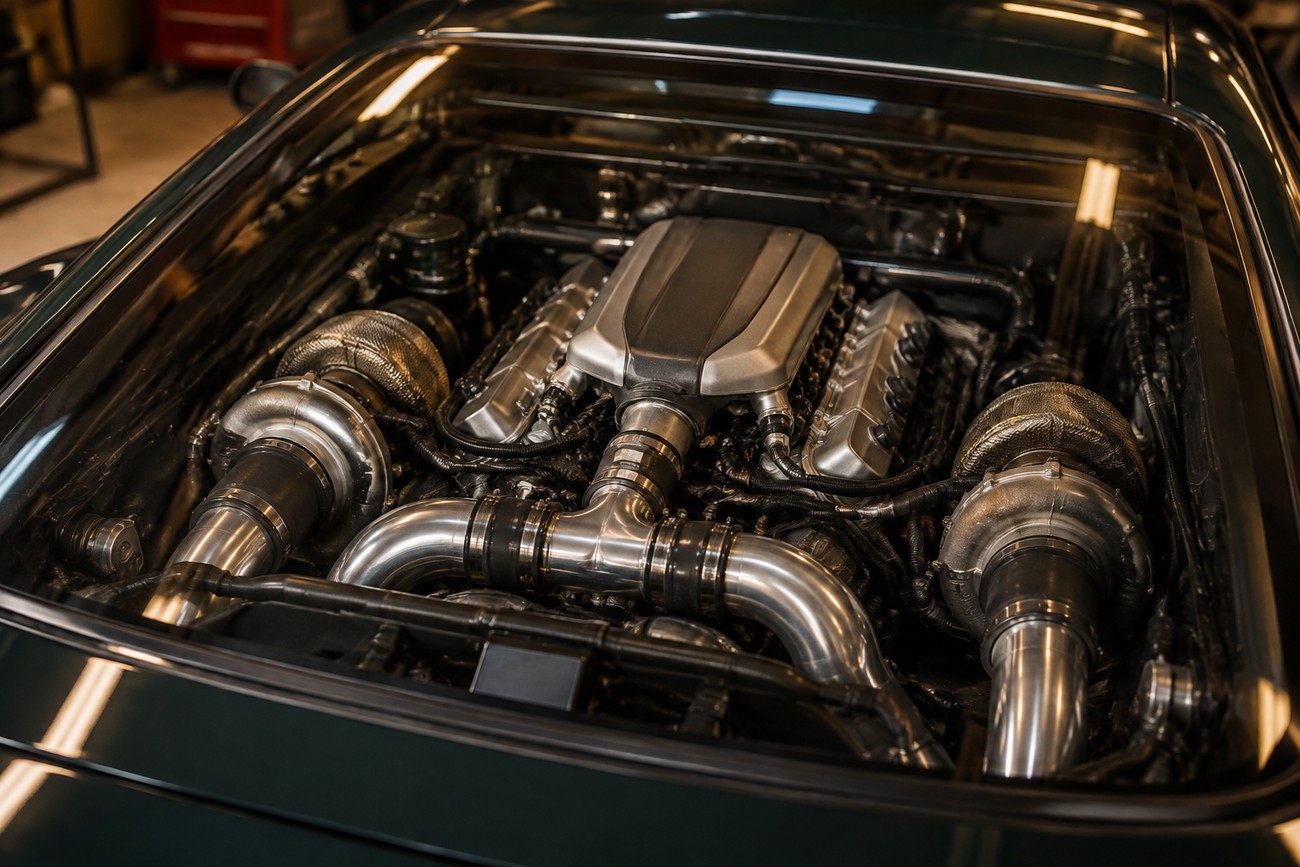
The Venturi 260 uses a turbocharged, liquid-cooled SOHC V6 with two valves per cylinder and a Garrett T3 turbocharger. A five-speed manual transmission sends the power to the rear wheels. Commonly cited figures are 260 hp at about 5,500 rpm and 431–432 Nm at about 2,000 rpm, giving the car unusually strong torque at ordinary road speeds.
That torque changes the experience more than the peak power figure alone suggests. The engine does not need to be kept at the top of its rev range to make the car move decisively, and overtaking can be completed with relatively little preparation. The turbo system, fuel delivery, cooling, and engine calibration must all be healthy for that response to remain consistent.
Displacement requires more care in a sales description. Some specifications give 2,849 cc, while other sources round the engine to 2.9 liters or cite 2,900 cc for LM-related versions. Those figures should not be treated as one verified specification for every Venturi 260. A buyer should confirm the individual variant, engine identity, and supporting documentation before ordering parts or comparing listings.
Period specifications commonly place mass at approximately 1,254–1,265 kg. Quoted performance is 0–100 km/h in about 5.1–5.3 seconds, with a stated top speed around 270 km/h. These are useful indicators of the car’s intended capability, not promises made by every surviving example. Age, boost control, fuel-system condition, tire choice, and maintenance can make a substantial difference.
What its mid-engine layout changes on the road
With the engine mounted between the axles, the Venturi has a different balance from the rear-engine 911. The front end can feel comparatively light and direct, while the car’s central mass supports a distinct response to steering input. The exact impression varies by suspension condition and setup, so one well-sorted Venturi should not be treated as representative of every car.
Tires are a particularly important part of the equation. Their condition and specification influence steering weight, braking confidence, ride quality, and the way the chassis settles after an input. Suspension alignment, worn components, and incorrect ride-height settings can make a fundamentally capable car feel nervous or dull.
The quoted acceleration figures also depend on mechanical health. A tired turbocharger, restricted fuel delivery, poor boost control, or an overheating cooling system can reduce the engine’s useful response even when the car still starts and drives. A test drive should therefore assess the progression of boost and the stability of temperatures, rather than focusing only on one hard acceleration run.
The Venturi’s character is best understood as its own combination of mid-engine balance and turbocharged torque. It does not need to imitate a 911 to be effective, and comparisons become more useful once the buyer stops expecting identical steering habits or weight transfer. A sorted example can feel unusually focused, while a neglected one may disguise its strengths beneath old tires and deferred maintenance.
Venturi 260 vs Porsche 911: the practical differences
Both cars can appeal to a buyer seeking a compact, high-performance classic, but their ownership assumptions are different. Porsche specifications vary by generation and version, so the comparison below stays qualitative.
| Area | Venture 260 | Contemporary Porsche 911 |
|---|---|---|
| Engine position | Mid-engine, rear-wheel drive, with a turbocharged V6. | Rear-engine, rear-wheel drive; exact engine and chassis details vary by version. |
| Driving character | Central mass and strong low-rpm turbo torque create a distinct, focused response. | Rear-engine weight distribution gives the car its own characteristic turn-in and traction behavior. |
| Parts and servicing | Venturi-specific parts and knowledgeable technicians can be difficult to source. Some French components may be shared, subject to verification. | Broader period support, documentation, and specialist access generally make routine ownership easier. |
| Cabin | Finish and ergonomics can feel less resolved, with some period mass-produced French components visible. | Comparable cars usually offer a more cohesive cabin and a stronger established parts network. |
| Resale audience | A small, specialist audience values provenance and correct maintenance, so selling may take time. | A larger market makes condition and pricing easier for buyers and sellers to benchmark. |
The ownership costs hidden behind the performance
The low production volume is the central ownership issue. Venturi-specific parts, original documentation, and specialist knowledge are limited, while the present-day factory support available to a mass-produced sports car is largely absent. Owners may need to order parts through enthusiasts or small specialist workshops, and a seemingly simple repair can become a search exercise before any labor begins.
The engine bay adds to that burden. Turbo hardware, hoses, sensors, and cooling components can be difficult to reach, so routine work may take longer than the same operation on a more familiar car. Cooling deserves particular attention because neglected radiators, hoses, or thermostats can lead to overheating and expose expensive weaknesses in the V6 and turbo system.
Age-related electrical faults are another inspection priority. Old wiring, connectors, sensors, instrument-cluster circuits, and lighting can produce intermittent symptoms that are difficult to reproduce. These are reported ownership patterns and risks to investigate, not universal failures present on every Venturi 260.
Some engine and transmission components may be shared with period PSA or Renault applications, which can make selected repairs easier. That advantage only works after the exact part has been identified. Assuming that a component fits because it came from a related French model can waste time or create a new reliability problem.
Real ownership cost is therefore shaped by downtime and specialist labor as much as by the purchase price. A car with a known history may cost more to acquire yet be substantially easier to live with than a cheaper example with undocumented repairs. The Venturi can be reliable with proper care, but reliability depends heavily on the quality of that care.
Buying a Venturi 260: inspect the car, not the badge
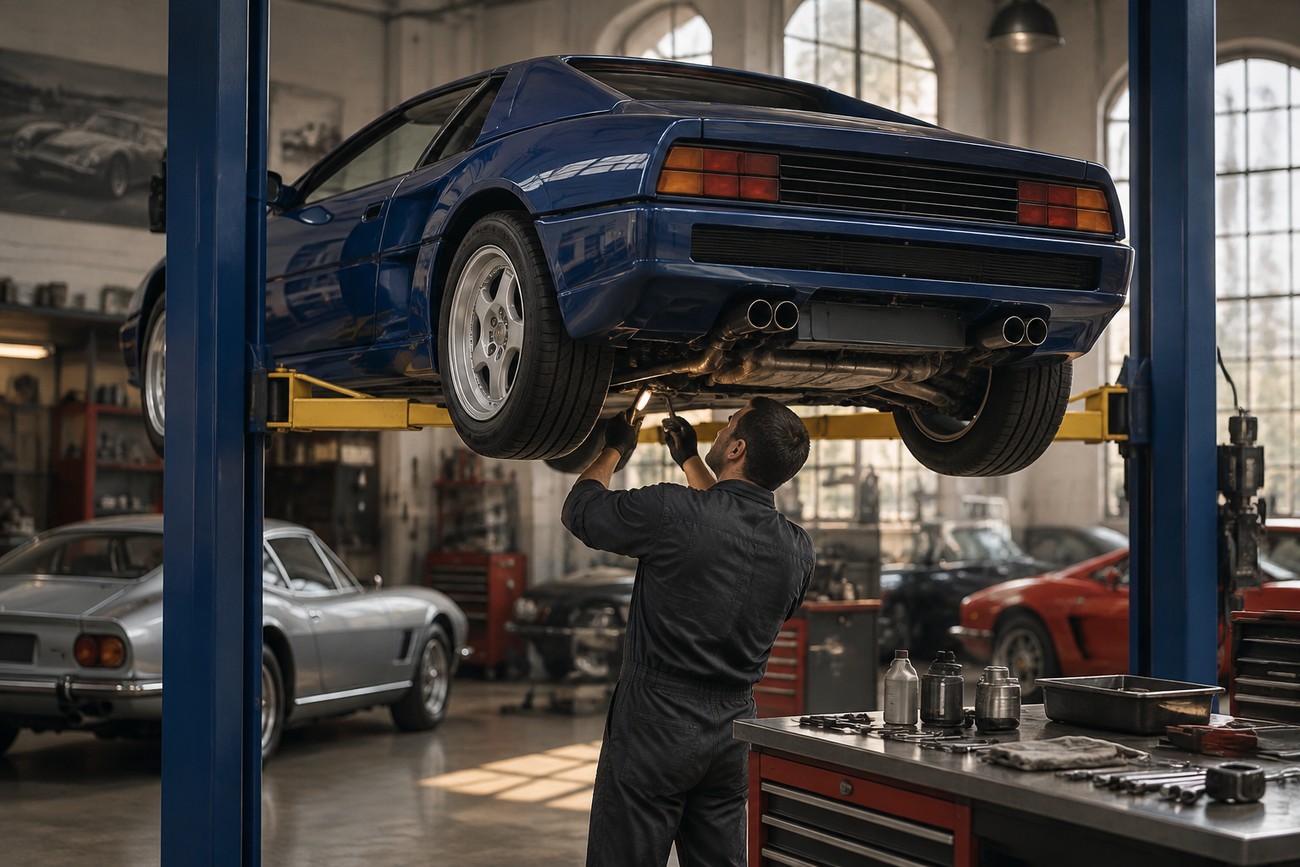
Begin by confirming what the car actually is. Check the individual variant, engine identification, displacement description, transmission, and any relationship to LM-related specifications. Sources may list 2,849 cc, a rounded 2.9 liters, or 2,900 cc, so an advertisement alone is not enough to establish the specification.
Next, require a coherent service history. A specialist should inspect the cooling system, turbocharger, boost control, fuel delivery, and signs of overheating. The examination should include a cold start and a road test long enough to establish whether temperatures remain stable and whether boost arrives progressively rather than fluctuating or disappearing.
Before approving a replacement Garrett turbo, match its specification to the car and check boost control and fueling rather than choosing a visually similar unit.
Electrical checks should cover the instruments, sensors, exterior lighting, charging system, and intermittent faults recorded by the owner. The composite body also deserves specialist attention. Repairs performed as if the panels were ordinary steel can leave poor geometry, uneven gaps, weak mounting points, or aerodynamic problems that are expensive to correct.
Be cautious with cars advertised primarily through power claims. Improvised turbo substitutions, increased boost without proper measurements, and chip tuning without mixture control can cause detonation and reduce engine life. A standard-looking car with documented maintenance is usually a more convincing purchase than a modified example whose calibration cannot be explained.
Finally, plan the ownership network before completing the sale. Identify a workshop familiar with Venturi cars, locate sources for model-specific parts, and understand how the car would be transported if it became immobile. Verified specialist care is valuable in the thin resale market because it gives the next buyer evidence that the performance has not been achieved by sacrificing mechanical health.
Frequently asked questions
The answers below address ownership decisions that are easy to overlook when the car is judged mainly by its rarity and performance figures.
How should you insure a Venturi 260 when standard valuations are unreliable?
Discuss an agreed-value policy with an insurer that understands unusual or collectible vehicles. Provide photographs, the specification of the individual car, purchase records, service invoices, and evidence of specialist maintenance so the valuation reflects its actual condition and provenance rather than an unreliable database estimate.
Ask how a claim would treat scarce parts, imported components, composite panels, and specialist labor. Clarify whether the policy permits repairs through a suitable workshop and whether the agreed value is reviewed when market evidence changes. Written confirmation is preferable to relying on a generic online quote.
What should you arrange before importing a Venturi 260?
Confirm local registration, inspection, tax, and documentation requirements with the relevant authority before buying the car. Check that the identity documents, ownership records, and specification information match the vehicle, especially where listings use different displacement descriptions.
Arrange suitable enclosed or otherwise appropriate transport, then secure post-arrival support from a workshop familiar with Venturi cars. Parts sourcing can take time, so the first inspection should be planned before the vehicle reaches its destination rather than after an electrical, cooling, or turbo problem appears.
What should you check before fitting modern tires to a Venturi 260?
Verify the individual car’s wheel dimensions and the correct tire fitment before ordering. Confirm appropriate load and speed ratings, inspect tire age, and check that the chosen tire does not create clearance or alignment problems. Guessing a size from a similar sports car can alter the handling balance.
Have the alignment and suspension condition checked at the same time. Modern tires can expose worn bushes, incorrect geometry, or unsuitable damping, and their effect on handling and comfort can be substantial. The best result comes from matching the tires to a healthy, correctly set-up chassis rather than treating them as an isolated upgrade.







