

Handing a valet the keys to a Corvette authorizes a parking job, not an aggressive drive. In a documented case, Performance Data Recorder footage showed a valet repeatedly revving a C8 above 6,000 rpm. The recording revealed troubling conduct, but it did not, by itself, establish that the engine was damaged.
That distinction matters if you collect the car and find extra miles, a scrape, or an unfamiliar warning light. You need to preserve what the car recorded, establish its condition before and after the handoff, and identify who controlled it in between. Corvette Valet Mode can help protect access and capture evidence when configured correctly, though its driving restrictions vary by vehicle.
- When a valet parking job becomes a joyride
- What Corvette Valet Mode and PDR actually do
- The handoff checklist that preserves your proof
- What to do after discovering the extra miles or damage
- Building a liability and insurance claim
- The Valet Mode myths that can weaken your case
- Frequently asked questions
- What if the PDR file will not open or appears to be missing?
- What car is the poor man’s Corvette?
- Why can’t dealers sell the Z06?
- What is the holy grail of Corvettes?
When a valet parking job becomes a joyride
A valet may need to move a car through a garage or to another parking area. Repeated hard acceleration, unnecessary distance, or a route unrelated to parking can point toward unauthorized use. The circumstances matter: a short drive on the property is different from taking the car onto public roads for personal enjoyment.
Owners often discover the concern only after collecting the Corvette and reviewing its PDR footage. In the documented C8 case, the recording showed a valet repeatedly revving the engine above 6,000 rpm. That is evidence of how the car was driven; the route, timing, odometer readings, and valet’s account help establish whether the driving exceeded the permitted task.
High engine speed can reasonably prompt concern about a cold engine, tires, clutch components where applicable, or the transmission. Yet revs alone do not show that any component failed, nor do they establish a repair cost. If the car develops a symptom, record it promptly and seek an inspection that addresses whether the reported use could have caused the specific problem.
What Corvette Valet Mode and PDR actually do
Corvette Valet Mode is primarily an access-control feature. Depending on the vehicle, it can lock multimedia functions, the glove box, and the center storage area behind a PIN. Keep that PIN to yourself: the valet needs the key to park the car, not permission to unlock your settings or belongings.
Driving restrictions require a closer look at the applicable owner’s manual. The 2015 Corvette manual says Valet Mode may limit maximum speed and power, as well as restrict storage access. Chevrolet’s exact functions vary by year and equipment, so a description of one Corvette should not be treated as a specification for another.
The Performance Data Recorder, or PDR, records video and driving data when it is available and operating. Automatic recording specifically for Valet Mode must be enabled in advance through the car’s settings. Switching on Valet Mode alone does not establish that every valet trip will be recorded.
Before relying on the system, check the settings and recording media for your Corvette. Missing media, a disabled recording option, an overwritten file, or a limited camera view can leave gaps. PDR is useful evidence when it works, but a photograph of the odometer and a retained valet ticket remain valuable independent records.
The handoff checklist that preserves your proof

Set up the car before reaching the valet stand. Confirm that the correct Valet Mode options are active, enable automatic PDR recording for Valet Mode if your Corvette supports it, and check that recording media is present. Enter the PIN privately and hand over only what the parking service needs to move the vehicle.
Take clear photographs of the odometer, fuel level, bodywork, wheels, and interior at the handoff location. Images that show the whole car as well as existing marks make a later comparison easier. Record the handoff time and location, and keep the valet ticket and receipt.
Note the employee’s identity if it is available on a badge, ticket, or receipt; do not depend on remembering it later. PDR readings and actual odometer mileage are separate evidence sources, so compare them rather than substituting one for the other. If the odometer shows more travel than the recording accounts for, that difference may call for an explanation without proving what happened on its own.
What to do after discovering the extra miles or damage
Start with the records while the car and the handoff details are fresh. Preserve the original PDR file before editing, sharing, or sending the car for service, and make a separate copy for review. Its metadata, date, and duration may matter as much as the footage visible on screen.
Photograph the odometer, fuel level, exterior, wheels, interior, and any warning messages. Write down when you received the car, who spoke to you, and what each person said; ask witnesses for their contact details. A prompt post-handoff inspection can connect visible damage and mileage to the valet timeline more clearly than a later recollection.
Notify the operator of the concern in writing and request preservation of security-camera footage, key-issue logs, and any relevant GPS records. Describe the car, ticket, and handoff times precisely, then keep a copy of the request. A calm, documented account is more useful than an argument that leaves only conflicting memories.
Building a liability and insurance claim
Organize the claim around two related issues: what the valet did and what loss followed. Video of an unauthorized drive may support the first issue. A repair claim generally needs photographs, diagnostic findings, invoices or estimates, and an explanation connecting the particular damage to the incident.
Responsibility depends on local law, the service arrangement, the valet’s conduct, and the evidence of causation. An Oklahoma Bar Association legal analysis notes that wrongful use of a delivered vehicle may create liability for resulting damage. That principle does not mean every recorded acceleration produces a payable mechanical claim.
A disclaimer printed on a valet ticket is not automatically a complete defense. Its effect depends on the jurisdiction, wording, and circumstances of use. Save the ticket rather than discarding it: its terms, operator name, and identifying details may all matter when you report the incident.
Texas provides a concrete example of how insurance rules can apply. Valet operators there must maintain financial security with minimum limits of $100,000 for injury to one person, $300,000 for injuries to multiple people, and $50,000 for property damage. Texas garage insurance requirements also address physical damage to vehicles in storage and vehicles operated by the valet service.
Those Texas requirements are not universal claim limits or procedures. Ask the operator to identify its insurer and claim process, and check whether your own auto policy offers a route for reporting the loss. Coverage can involve exclusions, separate limits, and a dispute over whether the claimed damage resulted from the valet’s conduct.
The Valet Mode myths that can weaken your case
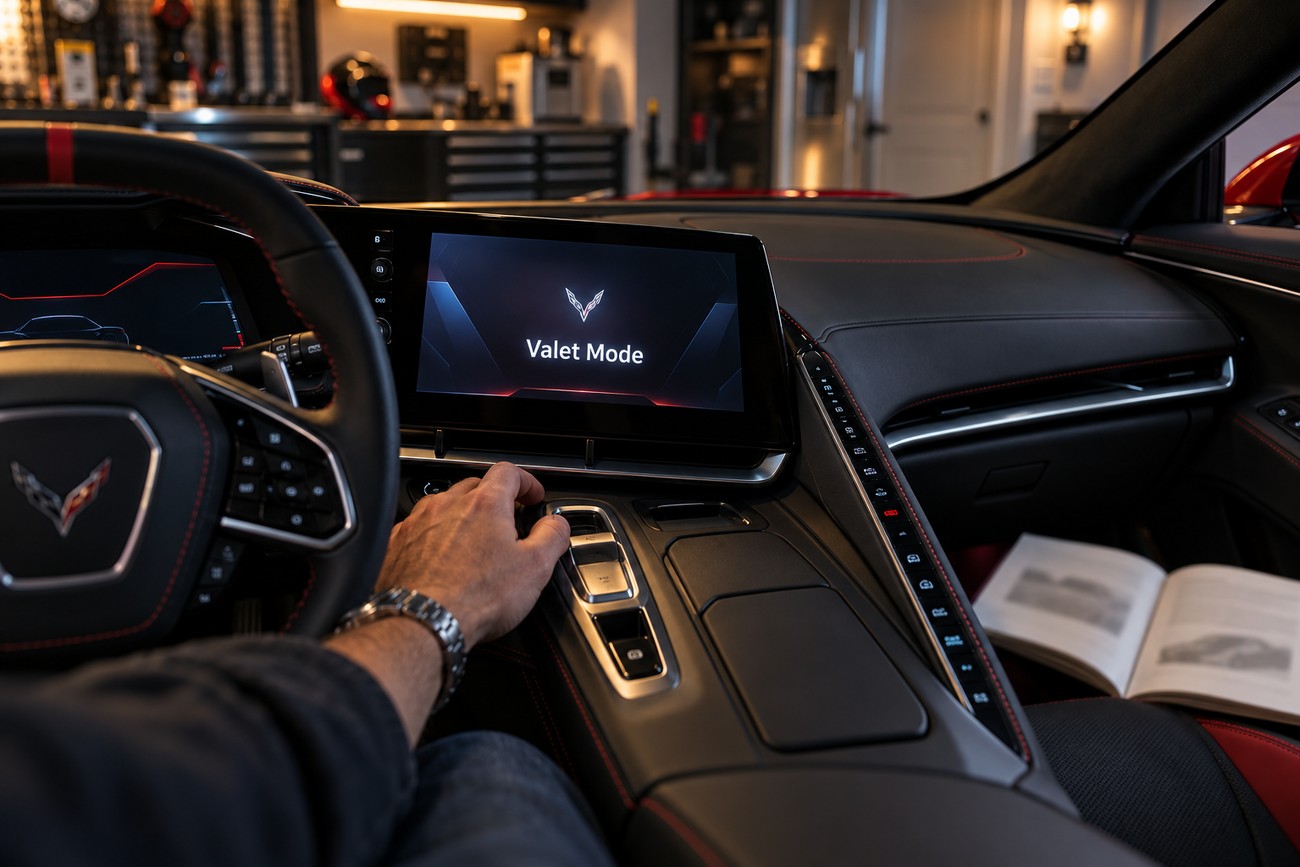
There is no single Chevrolet-confirmed Valet Mode rule limiting every Corvette to about 3,000 rpm and third gear. Online accounts may describe a particular vehicle or repeat an unsupported assumption. Use the manual for your model year and equipment when explaining what your car’s mode was designed to do.
A locked glove box does not prevent someone from driving aggressively. Valet Mode can restrict access and settings, while its speed and power functions vary. Treat it as one precaution rather than proof that a joyride was physically impossible.
PDR footage also has limits. Recording may be unavailable, unconfigured, overwritten, or incomplete, so an absent clip does not settle what occurred. Likewise, the existence of valet insurance does not guarantee payment: the relevant policy, claim procedure, and evidence of loss still matter.
Frequently asked questions
The questions below cover missing PDR files and several broader Corvette topics. If a recording is missing, preserving the media and checking the vehicle’s settings are the first concerns. Questions about other models, dealer availability, and collectible Corvettes depend on the specific vehicle.
What if the PDR file will not open or appears to be missing?
Keep the original storage media and stop recording onto it while you investigate. Document the error message, the settings you found, and any files visible on the media. If possible, make a forensic copy before attempting recovery, so troubleshooting does not alter the only potential evidence.
Check the vehicle’s recording settings and consult the applicable owner’s manual or a qualified data-recovery specialist. Avoid repeatedly testing the recorder with the same media: new recordings could overwrite material that might otherwise be recoverable.
What car is the poor man’s Corvette?
“Poor man’s Corvette” has no official or agreed model designation. People sometimes use it for a more attainable sports car, including the Chevrolet Camaro, but the comparison depends on whether they mean styling, performance, or purchase cost.
If you are choosing a car, compare the particular model years and versions you can buy rather than relying on the nickname. A Camaro and a Corvette differ in layout, seating, and intended use, even when a casual comparison groups them together.
Why can’t dealers sell the Z06?
There is no general rule preventing dealers from selling a Corvette Z06. A specific dealer may lack an allocation or available inventory, or a particular vehicle may be subject to a temporary stop-sale or another manufacturer restriction. The reason depends on the car and the time of sale.
Ask the dealer whether the issue concerns ordering, delivery, or sale of a specific vehicle, and request the applicable notice or vehicle status in writing. That distinction helps separate a limited supply from a restriction that must be resolved before delivery.
What is the holy grail of Corvettes?
The original 1963 Corvette Grand Sport is often cited as a “holy grail” because of its racing history and rarity. The phrase is subjective, though: collectors may prize different Corvettes for their provenance, condition, or place in the model’s history.
For a particular car, documented identity matters more than the label. Records establishing what the vehicle is, along with its ownership and restoration history, are essential when evaluating a claim of unusual significance.







