
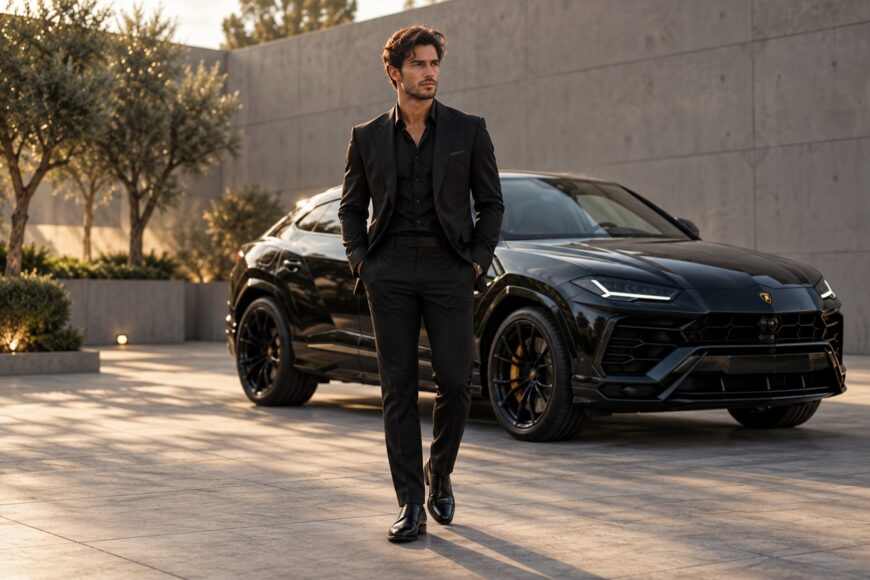
The Lamborghini Urus brings immediate visual authority to a fashion set. Its seating position is higher than a coupe or sedan, its proportions read clearly from a distance, and its status image can turn an otherwise plain location into a premium backdrop. That impact is useful only when the vehicle is treated as part of the composition rather than as an expensive object parked beside the model.
The same presence creates production demands. The Urus can overwhelm the subject, reflect every light stand and operator, show dust quickly, and consume valuable time during repositioning. Access, surface quality, cleaning, and permission to use visible brand identifiers should be settled before the first call sheet is issued.
- Why the Urus Works in Fashion—and When It Works Against You
- Choose a Location That Can Actually Handle the SUV
- Build the Image Around Light, Reflections, and Perspective
- Design the Shoot Day to Reduce Paid Downtime
- Permissions, Brand Use, and Commercial Risk
- The Mistakes That Make an Urus Look Expensive in the Wrong Way
- Frequently asked questions
- What is the poor man’s Urus?
- What is the poor man’s Lamborghini?
- Which Urus color is easiest to photograph?
Why the Urus Works in Fashion—and When It Works Against You
The Urus works because its taller SUV profile gives the frame a stronger vertical hierarchy than a low coupe or sedan. The vehicle can sit behind the model as a recognizable luxury status symbol, anchor a full-length portrait, or create a hard architectural shape against a simple background. Its visual weight is especially useful in editorial images built around power, control, or urban luxury.
That weight must be measured against the model’s role. Place the vehicle too close, and its hood, roofline, or bright bodywork can swallow the person. Use a busy location as well, and the frame loses hierarchy: the car dominates, the model becomes a scale reference, and the background competes with both.
A high rental cost does not create a fashion image by itself. The result depends on distance, lens choice, light direction, and the relationship between the model’s pose and the vehicle’s geometry. A simple static composition with clear negative space can feel intentional, while a more elaborate setup may look like a dealership image if the car has no defined visual function.
Decide what the Urus is doing before it arrives: framing the model, providing a reflective surface, establishing scale, or carrying the movement of the image. That decision controls where it sits, how much of it appears, and whether the final photograph feels like fashion rather than automotive documentation.
Choose a Location That Can Actually Handle the SUV
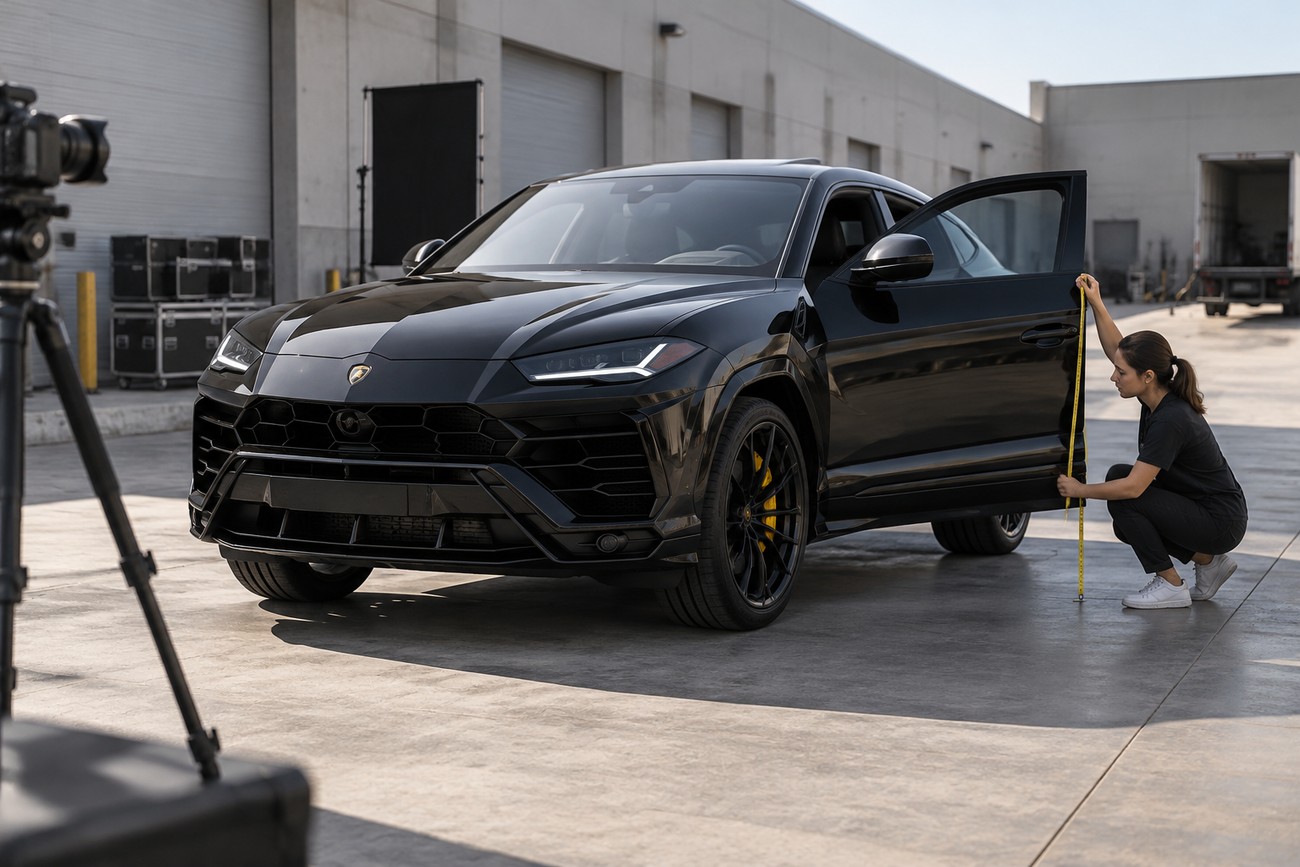
Location checks should begin with access and staging, before anyone discusses the most attractive wall or background. The Urus is approximately 5.1 m long, approximately 2.0 m wide without mirrors, and approximately 1.64 m high. Those dimensions affect side clearance, rear clearance, camera distance, loading access, and the room needed to open doors without compromising the set.
Low entrances, arches, underground parking areas, and narrow driveways can restrict both the vehicle and the camera. A location may be large enough for a parked car yet too tight for a safe turn or a useful shooting angle. The Urus also has a noticeably larger turning radius than typical passenger cars, so repeated resets can take much longer than a crew expects.
Surface inspection is equally important. With a mass of approximately 2.2–2.3 t depending on version, the vehicle places substantial load on soft ground, wet grass, paving, and sand. These surfaces increase the risk of sinking, surface damage, or vehicle damage, while low curbs, ramps, bumps, and rails can create clearance problems.
Before booking, walk the complete route from entry to exit and mark the holding position, camera positions, turning points, and emergency exit route. Include a backup route if the primary access depends on a gate, elevator, or managed parking area. A short technical recce can prevent hours of paid delay and avoid forcing the driver into improvised maneuvers around equipment and talent.
Build the Image Around Light, Reflections, and Perspective
Glossy Urus panels behave like large curved mirrors. They can reflect the operator, lighting equipment, softboxes, stands, nearby vehicles, and unwanted parts of the location. A clean frame therefore requires control of the environment around the car, not only control of the subject in front of it.
Flag reflective surfaces before placing the model. Moving a stand, changing the camera angle, or hiding a bright vehicle outside the frame can remove an entire production problem before retouching begins.
Black paint makes body detail and highlight control more difficult. In weak light, the form can disappear; in uncontrolled light, highlights break into distracting patches. Clean wheels and wheel arches deserve particular attention because dust, brake residue, and road film immediately reduce the premium impression, even when the main body looks polished.
A longer focal length and controlled perspective can help the Urus retain the scale it has in person. Wide lenses used too close may stretch the front end or make the vehicle look less substantial. Give the camera enough distance to preserve its proportions, then use the model’s position and the car’s visible surfaces to build depth.
Wet asphalt can be an effective optional surface because reflections emphasize the vehicle’s body line. It also increases glare and safety considerations, so the effect should be planned rather than created casually. For vertical content, a static Urus composition often preserves the SUV’s visual mass better than motion, which can make the vehicle read as a partial blur or lose its distinctive volume.
Design the Shoot Day to Reduce Paid Downtime
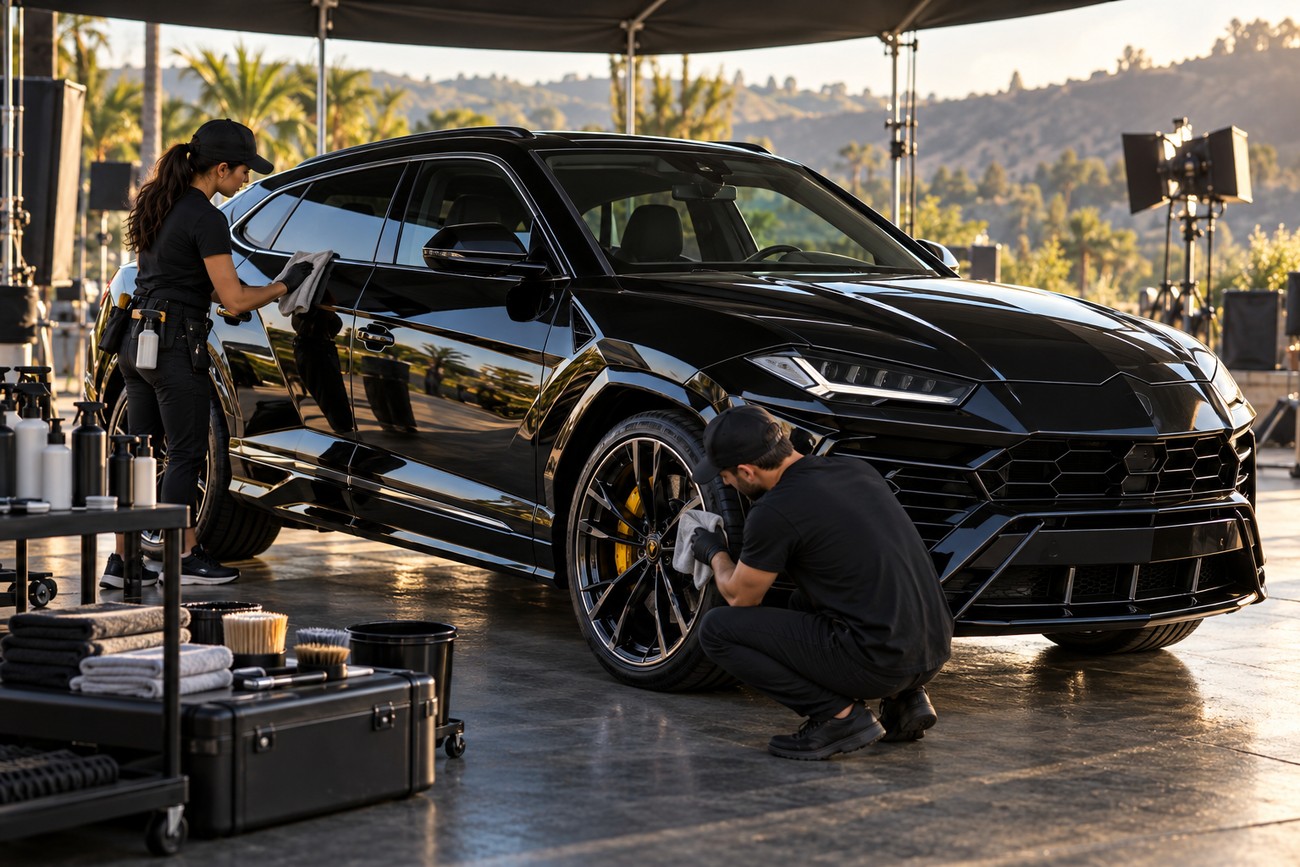
Build detailing into the schedule as a production task, not as a final courtesy. Dust, fingerprints, streaks, dirty wheels, and brake dust show immediately on a premium vehicle. Plan a detailed wash and wipe before each major series, with a dedicated check of the wheels, arches, glass, door edges, and reflective body panels.
The car also needs a holding position between takes. Direct sun can quickly heat the body and make waiting uncomfortable for the crew and model. A shaded or cooler staging plan helps manage heat and glare and keeps the vehicle available without repeatedly moving it through the set.
Dynamic shots require substantial space and an experienced driver. “Drive past the model” is rarely a complete action direction: speed, stopping distance, camera position, pedestrian control, and the vehicle’s exit route all need to be defined. If the location cannot support those variables, a controlled static frame is usually the safer production choice.
Schedule repositioning as paid work. A large SUV takes time to move, turn, clean, and reset around stands, talent, and camera equipment. Waiting and repositioning can make rental downtime more expensive than the location itself, particularly when the team is still deciding where the car should go.
Permissions, Brand Use, and Commercial Risk
Permission to use the vehicle is separate from permission to conduct the shoot at a location. Professional productions commonly need approval from the owner or rental provider, as well as the venue. Private property, shopping centers, monument areas, and blocked pedestrian routes may involve additional rules, access limits, or charges.
Send the venue a practical description of the production: vehicle movements, crew size, equipment, parking requirements, sound, lighting, and the intended schedule. A short fashion shoot can still trigger security concerns if the car occupies a drive lane, blocks an entrance, or arrives with a large crew and lighting package.
Commercial use of the Lamborghini name, logo, or other brand identifiers can raise trademark and licensing issues. Renting the vehicle does not automatically settle how those identifiers may appear in a final advertisement. Product placement, editorial coverage, and paid campaign work can be treated differently by the relevant rights holders.
Confirm the intended use before production and again before final delivery. Written permission is the safer standard when brand elements appear in commercial advertising, especially if the campaign will identify the vehicle directly or present it as an approved brand association.
The Mistakes That Make an Urus Look Expensive in the Wrong Way
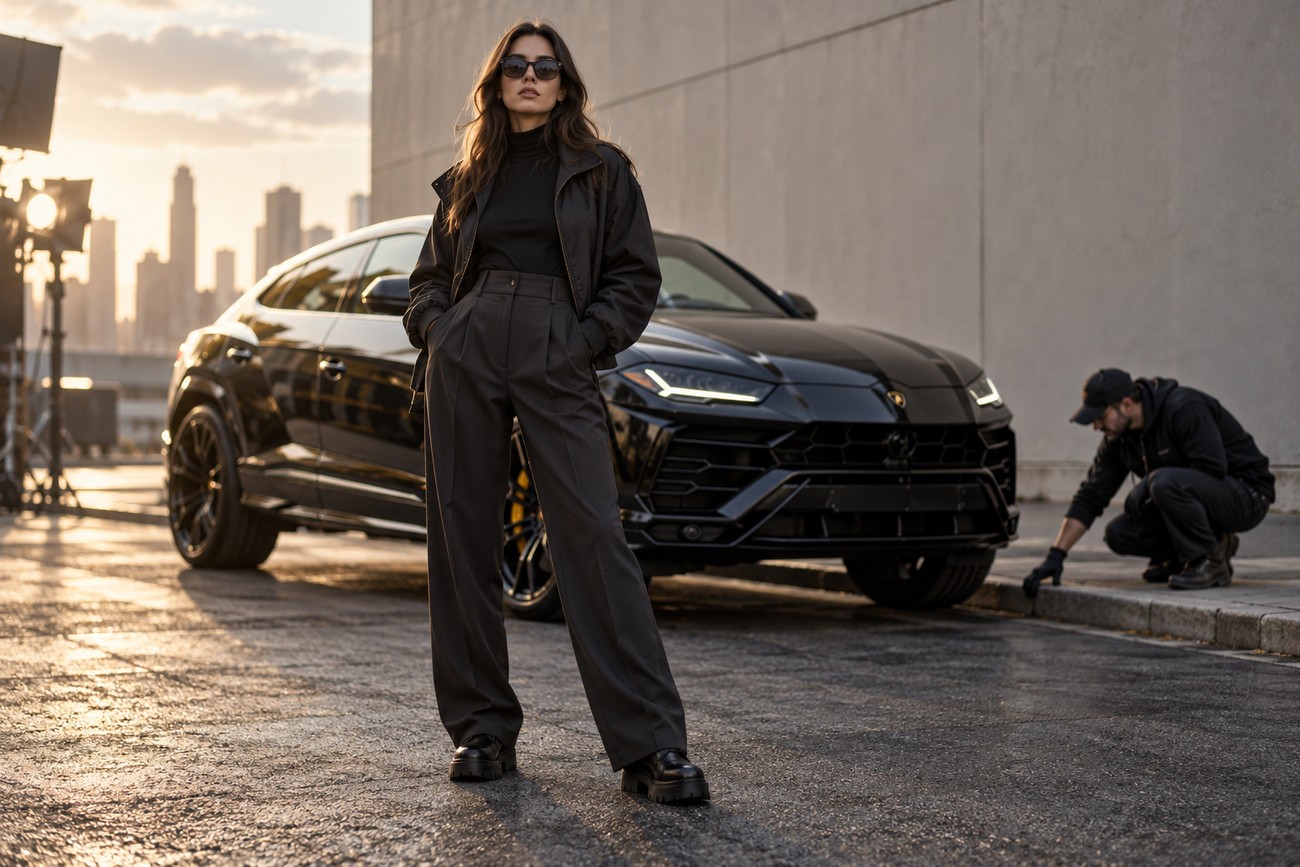
The first warning sign is scale without hierarchy. If the Urus sits too close to the model, its height and body width overpower the person. Move it back, turn it slightly, or show less of the vehicle so the model remains the subject and the car supports the visual idea.
Another failure begins at the entrance. A location without a movement plan, a clear exit, and a backup route creates delays as soon as the first angle changes. Low curbs, ramps, bumps, and rails can create clearance problems, while an uninspected surface can put the tires, wheels, underside, or paving at risk.
Reflections and detailing are not finishing concerns. If the operator appears in a door panel, a softbox cuts across the hood, or brake dust marks the wheel, the image loses control. The same applies to black paint photographed without a deliberate highlight structure: the vehicle may look flat in one frame and chaotic in the next.
A dynamic drive-by is not automatically stronger than a static frame. Movement needs space, a skilled driver, and a camera position that preserves the SUV’s mass. Not every location is suitable for the Urus, and a luxury vehicle alone does not create fashion value without controlled light, space, and composition.
Frequently asked questions
The most useful comparison terms around the Urus and Lamborghini often come from informal automotive language. They can help describe market positioning, but they should not be treated as official classifications or as substitutes for production planning.
What is the poor man’s Urus?
“Poor man’s Urus” is an informal comparison commonly applied to the Audi RS Q8. The phrase reflects overlapping performance positioning and SUV practicality, rather than an official relationship between the vehicles.
The Audi RS Q8 may serve a similar visual role in a shoot where the brief needs a high-performance luxury SUV without the same Lamborghini identity. It does not provide the same badge, design language, or brand recognition, so it should be presented as a different creative choice rather than as an interchangeable Urus.
What is the poor man’s Lamborghini?
“Poor man’s Lamborghini” is an informal comparison commonly applied to the Audi R8. Casual automotive discussion uses the phrase because the R8 occupies a related performance space and may offer a more accessible route into an exotic-car image.
A lower price or related engineering does not make the Audi R8 a substitute for Lamborghini branding in a campaign. The silhouette, badge, audience associations, and licensing considerations remain different, which matters if the vehicle is meant to communicate a specific marque rather than general performance.
Which Urus color is easiest to photograph?
A medium or lighter paint color is usually easier to photograph because it keeps the body lines readable and gives the crew more room to control highlights. It also makes ordinary dust less visually dominant than it can be on a dark finish, although wheels, arches, and glass still require careful cleaning.
Choose the color according to the intended mood. Dark finishes can support an aggressive, restrained image, while lighter or more visible finishes can preserve the SUV’s shape in low-contrast locations. The easiest color is the one that matches the available light and background, rather than the one that looks most dramatic in isolation.







