
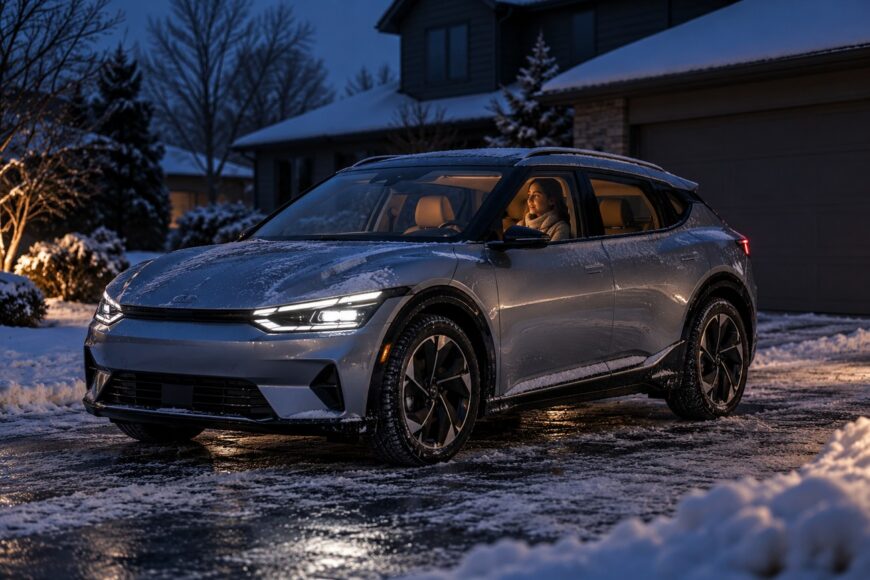
During a cold power outage, the Kia EV6 can serve as a temporary warm shelter, but battery power must cover two needs: keeping you comfortable and leaving when conditions require it. Set aside a departure reserve before treating the car as a heated room.
The EV6 heats its cabin electrically, so there is no universal number of hours. Available charge, outdoor conditions, wind, door openings, insulation, and the selected temperature matter more than any advertised estimate. Your parking location, climate settings, and exact vehicle specification also determine whether the plan works safely.
- Park safely and check the car before settling in
- Keep the cabin warm with Utility Mode
- Budget heat against the charge you need to leave
- Use V2L for essentials, not as a plug-in home generator
- Frequently asked questions
- What should I do if the windows fog up while sleeping in the EV6?
- What should I keep in the EV6 before a winter power outage?
- How do I use Utility Mode on a Kia EV6?
Park safely and check the car before settling in
Park outdoors in an open, ventilated location, secure the vehicle, and keep every exit accessible. An enclosed garage is unsuitable even though the EV6 has no tailpipe exhaust: nearby combustion sources, including other vehicles or equipment, can create a carbon monoxide hazard. Keep the car clear of snow, and do not block its cooling areas.
Check the battery level, charging options, climate controls, and the relevant instructions for your model year. V2L equipment and specifications depend on market, model year, and trim, so another EV6’s procedure may not apply to yours.
Run a short test before an outage. Confirm that the cabin remains warm in the intended power mode, that the display shows the expected settings, and that the adapter, cable, and appliances you plan to use work together. This trial can expose a mode conflict or faulty equipment while help and power are still available.
Keep the cabin warm with Utility Mode
Follow the manual for your vehicle to start the EV6 and select its intended stationary power mode, such as Utility Mode. Set a modest cabin temperature, then verify that climate control is operating. The EV6 uses high-voltage battery energy for electric heating.
Simply switching the vehicle off is not a dependable way to sustain a long stop. Internal V2L stops when the vehicle is switched off, and climate operation may also change. Check the display and cabin conditions periodically rather than treating one setting as an unattended guarantee.
Before using V2L, cancel any active scheduled-climate setting. Kia identifies a scheduled climate setting as a possible reason V2L will not start. Keep the vehicle’s cooling areas uncovered; a motor-compartment fan may start while V2L is operating, even when the vehicle appears switched off.
Budget heat against the charge you need to leave
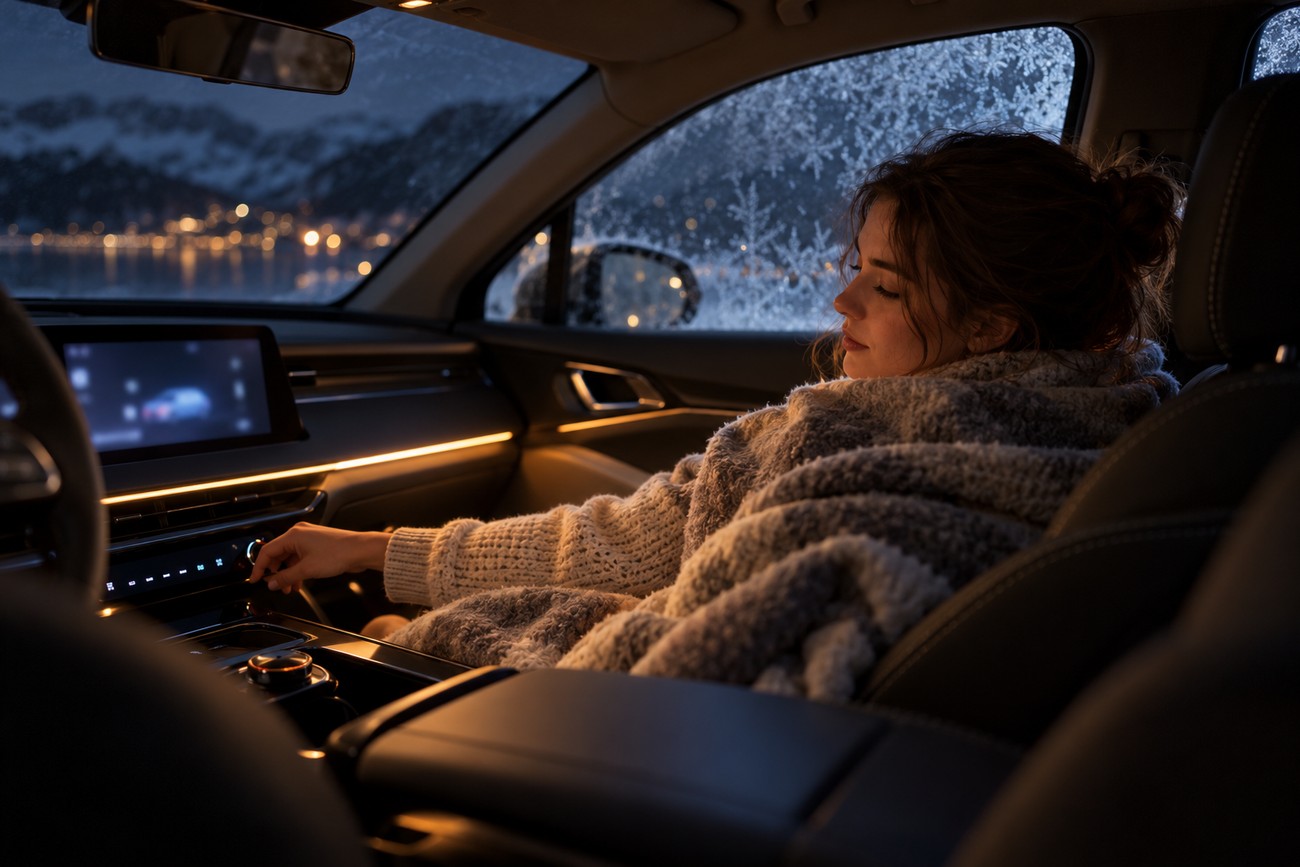
Kia provides no universal number of hours for cabin heating during an outage. Cold air, wind, poor insulation, frequent door openings, and a higher thermostat setting increase demand. A warm, occupied cabin may therefore use energy at a different rate from a briefly preheated one.
Preheat the cabin, then reduce the setting to the lowest comfortable level. Warm layers, blankets, and a suitable sleeping bag reduce the need to maintain a household-style temperature. Open doors only when necessary, and monitor the battery rather than waiting for an automatic cutoff.
Cabin heating and V2L consume energy that would otherwise remain available for driving. At a low charge, warmth competes with phone charging, lighting, refrigeration, and the ability to leave. Choose a departure reserve before the outage becomes harder to manage, and do not spend it casually on comfort loads.
Use V2L for essentials, not as a plug-in home generator
Where fitted, V2L can power suitable appliances through the internal outlet or the correct external adapter. Follow the limits stated for your EV6, and avoid running several high-draw appliances together. A kettle, microwave, heater, or refrigerator can create a substantial combined load, including starting demand.
V2L stops at the configured high-voltage battery charge limit and may shut down if the adapter or system overheats. A thin or unsuitable extension cord can also heat under load. Use properly rated cables, protect connections from moisture, and keep the adapter and vehicle cooling areas clear.
V2L reduces the remaining driving range, and Kia warns that regular use may contribute to high-voltage battery degradation. It can run suitable individual loads, but it is not an unrestricted home generator. Connecting household wiring requires a properly designed inlet and interlock or transfer arrangement installed by a qualified electrician; never use a homemade backfeed lead.
Frequently asked questions
Cabin comfort, visibility, and battery charge all need attention during a winter stop. Keep supplies within reach so you do not have to open the doors repeatedly. Check your model-year manual for the controls and equipment fitted to your EV6.
What should I do if the windows fog up while sleeping in the EV6?
Use the vehicle’s defog function and briefly admit fresh air when it is safe. Dry wet clothing separately, avoid covering vents, and clear the windows before moving the vehicle. Visibility takes priority over retaining warm air.
What should I keep in the EV6 before a winter power outage?
Keep warm layers or blankets, water, a flashlight, and phone-charging essentials in the cabin. Add any medications or personal items you may need, and store them where they remain reachable without opening the vehicle repeatedly.
How do I use Utility Mode on a Kia EV6?
Use the vehicle’s controls and model-year manual to select Utility Mode after starting the EV6 as required. Confirm that the battery is supplying the stationary systems and that climate control remains active. Menu names and availability can vary by market, trim, and model year.







