
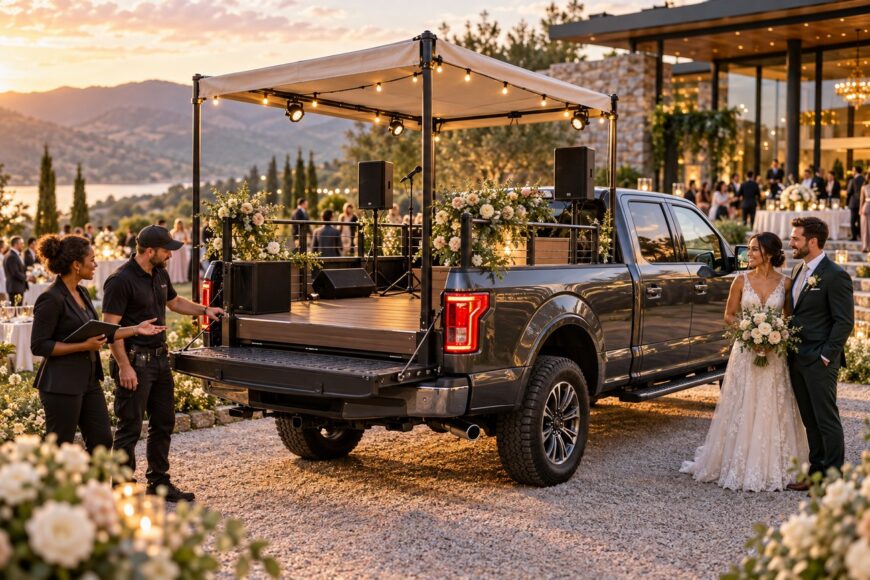
An F-150 can give a wedding a distinctive, compact performance area, especially for a short speech, acoustic set, or photo moment. The truck is easy to position, visually striking, and useful when a venue has limited space. Its bed remains a cargo area first, so a successful setup depends on engineering and event controls rather than appearance.
The central check starts with the specific truck’s Tire and Loading Information label. That payload limit covers people, décor, stage components, equipment, installed accessories, cargo, and applicable trailer-related load. Fall protection, weather, vibration, bed dimensions, and venue rules also determine whether guests should be allowed into the bed at all.
- Can an F-150 Bed Really Work as a Wedding Stage?
- Calculate the Real Load Before You Invite Anyone Up
- Build the Platform for Feet, Sound, and Fall Protection
- Solve the Wedding-Day Problems People Notice Too Late
- Frequently asked questions
- How big is an F-150 truck bed for a wedding stage?
- How can I decorate the F-150 without damaging it?
- What color should a wedding car be?
Can an F-150 Bed Really Work as a Wedding Stage?
An F-150 bed may work as a controlled platform for a light presentation or a small performance if the vehicle, deck, barriers, and site are assessed as one system. A public stage has to manage people moving near edges, equipment loads, access routes, and changing weather. Ford designs the bed primarily to carry cargo and does not universally certify it as a public stage for guests.
The truck’s configuration matters throughout the decision. Payload and usable bed area vary with model year, cab, bed length, engine, drivetrain, GVWR, and options. The maximum payload shown on the specific truck’s Tire and Loading Information label is the relevant starting point; an advertised figure for an F-150 range cannot confirm what that particular vehicle can carry.
A brief speech with guests remaining on the ground is a different use from dancing, a band, or a crowded platform. Dancing, leaning, and people moving together create dynamic forces that standing weight does not represent. If the plan depends on a large group, tall scenic structures, a heavy sound system, or a dance floor, a purpose-built stage is usually the safer and simpler choice.
Calculate the Real Load Before You Invite Anyone Up
Make a written load schedule before building anything. Include performers and guests, the modular deck, rails, stairs or ramps, lighting, truss, speakers, subwoofers, batteries, a generator, décor, cable covers, and every item stored in the bed or cab. Include applicable trailer-related load as well, since it consumes payload capacity.
Begin with the payload shown on the vehicle-specific label, then subtract the mass of installed equipment and accessories as required by Ford. Account for occupants and cargo elsewhere in the truck too. The remaining capacity is the planning limit for the proposed stage, rather than a reserve that can be filled casually during setup.
- Measure and weigh the deck, barriers, access equipment, and scenic elements.
- Obtain actual weights for sound, power, batteries, and generators.
- Estimate the maximum number of people who may enter at one time.
- Check how each heavy item transfers force into the bed, rails, tailgate, or support frame.
- Have the completed arrangement reviewed by a qualified staging or structural professional when public occupancy is planned.
Total payload compliance does not make every location safe. A concentrated speaker, narrow leg, rail clamp, or tailgate load can create damaging point pressure even when the combined weight is below payload. A deck must therefore distribute forces through suitable support points, and its manufacturer or engineer should confirm the intended loading pattern.
People also load a platform dynamically. A guest stepping down, a group leaning against a rail, or dancers moving in rhythm can produce forces that a simple standing-weight calculation misses. Set a clear occupancy limit, keep heavy equipment low, and prevent guests from treating the bed as an unrestricted dance floor.
Build the Platform for Feet, Sound, and Fall Protection
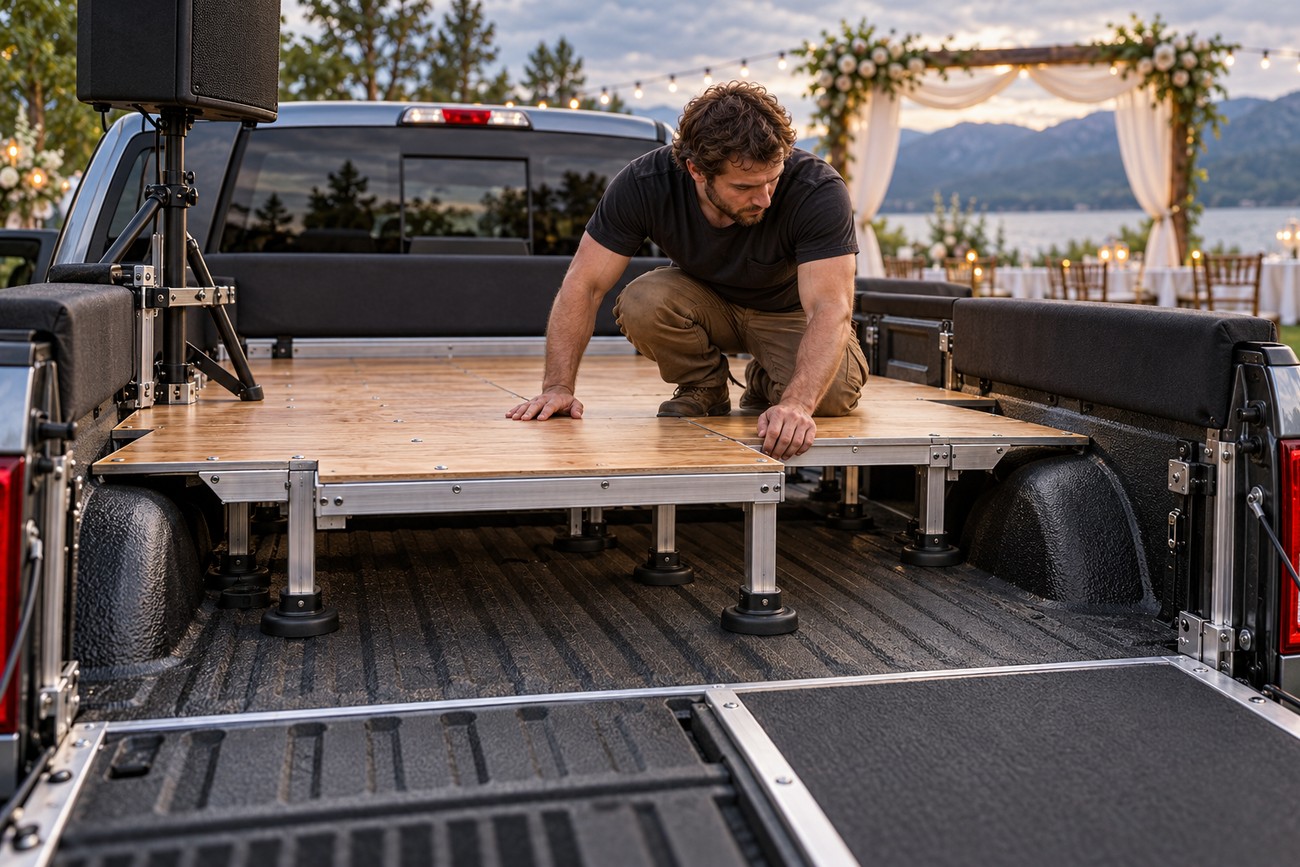
The usable flat area is smaller than the outside bed dimensions suggest. Wheel arches, the bed width between the rails, the tailgate position, and an open rear edge interrupt circulation. Measure the actual truck and design the deck around those obstructions instead of assuming a generic F-150 bed will fit a standard stage panel.
Use a modular deck that distributes pressure through suitable supports and protects the bed surface. Thin plywood laid directly across the bed can flex, concentrate loads, and shift under feet or speaker stands. The deck should be secured against movement, provide a stable walking surface, and include a slip-resistant finish appropriate for shoes, dust, and damp conditions.
A closed tailgate does not replace barriers at the sides or other fall-protection measures. Temporary guardrails should be securely attached and able to withstand at least 200 pounds of horizontal or downward force at the specified point under the OSHA guidance cited here. Confirm the applicable local requirements and keep the barrier geometry suitable for the people using the platform.
Test the finished deck, rails, speaker stands, and cable routes as one loaded system. A component that is secure by itself can shift when vibration, footsteps, and a changing crowd act on the completed platform.
Keep speakers, batteries, and generators low and distributed between the axles rather than concentrated at the rear. Provide a stable stair or ramp with a handhold, and protect cables from foot traffic, sharp edges, water, and tailgate movement. Leave access to the first-aid kit, fire extinguisher, and an unobstructed exit route.
Solve the Wedding-Day Problems People Notice Too Late
Sun can make a metal bed surface uncomfortably hot, while painted or plastic surfaces may become slippery. Test the floor in the actual footwear expected at the event and add a suitable deck surface rather than relying on the original coating. Lighting should also reveal the edges, stairs, and barriers without creating glare that hides a trip hazard.
Sound equipment introduces a separate stability problem. Speakers and subwoofers can cause vibration, rattling, and movement in unsecured stands, while the bed and tailgate can transmit noise into the structure. Isolate and secure the equipment according to its installation requirements, then test it at working volume with the deck occupied only by authorized crew.
Loading changes the vehicle itself. As the suspension settles, ride height, ramp angles, and ladder stability can change after the equipment is installed. Recheck access after the truck is fully loaded, set the vehicle on firm level ground, switch off the engine, and engage the parking brake. Transporting people in a moving bed is separate from stage use and should not be part of the plan.
The open bed leaves equipment exposed to rain, dust, side wind, and guest access. Tents, banners, and decorative arches add sail area that can destabilize the temporary structure or the vehicle. Use weather limits, a stop-work plan, and a method for securing or removing scenic elements before wind becomes a problem.
Allow only designated crew to load, adjust, and inspect the setup. A damaged bed, blocked light, failed cable, or mid-event shift can create injuries, program delays, repair costs, and insurance complications. Before approval, check venue permission, liability insurance, fire-safety controls, and local requirements for temporary structures and public occupancy.
Frequently asked questions
These answers apply to planning a specific truck and event. The vehicle year, configuration, venue, and local rules can change the practical answer.
How big is an F-150 truck bed for a wedding stage?
There is no single usable F-150 stage size. Bed length, width between the rails, wheel-arch intrusion, and tailgate position vary by model year, cab, and bed configuration. Measure the actual truck, including the level area available with the tailgate open or closed, before ordering a deck or access system.
Outside dimensions also overstate the working area because rails, arches, barriers, and equipment consume space. A site plan should show performer positions, guest circulation, speaker locations, stairs, and an exit route. Generic online dimensions are suitable for an initial estimate, not a safety decision.
How can I decorate the F-150 without damaging it?
Use removable, padded attachment methods designed for vehicle surfaces, and test them on a concealed area first. Keep decorations clear of lights, plates, lamps, doors, hinges, emergency access, and the driver’s view. Protect paint and bed surfaces from water, abrasion, adhesive residue, and movement caused by wind.
Avoid drilling, permanent clamps, loose cords, and attachments that can fall into the road or obstruct inspection points. Route decorative lighting separately from audio and power cables, protect connections from moisture, and remove every attachment after the event so trapped water or grit cannot mark the finish.
What color should a wedding car be?
Any color can suit a wedding vehicle if it fits the venue, flowers, photography, and overall design. White, black, silver, and neutral tones are easy to coordinate, while a bold factory color can provide a deliberate visual accent.
Color should never take priority over visibility and safety. Avoid coverings that hide lights or plates, reduce the driver’s view, or make edge markings and reflective equipment harder to see. For a staged F-150, a clean, removable design is more useful than a color choice that requires permanent paint or unsafe attachments.







