
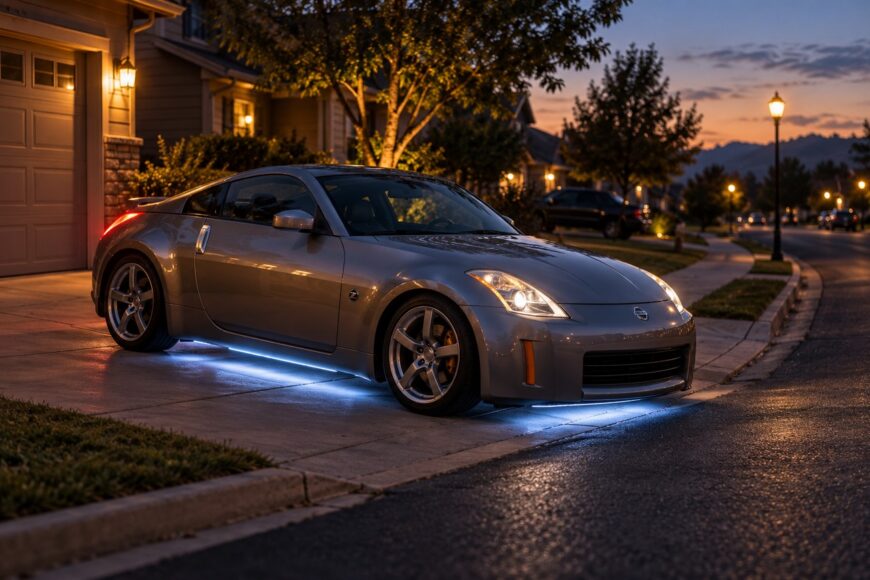
An RGB underglow kit may be easy to fit to a Nissan 350Z yet difficult to use legally on public roads. A product listing can tell you whether the kit suits the car’s electrical system. It cannot tell you whether you may drive with its lights on.
There is no single federal U. S. rule that uniformly permits or bans underglow. Legality depends mainly on state law, local ordinances, the color and behavior of the light, how it is mounted, and where the car is used. Those details matter more than a “street legal” label on the box.
- Is Underglow Legal on a Nissan 350Z?
- Color, Flashing Modes, and Visibility Matter More Than the Kit
- California and New York Show Why State Rules Cannot Be Generalized
- Why a 350Z Creates Extra Visibility and Enforcement Risk
- The “Street Legal” RGB Kit Trap
- A Practical Pre-Drive Compliance Check
- Frequently Asked Questions
- What color underglow is illegal on a Nissan 350Z?
- How much is a ticket for illegal underglow?
- Why are neon lights illegal in some places?
Is Underglow Legal on a Nissan 350Z?
Underglow can be legal in some circumstances, but there is no nationwide yes-or-no answer for a 350Z. State vehicle-lighting rules may limit permitted colors, visible light sources, or auxiliary lamps. A city or other local jurisdiction may add restrictions that affect where you actually drive.
Public-road use deserves a separate check from installation. A jurisdiction might allow you to own or fit a kit while prohibiting you from illuminating it in traffic. Rules can also differ between a public street, a public parking area, and private property; permission from a property owner does not override every applicable lighting rule.
Popular state-law summaries cite about 9 states that prohibit underglow on public roads completely or nearly completely. That is a summary estimate, not a current statutory list to rely on for a trip. If your route crosses a border, the rules where you drive may be stricter than those where the 350Z is registered.
A listing marked “for Nissan 350Z” establishes fitment or electrical compatibility, not road approval. Before treating the kit as a driving accessory, check the law for each place where you intend to use it and the exact configuration you intend to run.
Color, Flashing Modes, and Visibility Matter More Than the Kit
Lighting rules often turn on what other road users can see. Red visible from the front is commonly restricted, while blue is often restricted because it can resemble police or other emergency lighting. The applicable rule may also distinguish light visible from the front, rear, or side, so choosing a color by name alone is insufficient.
Operating mode can change the answer even if the color stays the same. A steady, nondazzling glow may be treated differently from flashing, chase, pulse, or other animated effects. A controller that remembers its last mode can therefore put a prohibited effect back into use unless you check its settings before driving.
Mounting matters as well. Some jurisdictions restrict directly visible aftermarket light sources; others require them to be covered and unlit on public roads. Neither is a universal U. S. rule, but both are reasons to inspect the installed car rather than rely on a photo of the intended glow.
Concealed strips can produce diffuse illumination beneath the body, while an exposed strip presents a row of distinct LED points to pedestrians and nearby drivers. Even where a particular glow is permitted, visible hardware, glare, or light that interferes with required lamps may raise a separate compliance issue.
California and New York Show Why State Rules Cannot Be Generalized
California discussions of vehicle-code requirements commonly emphasize that auxiliary lighting must not replace or interfere with required lamps. They also identify red light visible from the front as prohibited and refer to illumination that is diffuse and nondazzling. Those points call for checking the installation and its effect on the car’s normal lights, as well as the selected color.
A cited New York state summary, by contrast, says aftermarket lighting, including underbody glow, is limited to white. Treat that as a prompt to verify the current official text and any applicable local requirements, rather than as permission for every white kit or a rule for the rest of the country.
The examples show why a setting that appears acceptable in one location may fail in the next. Changing from a colored mode to white does not necessarily resolve restrictions on mounting, flashing, source visibility, or use on a public road. Check the rules for the destination and the route, including places where you may park with the lights on.
Why a 350Z Creates Extra Visibility and Enforcement Risk
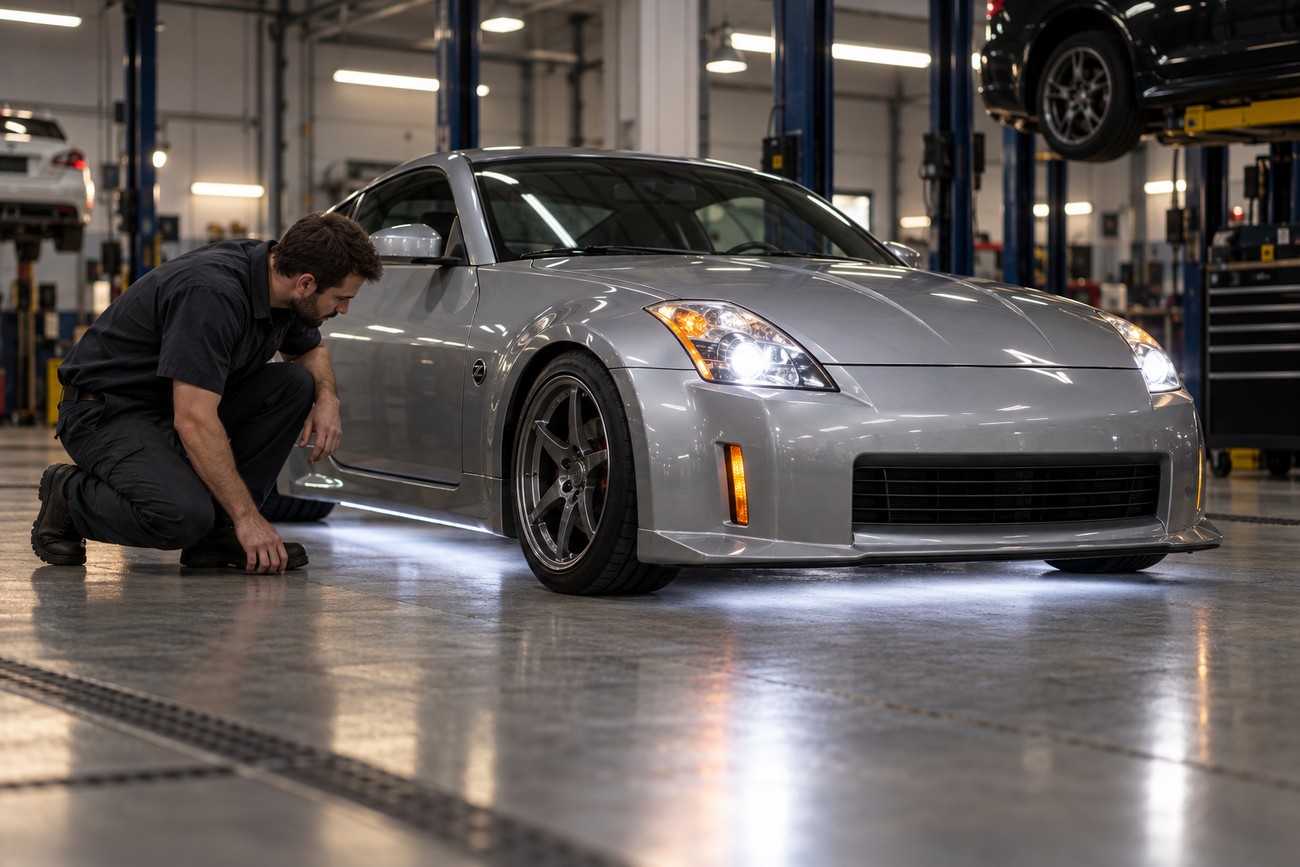
The 350Z’s low stance and relatively exposed lower body can make underglow hardware easier to see than it would be on a taller vehicle. A strip that looks hidden while the car is on a lift may be visible from beside it at street level. That can draw attention even when the owner intended a soft pool of light under the car.
Before fixing the strips in place, consider where the emitters will sit relative to the lower body edges and wheel openings. Roadside visibility is a separate issue from whether the strips physically fit. A row of visible LED points may attract complaints more readily than illumination that remains diffuse beneath the car.
Test the finished installation from ordinary pedestrian and approaching-vehicle sightlines, not only from the driver’s seat. The driver may never see an exposed strip that is obvious to someone beside the car.
Kits marketed for the 350Z commonly use 12V power; one cited listing specifies 6 strips and 10W. These are product specifications, not legal limits or evidence that the installed lights comply. The model name on the listing likewise says nothing about which colors or modes may be used on a public road.
The “Street Legal” RGB Kit Trap
“Street legal” and “legal in most states” leave out the facts needed for a useful legal claim. They rarely identify the jurisdiction, permitted color, operating mode, mounting position, source visibility, or whether the claim applies while driving or parked. A full-RGB kit can offer many settings while only a narrow selection, or none, is lawful on public roads in a given location.
The common purchase mistake is to check that the kit fits, then choose a road-use mode afterward. If local rules prohibit blue, flashing effects, or visible emitters, turning the controller to a steady alternative may address only part of the problem. In some places, aftermarket light sources must remain covered and unlit on public roads.
Switching the lights off when an officer approaches is no compliance plan. It does not undo prohibited use already observed, and it may not resolve a rule concerning the installation or visibility of the source itself. Some restrictions may also apply to an illuminated car while it is parked.
Read marketing claims as descriptions of the product, then test your intended use against current law. That distinction can prevent the frustrating outcome of installing a capable RGB system that has few lawful road-use settings where you drive.
A Practical Pre-Drive Compliance Check
Start with the places the 350Z will actually go, including jurisdictions crossed on routine drives. Consult current official state statutes or regulations and relevant local ordinances; aftermarket summaries can help identify issues but may be incomplete or outdated. If the wording is unclear, ask the relevant local authority how it applies to underbody lighting.
Check the permitted colors for each direction from which the light is visible. Then check whether the rule distinguishes steady illumination from flashing or animated effects and whether it applies on public roads, in parking areas, or while the car is parked. Registration in a more permissive jurisdiction does not establish permission elsewhere.
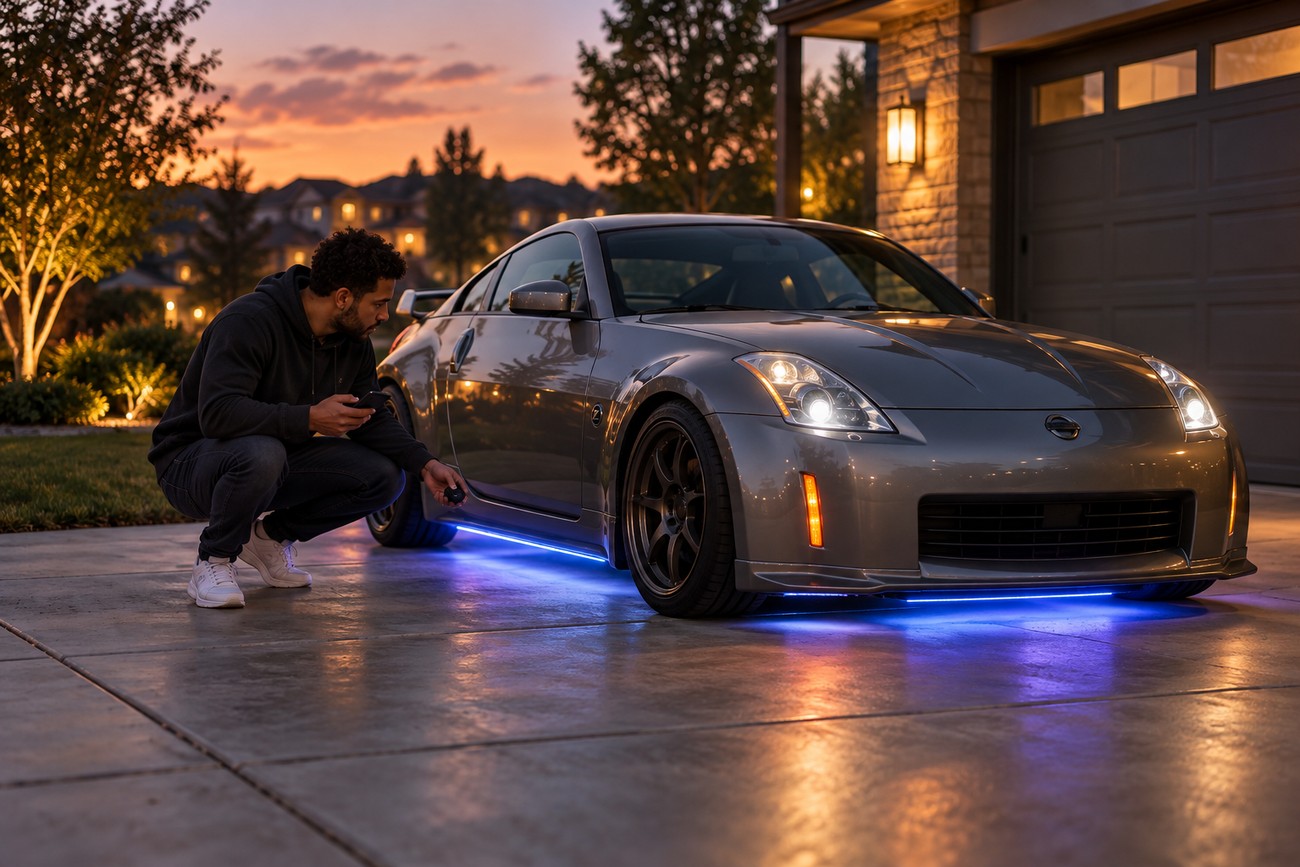
Inspect the installed kit at street level with the car stationary. Look for directly visible strips or LED points, glare, and any effect on required lamps. Confirm that the controller can reliably prevent prohibited colors and effects; a setting you cannot keep disabled is a poor choice for road use.
Finally, decide separately whether the kit may be installed, whether it may be illuminated in each setting, and whether it must be covered or switched off on public roads. A concealed, steady glow is a more cautious configuration than an exposed flashing strip, but even that setup needs jurisdiction-specific verification before you drive.
Frequently Asked Questions
Underglow rules depend on the location and on what the installed lights actually show to other road users. These answers address common points of confusion; the current rules for your route still govern the result.
What color underglow is illegal on a Nissan 350Z?
There is no nationwide list of illegal underglow colors for a 350Z. Red visible from the front is commonly restricted, and blue is often restricted because of its association with emergency vehicles. A state may impose a narrower rule: the cited New York summary, for example, says aftermarket underbody lighting is limited to white.
Check where the light is visible, as front-facing, rear-facing, and side-visible lighting may be regulated differently. An allowed color also does not automatically make flashing effects or exposed LED strips acceptable.
How much is a ticket for illegal underglow?
There is no single U. S. ticket amount for illegal underglow. The consequence depends on the jurisdiction, the rule cited, and the circumstances, including whether the issue is a prohibited color, an animated mode, or interference with required lighting. An officer may cite more than one applicable lighting offense.
For a useful estimate, look up the current violation and penalty schedule where the car would be driven. A fine quoted for another state, or for a different type of lighting violation, may bear little relation to your case.
Why are neon lights illegal in some places?
Restrictions commonly aim to prevent confusion with emergency vehicles, reduce glare and distraction, and keep aftermarket lighting from obscuring or interfering with required lamps. These concerns can apply to LED underglow as well as traditional neon tubes; the effect of the light matters more than the technology used to produce it.
That is why a rule may target a particular color, a flashing pattern, or a directly visible light source rather than ban every form of underbody illumination. The scope of the restriction depends on the jurisdiction’s wording.







