
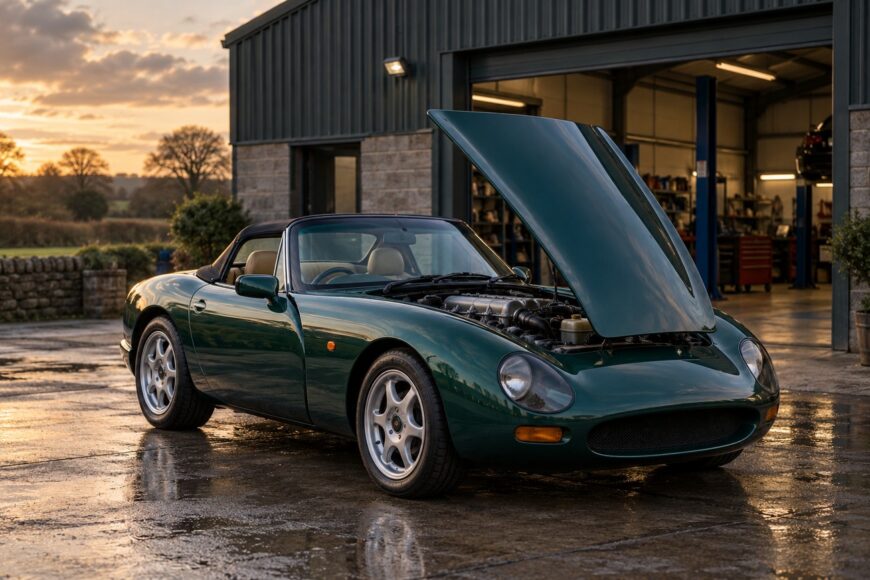
The TVR Griffith 500 offers extraordinary performance through low mass, a naturally aspirated V8, and almost no electronic intervention. That same formula can make a poor example expensive and intimidating: age, heat, wiring faults, tired suspension, and questionable repairs all matter more than the badge or the noise.
This is a buying decision rather than a nostalgia exercise. A clean-looking cabin and a strong acceleration run prove little if the car has a history of overheating, hidden chassis work, or improvised electrical repairs. Condition, documentation, and a specialist inspection deserve more weight than headline power, rarity, or a freshly polished body.
- Why the TVR Griffith 500 Still Matters
- Performance: The Numbers Versus the Road
- Engine, Cooling, and Electrical Reliability
- Chassis, Body, and Tires: Look Beyond the Cosmetics
- What It Is Really Like to Own and Drive One
- TVR Griffith 500 Pre-Purchase Inspection Priorities
- Running Costs, Specialists, and Modifications
- How to Judge Value and Choose the Right Car
- Frequently asked questions
- How much is a TVR Griffith 500 worth?
- What is the most desirable TVR?
- Which upgrades are safest on a TVR Griffith 500?
Why the TVR Griffith 500 Still Matters
The TVR Griffith 500 is a limited-run British sports car from the 1990s, built around a simple and unusually direct idea. It combines very low mass with rear-wheel drive, a manual gearbox, and a naturally aspirated Rover V8/LT77-family drivetrain, depending on market and year. There is little between the driver and the engine, giving the car a sense of immediacy that modern performance cars often filter out.
Its appeal comes from the whole mechanical package rather than one isolated specification. The steering, throttle, clutch, and gearbox all contribute to the experience, while the car’s low overall mass allows it to react quickly to small inputs. That response can feel vivid on a good road, especially when the chassis is correctly aligned and fitted with suitable tires.
Minimal modern electronic assistance also places more responsibility on the driver. The Griffith does not offer modern ABS or stability control. On a damp or uneven road, braking technique, throttle discipline, tire condition, and restraint during sudden maneuvers matter considerably more than they do in a contemporary sports car.
Rarity adds interest, but it does not certify quality. Exact production totals vary across public and club sources, so limited-run is more useful here than a hard production number. A rare car with poor cooling work, deteriorated bushings, or amateur wiring can require more money and patience than a less fashionable example with complete records and sound engineering.
Performance: The Numbers Versus the Road

Quoted output for the Griffith 500 is about 340–355 hp, with variation between cars due to condition, tuning, and dyno method. Torque is commonly described as 400+ Nm, again with variation according to condition and measurement. Those figures are substantial in a car with such low mass by modern standards, which helps explain why the Griffith feels so quick on the road.
Quoted 0–60 mph performance commonly falls around 4.1–4.5 seconds. Real results depend heavily on traction, tires, and drivetrain condition. A worn clutch, poor differential setup, tired gearbox, or old rear tires can turn a promising launch into wheelspin and hesitation, while an experienced driver may produce a better result than a novice without changing the car at all.
Low mass improves response, braking feel, and the sense of acceleration, yet it does not automatically make the Griffith easy to control. The car can become nervous on poor surfaces and during abrupt maneuvers, particularly when the geometry is wrong or the suspension bushings have softened with age. A short straight-line run can therefore flatter a car that would feel unsettled through bends or over broken asphalt.
Use the performance test as one part of the inspection. The engine should pull cleanly, the clutch should engage consistently, and the gearbox should select each gear without resistance or noise. If the seller encourages repeated hard launches while avoiding a proper road test with the engine hot, the demonstration is serving excitement rather than establishing mechanical health.
Engine, Cooling, and Electrical Reliability
The Rover V8 can be rewarding when assembled and maintained correctly, but the Griffith 500 is not a trouble-free V8. Overheating history is especially important because a car may start smoothly and appear healthy while carrying concealed cylinder-head, gasket, or lubrication-system problems. A cold start is useful information; it is not a diagnosis.
Cooling performance must remain stable in traffic and at low speed, where airflow is limited and heat accumulates around the engine bay and transmission tunnel. Check the condition and routing of hoses, the radiator, fans, switches, expansion system, and evidence of previous repairs. Fresh-looking components deserve scrutiny if the installation is untidy or the repair history is unclear.
Heat management affects more than the temperature gauge. Excess heat can create smells, discomfort, electrical deterioration, and repeated stress on seals and connectors. Look for stable temperature, credible oil-pressure behavior, a smooth idle, and no signs of heat-related distress after slow running and a hot restart.
Age-related wiring, connectors, and grounds can cause intermittent faults in sensors, lighting, windows, instruments, or starting circuits. These problems are often harder to trace than a failed component because the fault may disappear when the car is moved, cooled, or inspected. Look for brittle insulation, loose grounds, non-standard joins, corroded terminals, and modifications added without proper protection.
Documentation should identify cooling work, engine rebuilds, head-gasket repairs, electrical troubleshooting, and long periods of storage. A repair invoice is more useful when it explains what was replaced and why. A folder full of parts receipts without test results or specialist notes may still leave the central risk unresolved.
Chassis, Body, and Tires: Look Beyond the Cosmetics
A polished Griffith can hide more than an untidy one. Inspect panel alignment, door and hood gaps, paint transitions, local cracking, and signs that panels have been removed or repaired. Good-looking bodywork may conceal poor repairs or inconsistent geometry, while a small cosmetic blemish can be less significant than a badly executed structural or mounting repair.
The chassis, suspension mounts, fasteners, bushings, and dampers deserve the same attention as the engine. Worn bushings and incorrect geometry can radically alter the handling, causing vague turn-in, instability under braking, or constant steering correction. A first-time driver may mistake those faults for authentic TVR character, especially during a short, dramatic test drive.
Tires are a major part of the Griffith’s safety margin. Check age, condition, specification, sidewall damage, uneven wear, and whether the tires are properly matched for the car’s use. Unsuitable or aged tires can make the car nervous even when the engine and steering components are sound.
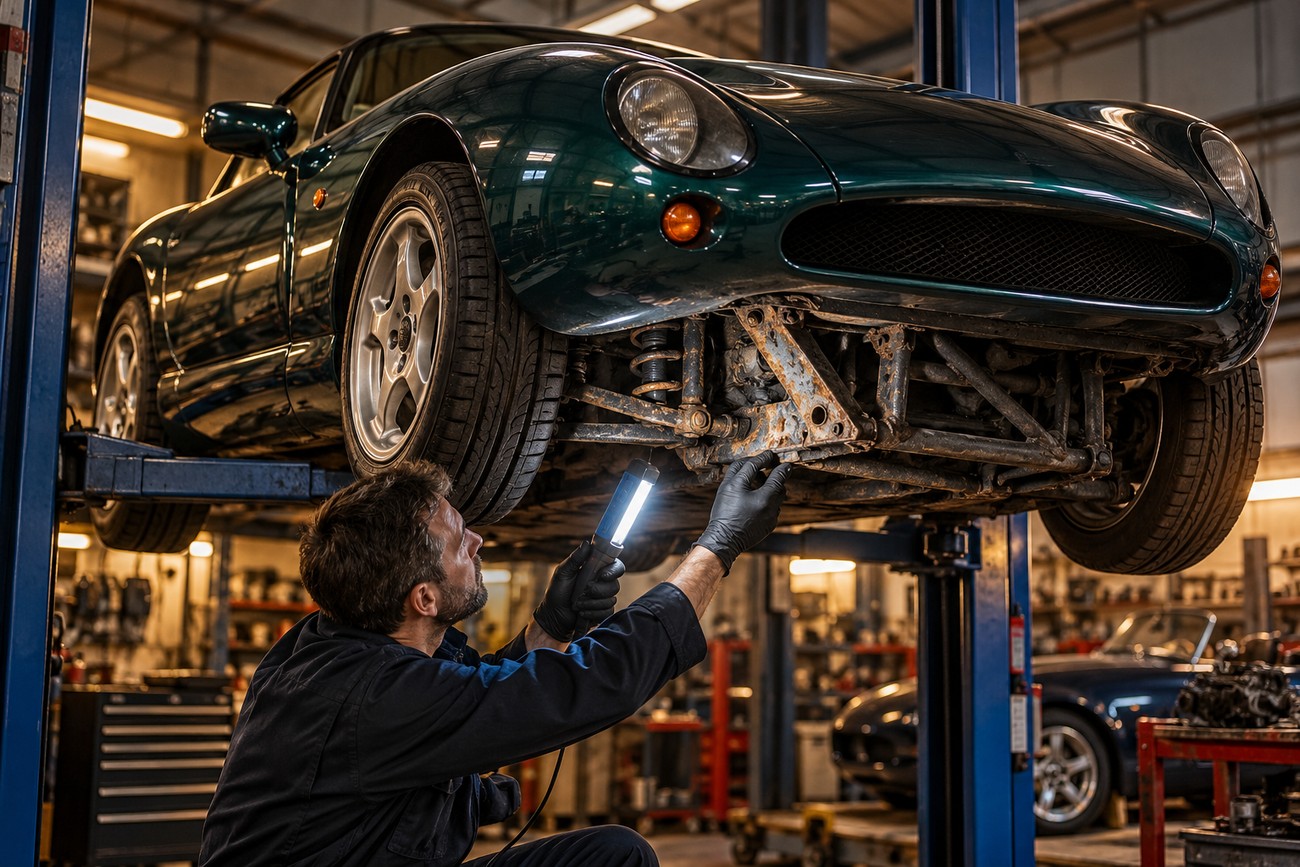
Examine the underside on a lift, ideally after a road test rather than before it. Look for fluid leaks, damaged mounts, loose fasteners, poor welding, and evidence of repeated impact. The inspection should establish whether the car has a coherent setup, because a new set of tires cannot compensate for worn bushings or incorrect alignment.
What It Is Really Like to Own and Drive One
The Griffith 500 is usable on the road, yet its usability depends heavily on expectations. Owners commonly report cabin heat, heat-soak smells, and warmth around the feet and transmission tunnel. Traffic can expose those characteristics more clearly than a fast open-road drive, particularly if airflow and cooling components are not working as intended.
Uneven asphalt can make the car follow ruts and demand frequent steering corrections. That behavior may come from the basic character of a light, direct sports car, but it can also indicate worn bushings, unsuitable tires, or incorrect alignment. A specialist should separate the design’s directness from defects that have developed during decades of use.
Noise and fatigue can make long journeys less comfortable than expected. Engine and road noise are part of the attraction for a short drive, while several hours at speed may expose the limitations of insulation, seating, ventilation, and luggage practicality. Plan realistic journeys and allow for more concentration than a modern grand tourer would require.
Driver technique remains central because the car has rear-wheel drive, a manual gearbox, and minimal modern electronic assistance. Smooth steering and throttle inputs are valuable, particularly in wet conditions or over changing surfaces. A Griffith that feels demanding in a controlled, predictable way can be enjoyable; one that reacts inconsistently needs its setup and maintenance investigated.
TVR Griffith 500 Pre-Purchase Inspection Priorities
A specialist pre-purchase inspection should include running with the engine hot, slow traffic, and a hot restart, rather than only a short acceleration run. Use the matrix below to compare several cars consistently and record evidence instead of relying on the seller’s description.
| Inspection area | Warning signs | Practical checks | Likely consequence |
|---|---|---|---|
| Engine and cooling | Temperature rise in traffic, coolant smell, unstable idle when hot, unexplained pressure, or a history of overheating | Inspect hoses, radiator, fans, expansion system, leaks, oil pressure, exhaust smoke, and hot restart behavior | Hidden cylinder-head, gasket, lubrication-system, or cooling repairs can become a major expense |
| Electrical systems | Intermittent gauges, lights, windows, sensors, starting faults, corroded terminals, or improvised wiring | Test every switch and circuit repeatedly; inspect grounds, connectors, fuses, harnesses, and non-standard additions | Fault tracing can be slow and costly, with recurring failures if the underlying wiring is poor |
| Chassis and suspension | Uneven ride height, vague steering, knocks, damaged mounts, tired bushings, leaking dampers, or uneven tire wear | Lift the car, inspect fasteners and mounts, measure alignment where possible, and test braking and cornering response | Unpredictable handling, accelerated tire wear, and a substantial suspension refurbishment |
| Body repairs | Inconsistent gaps, mismatched paint, local cracking, overspray, or evidence of hurried panel removal | Inspect panels, joins, underside areas, mounting points, and repair quality in natural light and on a lift | Cosmetic correction may conceal expensive or technically poor previous work |
| Tires | Old or mismatched tires, unsuitable specification, sidewall damage, or uneven wear | Check date markings, tread and sidewalls, pressures, matching, and alignment-related wear | Reduced grip and nervous behavior, followed by immediate replacement costs |
| Transmission | Clutch slip, difficult engagement, gear noise, driveline vibration, or differential backlash | Test every gear when cold and hot; check clutch take-up, reverse, acceleration, overrun, and smoothness | Clutch, gearbox, differential, or propeller-shaft work may be required |
| Documentation | Long unexplained gaps, vague claims, missing invoices, inconsistent mileage, or unclear engine and cooling history | Compare records with the car, verify major repairs, and seek specialist or club knowledge where available | Deferred maintenance and uncertain history make the purchase difficult to budget |
| Modifications | Unprotected wiring, improvised cooling changes, extreme suspension settings, or unidentified engine parts | Establish who performed the work, why it was done, and whether it is reversible and properly engineered | A supposed upgrade may worsen reliability, handling, resale prospects, or future diagnosis |
Take the car through town, allow it to idle in traffic, and repeat the restart once fully warm. The test should also include gentle driving over uneven surfaces, braking from different speeds, and observation of steering self-centering. A seller who refuses a proper hot inspection is giving you useful information about the transaction.
Compare physical evidence with the service history. A recently rebuilt cooling system, for example, should have a coherent explanation and competent installation. Assess previous modifications on workmanship and effect, especially around cooling, wiring, and handling.
Running Costs, Specialists, and Modifications
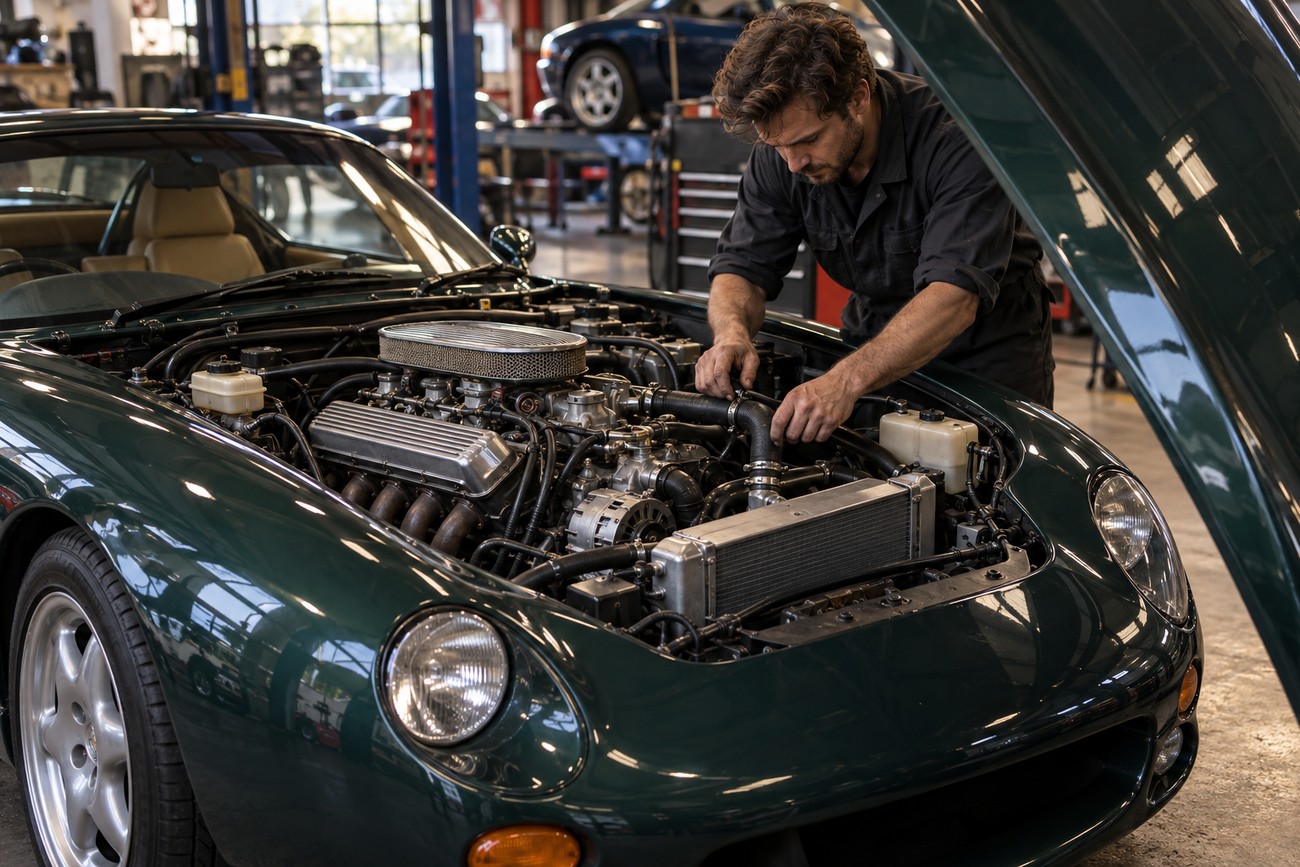
Ownership support comes mainly through clubs, specialist workshops, and donor solutions rather than a conventional mass-market dealer network. That ecosystem can be excellent when you find the right people, but access to suitable expertise may depend on location and availability. A general repair shop may maintain routine components while missing the specific weaknesses of TVR installation and Rover V8 systems.
Finding a mechanic familiar with TVRs and Rover V8 systems can be difficult and costly. Before buying, identify who can inspect, diagnose, and repair the car in your area. This is especially important for electrical faults and intermittent overheating, where repeated parts replacement can cost more than a careful diagnostic process.
Budget for secure storage, insurance, scheduled maintenance, fluids, seals, tires, and age-related replacement work. Insurance, storage, and maintenance may cost more than a buyer expects from a 1990s muscle-car purchase. A car used occasionally still deteriorates if stored poorly, left with a weak electrical system, or driven only for short journeys.
Judge modifications by their engineering quality, purpose, and reversibility. Preventive cooling work, sound electrical repairs, sensible suspension renewal, and correct tires may improve ownership without changing the car’s identity. Fashionable engine tuning or aggressive geometry can create new problems if it compromises cooling, wiring, drivability, or future diagnosis.
How to Judge Value and Choose the Right Car
Condition, documentation, and engineering quality drive value more than rarity alone. Start with the car’s ability to run consistently when hot, then assess the chassis, suspension, tires, body repairs, transmission, and electrical systems. Only after those areas are understood should you place much weight on trim, originality, or extra power.
A documented, consistent car with known maintenance may be preferable to a cheaper example with hidden overheating or chassis work. The cheaper car can absorb the difference through cooling repairs, suspension refurbishment, electrical diagnosis, body correction, and specialist labor. This is why purchase price alone is a poor measure of affordability.
Originality has value when it shows that the car has avoided careless alteration, but original parts do not excuse deterioration. A well-executed, reversible upgrade can be useful if it solves a known problem and is supported by documentation. A heavily modified car with impressive output remains a risk if its wiring, cooling, geometry, or engine history cannot be established.
Use a simple decision framework: inspect first, price deferred work, confirm access to specialist support, and then decide whether the car fits your intended use. A limited-run car with a sound inspection report and traceable maintenance is usually a stronger proposition than a visually perfect project. Rarity may preserve interest, while condition determines whether ownership is enjoyable.
Frequently asked questions
Price, desirability, and upgrades all depend on the condition of the individual car. The same inspection priorities apply when comparing asking prices or judging a modification. Start with evidence of sound cooling, wiring, chassis setup, and maintenance, then consider how the car fits your intended use.
How much is a TVR Griffith 500 worth?
There is no universal value that can be applied to every Griffith 500. A practical valuation starts with the cost of making the car dependable: assess cooling, engine health, wiring, chassis, suspension, tires, transmission, and body repairs before comparing asking prices.
A usable, documented car with consistent hot running and specialist inspection evidence deserves a different assessment from a cosmetically attractive project with unexplained gaps in its history. Treat deferred maintenance as a direct deduction from the car’s real value, and allow for specialist labor rather than pricing repairs as if the car were a mass-market model.
What is the most desirable TVR?
There is no single answer because desirability depends on the balance between performance, usability, originality, and condition. The Griffith 500 appeals to buyers who want a particularly direct, lightweight V8 sports car, while another TVR may suit someone who values a different body style, driving position, or level of practicality.
Within the Griffith 500 market, a sound example is usually more desirable than the most modified or most powerful one. A car with sound engineering, clear records, correct tires, and a manageable ownership plan can be more satisfying than a higher-output car whose history is difficult to verify.
Which upgrades are safest on a TVR Griffith 500?
The safest upgrades usually begin with reversible reliability and safety work: correcting wiring and grounds, improving cooling with a properly engineered installation, renewing worn suspension components, setting accurate geometry, and fitting suitable tires. The aim should be predictable behavior and easier maintenance.
Be cautious with modifications that alter wiring, cooling flow, suspension geometry, or engine calibration without clear documentation. A useful upgrade has a defined purpose, competent workmanship, and a path back to a known baseline. If it makes diagnosis harder or depends on unidentified parts, it may reduce the car’s value even if it sounds impressive.







