
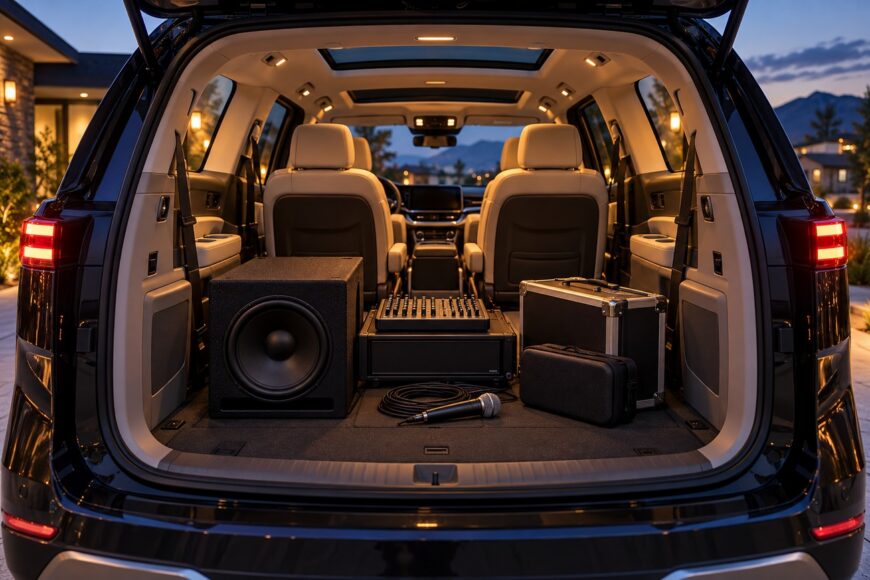
Turning a Kia Carnival into a private karaoke lounge can make family trips, tailgate stops, and campsite evenings more social. The van already offers generous passenger space, a useful factory display, and enough flexibility to carry microphones, a mixer, and compact speakers without sacrificing every seat.
The factory system is designed to play music, navigation prompts, and phone audio. It is not automatically designed to mix a live microphone with a backing track. A successful conversion therefore depends on the exact seating layout, whether singing happens while parked or moving, microphone latency, available electrical power, and keeping the driver’s attention and the vehicle’s safety systems undisturbed.
- Start With the Carnival You Actually Have
- Choose the Audio Architecture Before Buying Gear
- Kia Carnival Karaoke Setups by Use Case
- Power the System Without Overloading the Carnival
- Place the Microphones, Speakers, and Gear Safely
- Tune, Test, and Store the Karaoke Lounge
- Frequently asked questions
- What Kia Carnival year should I stay away from for a karaoke conversion?
- What is the lawsuit against the Kia Carnival, and does it affect a karaoke build?
- How can I keep karaoke comfortable for passengers on a long drive?
Start With the Carnival You Actually Have
Begin with the vehicle’s exact year, market, trim, and seating configuration. Kia Carnival versions are available in 7- and 8-seat configurations, and the second row may use separate seats or a removable bench, depending on the version. Those differences affect where passengers sit, how easily equipment can be loaded, and whether a singer has enough room to handle a microphone without disturbing another passenger.
The 60:40 split-folding third row folds into the floor, creating a useful platform for a compact amplifier, mixer, microphone cases, or a subwoofer. That space is especially practical for a system used while parked, because gear can remain behind the second row while passengers use the cabin. It still needs to remain accessible, and equipment must not be buried under luggage where heat cannot escape.
Separate second-row seats can offer a more comfortable lounge arrangement, while a removable bench may be easier to clear when you need maximum cargo space. The choice also affects storage: removed seats, fasteners, trim plugs, and covers need a dry, organized place. A conversion that works on paper can become frustrating if every equipment session begins with searching for hardware or moving heavy seats.
Do not assume that similarly named trims have identical rear entertainment or audio equipment. Features and audio hardware vary by year, market, and trim, including the number of speakers, screen arrangements, USB ports, and available factory entertainment. Check the individual vehicle rather than relying on a sales listing’s use of terms such as “premium” or “surround.”
Choose the Audio Architecture Before Buying Gear
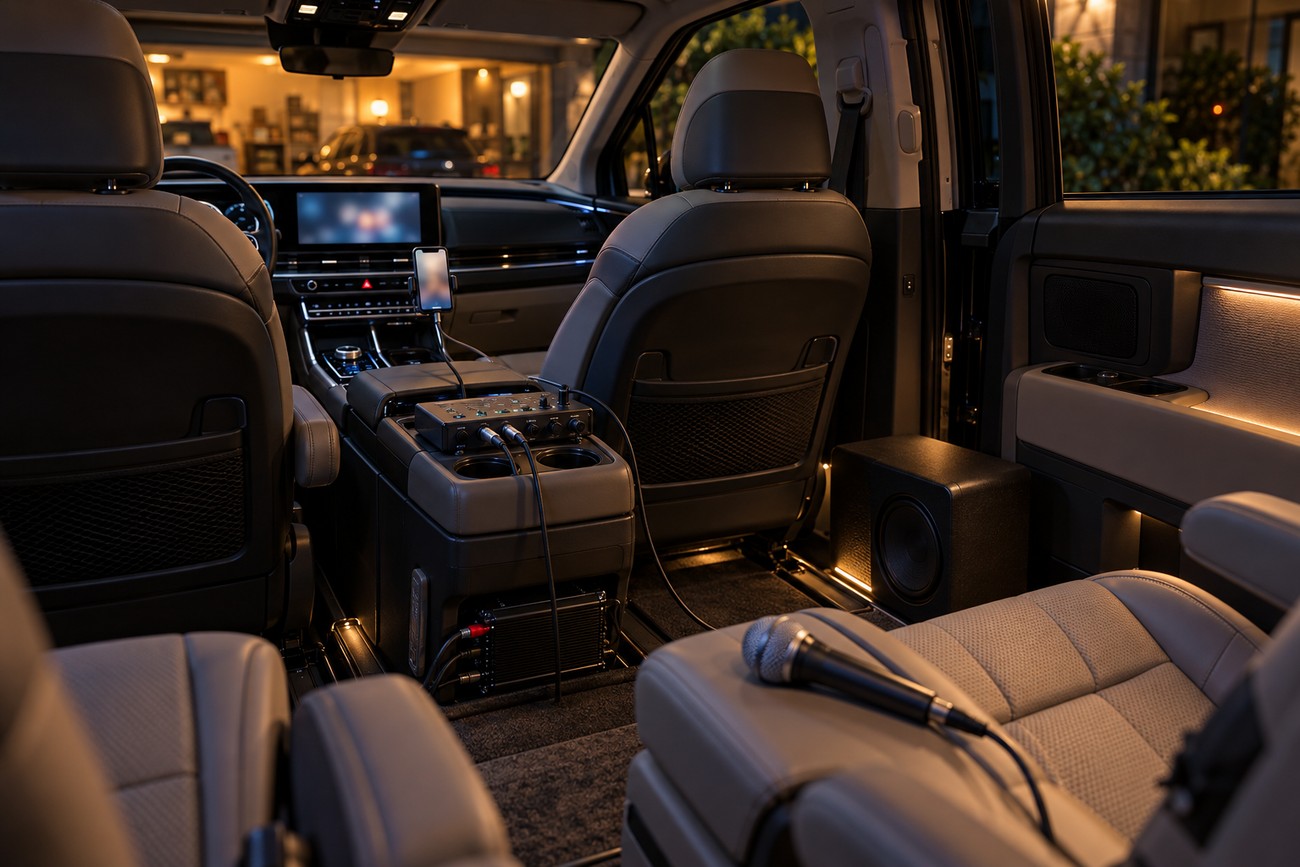
The factory system can be a convenient source for backing tracks because Apple CarPlay and Android Auto are available through it. Your phone can therefore supply karaoke music without a second head unit. That connection does not, however, create a karaoke mode or provide independent control of a singer’s microphone.
Factory audio systems may have 6, 8, or 12 speakers, depending on the market and trim. Some Bose versions may include an external amplifier and subwoofer; this is not universal. Official materials do not confirm a karaoke mixer, microphone inputs, or a complete vocal processor in the factory system, so speaker count should not determine the installation plan.
The more predictable architecture is a phone or tablet with a backing track → mixer with microphone → separate amplifier and speakers. A small mixer with equalization and limiting gives you control over vocal level, harshness, and sudden peaks. The factory system can remain the source of background music or low-volume entertainment when appropriate, while the dedicated chain handles live vocals.
Bluetooth microphones are tempting because they reduce visible wiring, but they may introduce noticeable latency. Even a modest delay can make singing feel disconnected from the music. A wired microphone into the mixer is generally more predictable, and it also makes it easier to keep vocal and backing-track levels separate.
Kia Carnival Karaoke Setups by Use Case
The right system depends on whether the Carnival is a quiet lounge, a passenger activity, or a parked party space. These three scenarios require different compromises in volume, equipment placement, and electrical demand.
| Use case | Source and microphone | Amplification and space | Main trade-off |
|---|---|---|---|
| Parked casual singing | Phone or tablet for backing tracks; wired microphone through a compact mixer | Small dedicated speakers and an amplifier can use the folded third-row area, with equipment placed for easy access | More flexible volume and placement, but gear must be secured before the vehicle moves |
| Passenger karaoke during a trip | Phone or tablet with a simple mixer; one wired microphone passed only to passengers | Low-power dedicated speakers, restrained gain, and compact equipment secured away from the driver | Vocals must remain clear and quiet enough that the driver can hear traffic and occupants |
| Louder party-style use while parked | Backing track through a mixer with equalization and limiting; wired microphones are preferred | Separate amplifier and speakers, with the 60:40 folded third row used as a ventilated equipment platform | Greater power demand, heat, and setup time; never treat the factory outlet as unlimited power |
Passenger karaoke during travel should be treated as a low-distraction entertainment system. Keep the driver out of the performance loop, place controls where the driver does not need to reach for them, and avoid displays or microphones that block sightlines. A system that sounds impressive while parked may be unsuitable once road noise, navigation prompts, and conversation compete for attention.
A parked setup allows more freedom, but the folded cargo area still needs ventilation clearance. Do not seal an amplifier, inverter, or subwoofer beneath blankets, bags, or tightly packed cases. The third row creates useful room; it does not remove the need for airflow or secure mounting.
Power the System Without Overloading the Carnival
Power planning is where many mobile audio projects become unsafe. Official 12-volt outlet guidance specifies a load below 15 A, and some versions specify a 180 W limit for the 12-volt outlet. Check the label, owner information, and fuse rating for the individual Carnival before connecting an amplifier, mixer, or inverter.
An inverter does not turn a modest vehicle outlet into a household power circuit. It introduces conversion losses, heat, and additional load on the vehicle wiring. Its headline wattage may describe a short peak rather than the continuous draw that matters during a full song session. Calculate the continuous demand of the complete system, including the amplifier, before choosing the power path.
Installers calculate continuous draw and ventilation rather than trusting an inverter’s headline wattage or the presence of a 12-volt socket. A system that plays for a few minutes can still overheat a connector or trip a fuse during a longer session.
The Carnival may have 5 to 7 USB ports, with USB-C availability varying by year, market, and trim. These ports are primarily for charging and multimedia. Their presence does not prove that a mixer, powered speaker, or other karaoke equipment can be safely powered from them.
For removable equipment, use properly rated connectors and a separately fused feed where the installation calls for one. Avoid permanent twists into factory wiring. If the required load exceeds the vehicle’s documented outlet capability, the safer choice is a lower-power system or professional electrical work designed around the vehicle’s specifications.
Place the Microphones, Speakers, and Gear Safely
Acoustic feedback begins when a microphone picks up sound from a speaker, amplifies it, and sends it back through the system. Placing a microphone near a speaker or aiming it at the ceiling can trigger the familiar rising squeal. Keep the microphone behind the main speaker direction where possible, and reduce gain before moving speakers closer to passengers.
A closed cabin also magnifies the practical effect of excessive vocal reinforcement. Loud singing can quickly overload factory speakers when amplified vocals are added, while passengers in the front row may find the sound tiring before those in the rear consider it loud enough. Clear, controlled vocals are a better target than maximum volume.
Mounting matters as much as audio quality. Keep screens, mixers, microphones, and cables clear of airbags, the driver’s sightlines, seat tracks, and other restraint-system areas. Do not run a cable across a seat rail or leave a hard case where it could become a projectile during sudden braking.
Use removable components and quick-disconnect cabling so the Carnival can return to normal passenger or cargo duty. The folded third-row area is convenient for equipment, but amplifiers, inverters, and subwoofers need ventilation clearance. Secure cases for travel, then remove or stow them properly when seats are restored.
Tune, Test, and Store the Karaoke Lounge
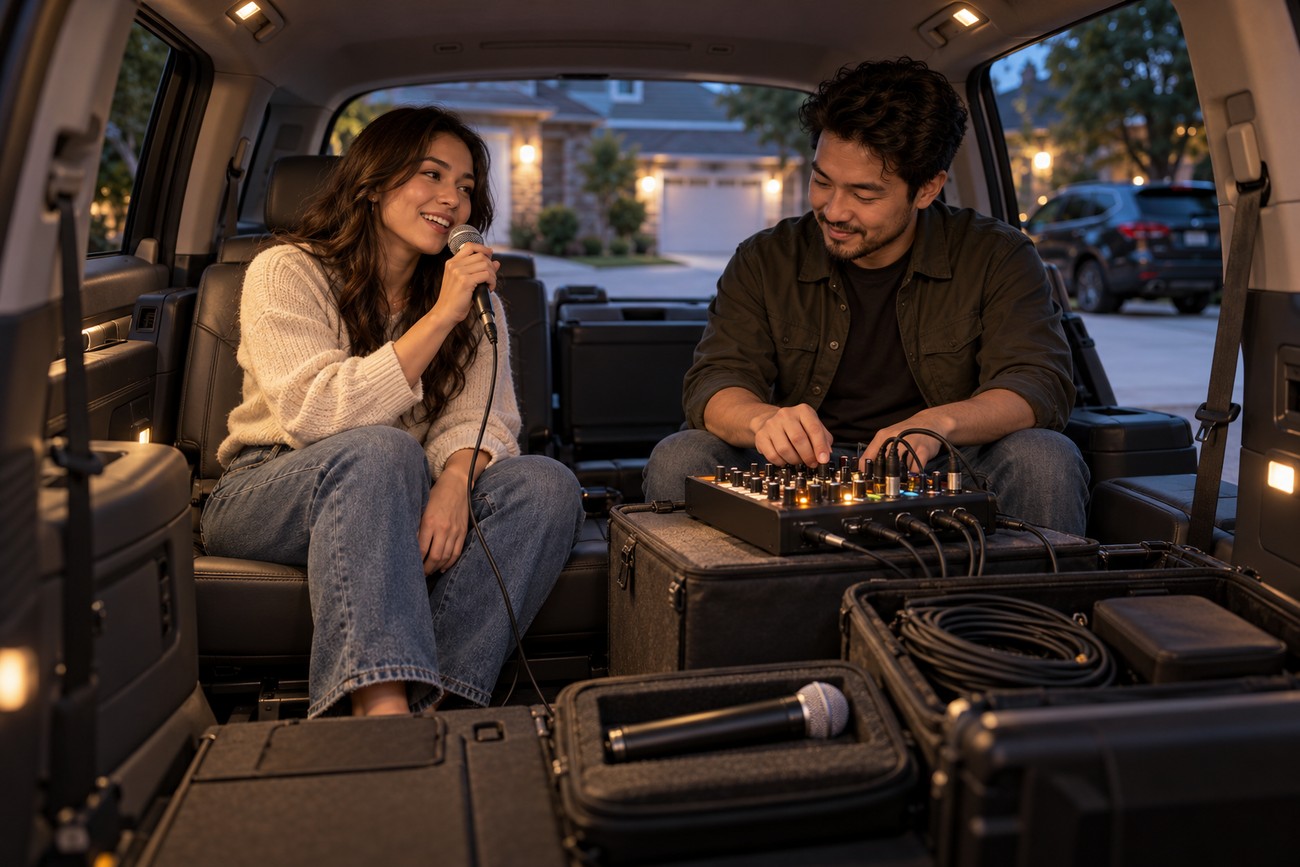
Commission the system in a quiet parked location. First verify that the phone or tablet plays the backing track reliably, then test the microphone with the intended cable and mixer input. If you are considering a wireless microphone, compare it directly with a wired one for timing; Bluetooth compatibility alone does not guarantee acceptable microphone timing or separate vocal and backing-track control.
Set vocal gain conservatively and raise the level in small steps. Check for feedback from each seating position, listen for distortion, and test with both a quiet singer and a louder singer before increasing volume. The mixer’s equalization and limiting should protect intelligibility and reduce sudden peaks rather than being used to force a small speaker system to imitate a concert rig.
Test the actual travel configuration, including passengers, closed doors, road noise, and navigation prompts. The number of factory speakers does not indicate professional karaoke capability. Karaoke requires microphone mixing, feedback control, and latency management in addition to music playback.
Keep a storage pouch for microphone cables, adapters, quick-disconnects, trim pieces, and seat hardware. Removed or repositioned seats require organized storage of hardware, fasteners, and trim pieces, especially when the vehicle changes between passenger and cargo duties. The best Carnival conversion is the one that can be removed without leaving loose parts, damaged trim, or a permanent distraction for the driver.
Frequently asked questions
What Kia Carnival year should I stay away from for a karaoke conversion?
There is no single Kia Carnival year to reject based on the supplied evidence. Screen the individual vehicle instead: verify its market, trim, seating hardware, factory audio system, USB layout, and 12-volt outlet rating before buying equipment.
A newer or higher trim may still lack the particular microphone inputs or power capacity you expected. A well-documented vehicle with a suitable seating layout can be a better starting point than one selected only by model year or a premium-sounding equipment label.
What is the lawsuit against the Kia Carnival, and does it affect a karaoke build?
A general vehicle-ownership or legal concern should be kept separate from the audio-conversion decision. A broad search result does not establish the equipment specification, electrical limit, or safety configuration of a particular Carnival.
Check current official notices and vehicle-specific information for the exact vehicle, market, and model year. For the karaoke build, independently verify the factory electrical and audio specifications before adding wiring, an inverter, or removable speakers.
How can I keep karaoke comfortable for passengers on a long drive?
Use restrained volume, keep the driver out of the performance loop, and favor vocal clarity over heavy bass or maximum loudness. Give passengers a simple control arrangement so they can pause or lower the system without asking the driver to adjust it.
Secure removable gear before moving, keep cables away from seat rails and walkways, and place microphones where they cannot strike passengers during braking. A short test drive with the intended seating arrangement can reveal distracting volume, feedback, or loose equipment before a longer trip.







