
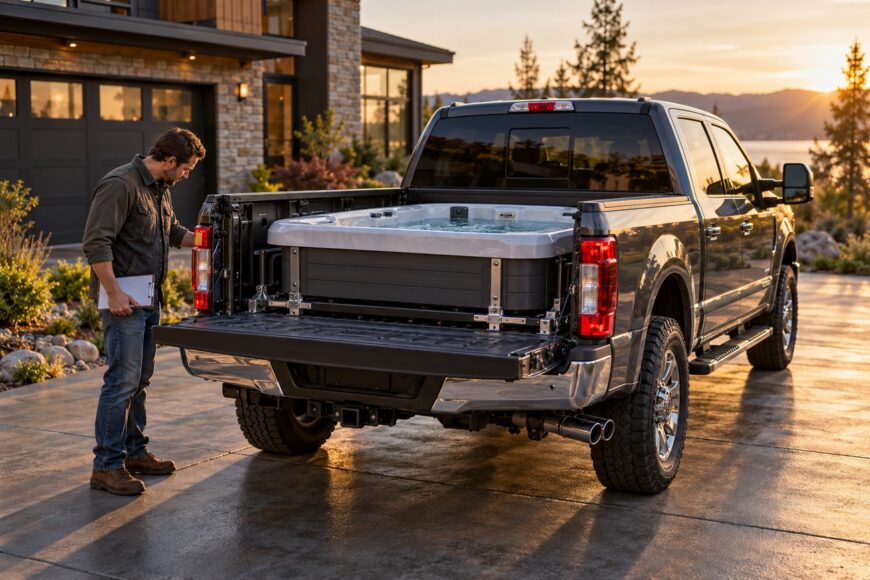
Turning a Ford F-250 bed into a hot tub has obvious show appeal: a lifted heavy-duty pickup, a warm pool at tailgate height, and a one-off display that draws attention wherever it is parked. The visual idea is simple. The engineering is not. Water adds weight quickly, heat accelerates corrosion, and a moving truck introduces forces that a stationary display never experiences.
The door-sticker payload rating for the individual truck determines whether the concept is even plausible. The F-250 name does not guarantee enough capacity, and a road-ready module must also account for sloshing, braking, suspension load, electricity, drainage, and legal equipment requirements. The sensible starting point is to choose between a parked showpiece, a removable event module, and a road-going hot tub before buying materials.
- Can a Ford F-250 Safely Carry a Hot Tub?
- Ford F-250 Hot Tub Load: Water Weight by Fill Volume
- Design Around Payload, Center of Mass, and Dynamic Load
- Build a Removable, Serviceable Tub Module
- Waterproofing, Insulation, and Corrosion Control
- Pumps, Heating, and Electrical Safety Around Water
- Why Driving With Water in the Bed Is the Hardest Part
- Common Failure Points and the True Cost of Ownership
- Choose the Safer Version of the Project
- Frequently asked questions
- What is the five-foot rule for a hot tub?
- Why is there a 15-minute hot tub rule?
- Why do people put a tennis ball in a hot tub?
- How should you insure a Ford F-250 with a custom hot-tub module?
Can a Ford F-250 Safely Carry a Hot Tub?
There is no universal yes-or-no answer because F-250 payload capacity varies widely. Depending on generation, cab, drivetrain, engine, 4×4 system, and options, an F-250 may have an approximate payload range of 1,500–4,000+ lb. Two trucks that look almost identical can therefore have substantially different usable capacity.
The controlling figure is the door-sticker payload rating for the individual truck. That number must cover the water, tub shell, support frame, pumps, plumbing, insulation, finish, passengers, and any other equipment carried in or on the truck. Towing capacity is not a substitute for payload capacity because the load is sitting on the truck rather than being carried by a trailer.
A typical 2–4-person hot tub may require approximately 200–400 gal before people and equipment are added. That water alone weighs about 1,668–3,336 lb, which can consume most or all of the available payload on some F-250 configurations. A heavy-duty badge does not make an overloaded truck safe to drive.
A parked display has different risks from a road-going installation. A stationary tub can be designed around a fixed, level surface, while a traveling module must withstand braking, road impacts, body flex, water movement, and sudden load shifts. Lifted-truck projects shared online are often approximately 100–200 gal static decorative installations; they do not show that a similar truck can safely carry a filled tub on public roads.
Ford F-250 Hot Tub Load: Water Weight by Fill Volume
Water weighs approximately 8.34 lb per US gallon. The figures below show why volume should be selected only after checking the truck’s actual payload.
| Water volume | Approximate water weight | Loads still to be counted |
|---|---|---|
| 150 US gal | Approximately 1,250 lb | Shell, frame, pumps, plumbing, insulation, finish, and people |
| 200 US gal | Approximately 1,668 lb | Shell, frame, pumps, plumbing, insulation, finish, and people |
| 250 US gal | Approximately 2,085 lb | Shell, frame, pumps, plumbing, insulation, finish, and people |
| 300 US gal | Approximately 2,502 lb | Shell, frame, pumps, plumbing, insulation, finish, and people |
| 400 US gal | Approximately 3,336 lb | Shell, frame, pumps, plumbing, insulation, finish, and people |
The water is only the first calculation. The complete load includes the shell or liner, support frame, pumps, heater, hoses, fittings, insulation, cover, battery or power equipment, exterior cladding, and occupants. A design that appears acceptable when empty can exceed the truck’s rating as soon as it is filled.
For that reason, a large tub volume is usually the wrong starting point. Check the available payload first, weigh every proposed component, and then determine whether the intended use fits within that figure. Do not treat an estimated shell weight or an average F-250 specification as a substitute for weighing the actual build.
Design Around Payload, Center of Mass, and Dynamic Load
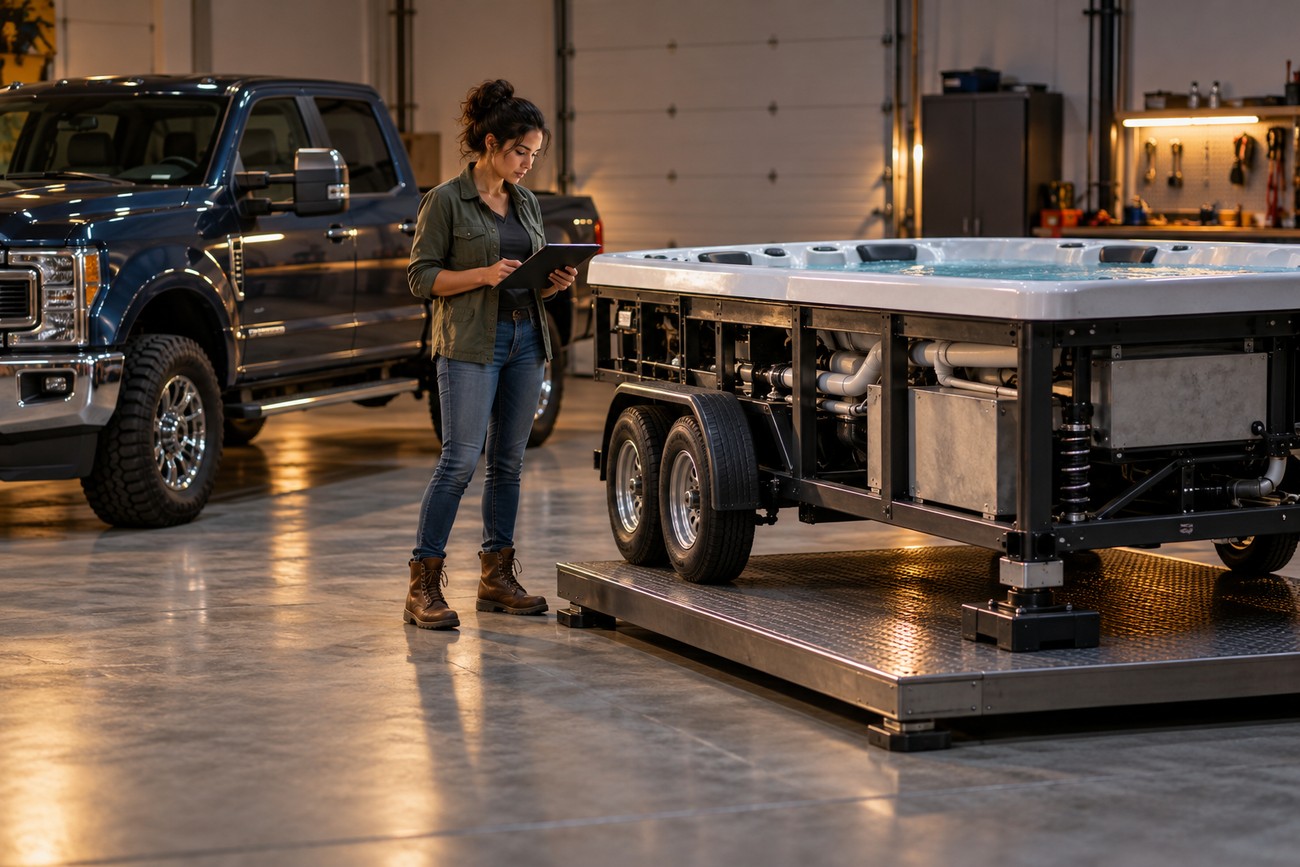
Begin with the truck’s door-sticker payload and inspect the bed, frame, suspension, and tire ratings for the individual vehicle. Weigh the proposed module and its equipment separately where possible, then account for people and anything carried during operation. Cab style, engine, drivetrain, 4×4 system, and options can all change the usable capacity.
Water should sit as low and as close to the truck’s center as the design allows. Heavy water positioned high or toward the rear increases the leverage acting on the suspension and can worsen sway. A short, shallow module is usually easier to control than a deep tank that places the weight above the bed rails.
Reinforcing the bed does not remove the load problem. Steel, timber, brackets, and additional suspension components add their own weight, while braking, tire loading, body movement, and water motion remain. A stronger platform can support a structure without making an overloaded truck easier to stop or more stable in a turn.
Water also creates dynamic loads that a simple parked weight calculation cannot describe. Acceleration, braking, potholes, and cornering can shift the load and increase stress on mounts and suspension components. Baffles, a controlled water level, secure mounting, and a low, centered load matter more for road use than maximizing the visible volume.
Build a Removable, Serviceable Tub Module
A separate support frame and removable tub module are usually more practical than making the pickup bed itself the water container. The truck bed can then remain protected and usable, while the module can be lifted out for inspection, repair, storage, or a change of purpose. This also makes it easier to design the load path deliberately rather than relying on thin bed panels.
The module should have a fast, controlled drain, a defined maximum fill level, and baffles that limit water movement. The fill level should leave room for occupants and motion without allowing water to surge over the sides. Every mount must resist both vertical impact and fore-and-aft movement during braking.
Provide service hatches for pumps, clamps, drains, valves, and electrical components. A leak or failed hose clamp should be reachable without removing decorative cladding or dismantling the entire tub. Drain paths should empty completely so that water cannot remain trapped between the module and the truck bed.
Hidden cavities need their own cleaning and drainage plan. Any enclosed space that can collect water, dirt, or condensation can become a source of mold, odors, and corrosion. A removable design is valuable only if the module can actually be inspected and dried.
Waterproofing, Insulation, and Corrosion Control
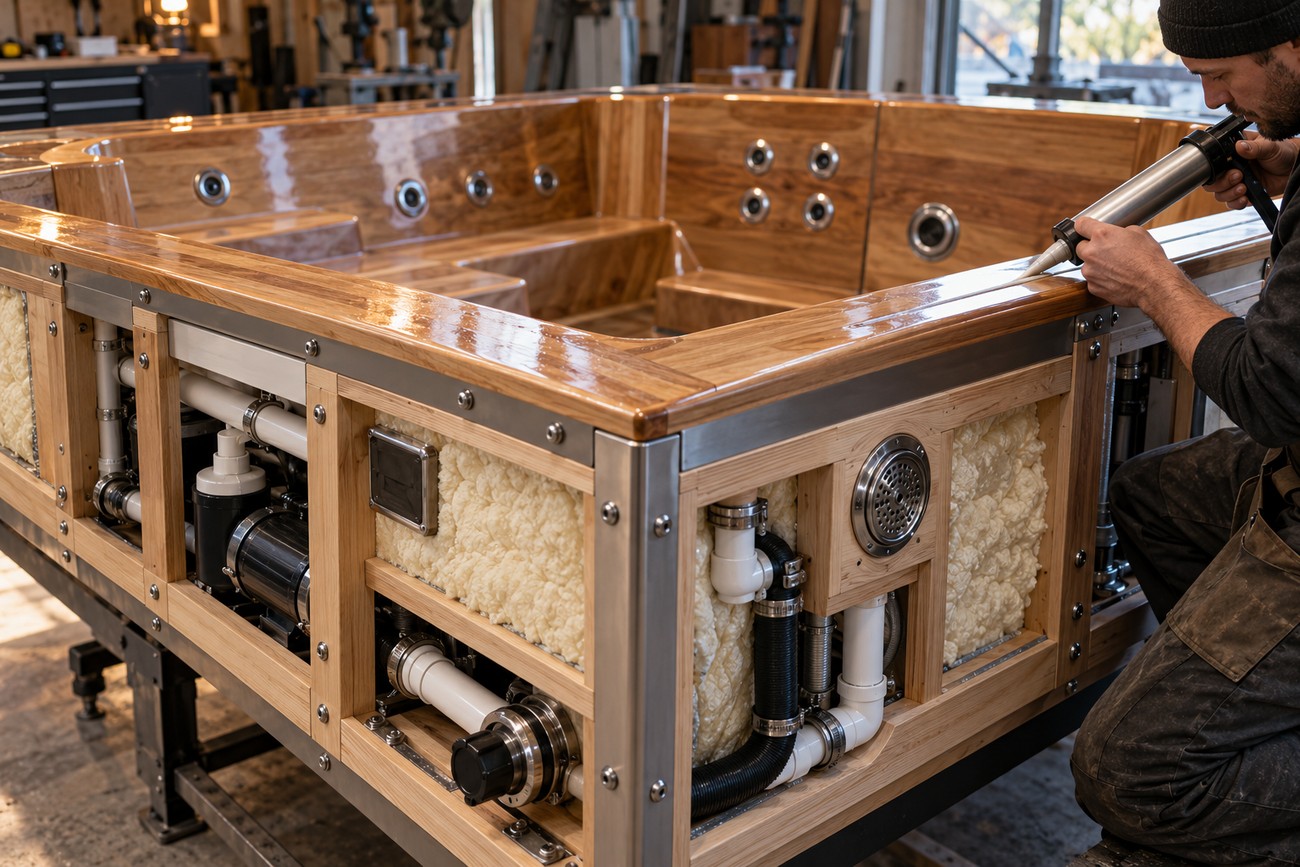
The shell, seams, penetrations, and drain fittings must be designed as a system. Every pipe opening and fastener is a potential leak path, especially when the structure flexes. Ordinary plywood or unsealed wood can absorb water, swell, lose strength, and eventually create leaks beneath the visible finish.
Use a continuous epoxy or polyurethane barrier where wood or other absorbent materials are part of the construction. Sealant alone is not a permanent structural solution because heat, vibration, water chemistry, and movement age the joint. Access to seals and fittings matters as much as the initial waterproofing.
Water, metal, and heat create a high corrosion risk. Use compatible corrosion-resistant fasteners, protect exposed surfaces, and provide deliberate drainage rather than allowing water to sit under cladding or around brackets. Stainless steel helps in many locations, but it does not eliminate galvanic corrosion when dissimilar metals, salts, or chemicals are poorly matched.
Insulation reduces the energy needed to keep the water warm, while a proper cover limits heat loss from the surface. Without both, the heater may spend much of its time replacing lost heat rather than maintaining a usable temperature. Seasonal storage also matters: freezing water can damage fittings, seals, and trapped sections of plumbing.
Pumps, Heating, and Electrical Safety Around Water
A heater alone does not make a usable hot tub. The system also needs reliable circulation, suitable filtration, a controlled water level, a proper cover, and safe access to pumps and fittings. Pump placement should allow inspection and replacement without draining or dismantling more of the module than necessary.
Pumps can create substantial noise and vibration, particularly when mounted directly to a thin panel. Use appropriate isolation and secure plumbing so vibration does not work fittings loose. Flexible connections may help, but they still require inspection because clamps and seals age under heat and movement.
Outdoor electrical equipment near water should use GFCI protection and moisture-rated components as baseline safety practices. Keep electrical components protected from splashes and condensation, and route cables so water cannot run along them into connections. An improvised extension cord is not an adequate substitute for a properly reviewed installation.
Wiring details and required clearances depend on the adopted electrical code and local inspection rules. A qualified local electrician should review the supply, disconnects, grounding, GFCI protection, equipment locations, and any truck-mounted power modifications. Electrical safety must be planned before the tub is filled, not added after a leak or shock hazard appears.
Why Driving With Water in the Bed Is the Hardest Part
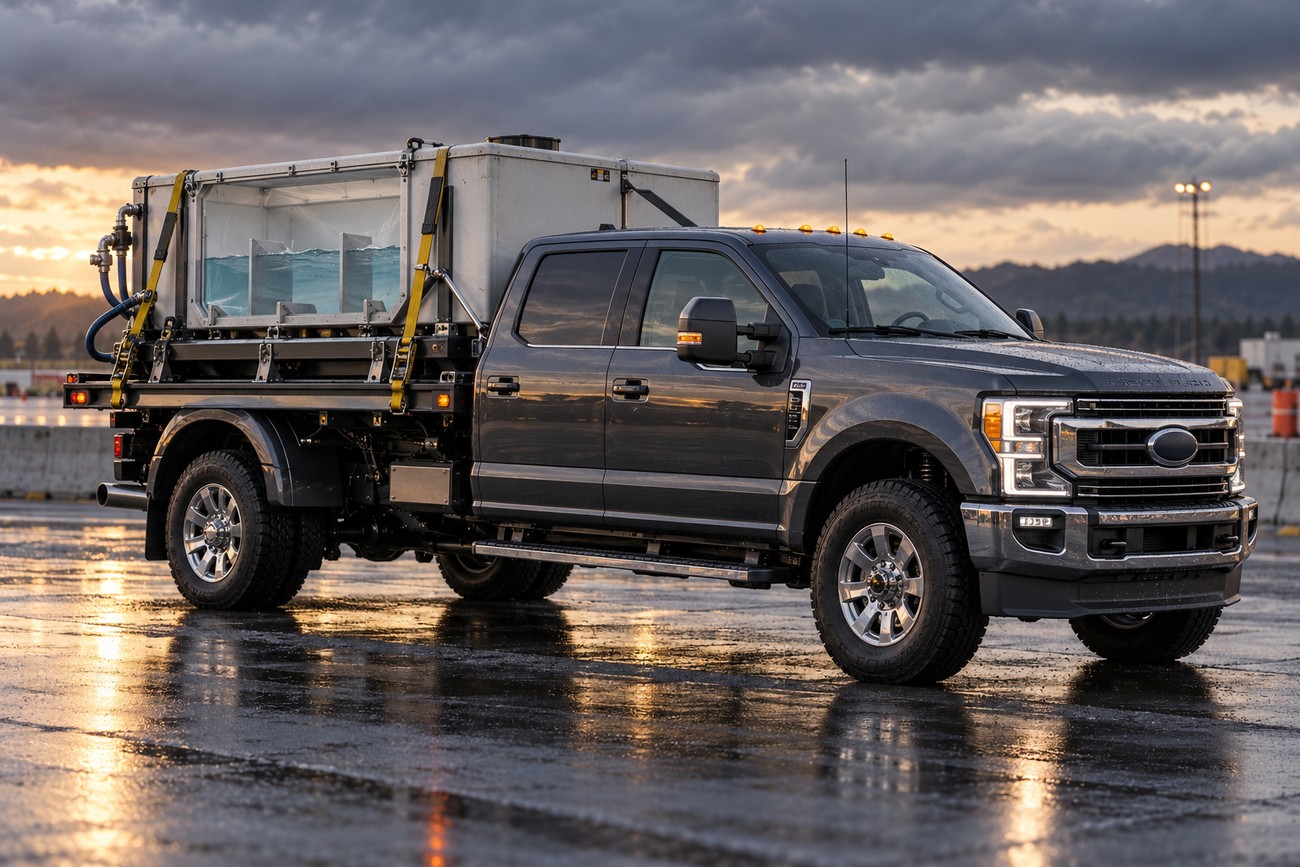
Water does not behave like a fixed load once the truck moves. It can surge into the bed sides, push against mounts, overflow, and shift the center of mass during braking or cornering. That movement can combine with suspension squat and sway, making the truck harder to control even if the static weight appears acceptable.
Road impacts add another problem. A tank that survives on a level parking surface may place high loads on its frame and fittings when the truck crosses a pothole or driveway transition. The module must be securely restrained in every direction, and its plumbing must tolerate movement without transferring excessive force into the shell or truck bed.
Static decorative projects do not prove road safety. Lifted-truck hot-tub examples are often approximately 100–200 gal installations intended for display while parked. A traveling tub needs a separate assessment of payload, restraint, water motion, braking, lighting, splash control, and road compliance.
Before driving, check state-specific requirements for lighting, splash or mud protection, license-plate visibility, equipment restraint, and any fuel or electrical modifications. The truck must remain visible and compliant with the module installed. Local rules and inspection practices vary, so road legality requires verification for the place where the vehicle will operate.
Common Failure Points and the True Cost of Ownership
Suspension sag is one of the earliest visible warnings that the design has consumed too much capacity or placed too much weight toward the rear of the truck. Leaks commonly appear at seams, drains, hose connections, and fittings. A small leak can spread water beneath cladding, where it remains hidden until the frame, wood, or truck bed is damaged.
Pump vibration can loosen clamps and create noise that makes the vehicle unpleasant to use. Heat loss can also be severe if the module lacks proper insulation and a fitted cover, increasing heater run time and power demand. A system that looks impressive when filled may become expensive and labor-intensive to maintain.
Winter exposes weak points that warm-weather testing can miss. Water trapped in plumbing or cavities can freeze, damage fittings, split seals, and create cracks. Rust can develop beneath insulation or decorative panels where inspection is difficult, especially if drainage was treated as an afterthought.
The expensive work is often outside the visible tub: sealing, insulation, pumps, power supply, support structure, and chassis modifications. Poor serviceability increases labor each time a clamp or fitting fails. Custom modifications may also be treated by insurers and future buyers as a specialized risk rather than an improvement, affecting coverage, valuation, and resale.
Choose the Safer Version of the Project
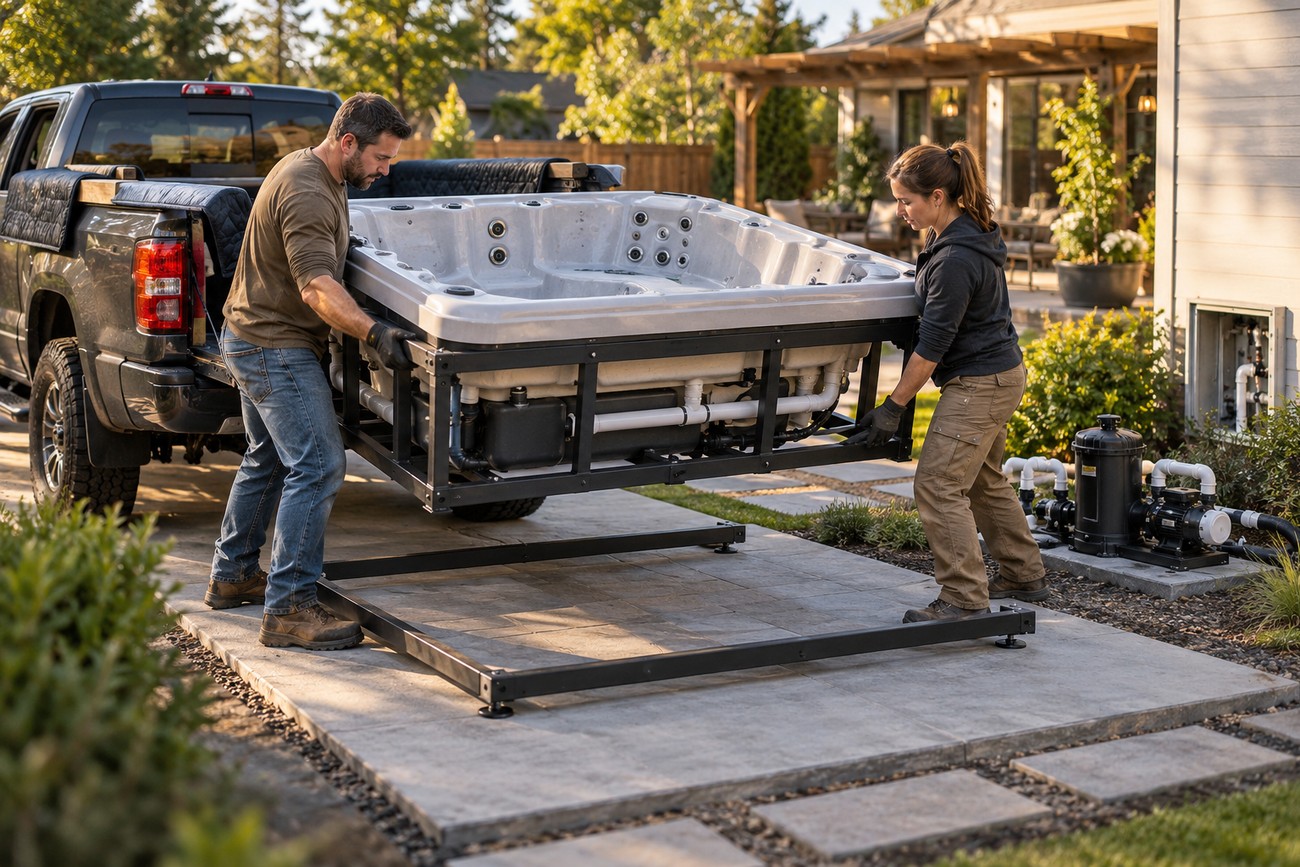
A parked display is the simplest version because it avoids road loads and can be installed on a properly prepared, level surface. It still needs safe electrical work, drainage, waterproofing, and structural support. This option suits a show vehicle or event installation better than a tub expected to travel filled.
A removable event module offers a more practical compromise. It can be transported empty, filled at the destination, drained quickly, and removed for maintenance or storage. The separate frame protects the truck bed and makes the system easier to inspect, although the loaded module still requires a payload and stability assessment before use.
A road-going system is the most demanding option. It needs a verified payload calculation, a low and centered load, effective baffles, secure restraint, controlled fill, reliable drainage, service access, safe electrical design, and compliance with local road rules. Even then, carrying water while driving may be less sensible than transporting the module empty and filling it after arrival.
Decide the use case before selecting the tub volume or buying materials. Check the door-sticker payload, weigh the proposed components, plan drainage and winterization, review electrical work locally, protect every corrosion-prone surface, and confirm lighting, splash protection, plate visibility, and equipment restraint requirements. The project can be workable as a carefully limited display or removable module, but it should never be assumed safe or legal simply because the truck is an F-250.
Frequently asked questions
Practical questions remain even after the module’s design is settled. Electrical placement and soak time affect how the tub is used, while cleaning and insurance shape its upkeep. The answers below explain these points without replacing local code review or policy confirmation.
What is the five-foot rule for a hot tub?
The commonly cited five-foot rule concerns the placement of an electrical disconnect relative to the hot tub. The exact distance, placement, disconnect type, and access requirements depend on the adopted electrical code and local inspection rules.
For a truck-mounted installation, the inspector may also consider the changing position of the module, the vehicle’s power connection, grounding, and exposure to spray. Treat the five-foot figure as a code-navigation reference, not a complete design instruction, and have the installation reviewed locally before use.
Why is there a 15-minute hot tub rule?
A 15-minute soak is generally a conservative safety guideline intended to limit exposure to hot water. It is not a universal rule for every hot tub or every user. Risk changes with water temperature, age, alcohol use, medication, dehydration, and individual health conditions.
Use a lower temperature or shorter session when those factors increase risk, and leave the water if you feel dizzy, weak, nauseated, or unusually tired. Children and people with relevant medical conditions may need specific advice from a healthcare professional.
Why do people put a tennis ball in a hot tub?
A clean tennis ball is sometimes floated in a hot tub to collect surface oils, sunscreen, and other film. It can help with light surface contamination, but it does not replace filtration, sanitation, water testing, or proper cleaning of the shell and plumbing.
Use a clean ball made from materials suitable for the water environment, and remove it if the cover, liner, or water becomes contaminated. A tennis ball cannot correct poor water chemistry or remove buildup below the surface.
How should you insure a Ford F-250 with a custom hot-tub module?
Contact the insurer before building or driving the vehicle and disclose the module as a custom modification. Ask whether the policy covers the truck, removable equipment, pumps and heater, damage while parked, road use, and liability associated with the filled module.
Confirm how the insurer values custom parts, whether photographs and receipts are required, and whether there are restrictions on electrical, fuel, suspension, or structural modifications. Obtain the response in writing and update the insurer if the design or intended use changes.







