
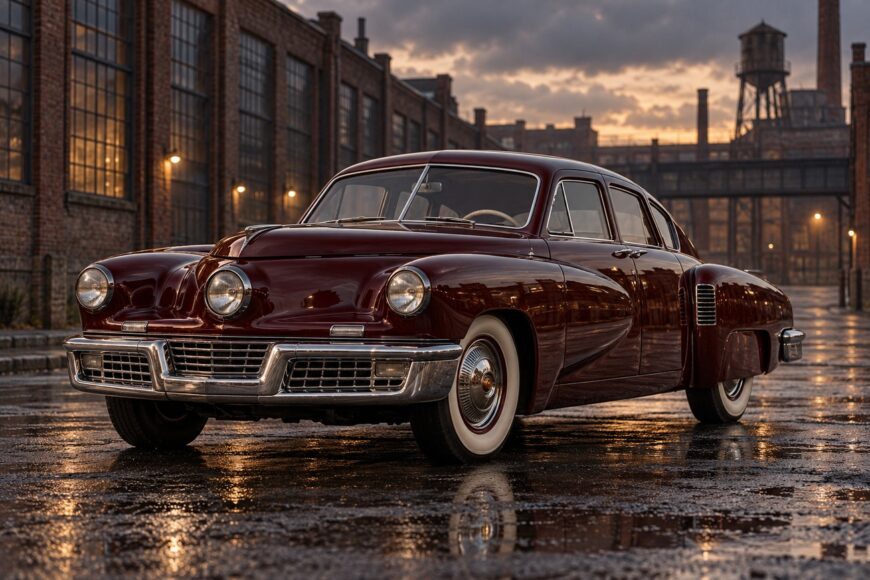
The Tucker 48 has the silhouette of a car that arrived from the future. Its rear-mounted engine, steering-linked center headlamp, impact-conscious cabin, and aerodynamic body challenged the assumptions behind the large American sedans of the late 1940s. The harder truth is less cinematic: only 51 automobiles were built, including prototypes, and mass production never began.
That small run leaves the Tucker 48 suspended between breakthrough and unfinished experiment. Its safety ideas were unusually serious, while its Bendix semi-automatic transmission, cooling system, service access, and component supply could demand more patience than a conventional collector car. Performance figures also require restraint, since specialist references commonly cite about 193 km/h, while some descriptions claim up to 200 km/h.
For collectors, the car’s importance therefore carries a practical warning. Rarity does not guarantee mechanical maturity, easy authentication, or affordable ownership. A Tucker 48 is an important piece of engineering history, yet each surviving example must be judged as an individual machine with its own development history, parts mix, and unfinished compromises.
- Why the Tucker 48 Looked Like a Threat to Detroit
- The Engineering: Ambitious, Clever, and Not Fully Sorted
- Tucker 48 Specifications: What the Numbers Actually Say
- Safety Features That Were Truly Ahead of Their Time
- Why the Tucker Project Failed Before Mass Production
- The Hidden Cost of Owning One Today
- Tucker 48 Myths That Do Not Survive Inspection
- Frequently asked questions
- How much is a Tucker 48 worth today?
- How many Tucker 48s are left?
- Why did the Tucker car fail?
Why the Tucker 48 Looked Like a Threat to Detroit
Postwar Detroit was built around familiar formulas: a large front engine, rear-wheel drive, body-on-frame construction, conventional front suspension, and styling that emphasized mass and chrome. The Tucker 48 rearranged that logic. Its engine sat behind the passenger compartment, the body pursued cleaner aerodynamic lines, and independent suspension was used at all four wheels.
The rear-engine layout created several theoretical advantages. It freed the front of the car for luggage space and crash-management ideas, reduced the visual dominance of a long hood, and placed the driving wheels near the power unit. The arrangement also introduced serious engineering demands, especially around cooling, weight distribution, service access, and transmission control.
Tucker’s safety priorities were equally unusual for the period. The design incorporated a padded dashboard, movable front seats, an outward-ejecting windshield concept, and a reinforced structure ahead of the engine. A steering-linked central headlamp turned toward a corner, helping illuminate the driver’s intended path rather than simply projecting straight ahead.
Those features explain the car’s reputation, though later legend sometimes turns them into claims Tucker never fully earned. The ideas were ahead of many late-1940s Detroit practices, but they were not industry-wide standards, and the car never accumulated the production volume needed to validate them through ordinary long-term use. The project’s threat to Detroit was therefore a challenge of direction and imagination, rather than proof that a complete rival manufacturing system already existed.
The Engineering: Ambitious, Clever, and Not Fully Sorted
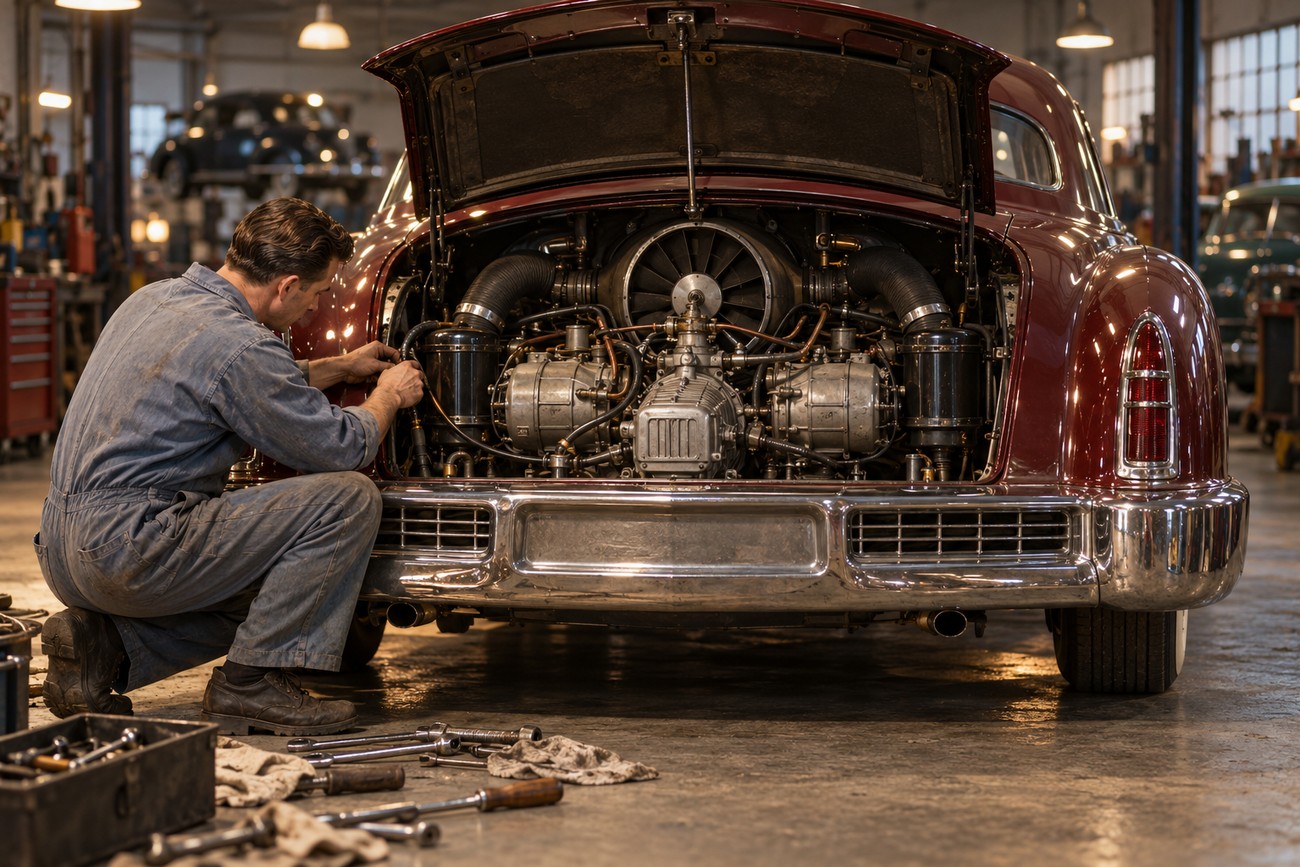
The production-direction Tucker 48 used a Franklin O-335 rear-mounted opposed six-cylinder engine. It was a gasoline, liquid-cooled unit of approximately 5,473 cc, or about 5.5 liters. Output was approximately 166–168 hp at about 3,200 rpm, with approximately 504 N·m of maximum torque at 2,000 rpm and a 7.0:1 compression ratio.
That torque-focused character suited a heavy sedan intended to move with authority at low engine speed. Power reached the rear wheels through a four-speed semi-automatic Bendix, or preselector, transmission. Exact transmission details and other components varied across development stages, which matters when a collector compares one car with another or evaluates whether a replacement part belongs to a particular example.
Rear-engine cooling was one of the layout’s less glamorous costs. A liquid-cooled engine still depends on correct airflow, plumbing, temperature control, and system adjustment. If the system is incorrectly set up, cooling can become difficult, particularly in hot conditions. That makes an apparently simple road test less useful than a careful inspection of operating temperatures under repeatable conditions.
The Tucker 48 should therefore be understood as an advanced prototype approaching production, rather than a fully matured mass-market sedan. Independent suspension on all four wheels was ambitious, and the Bendix transmission offered a distinctive driving experience, yet both systems needed specialist understanding. The surviving cars reflect an engineering program still changing as construction proceeded.
Tucker 48 Specifications: What the Numbers Actually Say
The figures below describe the commonly cited production direction, while acknowledging uncertainty around claimed performance and variations between individual cars.
| Specification | Claimed or approximate figure |
|---|---|
| Engine | Franklin O-335 rear-mounted opposed six-cylinder, gasoline, liquid-cooled |
| Displacement | Approximately 5,473 cc, or about 5.5 liters |
| Power | Approximately 166–168 hp at about 3,200 rpm |
| Maximum torque | Approximately 504 N·m at 2,000 rpm |
| Compression ratio | 7.0:1 |
| Transmission | Four-speed semi-automatic Bendix/preselector; details varied across development stages |
| Drivetrain | Rear-wheel drive with a rear-mounted engine |
| Suspension | Independent suspension on all four wheels with springs |
| Claimed acceleration | Approximately 10–10.5 seconds from 0 to 96/100 km/h |
| Top speed | Approximately 193–200 km/h; specialist catalogs commonly cite about 193 km/h |
| Length | Approximately 5.56 m |
| Width | Approximately 2.0 m |
| Mass | Approximately 1,900 kg |
| Brakes | Hydraulic drum brakes |
Safety Features That Were Truly Ahead of Their Time
The Tucker 48’s safety program was more coherent than its later image as a collection of spectacular gadgets. The windshield was designed to pop outward during a severe collision, reducing the chance that the glass would become a rigid barrier in front of occupants. The dashboard was padded, and the front seats could be repositioned or moved forward as part of the impact strategy.
The car also used a parking-brake lock that served an anti-theft function. That detail shows how Tucker treated safety and security as practical parts of the same design problem. A reinforced area ahead of the engine was intended to manage the consequences of a frontal impact, while the broader layout aimed to keep the engine from intruding into the passenger compartment.
The rear-engine concept supported that philosophy in a specific way. In a serious frontal crash, the engine was intended to move beneath the passenger compartment rather than into it. The idea anticipated a later emphasis on controlled structural behavior, even though the Tucker’s execution belonged to an era before modern crash testing, computer modeling, and standardized occupant-protection requirements.
The center headlamp was also more than a styling ornament. Linked to the steering, it turned toward the direction of a corner and could improve visibility on a dark road. It was an early prominent adaptive-lighting solution, although claims that Tucker was unambiguously the first experimental example go beyond what the historical record securely establishes.
Why the Tucker Project Failed Before Mass Production
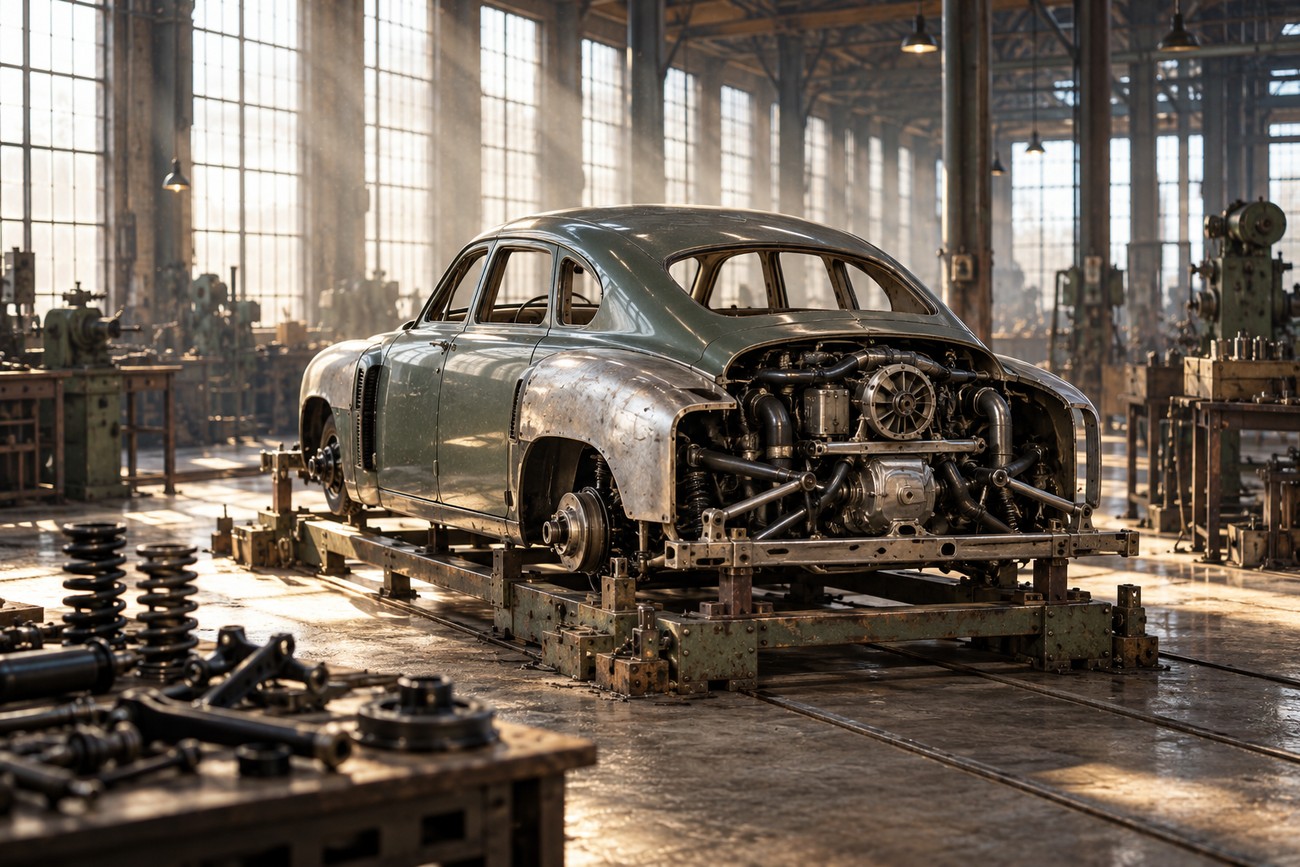
The Tucker project failed through several pressures acting together. Engineering remained unfinished, manufacturing a new sedan at volume required major capital, and the business had to persuade customers and investors that its unusual systems could be built consistently. Only 51 cars, including prototypes, were built, and mass production never started.
The powertrain story illustrates the scale of the development problem. The original plan called for a very different nine-liter inline-six with fuel injection and hydraulically operated valves. That proposal was abandoned, and the project moved toward the Franklin O-335 rear-mounted opposed six-cylinder. Such a change affected packaging, cooling, weight distribution, controls, and the production process.
Many systems retained prototype characteristics when construction stopped. The Bendix transmission required careful adjustment, cooling performance depended on correct setup, and the exact specification of individual cars could vary. Without a large-scale reliability record or complete long-term series testing, Tucker could not demonstrate the kind of predictable service life expected from a high-volume family sedan.
Business and legal controversy became a major part of the Tucker story, and corporate pressure clearly mattered. A fair assessment still needs to separate that controversy from the vehicle’s technical position. Detroit’s established manufacturers may have represented formidable competition, yet the Tucker organization also faced the ordinary industrial problem of proving an ambitious design while financing and organizing production.
The result was a car whose historical influence exceeded its manufacturing success. Tucker showed how safety, packaging, and aerodynamic design could be treated as central engineering subjects. It did not prove that its complete package was ready for trouble-free mass production.
The Hidden Cost of Owning One Today
Ownership begins with parts, and original Tucker components are extremely scarce. A repair may require a rare-source part, specialist fabrication, or careful restoration of an existing component. Substituting a modern-looking item can keep the car moving while weakening its originality, historical accuracy, or future valuation.
The Bendix semi-automatic transmission deserves particular caution. It is sensitive to setup and maintenance, and the pool of people able to diagnose and repair it properly is limited. A conventional garage familiar with ordinary American automatic or manual transmissions may lack the specialized knowledge required for a rare preselector system.
Rear-engine service adds another layer of labor. Access to the Franklin engine and its cooling hardware can be more complicated than access to a conventional front-engine sedan. Brake hydraulics, suspension components, and long-stored mechanisms also need inspection before regular driving, even when the car appears cosmetically complete.
Transmission adjustment, cooling behavior, brake hydraulics, and component provenance should be checked before cosmetic restoration begins. Ordinary garage servicing can worsen rare original systems when technicians treat them like familiar mass-production hardware.
Storage is an active maintenance task rather than a substitute for maintenance. Long periods without preventive running and inspection can leave mechanisms seized and create problems in the transmission and brakes. Insurance, specialist labor, transport to qualified workshops, and controlled storage can make ownership substantially more expensive than the purchase decision suggests.
Documentation has a mechanical value as well as a historical one. Incomplete or disputed records can complicate authentication, especially when the engine, transmission, safety components, or other major assemblies have changed over the car’s life. For a Tucker 48, provenance is part of the machine’s identity.
Tucker 48 Myths That Do Not Survive Inspection
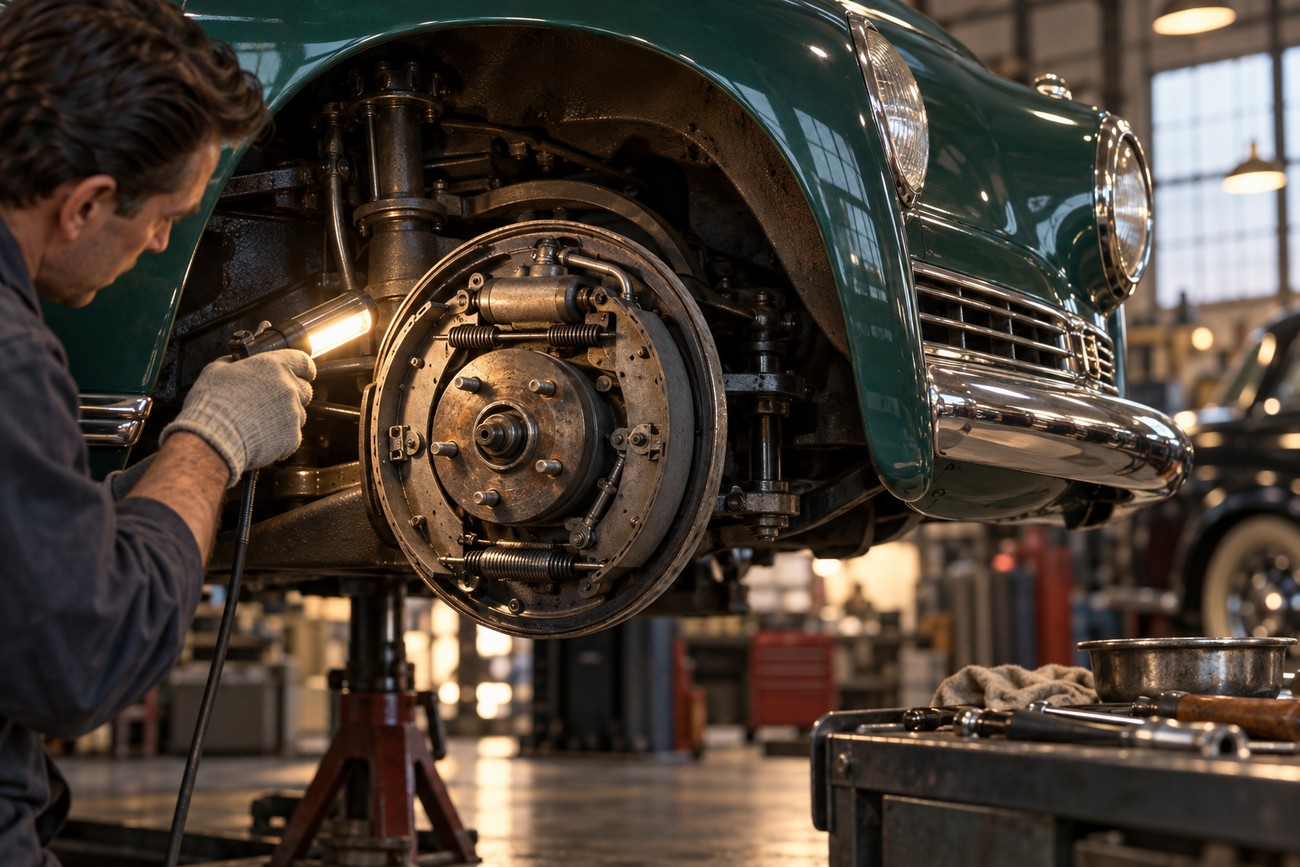
A frequent error is the claim that Tucker 48 cars had production disc brakes. They used conventional hydraulic drum brakes. Disc brakes were considered as a future development, which explains some later confusion, but they were not a standard production feature.
Another claim presents the Tucker as a fully sorted sedan ready for high-volume manufacture, halted only by hostile Detroit interests. The business and corporate controversy was real, yet the cars also contained prototype-level systems, varied across development stages, and lacked large-scale reliability validation. The evidence supports a more complicated failure than a single outside conspiracy.
Performance claims also need a firm ceiling. Specialist catalogs commonly cite a top speed of about 193 km/h, while some descriptions claim up to 200 km/h. Claims above approximately 210–220 km/h are not supported by the cited technical references. The claimed acceleration figure of approximately 10–10.5 seconds from 0 to 96/100 km/h should likewise be treated as a period performance claim rather than a universal result for every surviving car.
- Myth: the car had production disc brakes. Reality: it used hydraulic drum brakes.
- Myth: every Tucker 48 was mechanically identical. Reality: transmission and detail components varied during development.
- Myth: the model was a proven, trouble-free mass-production sedan. Reality: only 51 automobiles were built, including prototypes, and mass production never began.
- Myth: Tucker unquestionably introduced the first rotating headlamp. Reality: the steering-linked center headlamp was an early prominent adaptive-lighting solution, while earlier experimental examples are discussed in specialist literature.
Frequently asked questions
These questions address the Tucker 48’s value, survival, and failed production program. The answers reflect the car’s limited production and varied development history. They also distinguish documented facts from estimates and claims.
How much is a Tucker 48 worth today?
There is no reliable single price derived from the production count alone. Value depends heavily on documented provenance, originality of the Franklin engine and Bendix transmission, condition, quality of restoration, and the specific auction or private-sale context.
A car with disputed history or major non-original components may be judged very differently from a well-documented example retaining historically appropriate systems. Market interest can also change the result of an individual sale, so published headline figures should not be treated as a universal valuation guide.
How many Tucker 48s are left?
The documented total built was 51 automobiles, including prototypes. That figure does not establish how many survive today, and no authoritative surviving-car total is established in the available brief.
Surviving-count estimates can vary because records, ownership histories, restoration identities, and public registries do not always align. A registry is useful evidence for research, yet it should not automatically be treated as a definitive census of every surviving car.
Why did the Tucker car fail?
The Tucker project failed because ambitious engineering, production difficulty, financing pressure, and corporate controversy converged before the company could establish a reliable high-volume manufacturing system. The move from the proposed nine-liter inline-six to the Franklin O-335 also shows how much the design was still evolving.
Detroit’s established industry formed a powerful competitive and institutional environment, but hostility alone does not explain the result. The Tucker 48 had important innovations and a compelling safety philosophy, while its unfinished systems and lack of long-term validation made mass production difficult to prove.







