
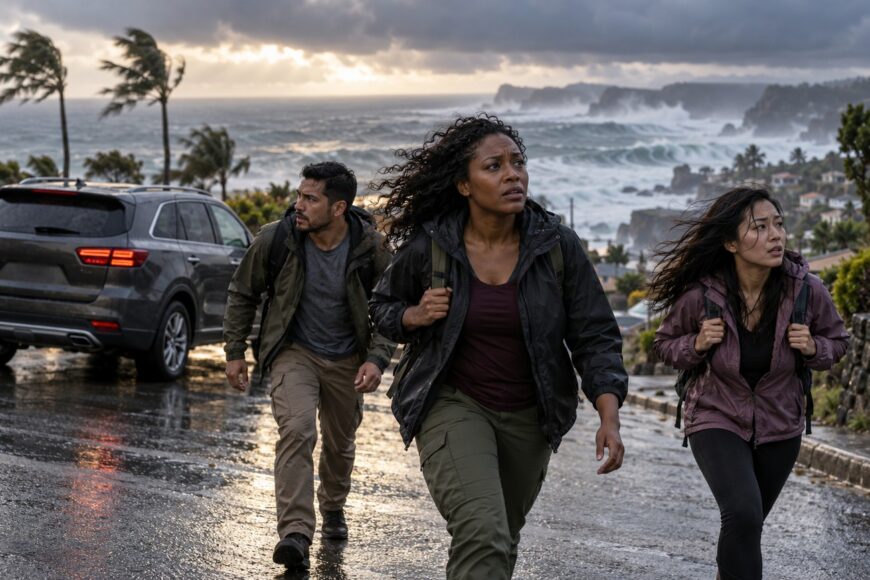
After a strong or long earthquake on the coast, move immediately to higher ground or inland. Do not wait for a tsunami siren before leaving. A nearby safe area is often reached faster on foot than in a Kia Sorento, even though the vehicle’s size may feel reassuring.
The decision depends on distance, terrain, road conditions, and traffic, rather than on the size of the SUV. A vehicle cannot be assumed to outrun a tsunami, and a traffic jam can leave you exposed on a road that becomes unsafe within minutes.
- The short answer: walk if safety is close
- Why a Kia Sorento does not make flooding safe
- When driving is necessary, avoid becoming the blockage
- The mistakes that make a tsunami evacuation worse
- Frequently asked questions
- How far inland do you need to go during a tsunami evacuation?
- How long should you stay away after the first tsunami wave?
The short answer: walk if safety is close
Walking is preferred when the safe area is within practical walking distance. Some emergency services use approximately 1–2 km as an orientation, but this is not a universal cutoff. The right target is the nearest accessible higher area or designated evacuation point.
If the earthquake was strong or lasted a long time, start moving without waiting for confirmation. Sirens, phone alerts, and official messages may arrive too late when the tsunami source is close. Take the route you have already identified, and keep moving toward safety.
Already outside the evacuation zone? Avoid an unnecessary drive into the evacuation traffic. Leaving your vehicle parked and staying clear of the flow can reduce congestion for people who still need to escape.
Why a Kia Sorento does not make flooding safe
The Kia Sorento is a high crossover, not an amphibious vehicle. Ground clearance may help on some rough or slippery surfaces, and all-wheel drive may improve traction in limited conditions. Neither feature protects you from moving water, hidden washouts, debris, or a damaged bridge.
No confirmed factory maximum wading depth is available across Sorento generations and trims. That makes roadside judgments especially dangerous. Floodwater can hide holes, broken pavement, and heavy objects, while rising water can reduce traction, move the vehicle, or stall the engine.
The decisive rule is simple: do not drive through flooded roads. Stop before the water and follow official directions to another route or safe area. Never use the vehicle’s size, wheel drive, or apparent water depth as a test of whether crossing is possible.
When driving is necessary, avoid becoming the blockage
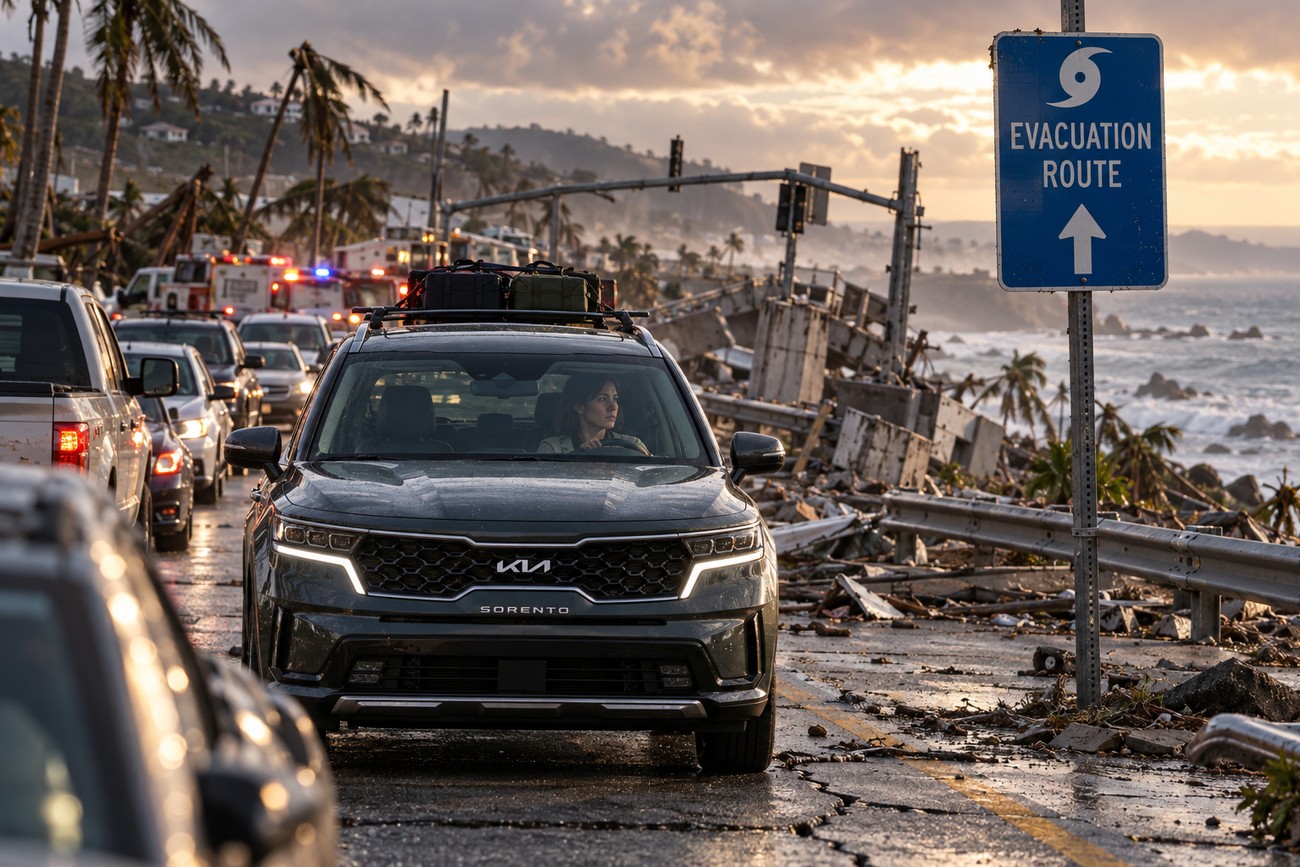
Driving may be necessary when walking is impossible or the safe zone cannot be reached on foot. Follow marked evacuation routes and official directions, and aim for the nearest accessible safe location rather than an ideal destination far away.
Official evacuation signs take priority over standard vehicle navigation. After an earthquake, a route planner may still suggest a road with a damaged bridge, blocked junction, or unsafe coastal approach. Keep the route simple, and do not spend time searching for a theoretically faster alternative.
The fastest route on a map can become the slowest route in an evacuation if it narrows near a hill entrance or emergency access point. Reaching the nearest signed safe area matters more than preserving a preferred route.
Do not stop where the Sorento blocks a junction, narrow street, hill entrance, evacuation access, or emergency vehicles. If traffic stops, leave enough space for others to pass when possible. A vehicle abandoned across the road can create a second hazard after the original danger has moved inland.
The mistakes that make a tsunami evacuation worse
Returning for relatives, documents, or belongings costs time while the danger is developing. Leave first, then follow official instructions for assistance. Do not drive back after the first wave: a tsunami can arrive as a series, and the first wave is not necessarily the largest.
Dangerous waves may continue for several hours. Remain in the safe location and return only after an official all-clear. A quiet shoreline or an apparently dry road does not prove that the hazard has ended.
Prepare before an emergency by walking the primary and backup routes. Identify nearby high ground, the nearest designated safe area, and places where roads narrow or flood. An earthquake may make a planned vehicle route unusable, while a walking route may remain available.
In a dense urban area, vertical evacuation may be the practical alternative when reaching higher ground or inland is impossible. This can mean moving to the fourth floor or higher of a suitable strong building. Use a building identified as appropriate for evacuation, and continue following local instructions.
Frequently asked questions
These decisions should be made before shaking starts, because a tsunami evacuation may leave little time for route planning. Use official alerts and local evacuation maps whenever they are available.
How far inland do you need to go during a tsunami evacuation?
There is no single universal inland distance. Move to the nearest officially designated safe area or sufficient elevation, rather than driving unnecessarily far. Local maps account for shoreline shape, terrain, and known hazard zones better than a general distance rule.
If the safe area is within practical walking distance, walk there. If you are already outside the evacuation zone, avoid driving into the evacuation flow unless authorities direct you to do so.
How long should you stay away after the first tsunami wave?
Stay in the safe location because later waves can follow for several hours, and the first wave is not necessarily the largest. Do not return to the coast, your vehicle, or your home simply because water levels appear to have dropped.
Return only after an official all-clear. Until then, remain above the hazard area and keep access routes open for emergency responders.







