
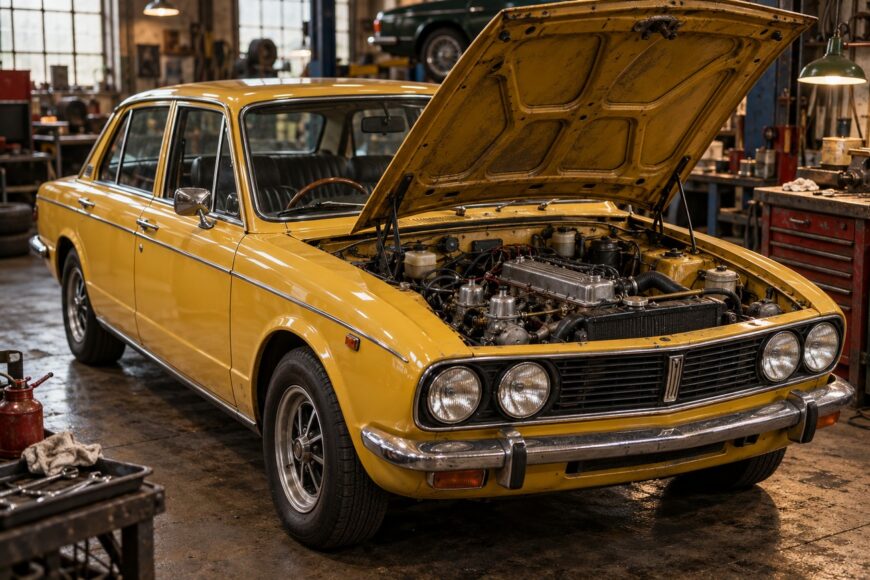
The Triumph Dolomite Sprint presents an apparent contradiction: a compact, family-shaped sedan launched in 1973 with a sophisticated 16-valve engine, yet one that demands more care than its restrained appearance suggests. Its appeal lies in that mismatch. The Sprint delivers genuine period performance from a relatively light four-door car, while its cylinder head and cooling system can punish careless maintenance.
You can therefore judge the Sprint in two ways. As an engineering milestone, it brought a relatively mass-produced SOHC 16-valve design to the road well before four-valve engines became commonplace. As a used classic, it must be assessed through its cooling history, cylinder-head condition, corrosion, previous repairs, and access to specialist parts. The badge alone is no substitute for evidence.
- Why the Dolomite Sprint Mattered in 1973
- The Sprint Engine: A SOHC 16-Valve Design
- Performance, Gearboxes, and the Sporting Compromise
- The Cylinder Head and Cooling System: Where Ownership Gets Serious
- Buying a Dolomite Sprint Today: Hidden Costs and Common Mistakes
- Living with the Sprint: Preservation over Maximum Power
- Frequently asked questions
- What engine did the Triumph Dolomite Sprint have?
- How fast was a Triumph Dolomite Sprint in everyday use?
- What was unique about the Triumph Dolomite Sprint?
- How many Triumph Dolomite Sprints were made?
Why the Dolomite Sprint Mattered in 1973
Series production ran from 1973 to 1980, with approximately 22,941 cars built. Triumph positioned the Sprint as a mass-market sporting sedan aimed at rivals including the BMW 2002. That made its engineering significant: four valves per cylinder and 16 valves in total were offered in a compact family car rather than an exotic limited-production machine.
The Sprint was not the first production 16-valve car. Its lasting achievement was more specific. Triumph packaged a 16-valve cylinder head around a single overhead camshaft, with the camshaft operating all valves through rocker arms or levers. This avoided the conventional twin-cam arrangement while retaining the breathing potential of four valves per cylinder.
Valve count alone did not create the car’s performance. Displacement, carburetion, ignition calibration, and the way the engine delivered its torque were equally important. The Sprint mattered because it combined those elements in an accessible sporting sedan, bringing advanced cylinder-head thinking into a class where an ordinary eight-valve engine was still the expected solution.
The Sprint Engine: A SOHC 16-Valve Design
At the heart of the car is a 1,998 cc inline four-cylinder engine inclined at approximately 45 degrees. The slanted installation helped the Dolomite retain its compact shape and contributed to the engine’s distinctive appearance. The important point is architectural: this is a SOHC engine, not a DOHC engine.
One overhead camshaft operates the 16 valves through rocker arms or levers. That arrangement made the head lower and lighter than many twin-cam alternatives, but it also introduced a specialized valve train. Correct rocker-gear condition, adjustment, and lubrication matter greatly, and procedures suitable for an ordinary Dolomite engine cannot simply be assumed to suit the Sprint.
Factory output was 127 bhp net at 5,700 rpm, with 165 N·m at 4,500 rpm. Those figures came from the complete package: the 1,998 cc capacity, the 16-valve head, carburetion, ignition settings, camshaft profile, and factory calibration. Replacing one component without matching the others can produce noise, flat spots, or heat rather than useful performance.
The design also explains the Sprint’s mixed reputation. It is technically clever and rewarding when correctly set up, but the extra valve gear gives a repairer more opportunities to introduce error. A good engine feels crisp and willing; one with worn rockers, incorrect clearances, or poor tuning can feel surprisingly ordinary despite its impressive specification.
Performance, Gearboxes, and the Sporting Compromise
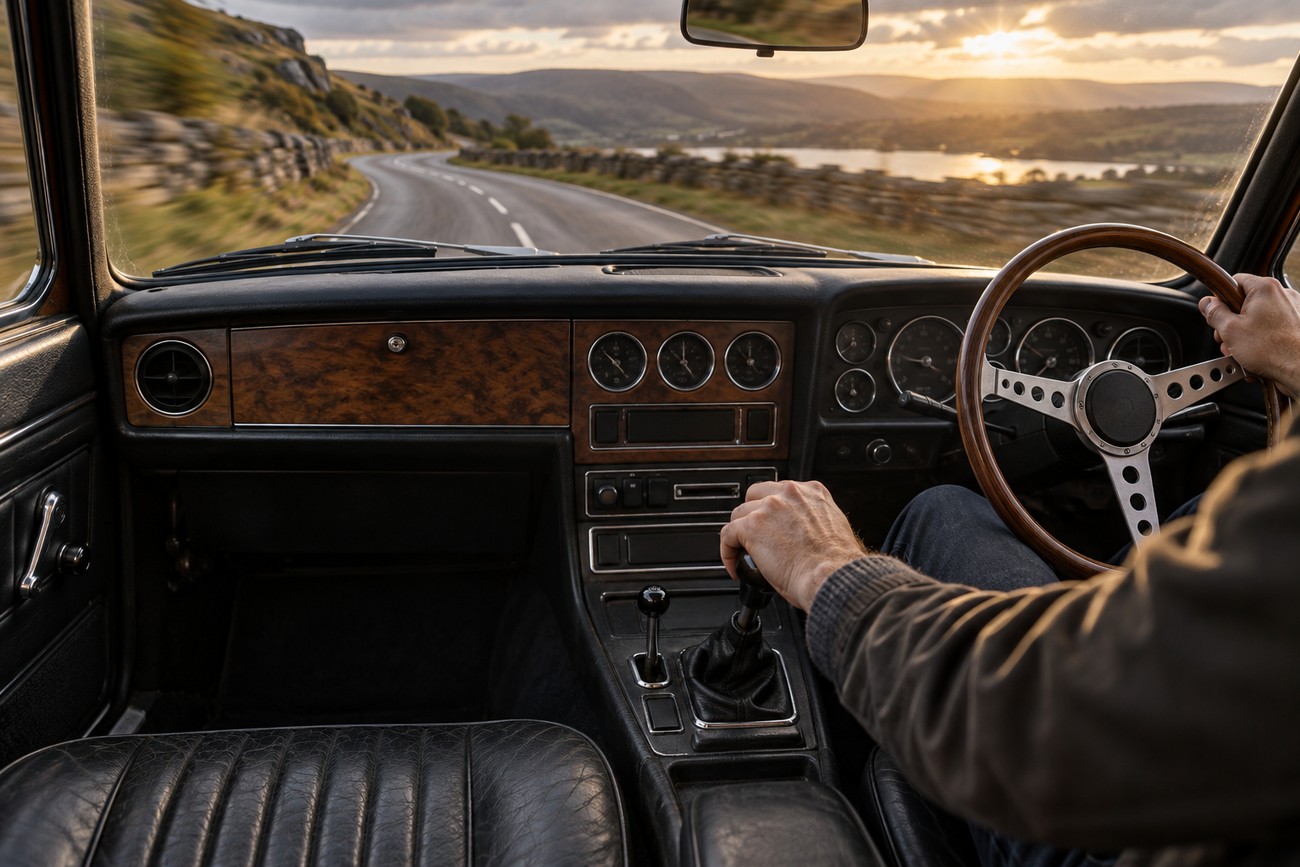
Period tests recorded approximately 116 mph or 187 km/h, with 0–60 mph in about 8.7 seconds. These were strong results for a four-door sedan weighing approximately 1,015–1,040 kg and riding on a 2,454 mm wheelbase. A surviving car may perform differently because of engine wear, gearing, carburetor adjustment, tire choice, and accumulated repairs.
The standard transmission was a four-speed manual, with overdrive initially offered as an option, or a three-speed automatic. Overdrive lowers engine speed during sustained cruising, reducing noise and fuel use. It also helps limit thermal stress on a healthy engine during long high-speed runs, provided the cooling system and overdrive itself are functioning correctly.
The Sprint’s engine could expose the limitations of the standard brakes and suspension. That does not make every original component inadequate, but worn dampers, tired bushings, poor alignment, or neglected brakes can make the car feel faster than it can safely stop or settle. Inspection should therefore treat chassis condition as part of performance, rather than judging the engine in isolation.
The Cylinder Head and Cooling System: Where Ownership Gets Serious
Accurate valve-clearance adjustment and correct rocker-gear setup require Sprint-specific knowledge. Wear in the rocker mechanism can alter clearances and reduce valve control, while incorrect adjustment can contribute to poor running and accelerated wear. Carburetors and ignition must also be considered together: incorrect settings can cause flat spots, power loss, unstable running, and excess heat.
Cooling is the central survival issue. A blocked radiator, aged thermostat, poor water pump, or neglected coolant can allow overheating, and overheating can contribute to head-gasket failure, cylinder-head distortion, or cracking. Owners commonly report these failures, but the fair conclusion is that the engine is sensitive to neglect and previous damage, not that every Sprint head is inevitably doomed.
Establish cooling-system health before tuning the engine. Set valve clearances, carburetors, and ignition as one system; treating each adjustment in isolation is a reliable way to chase symptoms and repeat a head failure.
The correct sequence matters because a mixture or ignition fault may raise temperature, while a cooling fault may be mistaken for a tuning problem. Coolant quality, radiator flow, thermostat operation, pump condition, and fan performance deserve attention before a road test is used to judge the engine. A clean cooling system is a safeguard for the cylinder head, not a cosmetic restoration detail.
Specialist parts add another layer of risk. Sprint-specific heads, camshafts, rocker gear, and selected timing components are harder and more expensive to source than ordinary Dolomite 8-valve parts. A head that has already been machined several times may look presentable while offering little margin for another repair, so previous workmanship is as important as current compression.
Buying a Dolomite Sprint Today: Hidden Costs and Common Mistakes
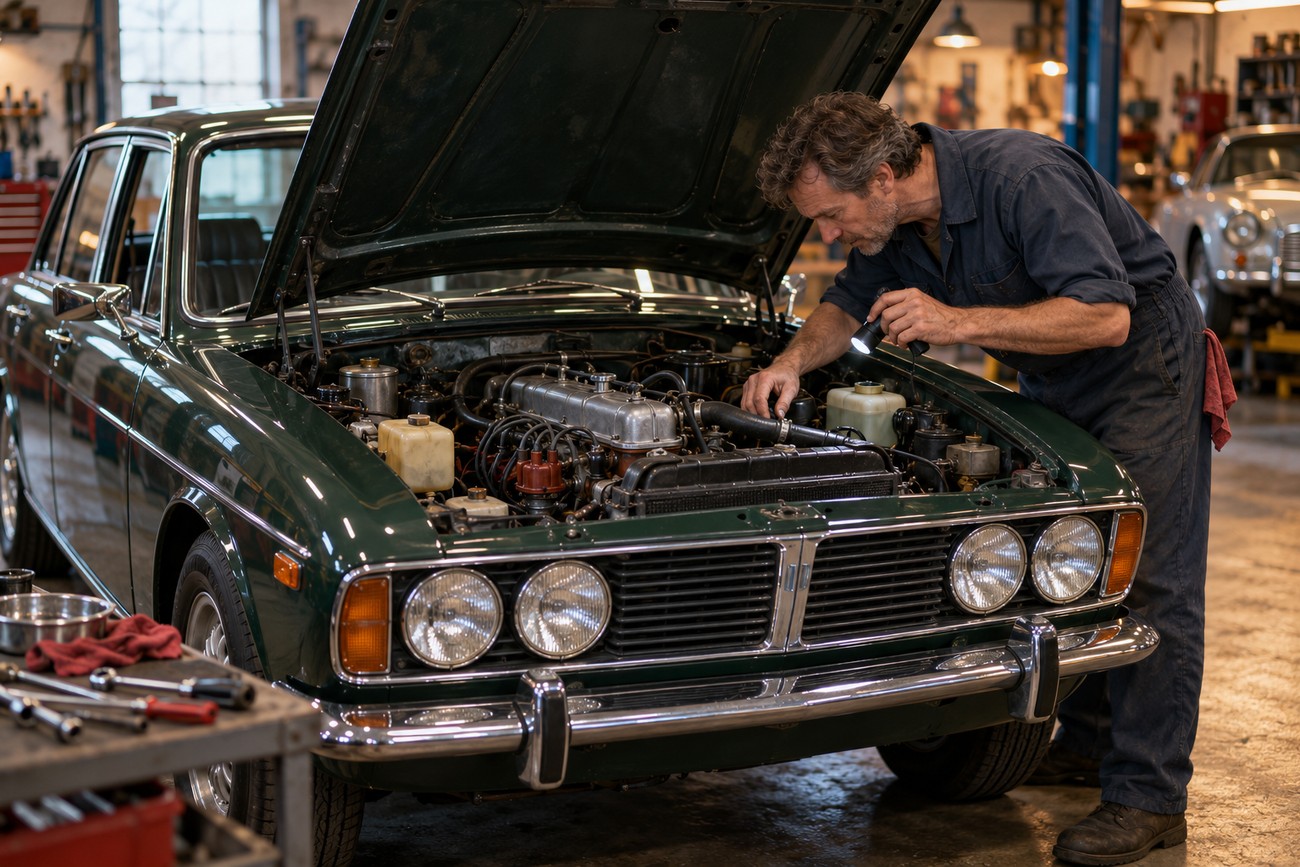
Begin with a cold start and observe the car through warm-up. Check for difficult starting, uneven running, cooling-system pressure, temperature instability, and signs of coolant loss. Compression or leak-down evidence is useful where available, but it should be read alongside the valve train, oil condition, cooling behavior, and any documentation of earlier head repairs.
Inspect the Sprint head with the assumption that previous work may not have followed the correct procedure. Ask what parts were used and who carried out the repairs, especially if the car has had several engine rebuilds. Good Sprint-specific components are scarce, and an apparently cheap replacement head or camshaft can become expensive once machining, setup, and ancillary work are included.
The body deserves equal attention. Typical corrosion areas include the sills, wheel arches, and lower door sections, where a tidy exterior can conceal structural or extensive repair work. A car with a sound engine but poor metalwork may be a worse purchase than one needing careful mechanical recommissioning, because body repairs can consume the value of the whole project.
Do not buy on the 16-valve badge alone. Generic cooling parts may not suit the Sprint’s requirements, while carburetor, exhaust, or power modifications can create poor running and overheating if the ignition and fueling are not recalibrated with them. Compared with a conventional Dolomite using an OHV or 8-valve engine, a Sprint generally costs more to maintain.
Living with the Sprint: Preservation over Maximum Power
The most sensible ownership strategy is conservative. Correct servicing, moderate engine speeds, carefully set ignition, and a clean cooling system usually protect the car better than chasing maximum output. A smooth, correctly calibrated Sprint is more enjoyable and more trustworthy than one modified beyond the ability of its cooling and valve train to cope.
Overdrive is especially valuable on longer journeys. By lowering cruising engine speed, it reduces noise and fuel use and can reduce thermal load during sustained high-speed travel. It also suits the Sprint’s character: the car can cover distance without being driven continuously at the upper end of its rev range.
Some restorations use a conventional 8-valve head to reduce operating cost or simplify parts supply. That can be a rational engineering compromise in a difficult market, but it is a departure from original Sprint specification. The car is best understood as an innovative specialist classic, rather than a simple family sedan with an unusually large engine.
Frequently asked questions
The essential distinction is between the Sprint’s clever specification and the practical demands created by that specification.
What engine did the Triumph Dolomite Sprint have?
It used a 1,998 cc SOHC inline four-cylinder engine with 16 valves. The camshaft operated all valves through rocker arms or levers, making it different from both ordinary Dolomite engines and a conventional DOHC 16-valve design.
This layout offers four valves per cylinder without two camshafts, but it changes servicing requirements. Valve clearances, rocker-gear wear, carburetor settings, ignition, and cylinder-head condition need specialist attention.
How fast was a Triumph Dolomite Sprint in everyday use?
Period tests recorded approximately 116 mph and 0–60 mph in about 8.7 seconds. Those figures describe a correctly functioning car of the period, not a guaranteed result for every surviving Sprint.
Real-world performance depends on compression, tuning, gearing, overdrive, tire condition, and drivetrain wear. Brake condition matters too: a car that accelerates well but has tired brakes or suspension should not be driven as though it still matched its test figures.
What was unique about the Triumph Dolomite Sprint?
Its notable feature was the combination of four valves per cylinder with one overhead camshaft in a relatively accessible mass-market sports sedan. The Sprint was not the first production 16-valve car, so the distinction rests on its compact, relatively mass-produced SOHC solution.
That engineering choice brought advanced breathing potential to a practical body style while retaining a lower and simpler head than many DOHC designs. It also created the specialized rocker gear and adjustment work that define ownership today.
How many Triumph Dolomite Sprints were made?
Approximately 22,941 cars were built between 1973 and 1980. That production total helps explain why Sprint-specific parts can be harder to source than ordinary Dolomite components.
Limited production does not prove that a survivor is valuable or mechanically sound. Condition, corrosion repair, cylinder-head history, and the quality of previous work matter far more than the number on the production ledger.







