
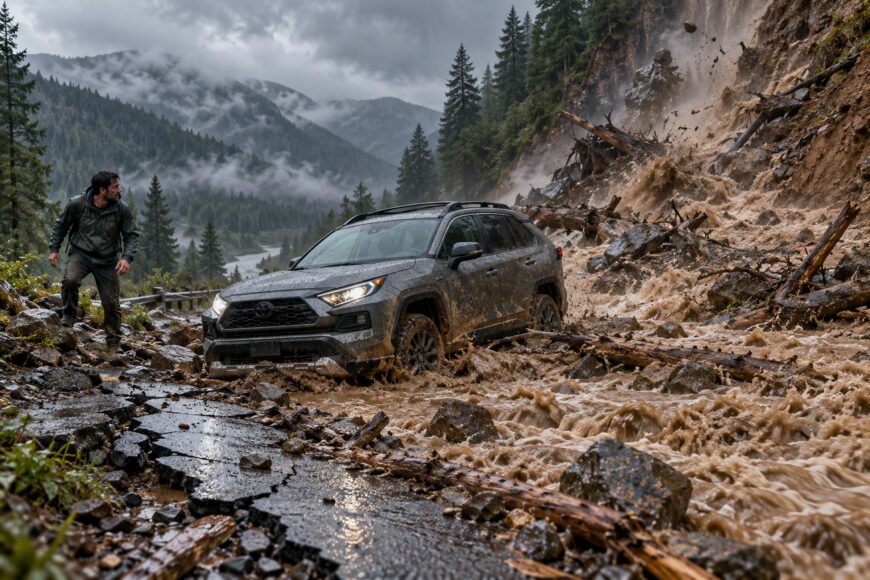
A Toyota RAV4 can become trapped within seconds when mud, water, rocks, or debris begin moving across the road. Its AWD system and elevated ground clearance may help on rough roads, but they do not make an active mudslide survivable. A moving debris flow can carry water, logs, and rocks with enough force to damage any drivetrain.
Your priority is leaving the flow path, not saving the vehicle. If mud or debris is moving toward the RAV4, follow CDC guidance: move immediately toward the nearest higher ground, avoid traveling downhill or along the channel, and abandon the vehicle if staying inside increases your exposure.
- The Moment a Mudslide Turns a RAV4 Into a Trap
- Why AWD and RAV4 Ground Clearance Stop Working in Mud
- The Recovery Mistakes That Make the RAV4 Worse
- Water Damage Is More Serious Than a Wet Interior
- What to Check After the RAV4 Is Freed
- Frequently asked questions
- How deep can a Toyota RAV4 go in water?
- What is the biggest problem with a RAV4 in mud?
- What is the biggest problem with a Toyota RAV4?
- What is the class action lawsuit against the Toyota RAV4?
The Moment a Mudslide Turns a RAV4 Into a Trap
Warning signs can appear before the main flow arrives. Cracks in the road or nearby ground, falling rocks, an unusual rumble, and suddenly muddy or changing water may indicate movement uphill. A slow-looking flow still contains heavy material and can accelerate, widen, or conceal unstable ground.
Once mud, water, or debris begins crossing the vehicle’s path, do not wait to see whether the RAV4 can drive through it. A mudflow can carry rocks and logs, bury wheels, block doors, and push the vehicle sideways regardless of whether it has front-wheel drive, AWD, or an available drive mode. The visible edge of the flow may also hide a deeper channel.
Leave the flow path immediately and move toward the nearest higher ground. Do not move downhill or follow the channel, where additional material may arrive. Choose the safest available exit side after checking the direction of the moving material; a door on the downhill or flow-facing side may be jammed by mud or exposed to the next surge.
The first flow may not be the last hazard. Secondary debris flows, rockfalls, landslides, and flooding can follow the initial event, and the ground around a stranded vehicle may collapse without warning. Once you are clear, keep away from the slide zone and contact emergency services or qualified recovery support rather than returning to retrieve the RAV4.
Why AWD and RAV4 Ground Clearance Stop Working in Mud
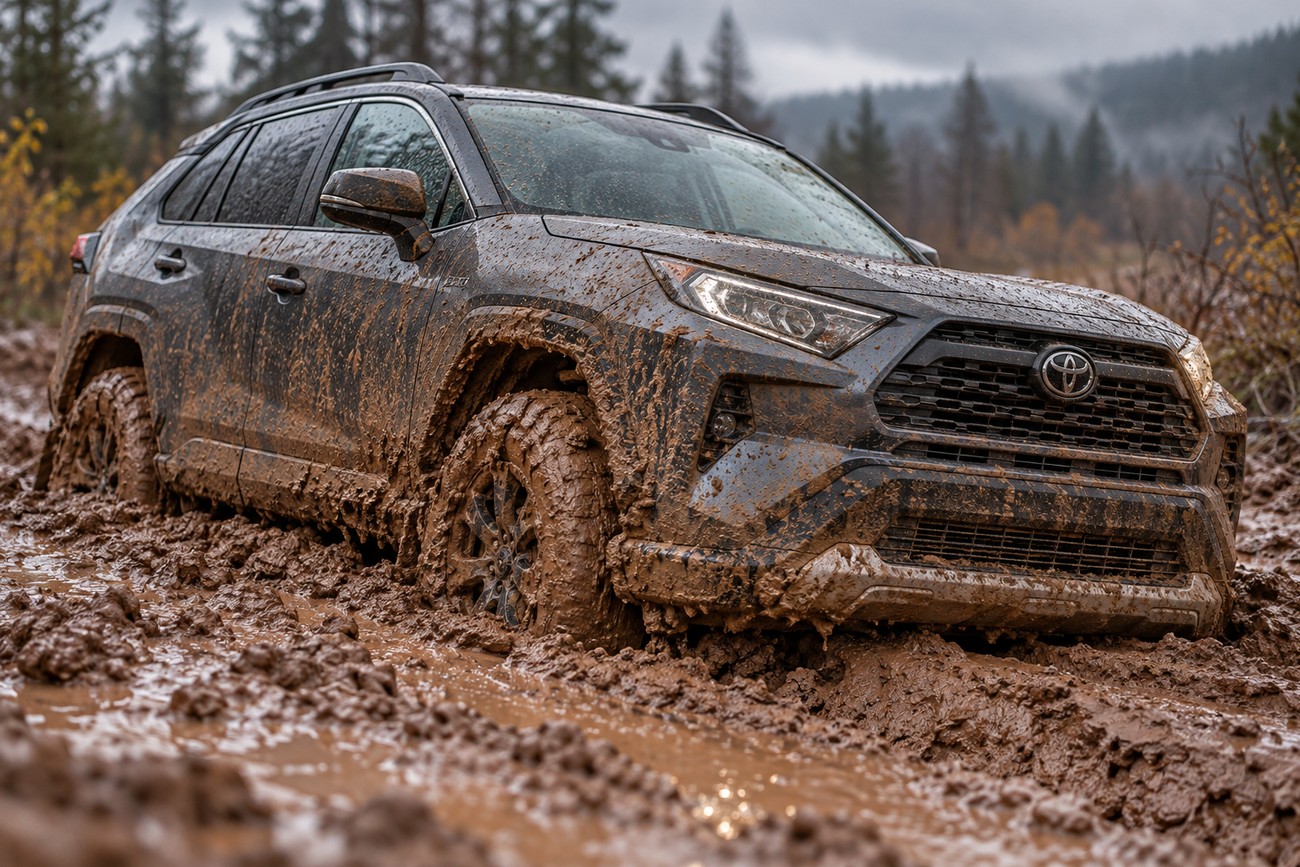
RAV4 ground clearance varies by version at approximately 8.1–8.6 inches (20.6–21.8 cm). That figure is the measured distance to the vehicle’s lowest point. It is not a safe mud depth, water depth, or wading rating.
Clearance can disappear when soft, saturated ground rises around the tires or packs against the underbody. The wheels may continue spinning while the vehicle’s weight rests on mud, leaving the tires unable to push the vehicle forward. This is a flotation and belly-grounding problem, not simply a shortage of engine power.
Repeated wheelspin can make the RAV4 settle deeper into soft ground. Mud packed into the tread also prevents the tires from shedding material, so their self-cleaning ability falls as the vehicle moves. Once all four tires lose useful grip, AWD can distribute drive to the wheels, but it cannot create traction where the surface provides none.
AWD, Trail, and Snow modes are driving aids for appropriate conditions, not protection against a moving flow. Viscous mud can allow the vehicle to slide sideways or roll on a slope even when all wheels are driven. A higher center of gravity also increases the need for caution on uneven ground and slopes.
The Recovery Mistakes That Make the RAV4 Worse
The most common mistake is continuing to apply throttle after the underbody begins carrying weight. Rocking the vehicle or alternating between forward and reverse may add sinkage, overheat or damage drivetrain components, and disturb the ground around the vehicle. It also keeps people near a hazard that may be moving again.
Before any recovery attempt, check whether the slope, mud, water, or debris is still moving. Do not climb beneath the vehicle or dig around its wheels if the ground is unstable. Entering the slide area to reach a buried tire can expose you to a secondary flow, a collapse, or falling material.
If occupants must leave, assess the doors and the direction of the flow first. A door may be blocked by mud, and exiting on the flow side can place a person directly in the path of moving debris. Move toward stable, higher ground, then keep clear while professional assistance is arranged.
Any towing connection must follow the owner’s manual and the vehicle-specific recovery provisions. Random bumper, suspension, or body parts are not safe attachment points and may pull away or damage the vehicle. A recovery attempt is secondary to personal safety, a stable work area, and qualified equipment.
Water Damage Is More Serious Than a Wet Interior
A RAV4 that looks recoverable after water or mud exposure may have serious damage that is not visible from the cabin. Toyota prohibits crossing rivers and bodies of water and warns that water can damage electronics, the engine, transmission, and AWD system. The vehicle’s clearance figure does not establish a permissible crossing depth.
Water entering the air intake can cause severe engine damage, including failure when the engine attempts to compress water. Water can also impair lubrication in bearings, differentials, transmissions, and transfer cases. These problems may appear later, after the vehicle has been pulled out and driven away.
Brakes can lose effectiveness when covered with mud or contaminated by water. Moisture and debris may also affect wheel bearings, electrical connectors, differential components, and AWD hardware. Dry seats and carpets therefore provide little evidence that the mechanical and electrical systems are sound.
Electrified RAV4 versions contain high-voltage components. After flooding or impact, do not assume the vehicle is safe for self-repair, cable handling, or an immediate restart. Keep people away from damaged electrical areas and arrange an inspection by appropriately qualified personnel.
What to Check After the RAV4 Is Freed
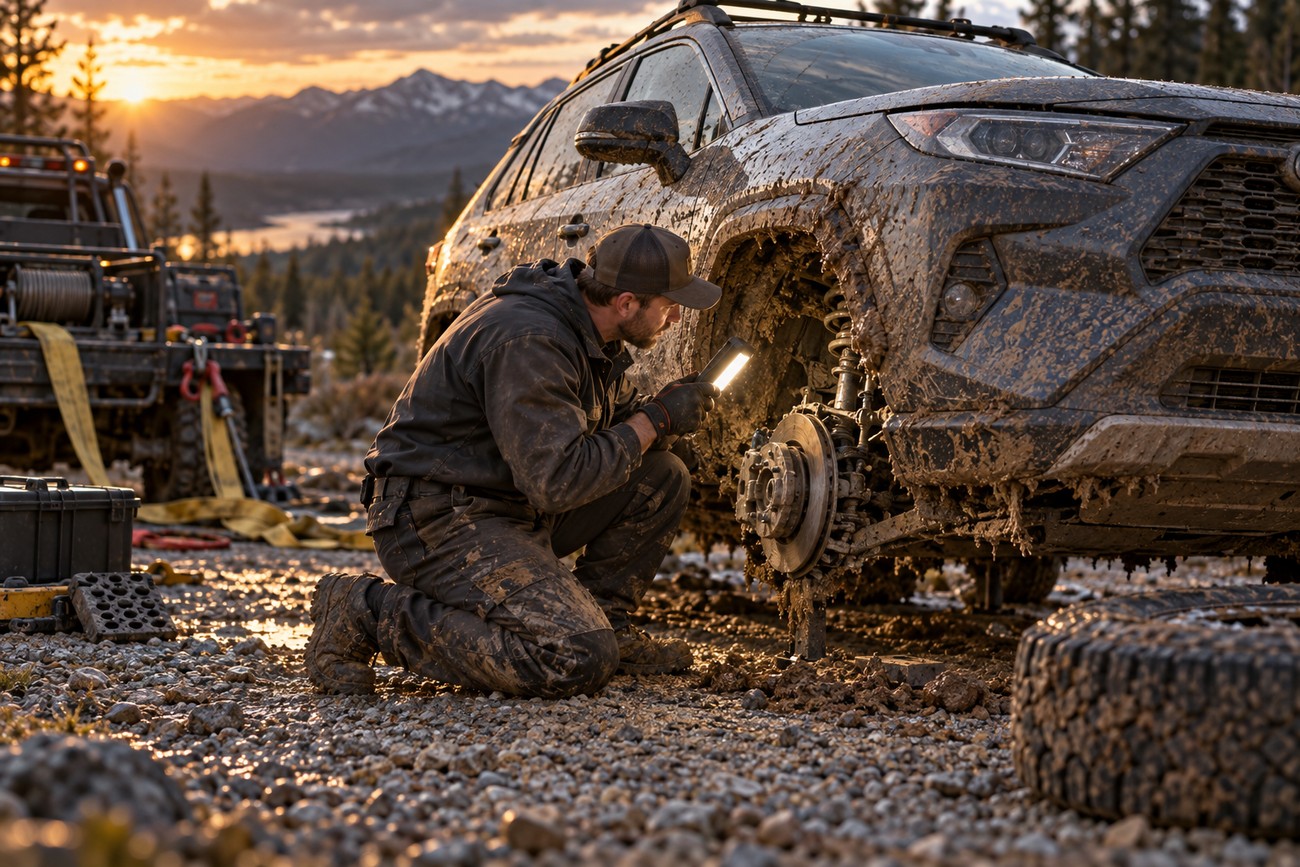
Extraction does not mean the RAV4 is ready to drive. First move it to a stable location only if the recovery operation can do so safely, then treat the vehicle as potentially damaged until critical systems have been examined. If water reached the cabin, engine bay, intake, or underbody, professional assessment is the safer course.
Check the brakes before any normal driving. Toyota requires checking the brakes after driving through mud, and material may remain around the wheels or brake components. If the pedal feels abnormal, braking is uneven, or the vehicle pulls to one side, stop and arrange transport rather than testing it on the road.
Clear the underbody of stones, branches, and caked mud or other material, then inspect for bent parts, leaks, damaged shields, and contact marks. Examine the air intake before starting the engine, and check visible connectors, fluids, wheel areas, and drivetrain components for contamination or damage.
Water exposure can create delayed faults in electronics, brakes, wheel bearings, connectors, differentials, transmission components, and AWD parts. An electrified RAV4 with flooding or impact damage requires particular caution because high-voltage systems may remain hazardous. Do not treat drying the interior as a complete inspection or continue driving until the vehicle has been assessed.
Frequently asked questions
The answers below distinguish ground clearance from water-crossing ability and explain why mud, flowing debris, and hidden damage require caution. A RAV4’s drive modes can assist in suitable conditions, but they cannot overcome unstable ground or a moving flow. After exposure, inspection matters more than whether the vehicle still starts or its wheels still turn.
How deep can a Toyota RAV4 go in water?
Toyota does not provide a universal RAV4 wading depth in the supplied guidance. The approximately 8.1–8.6 inches (20.6–21.8 cm) of ground clearance, depending on version, is a measurement to the lowest vehicle point, not a factory water-crossing rating.
Stop and inspect after any unexpected water exposure, especially if water may have reached the intake, electrical connectors, drivetrain, or brakes. Toyota prohibits crossing rivers and bodies of water because water can damage the engine, electronics, transmission, and AWD system.
What is the biggest problem with a RAV4 in mud?
The primary problem depends on what has happened first: the underbody may be grounded, the tire tread may be packed with mud, or water may have reached sensitive components. Grounding prevents the tires from transferring useful force, while clogged tread reduces traction and self-cleaning.
If the vehicle has been submerged or exposed to flowing water, hidden mechanical and electrical damage becomes the greater concern. Stop wheelspin, leave an active flow path, and arrange a controlled inspection instead of judging the vehicle by whether its wheels still turn.
What is the biggest problem with a Toyota RAV4?
There is no single biggest problem that applies to every RAV4 or every model year. In a mudslide situation, the critical limitation is the gap between a road-oriented vehicle’s traction aids and the physical forces of unstable ground, moving debris, and water.
The correct response depends on the hazard: escape a moving flow, stop attempts that deepen the vehicle’s sinkage, and inspect for water or impact damage after recovery. A specific mechanical concern requires the vehicle’s model year, condition, and diagnostic inspection.
What is the class action lawsuit against the Toyota RAV4?
There is no single class action lawsuit that can be identified from the supplied information as applying to every Toyota RAV4. Class actions are tied to particular allegations, model years, jurisdictions, and court proceedings, so a general description would risk confusing unrelated cases.
For accurate legal information, check the relevant court record, an official settlement notice, or advice from a qualified attorney. A mudslide, flooding event, or recovery failure does not by itself establish that a particular vehicle is covered by any lawsuit.







