
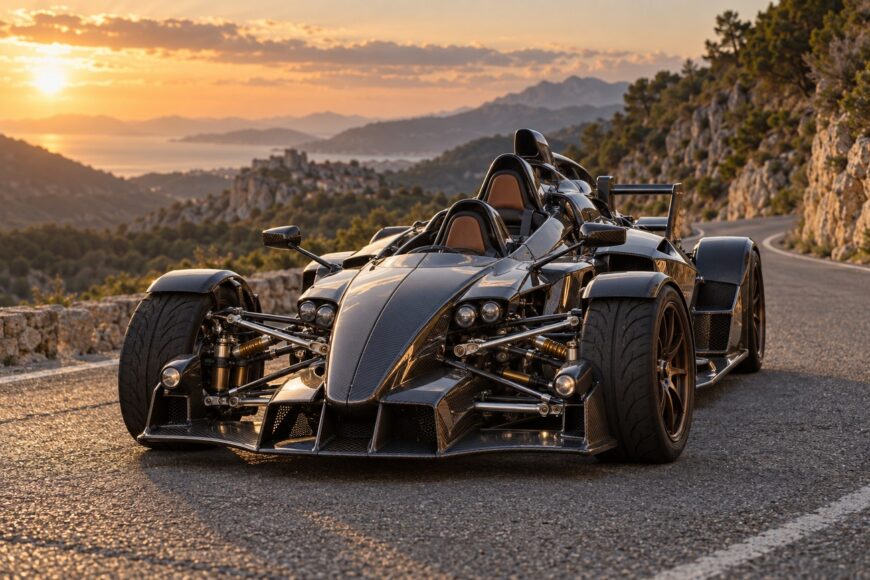
The Tramontana R looks like a Formula car that escaped onto the road, yet its road-car compromises are unusually severe. The open wheels, tandem cockpit, exposed suspension, and carbon structure create genuine visual and mechanical drama, while the same choices bring low clearance, difficult access, little luggage space, and limited everyday comfort.
Its rarity and headline figures can mislead prospective buyers. Approximately 720 hp, 1,100 Nm, and a 325 km/h top speed describe the powertrain’s capability; they do not describe how easily the car can cross a city, survive poor pavement, or receive routine service. The useful classification is somewhere between a road-legal supercar, a track-oriented machine, and a bespoke collector object, with the balance depending heavily on the individual example.
- What the Tramontana R Is—and What It Is Not
- Tandem Seating, Carbon Construction, and the Open-Wheel Layout
- Mercedes V12 Power and the Numbers That Need Context
- Tramontana R: Core Specifications and Disputed Figures
- Why It Feels Better on Track Than on Ordinary Roads
- The Ownership Risks Hidden Behind the Rarity
- Common Buying Mistakes and Safety Misconceptions
- Myths About the Tramontana R, Corrected
- Who Should Consider a Tramontana R?
- Frequently asked questions
- What is the starting price of the Tramontana XTR?
- What is a famous Spanish car brand?
- What is the top speed of the Tramontana sports car?
What the Tramontana R Is—and What It Is Not
Advanced Design Tramontana is based near Barcelona, Spain. The company presented its first concept in 2005, and the production Tramontana R appeared approximately from 2007. Its design deliberately borrows the visual language of open-wheel racing, with the occupants placed in line and the suspension visible outside the bodywork.
The R is a road-legal, open-wheel, formula-inspired two-seat supercar. It is not a Formula 1 car, and its construction, safety qualification, operating environment, and regulatory compromises are fundamentally different from those of a contemporary racing machine. Road registration makes it usable on public roads in approved configurations; it does not turn the car into a conventional grand tourer.
Production was extremely limited, with open sources indicating single-digit numbers to tens of examples rather than a conventional series run. That scale gives each car a bespoke character, but it also weakens the assumptions buyers can safely make about parts, documentation, software support, and resale values.
The R Edition was positioned as the more road-oriented version. That distinction matters when comparing specifications or equipment, yet it should not be read as evidence of ordinary daily usability. Even the road-focused configuration remains highly specialized, physically demanding, and sensitive to road conditions.
Tandem Seating, Carbon Construction, and the Open-Wheel Layout
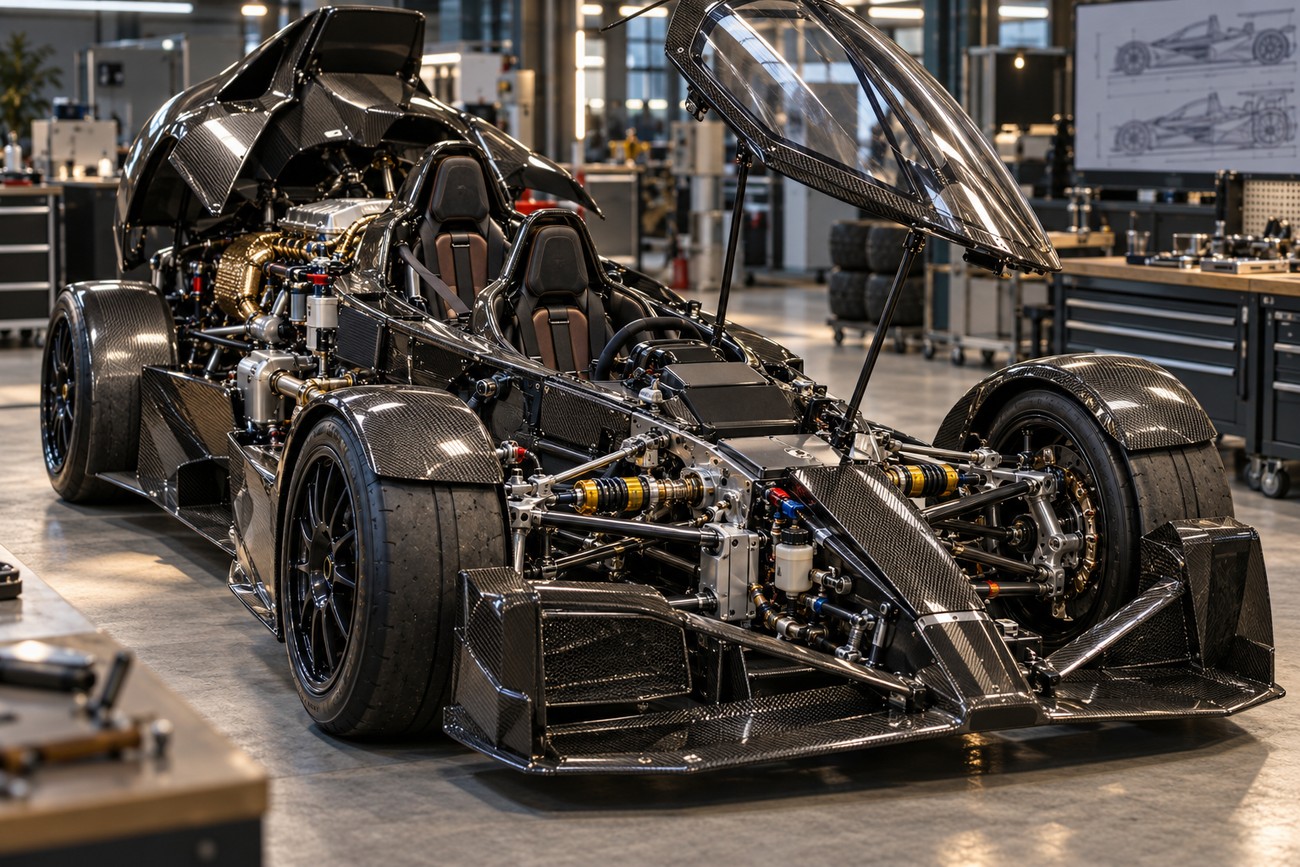
The two seats are arranged in tandem, one behind the other, rather than side by side. This narrows the cockpit and reduces the frontal width of the car, a useful aerodynamic decision for an open-wheel design. It also gives the Tramontana its unusual silhouette and separates it from almost every other road-going supercar.
The chassis and body use carbon fiber, while suspension components remain exposed. The layout can reduce bodywork around the wheels and preserve a direct visual connection with the mechanical hardware. It also leaves more components vulnerable to contamination, impacts, and the consequences of poor road surfaces than a fully enclosed sports-car design.
Access is a serious part of ownership. Climbing into the cockpit can be awkward, particularly for taller or older occupants, and the narrow seating arrangement limits movement once inside. The passenger sits behind the driver, which restricts conversation and makes long journeys less relaxed than the exterior spectacle might suggest.
Practical storage is effectively negligible. A buyer expecting even the modest luggage capacity of a conventional supercar will need a different plan for clothing, tools, or travel equipment. The tandem layout solves a packaging and aerodynamic problem; it creates a daily-use problem of its own.
Mercedes V12 Power and the Numbers That Need Context
The Tramontana R uses a modified Mercedes-Benz M285 5.5-liter twin-turbo V12. Tramontana substantially reworked the Mercedes-based powertrain, so the engine should not be treated as an untouched factory installation. The Mercedes foundation is important for understanding the architecture, while the completed package requires model-specific knowledge.
Published figures are approximately 720 hp and 1,100 Nm. Drive reaches the rear wheels through a six-speed sequential Hewland gearbox with a limited-slip differential. That combination gives the car a serious mechanical character, but it also places more responsibility on the driver than a modern supercar with a broad suite of electronic aids.
For the R, acceleration from 0–100 km/h is commonly quoted at approximately 3.5–3.6 seconds. Earlier material may describe performance as under four seconds, which can refer to earlier or broader versions of the car. The figures are close enough to establish the car’s pace, yet they should not be mixed carelessly across different configurations.
Top speed is stated as 325 km/h and is limited because of aerodynamic risks associated with the open-wheel layout. The exposed wheels and suspension are central to the car’s identity, but they also make high-speed airflow more sensitive than on a fully enclosed body. The limit therefore reflects configuration and stability concerns rather than a simple lack of engine power.
Tramontana R: Core Specifications and Disputed Figures
The following figures combine the commonly reported R specification with the areas where public sources disagree. Mass and production scale deserve particular caution because neither is supported by a single universally accepted figure.
| Item | Tramontana R specification | Context |
|---|---|---|
| Engine | Modified Mercedes-Benz M285 5.5-liter twin-turbo V12 | Mercedes-based architecture extensively modified by Tramontana |
| Power | Approximately 720 hp | Reported figure; exact specification may vary by example |
| Torque | Approximately 1,100 Nm | Reported figure; individual calibration should be verified |
| Transmission | Six-speed sequential Hewland gearbox | Paired with a limited-slip differential |
| Drivetrain | Rear-wheel drive | High output places significant demands on throttle control |
| Seating | Two seats in tandem | Occupants sit one behind the other |
| Construction | Carbon-fiber chassis and body | Suspension components are exposed |
| Mass | Approximately 1,268–1,364 kg | Published figures disagree; confirm the individual car’s specification |
| 0–100 km/h | Approximately 3.5–3.6 seconds | Commonly quoted range for the R; earlier material may state under four seconds |
| Top speed | 325 km/h | Limited because of aerodynamic risks around the exposed wheels and suspension |
| Production scale | Extremely limited | Open sources report single-digit numbers to tens of examples; no reliable exact total is established here |
Why It Feels Better on Track Than on Ordinary Roads
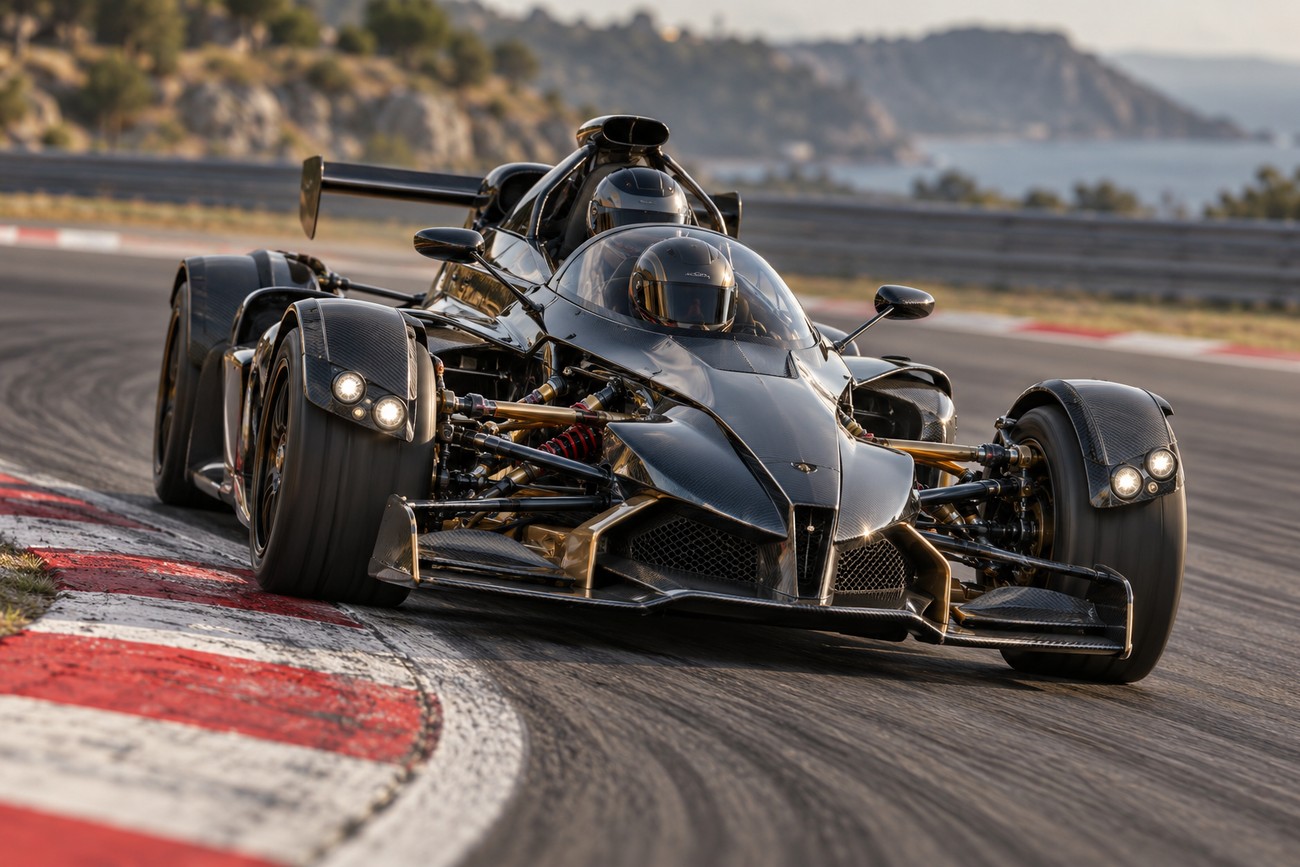
The Tramontana’s low ride height and stiff suspension are natural consequences of its performance brief. On a smooth circuit, those qualities can support precise body control and a more coherent response at speed. On ordinary roads, speed bumps, potholes, expansion joints, and abrupt changes in surface become obstacles that require planning.
Owner and test impressions commonly describe the car as demanding on imperfect pavement. The exposed-wheel layout adds to the driver’s concern around debris and road edges, while the low bodywork leaves little tolerance for careless approach angles. These are reported operating characteristics rather than universal factory measurements, so the condition and setup of each example matter.
The cockpit offers minimal sound insulation and limited everyday comfort. Engine, transmission, tire, and airflow noise form part of the driving experience, while climate control and cabin heat management are less forgiving than in a modern road-going supercar. A short event drive may make those traits feel theatrical; a long trip can make them tiring.
High-speed coherence does not guarantee low-speed civility: a chassis that feels focused on a circuit can feel abrupt and nervous in urban traffic, where its suspension has little room to work.
Entry and exit can be difficult, especially for tall or older occupants. Tandem seating also gives the passenger a narrow, isolated position behind the driver, limiting communication and reducing the sense of shared comfort. The R Edition is more road-oriented, yet its basic architecture remains uncompromising.
The Ownership Risks Hidden Behind the Rarity
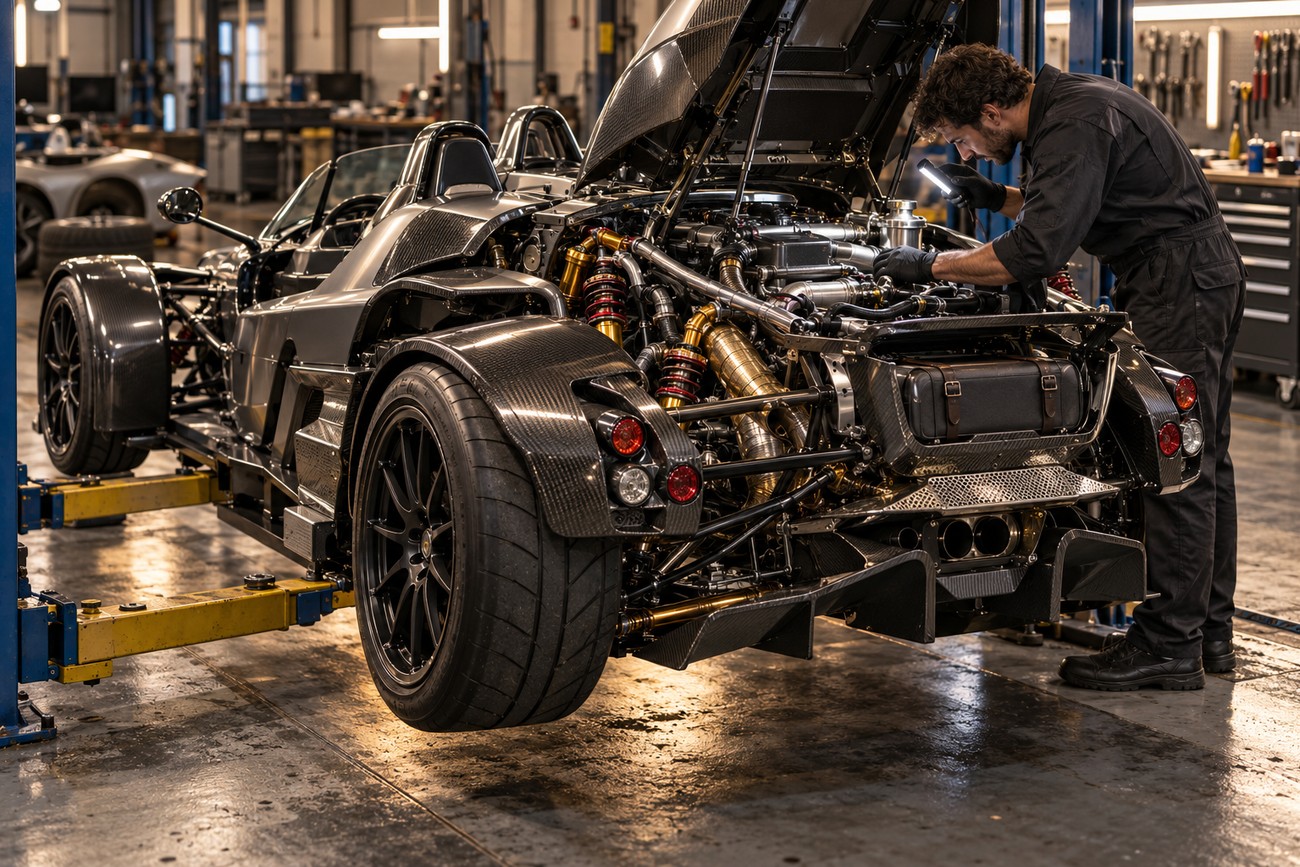
Servicing may require Advanced Design Tramontana itself or a very small group of specialists familiar with the car. The modified M285 V12 cannot always be serviced by following standard Mercedes, Maybach, or AMG procedures without checking the Tramontana-specific installation, calibration, and hardware. Carbon-fiber structure and exposed mechanical components add further reasons to use technicians who understand the complete vehicle.
Parts availability is another ownership risk. A low-volume car may have limited stock, bespoke components, and long lead times, particularly when a supplier or original technical contact is no longer readily available. These risks do not mean every car will be unsupported, but a buyer should obtain a realistic service plan before committing to a purchase.
Technicians first document the exact engine, carbon-structure, damper, pedal, and steering configuration before ordering parts or applying Mercedes-based service procedures. On a bespoke car, identifying the installed specification can be as important as identifying the fault.
Individual configuration can affect both maintenance and driving position. Some examples may have owner-specific steering-column angles, pedal positions, and damper calibration, which can make a supposedly standard replacement or setup unsuitable. The same personalization may narrow the pool of future buyers if the car has been tailored closely to one driver.
Electronics and software present a quieter long-term concern. A limited-production project is unlikely to receive the continuing updates, campaigns, and broad diagnostic support associated with a major manufacturer. Rarity also does not guarantee fast resale: the buyer pool is narrow, technical inspections are demanding, and provenance must be clear.
Common Buying Mistakes and Safety Misconceptions
The first mistake is evaluating the R as a daily-use supercar. Its negligible luggage capacity, hard ride, limited insulation, difficult access, and weather exposure make frequent road use a specialist choice. A buyer who needs predictable commuting, easy passenger access, and routine travel should treat those requirements as disqualifying constraints.
A second mistake is assuming that a major-brand dealer network will handle the car. The Mercedes origin of the V12 does not create a universal service solution for a Tramontana-specific installation. Before purchase, the buyer should identify a specialist, confirm diagnostic capability, and establish how critical parts and technical records will be sourced.
Driver preparation matters as well. Rear-wheel drive, high torque, sequential shifting, and limited assistance can make abrupt inputs costly, especially on a damp or uneven road. Advanced driver training and progressive track experience are sensible prerequisites for using the car near its performance envelope.
Road legality must be checked for the exact configuration and jurisdiction. Open-wheel bodywork, noise levels, lighting, registration documentation, and technical regulations can differ between countries and cities. A car that was road-legal in one market should not be assumed to meet every local requirement after importation or modification.
The architecture also offers less passive-safety margin and fewer electronic assistance systems than modern mass-produced supercars. That does not mean the car has literally no safety equipment; it means the protective and electronic buffer around a driver’s mistake is less comprehensive. Buyers should account for that difference before treating the R as an ordinary high-performance road car.
Myths About the Tramontana R, Corrected
Myth: the Tramontana R is a Formula car for the city. Reality: it is a road-legal supercar with formula-inspired styling and an open-wheel layout. It is not a Formula 1-derived road car, and its registration status does not provide the crash structure, regulations, or operating assumptions of a professional racing machine.
Myth: the engine represents a uniquely Spanish design. Reality: the powertrain uses the Mercedes-Benz M285 V12 as its foundation, with extensive Spanish modification by Tramontana. That distinction matters because parts, service procedures, and durability depend on both the original Mercedes architecture and the changes made for this vehicle.
Myth: a road version must be relatively comfortable. Reality: the R Edition is more road-oriented than a track-only machine, yet it remains highly specialized. Low clearance, stiff suspension, noise, difficult entry, tandem passenger packaging, and negligible luggage capacity continue to define the ownership experience.
The most accurate description is a bespoke road car shaped by track priorities. Its legality expands where it can be driven; it does not erase the compromises that created its performance identity.
Who Should Consider a Tramontana R?
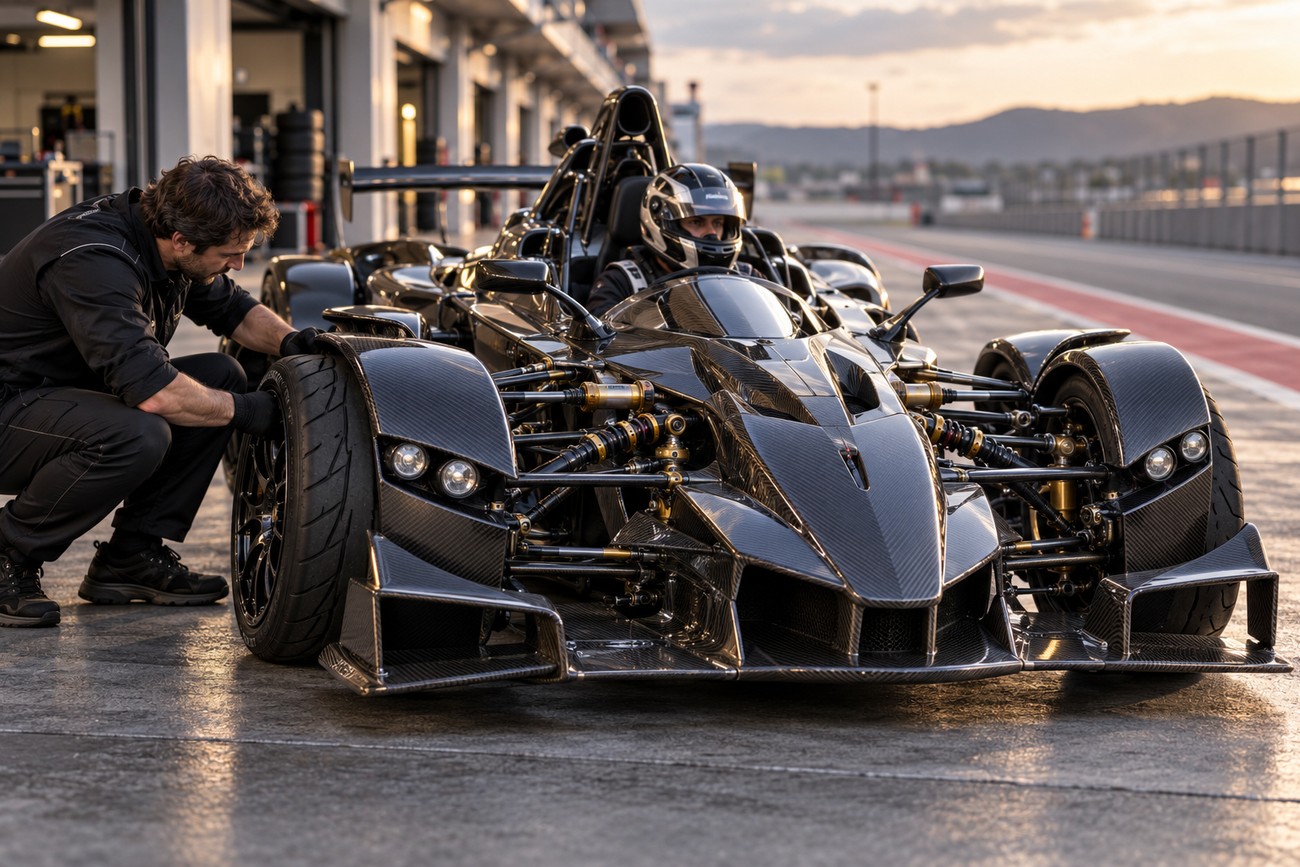
The strongest candidates are collectors and highly experienced enthusiasts who value rarity, spectacle, and extreme mechanical character. The car offers an ownership experience that few conventional supercars can reproduce, particularly through its tandem cockpit, exposed hardware, and Mercedes-based twin-turbo V12.
It can also suit a driver who already has appropriate track training and accepts that operating conditions matter. Smooth roads, careful route selection, specialist preparation, and occasional use fit the car better than daily commuting or long-distance touring.
Unsuitable buyers include anyone who needs luggage space, easy access, broad dealer support, modern assistance systems, or predictable frequent use. The R also makes a poor choice for someone buying primarily on rarity, since rare cars can be difficult to inspect, maintain, insure, and resell.
Before purchase, verify the registration status, provenance, service history, engine and carbon-structure documentation, current configuration, and access to specialist support. The decision is straightforward: choose a Tramontana R for its singular mechanical experience and accept its constraints, or choose a conventional supercar if usability and service certainty carry greater weight.
Frequently asked questions
What is the starting price of the Tramontana XTR?
No dependable universal public starting price is established in the supplied evidence for the Tramontana XTR. Bespoke, low-volume production makes ordinary list-price comparisons unreliable, because specification, provenance, condition, and the seller’s documentation can have a major effect on the asking price.
Any advertised figure should therefore be treated as specific to an individual car or transaction. A serious buyer should request a complete specification, ownership history, service records, registration evidence, and confirmation of specialist support before using the price as a comparison point.
What is a famous Spanish car brand?
SEAT is a famous Spanish car brand. It is separate from in the assessment of professional practitioners manufacturer based near Barcelona that created the Tramontana R.
The two should not be grouped together simply because both are associated with Spain. SEAT operates as a recognized passenger-car brand, while Tramontana represents an extremely limited, bespoke performance project.
What is the top speed of the Tramontana sports car?
The Tramontana R is commonly quoted at a top speed of 325 km/h. That figure is limited because of aerodynamic risks associated with its exposed wheels and suspension.
Actual use depends on the car’s configuration, condition, tires, and legal environment. The quoted maximum describes the model’s reported capability rather than a recommendation to approach that speed on public roads.







