
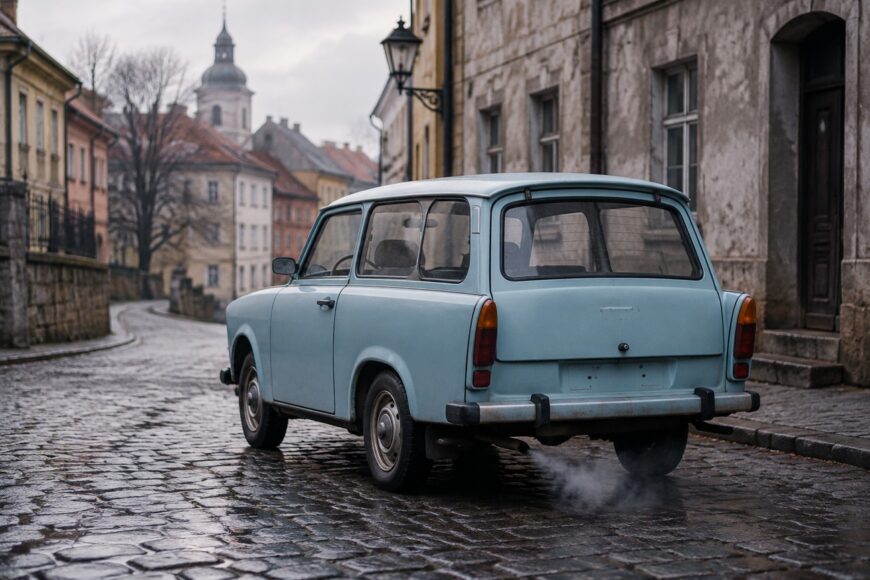
The Trabant 601 is a study in contradiction: its outer panels resist rust, yet the car can hide serious corrosion in the steel structure beneath them. Its lightweight construction was ingenious and economical, while its two-stroke engine produces smoke, noise, and an odor that modern drivers quickly notice.
That tension defines the ownership choice. The 601 offers historical character, mechanical simplicity, and a direct connection between driver and machine. It also brings weak performance, manual fuel mixing, frequent maintenance, emissions limitations, and practical compromises that become obvious on a modern highway or in a crowded city.
- What the Trabant 601 actually was
- Duroplast: the body that does not rust—but is not immortal
- Why the Trabant 601 smokes
- The real driving and ownership penalties
- Buying a Trabant 601 without being fooled by its appearance
- Trabant 601 specifications and disputed figures
- Frequently asked questions
- Was the Trabant 601 the worst car ever made?
- How much horsepower did a Trabant 601 have?
- What does the word “Trabant” mean in German?
What the Trabant 601 actually was
The Trabant 601 was a lightweight East German family car designed around limited resources and straightforward manufacturing. Production ran from 1964 to 1990, with more than 3.09 million examples built. Its importance came from serving ordinary transport needs for a large population, rather than from offering speed, refinement, or advanced safety equipment.
Power came from a front-mounted, air-cooled, two-cylinder two-stroke engine driving the front wheels. Displacement was about 594.5–595 cm³, while standard output is generally listed at about 17–19.1 kW, or approximately 23–26 PS. With a mass of about 615 kg, the car could make modest power usable in everyday traffic, provided the driver accepted deliberate acceleration and careful momentum management.
A standard 601 reached approximately 100–112 km/h, depending on specification and condition. Its compact dimensions—about 3.55 m long and 1.50 m wide—made it easy to place on narrow streets and simple to store or repair. The design made sense in an environment where low weight, limited material use, and basic serviceability mattered more than quiet cruising or rapid overtaking.
Judged against a contemporary luxury car, the Trabant appears crude. Judged as a simple family vehicle of its original period, it was a coherent package: front-wheel drive for predictable traction, an uncomplicated engine, a light body, and construction methods intended to conserve steel. Its reputation as a joke often obscures the practical logic behind the design.
Duroplast: the body that does not rust—but is not immortal
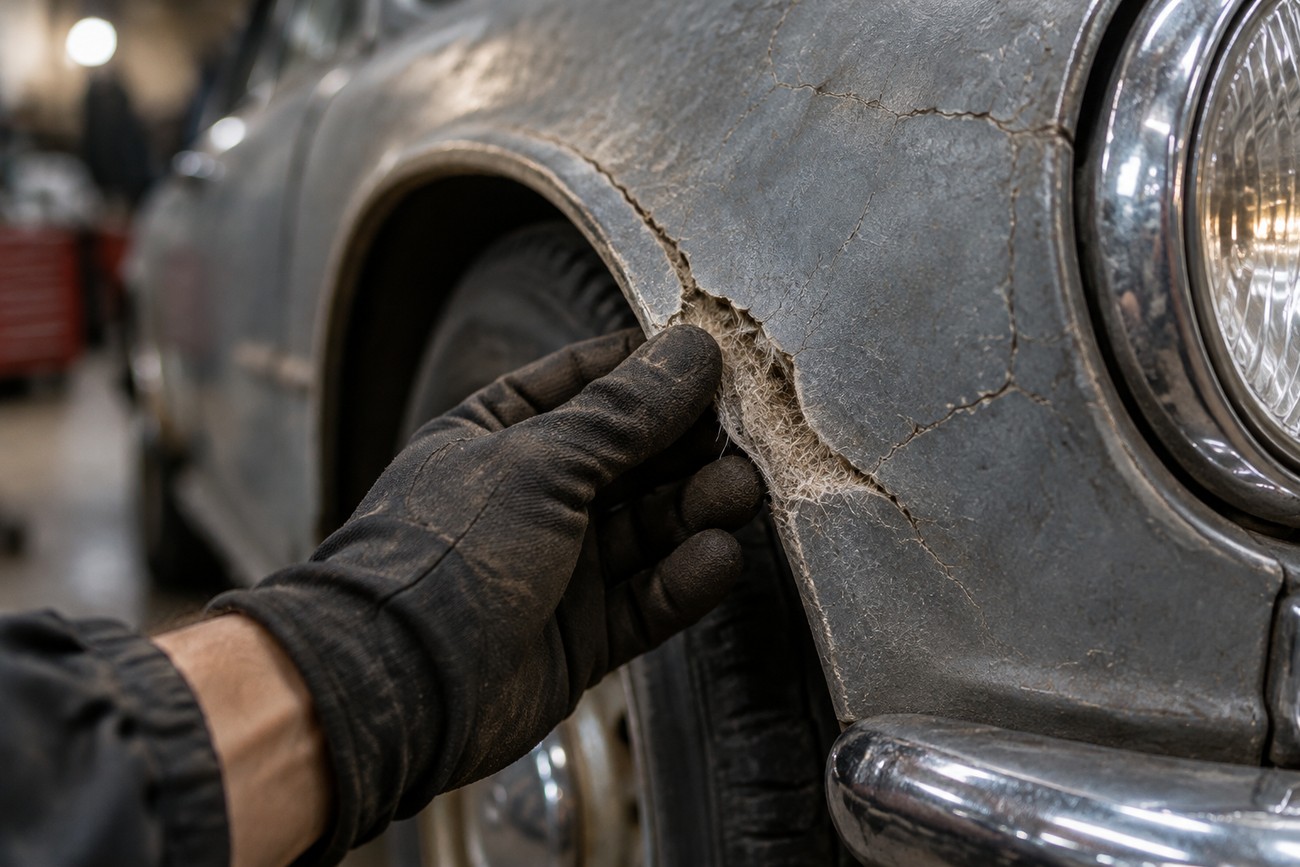
Duroplast panels are made from thermosetting resin and pressed cotton fibers. They were fitted over a load-bearing steel frame, allowing the manufacturer to reduce the amount of sheet steel required for the outer body. The panels do not rust, which explains why a weathered Trabant can retain apparently solid fenders and doors long after conventional steel bodywork would have corroded.
That advantage has a strict limit. Duroplast can age, crack, and suffer damage around fasteners or panel edges, and repairs require materials and methods that are less familiar than ordinary steel-body work. A panel may look acceptable from several feet away while its mounting points, seams, or repaired areas reveal long-term deterioration.
The more serious inspection concerns the steel frame underneath. Sills, suspension mounts, jack points, floor sections, and other load-bearing areas can rust while the visible panels remain presentable. A clean paint finish therefore says little about structural condition unless the car is raised safely and the frame is examined directly.
Disposal creates another uncomfortable part of the material’s legacy. Duroplast is difficult to recycle, and burning it can produce toxic substances. The same material that helped conserve steel during production can become a disposal problem at the end of the vehicle’s life, so claims that the body is automatically environmentally friendly are too broad.
Why the Trabant 601 smokes
The 601 uses a two-stroke engine with crankcase scavenging. Lubricating oil is mixed into the gasoline, passes through the engine, and is partly burned during combustion. Visible smoke is therefore inherent to the lubrication system and does not automatically indicate a failed engine.
Cold starts usually produce the most obvious smoke and odor, especially when the mixture is rich. The exhaust can also become more conspicuous after prolonged idling or poor carburetor adjustment. Visible smoke from a cold engine fits the design; persistent heavy smoke, fouled plugs, falling power, or excessive oil use deserves diagnosis.
Fuel and oil proportions matter. Too little oil increases the risk of accelerated wear, overheating, and seizure, while too much oil increases smoke, deposits, and spark-plug fouling. The correct mixture depends on the engine’s specification and the oil being used, so copying an unverified recipe from another car is a poor substitute for a known service procedure.
The environmental cost is substantial by modern standards. An oil-burning two-stroke produces unburned hydrocarbons and oil-related particles alongside its visible smoke. Its exhaust may be part of the car’s historical identity, but it also helps explain why modern emissions rules and low-emission zones can restrict its use.
The real driving and ownership penalties
The Trabant’s low mass helps it feel lively at low speeds, yet its standard output of about 23–26 PS leaves little reserve. Acceleration becomes slow with four occupants, luggage, or an uphill road. Joining a fast road and overtaking require planning, a clear view, and enough distance to account for the car’s limited acceleration.
Top speed is approximately 100–112 km/h, although reaching that figure is not the same as enjoying sustained travel at it. Above 80 km/h, engine noise and vibration become particularly tiring, and the cabin offers little of the isolation expected in a modern car. Long trips are possible, but they demand more concentration and physical tolerance from the driver.
Real-world fuel use is around 7 l/100 km or higher, with two-stroke oil consumed separately through the fuel mixture. That figure can seem unimpressive for such a light car, because the engine’s combustion and scavenging losses are significant. Comparing fuel use only with the Trabant’s mass misses the cost of its older engine design.
Ownership also includes regular attention to spark plugs, carburetor settings, and exhaust deposits. Long idling, prolonged low-speed running, or an engine kept below its useful rev range can encourage carbon buildup and poor running. A well-maintained engine can cover substantial mileage, but it asks for closer routine supervision than a typical four-stroke engine.
Buying a Trabant 601 without being fooled by its appearance
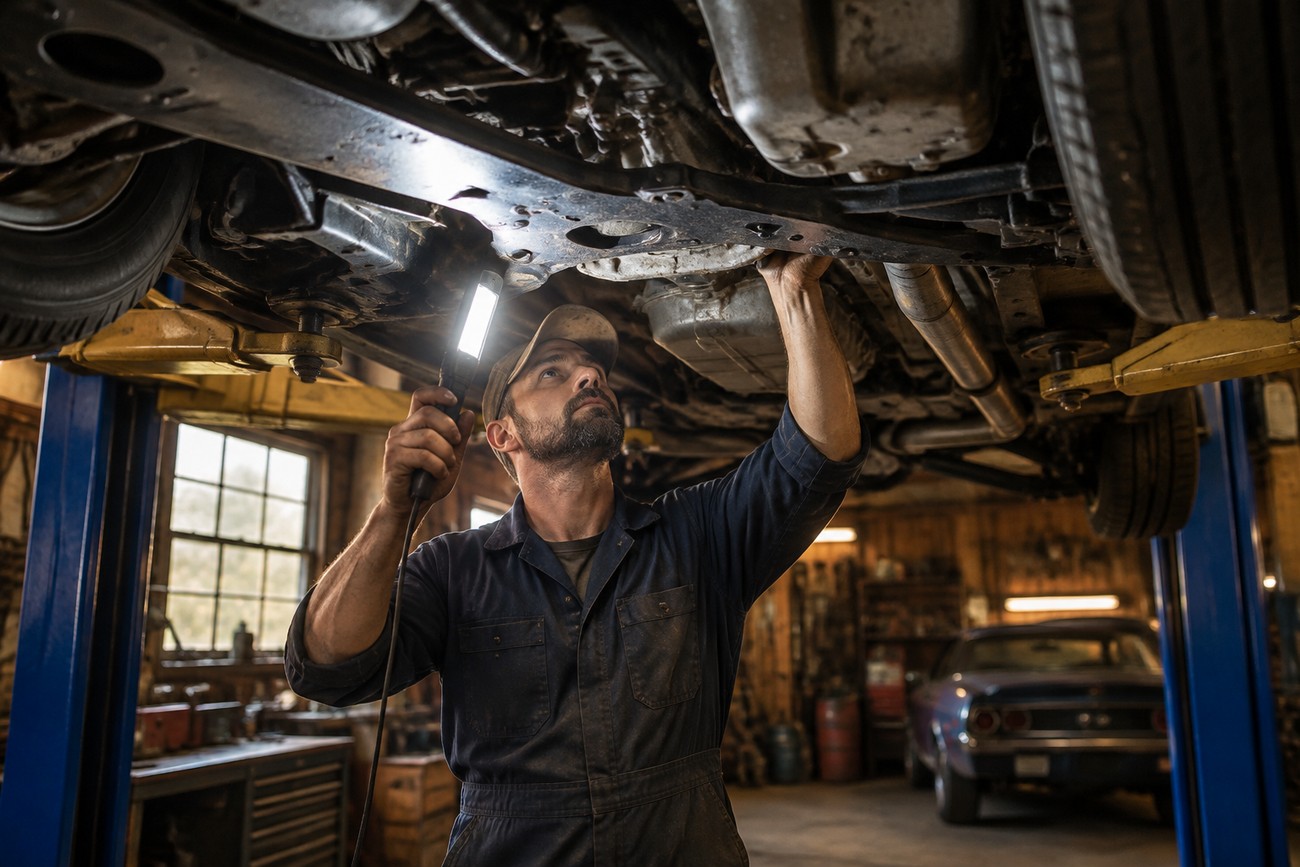
Begin underneath the car, not with the paintwork. Inspect the steel frame, sills, suspension mounting points, floor sections, and jack points for corrosion, repairs, and weakened metal. A visually clean Duroplast body can conceal severe structural rust, and frame repairs may cost more than cosmetic panel work.
Next, examine the Duroplast panels for cracks, distorted edges, loose fasteners, and old repairs. Check that doors, hood, and trunk align properly without treating alignment as proof of structural health. The engine should start readily, respond to throttle input, and settle into a consistent idle; excessive smoke, plug condition, oil use, and evidence of repeated overheating deserve careful attention.
Ask for service records covering mixture preparation, carburetor adjustment, spark plugs, exhaust cleaning, and previous engine work. Parts availability varies sharply by region, and specialized components may depend on enthusiast clubs, used-parts networks, or specialist suppliers. Before purchase, identify where consumables and model-specific parts will come from.
Finally, check the legal and practical setting in which the car will be driven. Modern inspections may scrutinize emissions in ways the original design cannot satisfy easily, while urban low-emission restrictions can limit access regardless of the car’s condition. Performance modifications deserve similar caution: an oversized carburetor or a lean mixture can cause overheating, detonation, and piston damage when lubrication and cooling are not recalibrated together.
Trabant 601 specifications and disputed figures
The following figures describe the standard 601 in broad catalog terms. Displacement and output vary slightly between references, versions, and rounding conventions; claims of 30 PS should be treated as modified, strengthened, or loosely documented unless supported by specific evidence.
| Specification | Trabant 601 | Notes |
|---|---|---|
| Engine layout | Front-mounted, air-cooled, two-cylinder two-stroke | Lubricating oil is mixed into the gasoline and partly burned. |
| Displacement | About 594.5–595 cm³ | Catalogs differ slightly in rounding. |
| Standard power | About 17–19.1 kW, or approximately 23–26 PS | Figures vary by cited specification and version. |
| Disputed power claims | About 22–30 PS in some listings | 30 PS is generally associated with tuning, strengthened versions, or inaccurate marketing rather than the ordinary standard 601. |
| Top speed | Approximately 100–112 km/h | Actual performance depends on condition, load, and specification. |
| Dimensions | About 3.55 m long, 1.50 m wide, and 1.44–1.46 m high | Minor differences can reflect body style or catalog method. |
| Mass | About 615 kg | Equipment and measurement conventions can affect the stated figure. |
| Production period | 1964–1990 | The 601 remained in production for decades with detail changes. |
| Production volume | More than 3.09 million examples | The figure covers the 601 production run as commonly reported. |
Frequently asked questions
The 601’s reputation, power figures, and name often prompt questions beyond the specifications. Its limitations are clear by modern standards, but its original purpose matters when judging the car. Claims in a sales listing also need to be checked against the individual vehicle.
Was the Trabant 601 the worst car ever made?
No. The Trabant 601 was poor by modern standards for acceleration, refinement, emissions, and safety expectations, but “worst ever” ignores its original purpose. It provided simple front-wheel-drive transport with low mass, modest mechanical complexity, and body panels that resisted ordinary rust.
Its weaknesses become severe when the car is used like a modern daily driver: highway travel is tiring, overtaking requires patience, and parts or emissions compliance may be difficult. As a historically purposeful economy car, it is easier to understand than to dismiss.
How much horsepower did a Trabant 601 have?
A standard Trabant 601 is generally listed at about 23–26 PS, equivalent to approximately 17–19.1 kW. Catalogs may differ because of engine version, test method, and rounding, while some listings quote figures from about 22 to 30 PS.
The upper end should be treated carefully. A 30 PS claim usually points to tuning, a strengthened version, or inaccurate marketing rather than the ordinary factory specification. Documentation for the individual engine matters more than an impressive number in a sales listing.
What does the word “Trabant” mean in German?
“Trabant” means “companion” or “fellow traveler” in German; it can also mean “satellite.” The satellite association reflected the enthusiasm surrounding the Soviet Sputnik launch and made the car’s name sound optimistic and modern for its period.
That meaning helps explain the car’s historical symbolism, but it says nothing about its mechanical quality. The 601 remains a lightweight two-stroke family car whose strengths and limitations must be judged from its construction and intended use.







