
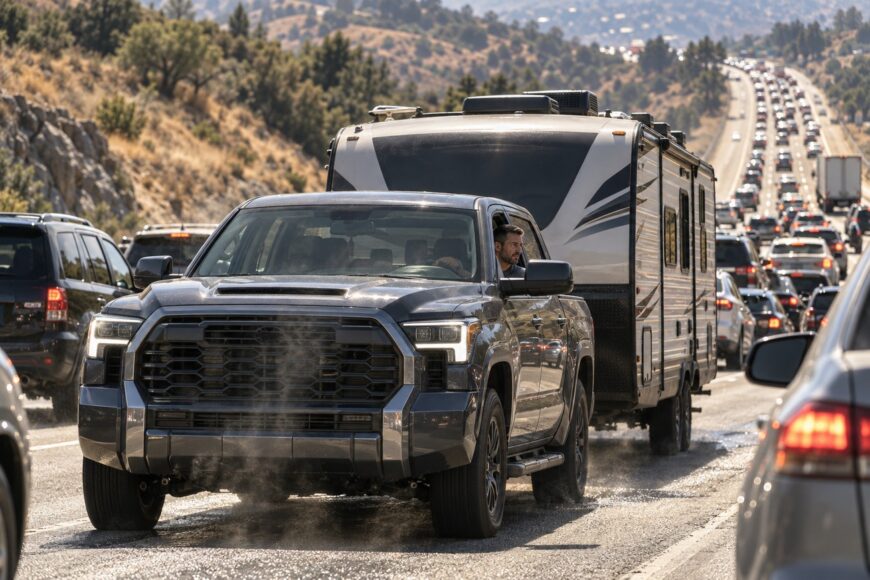
A Toyota Tundra that runs normally unloaded may begin overheating during a slow climb, in stop-and-go traffic, or while towing a trailer. The pattern often appears when the truck is working hardest and moving slowest: engine and transmission heat rise, while the airflow that normally passes through the radiator becomes limited.
Staying below an advertised towing maximum does not guarantee safe temperatures in every condition. The rating depends on the specific year, engine, drivetrain, cab, trim, and equipment, while heat, grade, headwind, trailer loading, air conditioning, and traffic reduce the available cooling margin. If the temperature rises, treat it as a safety problem first and a parts problem second.
- Why a Toyota Tundra Overheats While Towing in Traffic
- What to Do When the Temperature Rises
- The First Diagnostic Checks: Airflow, Coolant, and Fans
- Towing Capacity Is Not the Same as Cooling Margin
- Transmission Heat, Gear Selection, and Driving Technique
- Common Mistakes, Hidden Causes, and the Right Repair Path
- Frequently asked questions
- Why does my truck only overheat when I’m towing?
- What’s the worst year for Toyota Tundra?
- How can I keep the transmission cool while towing?
Why a Toyota Tundra Overheats While Towing in Traffic
At road speed, moving air helps pass through the grille and the radiator/condenser package. In traffic or during a slow climb, that ram air drops sharply. The fan must create most of the airflow, and any weakness in the fan, fan clutch, electric fan control, or airflow path becomes more significant.
A trailer adds continuous load to the engine, automatic transmission, and drivetrain. A grade increases that load further, while repeated gear changes can create additional transmission heat. The air conditioner adds another heat source in front of the radiator, so the engine temperature may rise more noticeably with the system running in a hot, stationary traffic queue.
External restriction can produce the same symptom. Dirt, insects, leaves, mud, or an accessory mounted near the grille can reduce airflow through the condenser and radiator. A large trailer or unusual trailer position may also disturb the air reaching the front of the truck, especially during maneuvering or backing.
A quick temperature drop after pulling over is useful information, but it does not prove the system is healthy. Stopping removes the towing load and changes the airflow and heat production. A weak fan, restricted radiator, coolant leak, or transmission problem can remain ready to return as soon as the truck is loaded again.
What to Do When the Temperature Rises
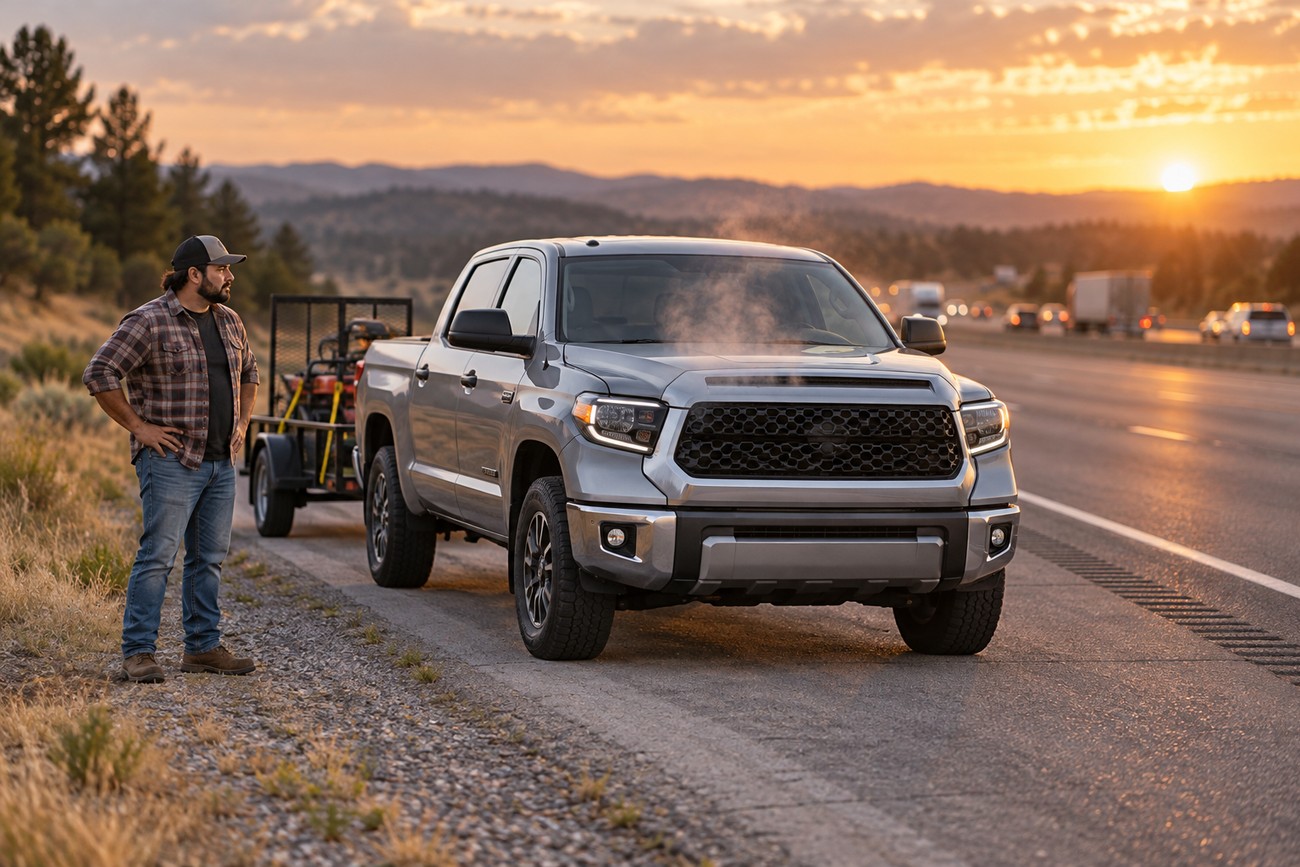
If the temperature warning appears or the gauge moves into an abnormal range, reduce risk before attempting diagnosis. Toyota’s overheating procedure is to stop safely, turn off the air conditioner, and turn off the engine. Use a safe shoulder or stopping area, keep clear of traffic, and avoid continuing simply because the gauge begins to fall.
Steam, visible coolant loss, a strong coolant smell, or a fan that does not operate as expected are reasons to arrange a tow or professional inspection. Do not open the radiator cap or coolant-system reservoir cap while the system is hot and pressurized. Hot coolant can escape violently and cause serious burns.
After the engine has cooled, inspect the ground and the engine bay for fresh coolant, split hoses, a damaged radiator, or other obvious leaks. Check the coolant level only when the system is cool and follow the procedure for that truck. Check whether the fan operates, while keeping hands, clothing, and tools away from moving components.
Turning the heater to maximum may temporarily transfer heat away from the engine while you move to a safe place. It is an emergency measure, not a repair, and it should never justify driving farther with a warning or severe overheating. Water may be used only as an emergency temporary substitute for coolant; normal operation requires the correct coolant and repair of the underlying problem.
The First Diagnostic Checks: Airflow, Coolant, and Fans
Begin with the symptom itself: overheating mainly in traffic points airflow and fan operation high on the list. Inspect the front of the condenser and radiator for packed debris, bent fins, mud, or accessories blocking the grille. The coolant level can be correct while the radiator package still cannot reject enough heat.
Next, verify fan operation under the conditions that produce the fault. Depending on the Tundra, the relevant component may be a fan clutch, an electric fan, or its control circuit. A fan that engages late, slips, runs intermittently, or moves too little air can allow temperatures to rise at idle and fall after the truck begins moving.
Test airflow under the traffic symptom before installing a radiator or thermostat. A truck that overheats only at low speed can send the diagnosis in the wrong direction if it is tested only while cruising.
Check the cooling system for leaks under pressure rather than relying on a visual inspection alone. Inspect the cap, hoses, radiator, water pump area, and connections for pressure loss. A small leak may admit air or lose coolant only when the engine is hot and loaded.
Use the correct coolant and confirm that the system was filled and bled properly after recent service. Air trapped after coolant replacement can cause repeat overheating under towing load, even when the reservoir appears full. The thermostat, water pump, and internal radiator restriction should be tested as part of the same diagnosis instead of replacing parts by guesswork.
Towing Capacity Is Not the Same as Cooling Margin
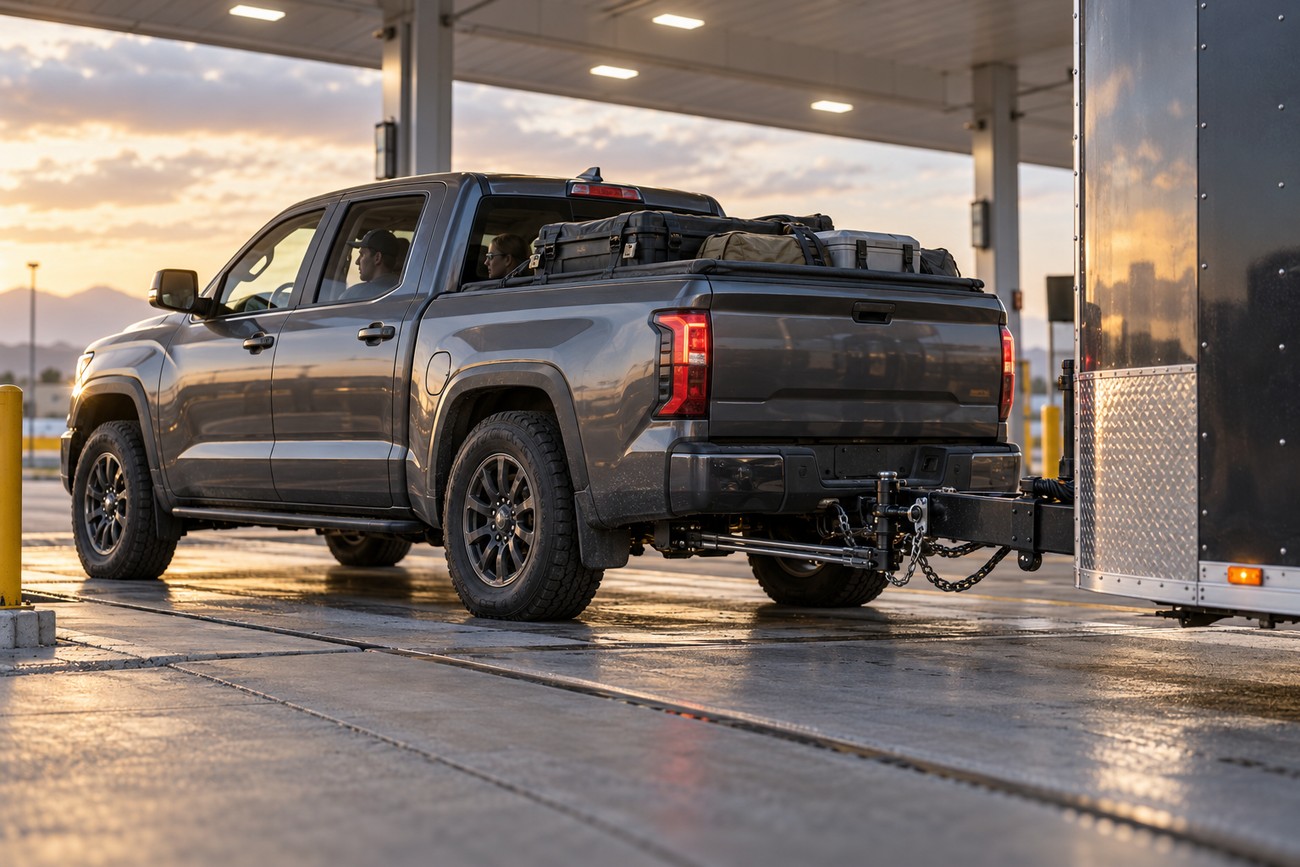
Newer Toyota Tundra configurations are advertised at up to 12,000 lb of towing capacity. That figure applies to certain configurations, not every Tundra, year, engine, drivetrain, cab, or trim. The relevant owner’s manual, ratings label, and equipment specification determine the limit for an individual truck.
Payload creates a separate constraint. For the 2026 Tundra, Toyota lists payload up to 1,850 lb, depending on configuration. Passengers, hitch equipment, bed cargo, and trailer tongue weight all reduce the remaining available payload, even when the trailer’s total weight appears acceptable.
Heat changes the practical operating margin. A trailer that is within its formal rating can still place substantial demand on the engine and transmission during a long grade, hot weather, a headwind, or a traffic queue. The towing number describes a rated capability under specified conditions; it does not promise identical cooling reserve in every environment.
Verify the actual trailer weight, cargo distribution, tongue weight, passengers, and truck payload before troubleshooting a repeated overheating event. A truck that is overloaded at the axle, hitch, or payload level can run hot for reasons a larger radiator will not correct. Keep the exact truck and trailer combination matched to the relevant Toyota documentation.
Transmission Heat, Gear Selection, and Driving Technique
Owners commonly describe frequent shifting, gear hunting, and transmission-temperature warnings while towing uphill. Repeated shifts generate additional automatic-transmission heat, even when the engine temperature appears normal. The factory engine gauge cannot be treated as a complete transmission-temperature monitor.
Use the tow mode or gear-selection procedure specified for the particular Tundra. The correct choice depends on the year, transmission, drivetrain, grade, and the applicable Toyota manual. There is no universal recommendation that every Tundra should use S4, a particular manual gear, 4H, or 2WD.
A suitable lower gear can reduce unnecessary shifting and help the engine hold a grade, while an unsuitable selection can raise engine speed or load without solving the problem. Follow the manual and pay attention to warning messages, shift behavior, and the terrain. Avoid copying a forum setting from a different generation or drivetrain.
Airflow can also change during unusual maneuvers. Backing a trailer, holding the truck at an awkward angle, or positioning the trailer close to the front airflow path can reduce cooling through the grille. If the engine gauge looks normal but the transmission warning appears, stop treating the issue as an engine-only problem and have transmission temperatures and cooler flow checked.
Common Mistakes, Hidden Causes, and the Right Repair Path
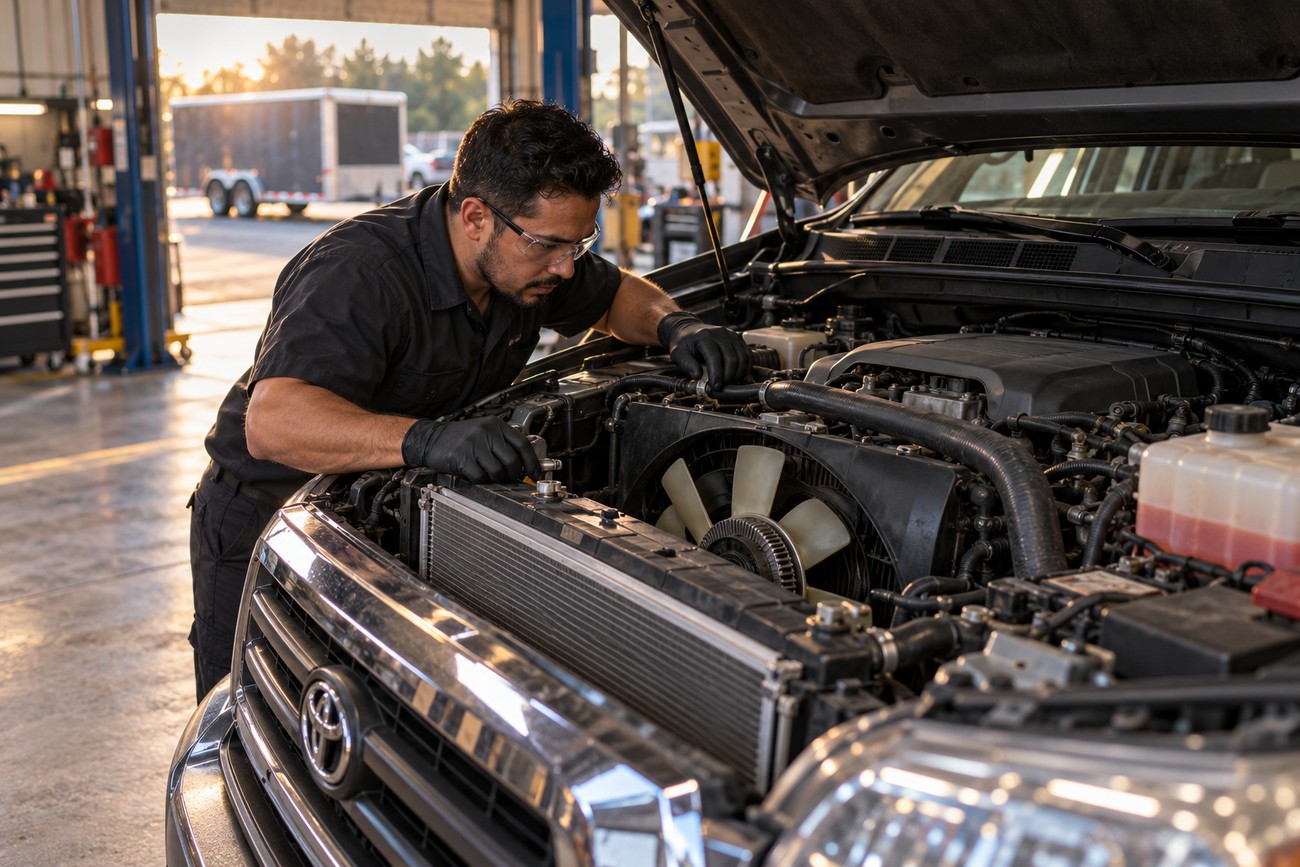
The first mistake is assuming that a trailer below the advertised maximum cannot cause overheating. A marginal fan, restricted radiator, trapped air, weak water pump, thermostat fault, leak, or excessive transmission heat may remain hidden without a trailer and appear only under load. Reproducing the symptom under controlled conditions can help a technician separate the trailer’s demand from a truck fault.
The second mistake is installing a larger radiator before checking the complete system. More radiator capacity cannot compensate for poor airflow, a failed fan, a pressure leak, incorrect coolant, trapped air, a thermostat or water-pump fault, or a transmission that is generating excessive heat. A pressure test, fan check, airflow inspection, and service-history review should guide the repair.
Cooling hardware also varies across Tundra generations and configurations. Late second-generation trucks may differ in factory transmission-cooler equipment, so verify the VIN, model year, and cooling-system layout before concluding that a cooler is present or absent. All Tundras do not share identical cooling hardware or identical towing instructions.
Inspect accessories and trailer equipment near the grille as part of the repair path. A grille obstruction, auxiliary lighting arrangement, or other front-mounted equipment can reduce airflow even when the trailer weight is within rating. Confirm the fan, radiator/condenser cleanliness, coolant circuit, and transmission cooling before approving repeated towing.
Continuing after an overheating warning can turn a manageable cooling fault into major engine or transmission damage. If the truck overheats again after cooling, arrange diagnosis before towing. A documented inspection should include the exact symptom, outside conditions, trailer load, warning messages, coolant history, and any recent cooling-system work.
Frequently asked questions
These questions address common overheating and towing concerns. The same basic checks apply: match the truck and trailer to the applicable ratings, identify whether the problem is related to airflow or load, and avoid continued towing after a warning.
Why does my truck only overheat when I’m towing?
Towing may expose a marginal cooling fault because the unloaded truck produces less heat. The trailer increases engine and transmission load, and a slow grade or traffic removes much of the airflow that hides a weak fan, restricted radiator, small leak, or trapped air.
The trailer may be contributing without being the sole cause. A technician can compare the truck’s configuration and load with the ratings, then reproduce the symptom safely while checking airflow, fan engagement, coolant pressure, and transmission temperature. Do not resume towing simply because the truck cools after stopping.
What’s the worst year for Toyota Tundra?
There is no defensible universal worst Tundra year based on the model name alone. A fair comparison separates generation, engine, drivetrain, cab, towing equipment, maintenance history, service records, and the conditions in which the truck is operated.
For an overheating concern, compare the VIN-specific equipment and Toyota service information first. Confirm the cooling layout, transmission cooler, applicable ratings, and any documented repairs rather than relying on a year-only reputation.
How can I keep the transmission cool while towing?
Start by confirming the factory cooling equipment for the truck’s VIN, year, and cooling-system layout. Then verify fluid condition and level according to the applicable procedure, inspect cooler lines and airflow, and check for gear hunting or warning messages under the actual towing conditions.
Use only the tow mode or gear selection specified in the owner’s manual. Additional cooling equipment may be appropriate for some configurations, but it should be selected after confirming compatibility, airflow, and the existing cooler arrangement. A universal cooler recommendation can be wrong for a different Tundra generation or drivetrain.







