
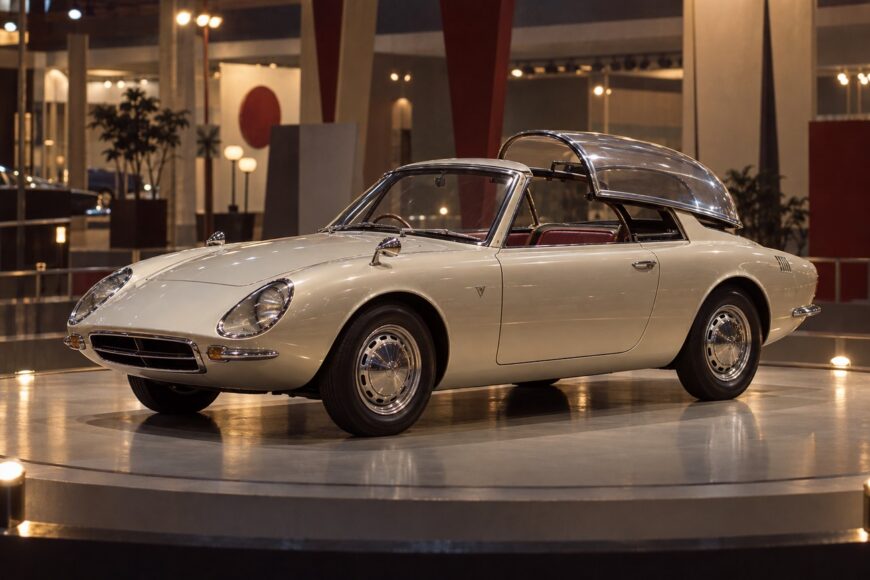
To enter the tiny Toyota coupe, the glazed upper section slid backward and left the two-seat cabin open from above. The effect was striking at the 1962 Tokyo Motor Show. It also made access to the seats depend on a moving roof rather than ordinary doors.
This was the Toyota Publica Sports Concept, a prototype rather than a production car. Its sliding canopy made it historically distinctive, but a show-car feature does not establish how well it would work on a commute or survive years of use. The distinction matters because photographs, catalog specifications, and listings often blur the concept with the later Sports 800 and other Publica models.
- A 1962 Concept, Not a Production Toyota
- How the Sliding Canopy Actually Worked
- Publica Sports and Sports 800: The Crucial Split
- Specifications Without the Catalogue Traps
- Why the Show-Car Idea Did Not Reach Production
- How to Identify the Car Behind the Name
- Frequently asked questions
- What is the average price of a Toyota Sports 800?
- How many Toyota Sports 800 were made?
- What engine did the Toyota Publica Sports concept have?
A 1962 Concept, Not a Production Toyota
Toyota showed the Publica Sports Concept at the 1962 Tokyo Motor Show. It took the familiar mechanical basis of the ordinary Publica and placed it beneath a lighter sports body. That relationship explains its name, although the exhibition car was never offered as a mass-production Publica Sports with a sliding canopy.
The wider Publica line ran from 1961 to 1978 and covered different generations and derivatives. A date or specification attached to “Publica” therefore needs a second identifying detail before it can describe the concept. The shared family name alone cannot establish its body design, engine output, or production status.
Its strongest claim to significance is the arrangement of its cabin access. Toyota used the concept to explore how a small, lightweight coupe might look and function with its glazed upper section moving as one element. That makes it valuable evidence of a design idea, rather than a ready-made specification for a car that customers could order.
Historical rarity and usable-car value are separate judgments here. The concept attracts attention precisely because its canopy was unusual and did not become the series solution. Its appearance at a motor show tells us far less about everyday ownership than photographs of a production vehicle might suggest.
How the Sliding Canopy Actually Worked
The Publica Sports Concept was a two-seat coupe whose glazed upper section slid rearward on guides to provide cabin access. Occupants entered through the opening created above the body side. Describing this as a panoramic roof misses its principal job: the canopy served in place of conventional side doors.
That change affects ordinary movements around a car. Entry requires an occupant to negotiate the body side and seat beneath an opened upper structure, a different task from stepping through a door aperture. The display demonstrated that the arrangement could make an impression; it did not establish that drivers would find it easy in tight parking spaces or during frequent stops.
A large moving glazed section also raises sensible engineering questions. Its guides and seals would need to keep the canopy moving and the cabin protected from weather, while the glass could affect comfort in strong sun. These are potential design challenges, not documented long-term failures of a production Publica Sports.
The distinction between a working show feature and a durable series system is important. A prototype can demonstrate a movement and a silhouette without proving how the mechanism behaves after repeated use, exposure to weather, and routine servicing. The canopy’s visual lightness should not be mistaken for evidence that it would have been simple to build or maintain.
Publica Sports and Sports 800: The Crucial Split
The later Sports 800 was the production sports derivative, but it did not preserve the concept’s entry system. The table separates what the two cars share in lineage from the details that matter when identifying one in a photograph or listing. In particular, a Sports 800 with its roof panel removed is still a door-equipped production car.
| Feature | Publica Sports Concept | Sports 800 |
|---|---|---|
| Status | 1962 show concept | Later production sports derivative |
| Cabin access | Glazed upper section slid rearward on guides | Conventional doors |
| Roof | Sliding canopy formed part of the access system | Removable roof panel |
| Body relationship | Sports body on a mechanically related Publica basis | Related production sports car, with a different body solution |
| Specification certainty | Later catalog figures cannot define the concept | Figures must still be checked against the production version described |
Conventional doors changed more than the Sports 800’s appearance. They gave occupants a familiar way into the cabin without moving the glazed roof structure. The removable panel retained an open-air option, but removing a panel is different from sliding the upper body backward each time someone enters.
That split is easy to lose when both vehicles are called a “Publica sports car.” A photograph showing a low Toyota coupe may point to their shared history, while its door openings and roof construction identify which vehicle it depicts. The existence of the Sports 800 does not mean the sliding-canopy Publica Sports entered series production.
Specifications Without the Catalogue Traps
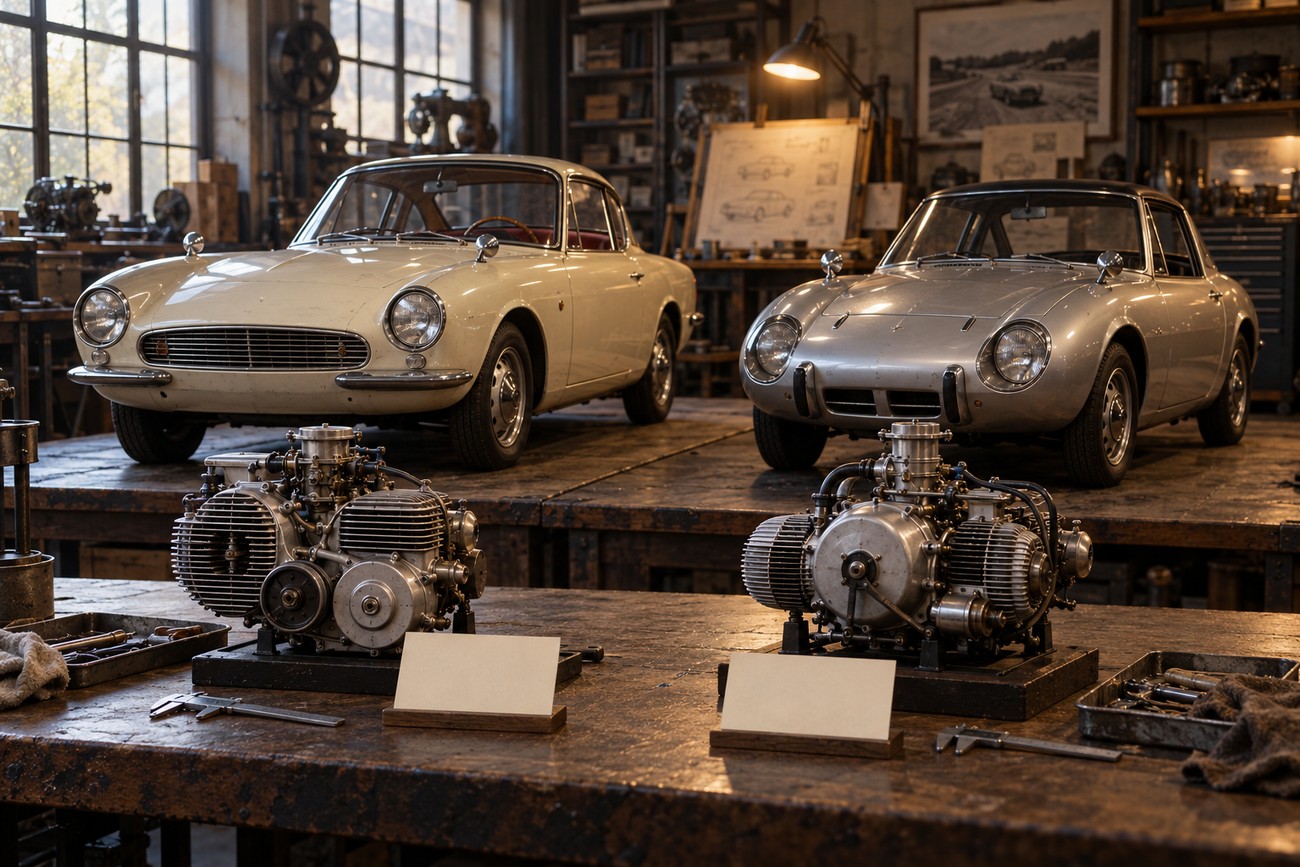
Engine figures become misleading when they travel without a model and year. Sources associate a subsequent sports version with a 790 cc engine, 45 bhp, and a mass under 600 kg. Those figures should not be copied into a specification box for the 1962 Publica Sports Concept merely because the cars are related.
Some catalog listings cite 790 cc and 36 hp for the P20 coupe. The similar displacement makes it tempting to combine that entry with the sports-version figures, yet the different power claims already signal that the listings describe different specifications. A label such as “Publica Coupe” is too broad to settle which car a number belongs to.
Across the wider Publica family, reported power figures range from 28 to 73 hp. That spread reflects why a single figure pulled from a family-level page is poor evidence for one show car. Before using any number, check the named derivative, its year or generation, and whether the source describes a production car or the concept.
The safe conclusion is narrow: the concept was mechanically close to the ordinary Publica and wore a lighter sports body. The supplied figures do not establish one definitive production-style engine and power specification for it. Leaving a concept specification unresolved is more accurate than assembling a plausible-looking one from later catalog entries.
Why the Show-Car Idea Did Not Reach Production
The sliding canopy was absent from the later Sports 800, which used conventional doors and a removable roof panel. That outcome shows Toyota chose a different production arrangement. It does not, on its own, reveal an officially documented reason for abandoning the original mechanism.
Several practical trade-offs help explain why such a decision would make engineering sense. A moving glazed upper structure needs guides, seals, and hardware that a fixed roof and ordinary doors do not need in the same form. Each component adds a point to manufacture, align, inspect, and potentially service, even if a show example operates smoothly.
Access poses a separate problem. Entering over the body side could become awkward beside another parked vehicle, and the opening must work for occupants of different sizes. Weather sealing and cabin temperature would also deserve testing before a heavily glazed arrangement could be judged suitable for regular use.
None of those concerns proves that the concept failed a durability test; the public show car does not supply that evidence. The Sports 800 instead demonstrates the compromise Toyota ultimately put into production: normal entry through doors, with a removable panel for drivers who wanted an opening above them.
How to Identify the Car Behind the Name
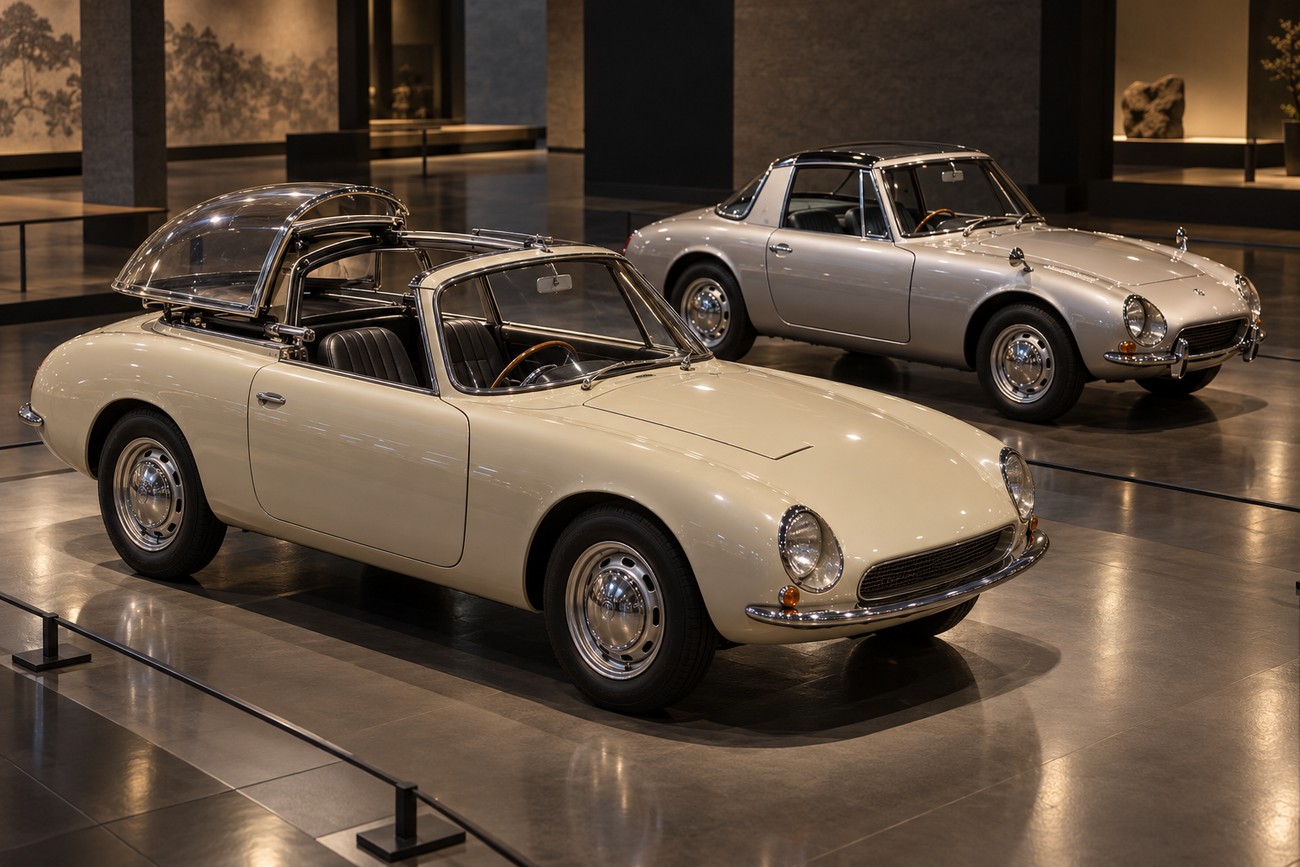
Start with the body, then read the label. A rearward-sliding glazed upper section is the defining feature of the 1962 Publica Sports Concept. If the car has conventional doors and a removable roof panel, identify it as a Sports 800 rather than calling its roof a version of the concept canopy.
Next, check whether a listing supplies a year, a precise model name, and photographs that support its description. “Publica,” “Publica Coupe/P20,” “Publica Sports Concept,” and “Sports 800” should remain distinct labels. An engine figure attached only to “Publica Coupe” cannot verify a sliding-roof claim, while an image of the concept cannot establish the equipment of a car offered for sale.
Check the claimed roof operation against the visible door openings before trusting an engine or rarity claim. A broad model label can be corrected later; a mistaken vehicle identity undermines every specification attached to it.
For an auction entry or catalog card, work through five checks in order: year, body style, cabin access, roof design, and the version to which any engine figure is attributed. If the text claims a normally purchasable, production sliding-canopy Publica Sports, seek stronger documentation rather than treating the name as proof.
The concept’s importance lies in its place in Toyota’s design history. That importance does not turn it into a proven everyday car, nor does it make a Sports 800 mechanically identical to the show exhibit. Keeping those values separate leads to a clearer reading of both the photographs and the market descriptions built around them.
Frequently asked questions
The answers below keep the show concept, the production Sports 800, and other Publica variants separate. That distinction is essential when a question involves prices, production numbers, or engine specifications.
What is the average price of a Toyota Sports 800?
There is no reliable single average without defining the market, date, condition, and originality standard. An asking price for a restored car and a completed sale for a car needing work answer different questions; comparing like-for-like transactions is more useful than relying on an isolated figure.
Any Sports 800 price concerns the later production vehicle. It cannot be transferred to the Publica Sports Concept, which was not a normally sold sliding-canopy model.
How many Toyota Sports 800 were made?
A verified production total is not established by the information used here, so a precise count would be unwarranted. For a count you intend to cite, check a source that identifies the Sports 800 explicitly and states what its total includes, rather than a listing that uses the broader Publica name.
Even a verified Sports 800 total would describe that production model alone. It would say nothing about how many Publica Sports Concept examples were built or displayed.
What engine did the Toyota Publica Sports concept have?
The concept was mechanically related to the ordinary Publica, but the later catalog figures do not confirm one exact engine-and-output specification for the 1962 show car. Sources associate 790 cc and 45 bhp with a subsequent sports version; some P20 coupe listings give 790 cc and 36 hp.
Those figures belong to their stated contexts. Neither output should be presented as a confirmed Publica Sports Concept rating without direct evidence for the exhibit itself.







