
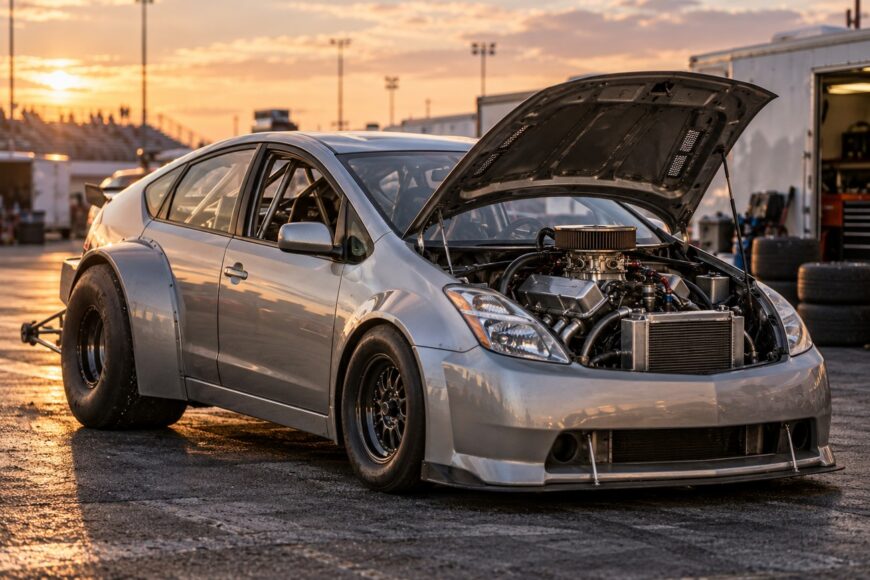
The Prius badge suggests fuel economy, quiet operation, and a tightly integrated hybrid system. PriuSRT8 suggests something else entirely: a Hellcat-based V8, rear-wheel drive, a manual transmission, and a drag-racing chassis beneath familiar Prius bodywork.
That clash creates the central problem with the popular “2,000-hp Prius” description. Is this a hybrid Prius producing extraordinary power, or a purpose-built race car wearing a Prius shell? The available descriptions support the second interpretation.
PriuSRT8 is best understood through its engineering choices rather than its headline number. The bodywork is recognizable, while the chassis, drivetrain, electronics, fuel system, and safety equipment serve a very different purpose from those of a standard Prius.
- What Is PriuSRT8, Exactly?
- Does This Prius Actually Make 2,000 HP?
- Why a V8 Swap Becomes a New Drivetrain
- The Parts That Must Survive the Launch
- What the Prius Disguise Costs in Practicality
- Frequently asked questions
- What is the highest horsepower a Prius can have?
- What evidence would verify a 2,000-hp claim?
- What should a buyer inspect before purchasing a Prius-bodied drag car?
What Is PriuSRT8, Exactly?
PriuSRT8 uses Prius bodywork on a purpose-built, roll-caged drag chassis. Its documented layout is rear-wheel drive with a Tremec manual transmission, rather than the factory Prius eCVT. That architecture changes the vehicle’s identity more fundamentally than an ordinary engine swap would.
The Prius shell provides the visual joke and the familiar silhouette. Underneath, the project is built around the requirements of a high-power drag car: a longitudinal engine, a conventional transmission, a driveshaft, and a driven rear axle. Those parts require a different structure and load path from the factory hybrid layout.
An operative factory Prius hybrid drivetrain is not documented for this build. The available descriptions do not establish that the original hybrid battery, inverter, electric motors, and control strategy remain functional as a working V8-hybrid powertrain.
That distinction matters because “Prius-bodied drag car” describes the evidence more accurately than “Prius with a large engine.” The badge and bodywork remain recognizable, but much of the engineering that defines a production Prius has been replaced or bypassed.
Does This Prius Actually Make 2,000 HP?
A 2,000-hp figure for this specific car is a promotional or circulating claim, not a reliably verified output figure. It should not be presented as an established specification without an attributable dyno record, a clearly identified configuration, and a defined measurement point.
Published descriptions of the Hellcat V8 build cite about 1,000 hp. A separate description reports more than 800 wheel horsepower and mentions an upgraded supercharger. These figures belong to different descriptions and should not be combined into one precise specification.
Engine horsepower and wheel horsepower are different measurement categories. Power measured at the engine does not equal power measured after losses through the clutch, transmission, driveshaft, differential, and tires. Without knowing the dyno type, test conditions, fuel, boost level, and configuration, a direct conversion would create false precision.
A roughly eight-second quarter-mile was stated as a goal, not established here as a recorded result. The target indicates the intended performance level, while a repeatable result would require timing data, track conditions, launch details, and confirmation that the same configuration produced the run.
Why a V8 Swap Becomes a New Drivetrain
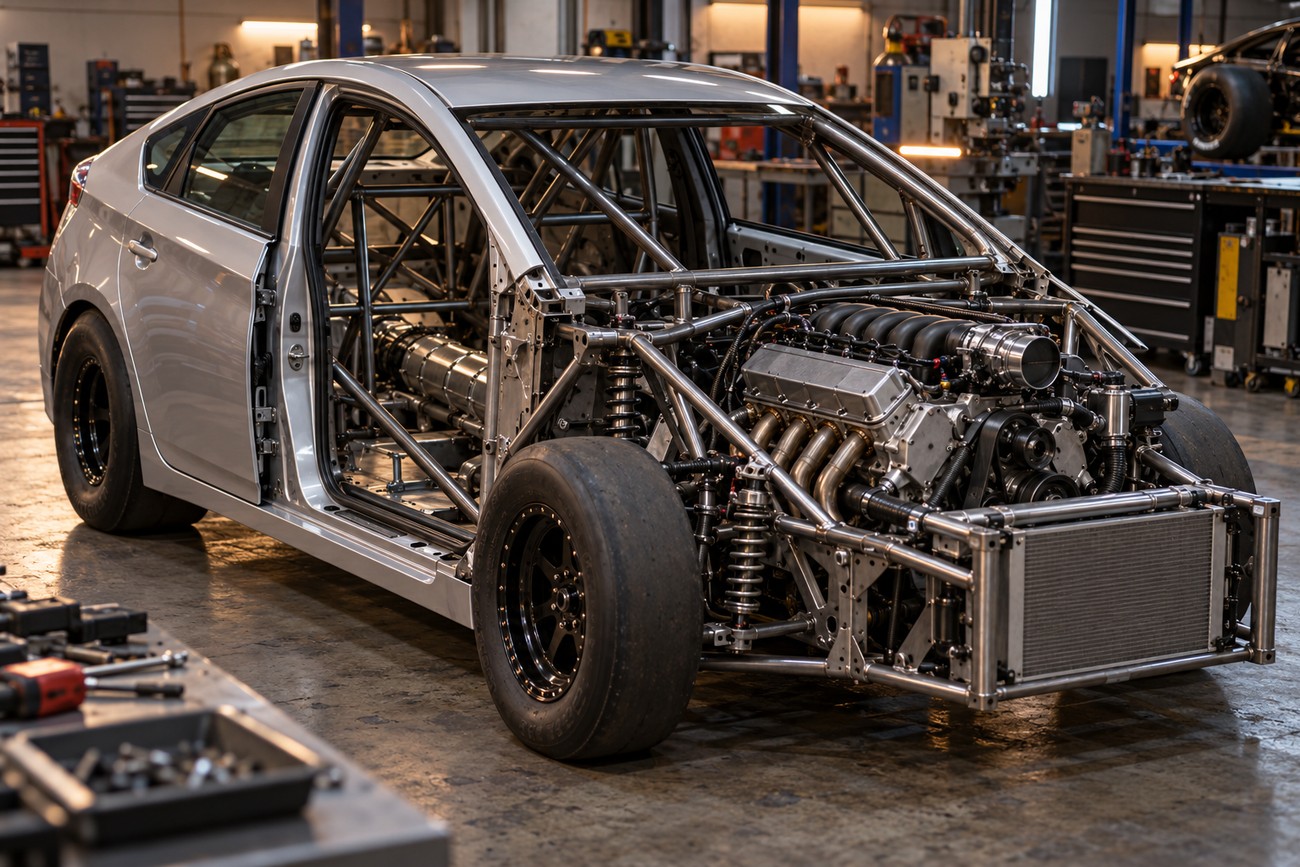
A longitudinal V8 needs space for the engine, its accessories, and a transmission positioned behind it. A rear-wheel-drive layout then adds a driveshaft tunnel, a differential, axle assemblies, and mounting points for the rear suspension. Those requirements do not align with simply placing a large engine into the original Prius engine bay.
The factory Prius eCVT is not the transmission used in the documented rear-wheel-drive build. Its design is part of an integrated hybrid system, with electric motor-generators, a planetary gearset, an inverter, and control software working together. It is not a plug-and-play path for transferring the output of a high-power supercharged V8 to a rear axle.
Packaging becomes a structural issue as soon as the engine and transmission are selected. The floor, firewall, transmission tunnel, suspension mounts, and rear structure may all need major fabrication. Builders must establish the position of the crankshaft, driveshaft, axle centerline, seat, pedals, and safety cage before finalizing the surrounding panels.
Electronics create a second conversion project. Factory Prius systems are closely interconnected, so a V8 installation requires separate engine control, custom wiring, and solutions for the instruments, starting system, charging system, brakes, ABS, and any remaining body functions.
The result is closer to a new vehicle assembled around Prius bodywork than to a conventional engine-bay replacement. Treating the project as a simple swap can leave major decisions about structure, control systems, and braking until too late in the build.
The Parts That Must Survive the Launch
Power delivery begins with fuel supply. The documented drag configuration uses separate fuel pumps and a race fuel tank, reflecting the fuel demand of a high-output supercharged V8. The original Prius fuel hardware and plumbing cannot be assumed to support that demand or the pressure and flow requirements of the new engine.
Traction equipment reinforces the car’s drag-racing purpose. Rear drag tires provide the working contact patch, while narrow front wheels reduce rolling resistance and help meet the demands of the chosen configuration. This arrangement also affects braking balance, steering response, suspension geometry, and the way the car reacts when the rear tires gain or lose traction.
Fuel delivery and driveline containment deserve attention before a higher boost setting. An engine-power target does not establish that the car can launch safely or keep a failed shaft, joint, or axle under control.
More than 800 wheel horsepower appears in one published description, yet repeatable 2,000-hp performance is not verified. At that level of output, the driveshaft, differential, axles, hubs, wheel studs, suspension links, and fabricated joints all see severe shock loads during a launch.
Cooling, braking, and chassis setup are equally important. The engine needs adequate coolant and charge-air control, the brakes must manage the vehicle’s speed and altered weight distribution, and the chassis must be tuned for the tires and prepared surface. A powerful engine alone does not establish a safe or effective launch.
Track preparation adds another variable. Tire pressure, suspension movement, launch control, surface grip, and gearing determine how much torque reaches the ground. The same dyno figure can produce very different results when the chassis setup or track surface changes.
What the Prius Disguise Costs in Practicality
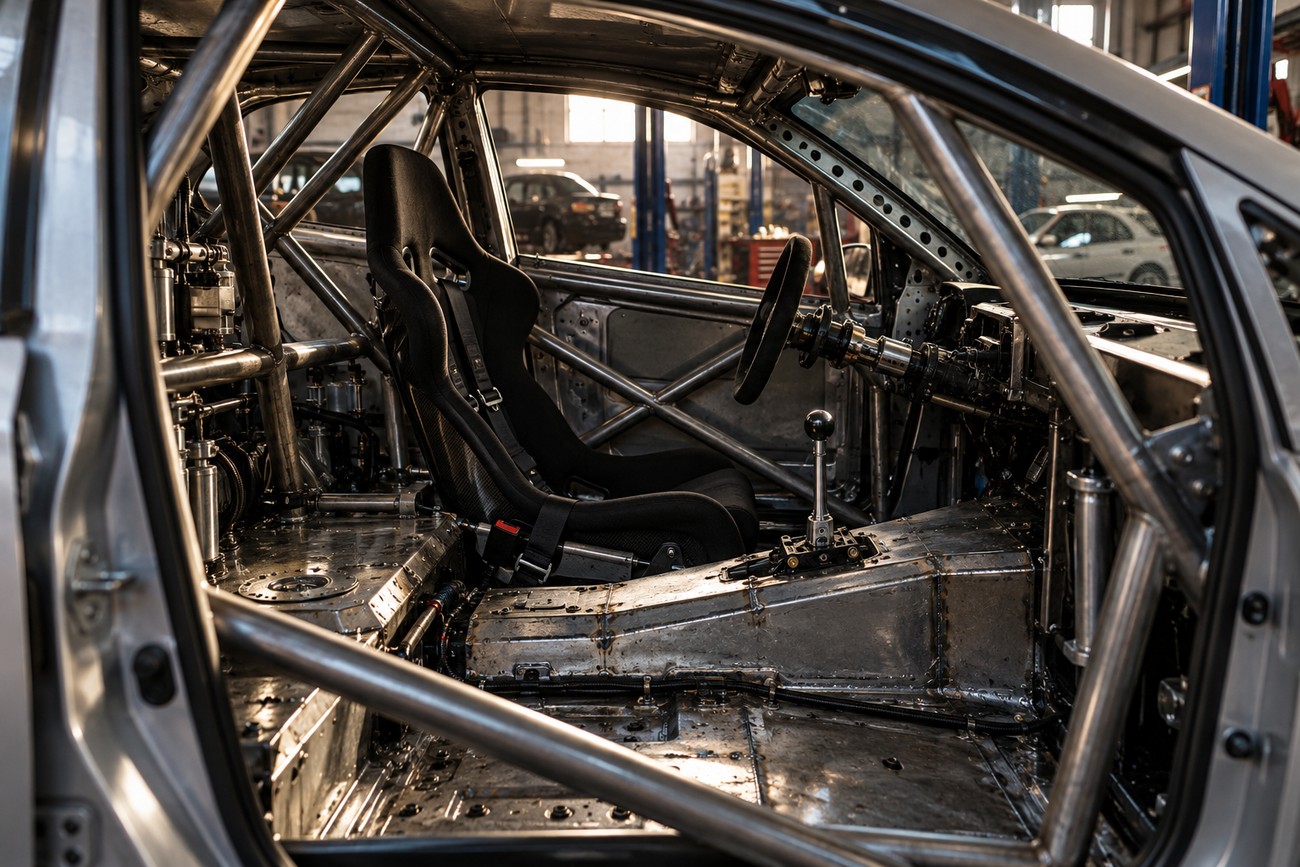
Under Prius bodywork, PriuSRT8 is a purpose-built, roll-caged drag car. Custom fabrication affects the cabin, access to mechanical components, service procedures, and the way the vehicle carries its mass. Removing hybrid hardware and adding a V8, transmission, cage, rear-drive components, and racing equipment can substantially change the balance of the car.
Those changes reduce the usefulness associated with a production Prius. Drag tires, a competition-oriented suspension, a roll cage, and altered controls are designed around track performance rather than quiet commuting. Ride comfort, interior space, visibility, and everyday drivability can all suffer as the race specification becomes more serious.
Road use introduces a separate compliance problem. A roll cage, modified structure, nonstandard lighting, racing tires, and changes to emissions or braking systems may affect registration and insurance. Requirements vary by jurisdiction, so a buyer must check local rules instead of assuming that a road-legal Prius title makes the finished car road legal.
The phrase “hybrid build” mainly describes the contrast between the Prius identity and the V8 drag-car hardware. An operative factory Prius hybrid drivetrain is not documented for PriuSRT8, so the label should not be read as confirmation of a functioning hybrid powertrain.
Frequently asked questions
The answers depend on whether the subject is a production Prius or a custom race car wearing Prius bodywork.
Power limits, verification standards, and buyer checks are different for those two cases.
The following questions address the distinction and the evidence needed to assess the build.
What is the highest horsepower a Prius can have?
There is no single meaningful maximum for both a factory Prius drivetrain and a custom race chassis wearing Prius bodywork. A production Prius is limited by the capacity of its engine, electric machines, battery, inverter, transmission, cooling system, and structural components as an integrated system.
A purpose-built drag chassis changes the question entirely. Once the factory drivetrain is replaced with a rear-wheel-drive layout, a Tremec manual transmission, and custom supporting systems, the practical limit depends on the new engine, transmission, chassis, tires, safety equipment, and track setup. That vehicle is no longer an ordinary Prius powertrain pushed to a specified maximum.
What evidence would verify a 2,000-hp claim?
Verification should begin by identifying the exact car and configuration, including the engine, supercharger, fuel, boost level, drivetrain, and date of testing. The report must also state whether the figure was measured at the engine or at the wheels.
Useful evidence includes an attributable dyno test, identifiable test conditions, and documentation linking the result to the same vehicle shown in the claim. A quarter-mile result can support the performance story, but it does not prove a specific horsepower figure by itself.
What should a buyer inspect before purchasing a Prius-bodied drag car?
Start with chassis and fabrication records. Check the cage, suspension mounts, transmission tunnel, rear axle structure, welds, and any inspection or certification documents required for the intended track or jurisdiction.
Then verify the drivetrain specification, fuel system, cooling system, brakes, wiring, and safety equipment. Any claimed power should have attributable test evidence that identifies the measurement type. Registration, insurance eligibility, and track-rule compliance should also be confirmed before money changes hands.







