
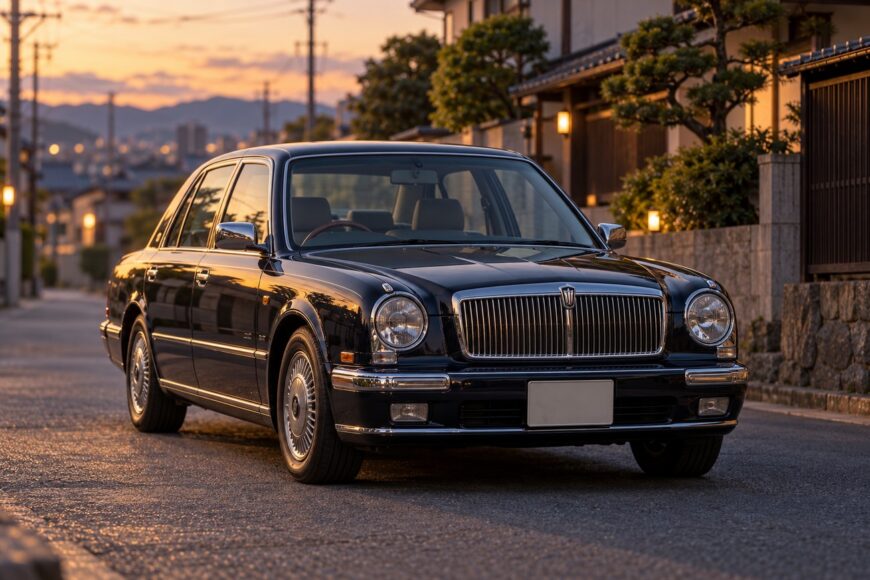
The Toyota Origin looks ready for a formal arrival. Its first-generation-Crown-inspired lines, bright trim, and rear-hinged passenger doors give it a ceremonial air, while ownership calls for less glamorous decisions: how to protect unusual bodywork, where to find missing trim, and who can diagnose its engine properly. A polished photograph can show why the car is desirable; it cannot show whether the door openings are sound.
Built for the Japanese market in 2000–2001, the limited-run Origin marked Toyota’s production of 100 million vehicles in Japan. Its historical reference is clear, but its mechanical identity belongs to a much later Toyota family. For a prospective owner, the distinction matters: some service parts have relatives elsewhere in the range, while a damaged Origin-specific panel may be difficult to replace.
- A milestone dressed as the first Crown
- Why the body makes the Origin feel special
- What sits beneath the Crown-inspired styling
- Driving it: occasion over speed
- The ownership risks hidden by polished photographs
- How to assess one before you buy
- Frequently asked questions
- How should you insure and value a Toyota Origin?
- Where can you find replacement Origin body trim?
- What should you service before driving a long-stored Origin regularly?
A milestone dressed as the first Crown
The Origin was Toyota’s commemorative model for a domestic-production milestone: 100 million vehicles made in Japan. That figure refers to Toyota’s broader manufacturing history, not to the number of Origins built. The car was produced in a limited run in 2000–2001 and sold for the Japanese domestic market, which helps explain why it remains an unusual sight elsewhere.
Its styling looks back to the first-generation Toyota Crown of the 1950s. The upright, formal silhouette and ornate detailing evoke that period without making the Origin a reproduction of an early Crown. It offers the visual character of a historic sedan in a vehicle engineered decades later.
That distinction is central to understanding the project. Toyota did not create an entirely new mechanical car simply to revisit the 1950s; it clothed a Progrès-related basis in a distinctive commemorative body. Buyers drawn by the heritage should therefore assess it as both a design object and an aging modern car. Each side brings a different set of ownership costs.
Why the body makes the Origin feel special
The Origin’s profile does much of the work. Its substantial sedan proportions, pronounced side treatment, and bright exterior details make it more imposing than a compact retro runabout. Those details also demand a closer look in person: a photograph can flatter chrome and paint while hiding poor fit around a door or a missing piece of trim.
The front doors are conventionally hinged; the rear doors are hinged at the rear. Opened for a passenger, they turn a routine arrival into something more formal. In a narrow parking space, the same arrangement takes planning, particularly if another car or a wall limits access alongside the rear doors.
Much of this visual identity is specific to the Origin. The body panels and exterior decoration cannot be treated as interchangeable with those of a mechanically related Toyota. A small parking scrape may therefore become a sourcing problem before it becomes a repair job. That is a practical reason to check panel condition and trim completeness as carefully as the car’s appearance from a distance.
What sits beneath the Crown-inspired styling
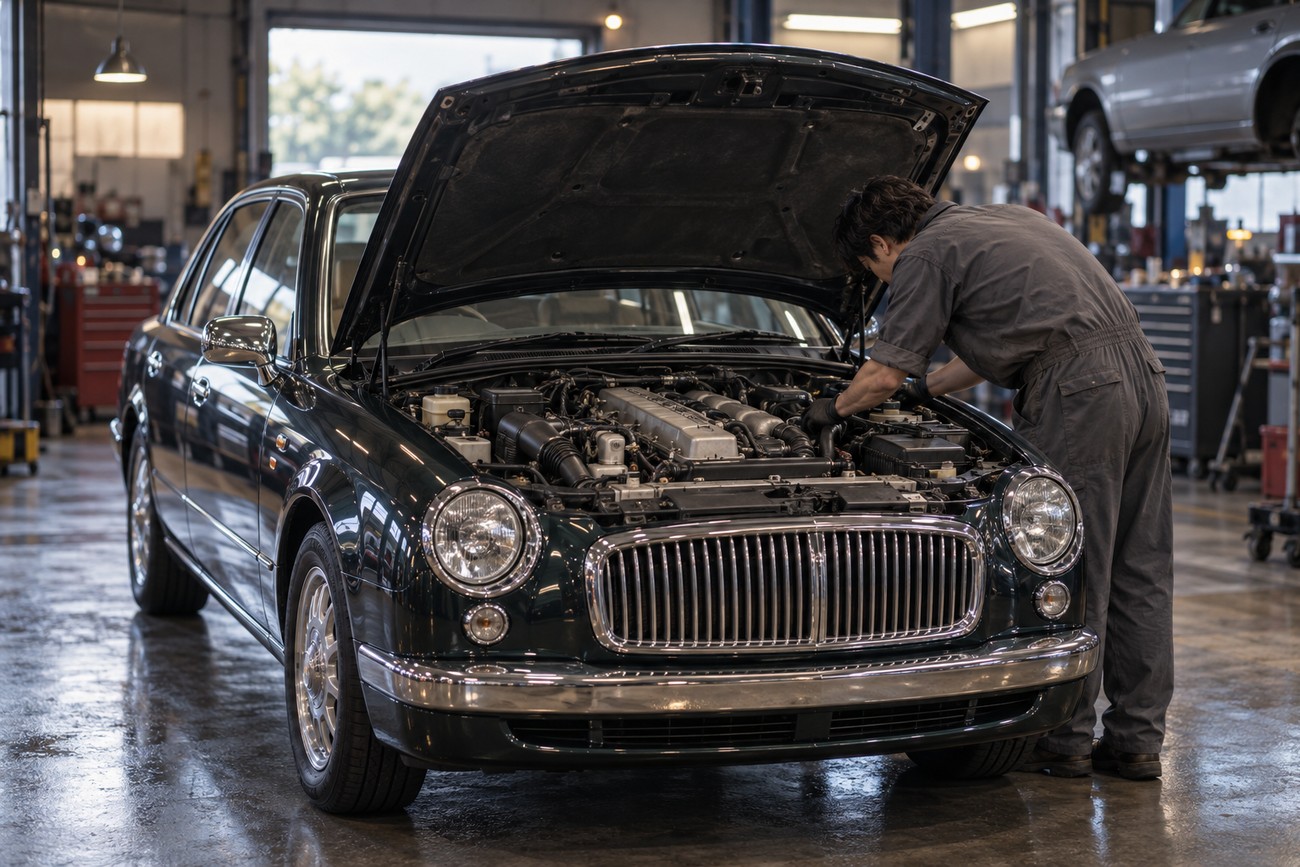
The Origin is mechanically related to the Toyota Progrès. Its first-Crown appearance does not establish Crown Comfort or XS10 taxi underpinnings, despite that claim appearing in some descriptions. Keeping the styling reference separate from the mechanical basis makes parts research and workshop conversations more productive.
Power goes to the rear wheels through a four-speed automatic; Toyota offered no manual Origin. The engine is the 3.0-liter 2JZ-FSE inline-six, which uses direct fuel injection. Its 2JZ designation may sound reassuring to enthusiasts familiar with other versions, but the injection equipment is an important distinction when budgeting for diagnosis and maintenance.
Published engine output is often quoted at approximately 215 hp, although nearby figures differ between sources. Anyone needing an exact rating should check the source and unit rather than treating one catalogue entry as universal. For ownership, the more useful specification is the complete powertrain: a direct-injection six-cylinder engine paired with a conventional four-speed automatic.
Driving it: occasion over speed
The Origin’s specification points toward unhurried sedan travel. Rear-wheel drive and a six-cylinder engine provide a familiar layout, while the four-speed automatic defines a measured response rather than a sporting one. The 2JZ name alone is a poor guide to how this particular Toyota feels or what its fuel system may cost to maintain.
Its size deserves attention before a buyer imagines using it as an easy city car. The formal body has a substantial presence, and confined streets ask more of the driver than the nostalgic styling might suggest. Check sightlines and parking access on a test drive instead of assuming that an older-looking car will feel small.
The rear doors add another everyday consideration. Passengers need room to open them safely, and their exposed edges deserve care where parking spaces are tight. These are consequences of the layout, not a claim that every owner finds the car difficult to use. An Origin can be driven regularly, provided its condition and the owner’s usual parking arrangements suit it.
The ownership risks hidden by polished photographs
Some mechanical components can be sourced through related Toyotas, which makes routine work less daunting than the Origin’s rarity first suggests. That advantage has limits. Origin-specific panels, chrome, and interior trim may be scarce, so a seemingly minor cosmetic defect can take more time to resolve than an ordinary service item.
Condition also has to be judged by age, not solely by distance traveled. Seals, hoses, and plastics can deteriorate while a car sits, and low mileage cannot confirm that they remain sound. A carefully stored example may be excellent, but its odometer reading should lead to an inspection rather than end one.
The 2JZ-FSE deserves its own assessment. Direct-injection fuel-system faults call for appropriate diagnostic expertise, and the reputation of other 2JZ engines does not make this configuration maintenance-free. Before buying, establish how it starts, runs, and responds under load, and look for evidence of relevant servicing rather than relying on the engine badge.
Restoration or repainting is not automatically a fault. On a rare car, thoughtful repair may be preferable to neglected original paint. What matters is whether the work preserved sound metal, correct geometry, and complete fittings. Fresh gloss cannot compensate for poorly repaired door openings or trim that has been removed because replacements were unavailable.
How to assess one before you buy
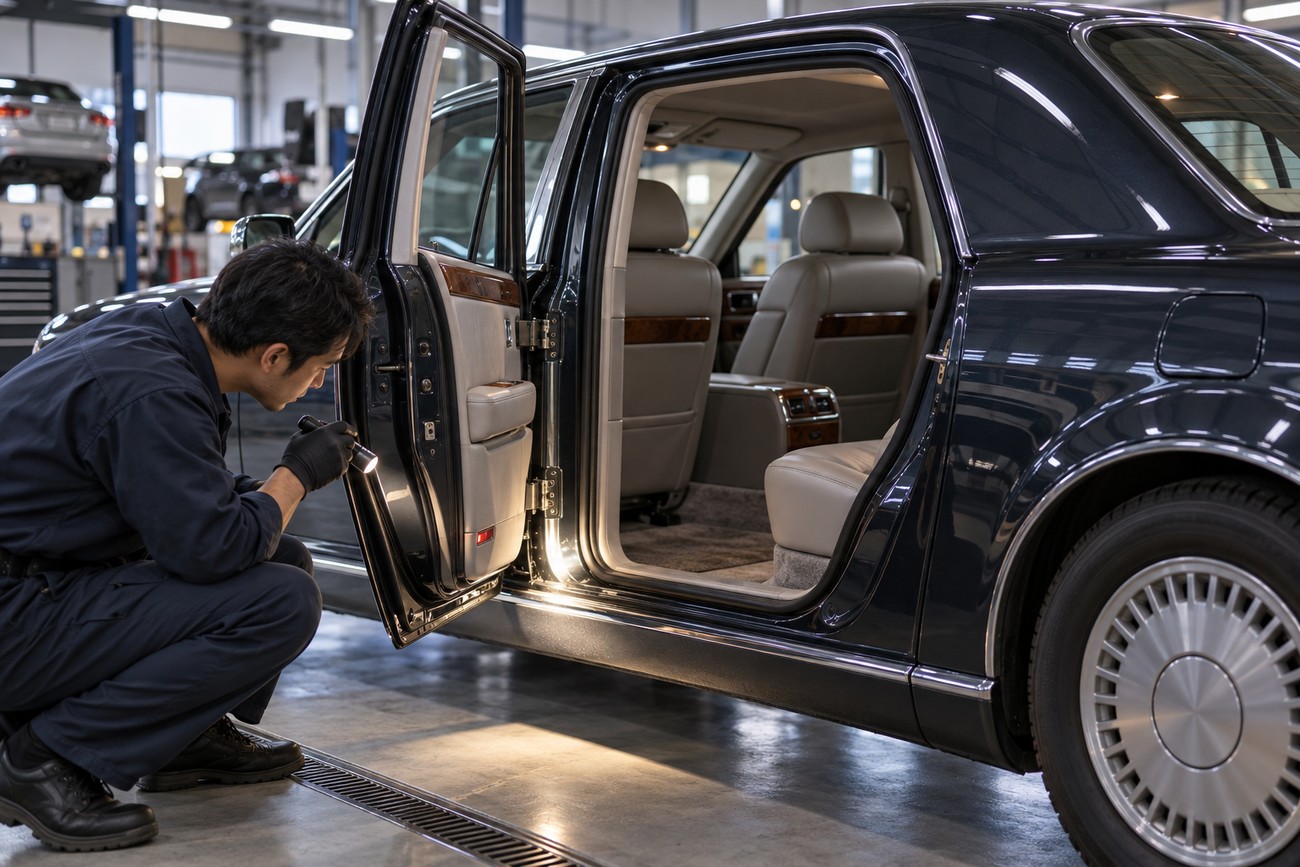
Begin with identity and history. Check that the vehicle’s documents agree with its identification markings, then compare any repair records with the areas that appear to have been repainted. A coherent history gives an inspector somewhere to start; gaps in it call for closer examination of the car itself.
Next, study the rear-door openings before admiring the exterior finish. Inspect hinge mounting areas, sills, and lower wing edges for corrosion or repair, and compare panel gaps with the doors closed. Open and shut each rear door gently to see whether it moves cleanly and latches without being lifted or forced.
Rear-door hinge mounting points and panel gaps reveal how well the body carries and locates the doors. Check them before judging paint or chrome, which can look tidy over an opening that still needs structural work.
Then examine the body as a complete assembly. Look along both sides for uneven reflections, inconsistent paint, or panels that sit differently from their neighbors. Make a record of every missing or damaged Origin-specific molding, brightwork piece, and cabin fitting. Confirm a realistic source for important items before treating cosmetic repairs as a simple bargaining point.
Finally, arrange an independent inspection that covers both the Progrès-related mechanical parts and the 2JZ-FSE’s direct-injection system. Ask the specialist to report faults and likely parts requirements separately from body concerns. A shared mechanical component may be manageable to replace; it does not make an Origin-specific door or damaged decorative panel cheap to put right.
Frequently asked questions
Buying an Origin also raises practical questions that a workshop inspection cannot settle. Insurance terms, parts channels, and recommissioning needs vary with the car’s condition and where you live. Resolve them before regular use rather than after a claim, a cosmetic repair, or a long first drive.
How should you insure and value a Toyota Origin?
Document the car’s condition with clear photographs, inspection findings, service records, and any evidence of comparable sales. Give the insurer accurate details of repairs and modifications, and ask whether an agreed-value policy is available and suitable. Valuation methods, cover, and premiums depend on the insurer and country, so obtain the terms in writing before assuming a rare Toyota will be valued as a collector car.
Where can you find replacement Origin body trim?
Identify the exact piece and its part number or other reliable identifier, then specify the condition you will accept. Contact Japanese Toyota-parts specialists and dismantlers with photographs of the required item and its mounting points. Check availability before approving a cosmetic repair that requires removal or replacement of intact trim; finding the part may determine what repair method is sensible.
What should you service before driving a long-stored Origin regularly?
Start with a recommissioning inspection rather than relying on a recent engine start. Check and replace fluids as needed, assess tire age and condition, inspect the brakes, and examine hoses, seals, and other aging rubber. Have the fuel system and 2JZ-FSE operation checked before sustained use, then address any faults found under controlled driving rather than committing immediately to a long trip.







