
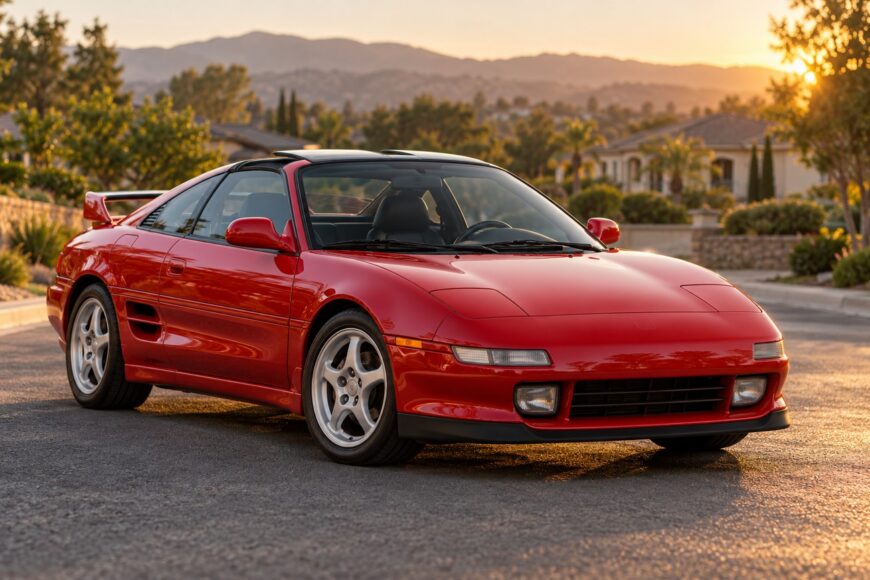
The second-generation Toyota MR2 Turbo earned its “Baby Ferrari” nickname through proportions as much as performance. The SW20 sits low, carries two seats between its axles, offers a removable targa roof, and sends power to the rear wheels from a mid-mounted engine. Its wedge profile and compact cabin recall the junior Ferrari models of the 1980s and 1990s.
The comparison becomes less convincing once the badge, speed, and ownership burden enter the discussion. The MR2 has no official Ferrari connection, and its turbocharged Toyota drivetrain delivers the pace of a quick sports car rather than the outright performance of a Ferrari 348 or 355. Its appeal lies in affordable mid-engine excitement, provided you accept the age, compromises, and maintenance demands of a serious sports car.
- Why the Toyota MR2 Turbo Became the “Baby Ferrari”
- What the SW20 Turbo Actually Is
- Performance: Fast Sports Car, Not a Ferrari Clone
- The Handling Myth: Why Snap Oversteer Still Matters
- Ownership Reality: Toyota Reliability With Sports-Car Costs
- Buying an MR2 Turbo: The Expensive Mistakes to Avoid
- Toyota MR2 Turbo by Market: U. S. Versus Japanese GT Versions
- Frequently asked questions
- What does “pre-revision” mean on an SW20 MR2?
- Why can two MR2 Turbos show different horsepower figures?
- What car is known as the baby Ferrari?
- What is the rarest MR2?
- Which car is known as poor man’s Ferrari?
Why the Toyota MR2 Turbo Became the “Baby Ferrari”
The SW20 was a two-seat, mid-engine, rear-wheel-drive coupe or targa produced roughly from 1989 to 1999. That layout immediately separates it from ordinary compact Toyotas, because the engine sits behind the cabin and ahead of the rear axle. The result is a short, low car with a concentrated mechanical package and a driving position close to the center of its wheelbase.
Its shape did much of the marketing work. The low wedge nose, rising beltline, broad rear haunches, and glassy targa roof create the visual language associated with period Italian sports cars. The car is closer in scale and concept to junior Ferrari models of the 1980s and 1990s than to a modern supercar, which explains why the nickname survived even when the performance comparison became difficult to defend.
The cabin reveals the Toyota side of the equation. Materials, controls, ergonomics, and general usability are closer to a well-equipped Japanese coupe than to the sparse, specialized environment of an older Ferrari. The MR2 also offers a level of mechanical familiarity and everyday logic that Ferrari buyers of the period did not necessarily receive, although its mid-engine layout still makes many repairs labor-intensive.
“Baby Ferrari” therefore describes the silhouette, seating position, and architecture. It does not establish shared engineering, shared development, or equivalent performance. Treating the label as a literal identity leads buyers toward the wrong expectations, especially when inspecting a modified or imported car.
What the SW20 Turbo Actually Is
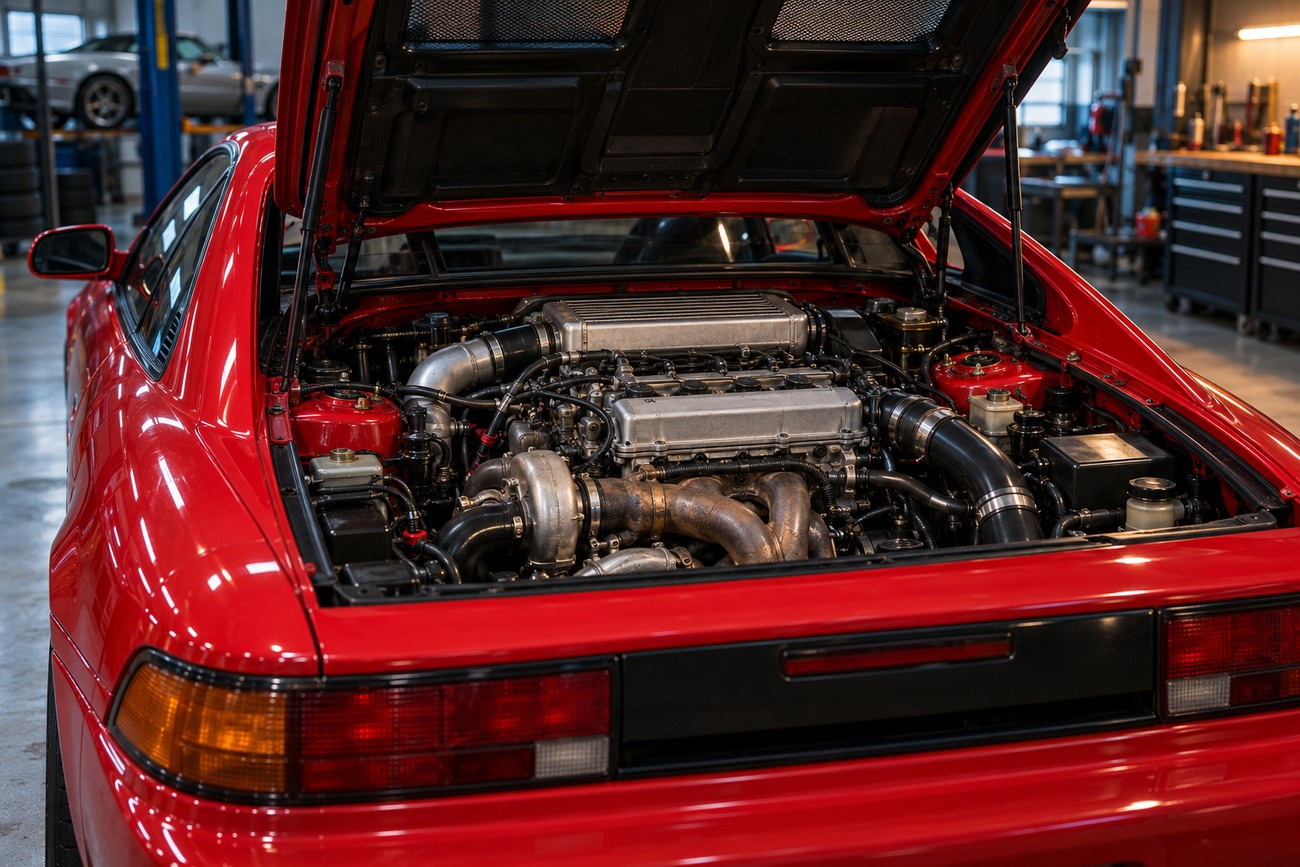
The turbo model uses Toyota’s 2.0-liter 3S-GTE inline-four: DOHC, 16 valves, electronic fuel injection, an iron block, an aluminum cylinder head, a turbocharger, and an intercooler. It is a compact, conventional four-cylinder design with strong aftermarket support and a reputation for durability when the cooling, lubrication, fuel, and ignition systems are properly maintained.
U. S.-market cars produced approximately 200 hp and 200 lb-ft. Japanese and some other-market GT versions reached up to approximately 245 hp and 304 Nm. That difference is substantial in a car weighing approximately 1250–1297 kg, and it explains why two SW20 Turbos with similar bodywork can feel noticeably different on the road.
Published specifications require caution. Some catalogs list 224 hp for the 2.0 turbo manual, while Japanese GT figures can reach approximately 245 hp. These are catalog and market discrepancies rather than a universal specification, and real dyno results can vary with fuel, test method, drivetrain condition, and engine health.
The engine’s reputation can obscure the rest of the car. A durable 3S-GTE does not make an aging turbo MR2 equivalent to a basic Corolla in service requirements. Heat management, hoses, wiring, turbo condition, fuel quality, and evidence of detonation deserve the same attention as the engine’s underlying design.
Performance: Fast Sports Car, Not a Ferrari Clone
A healthy U. S.-market MR2 Turbo can reach 60 mph in approximately 5.9–6.0 seconds, with quarter-mile performance around 14.3–14.7 seconds. Top speed is approximately 144–150 mph, or about 232–241 km/h. Those figures remain serious on a public road, especially in a compact car with a low seating position and strong turbo response.
The car feels quick because its mass is modest and the engine drives the rear wheels from a mid-engine layout. Acceleration benefits from traction, while the short body makes speed feel more immediate than it does in a larger grand tourer. Claimed factory figures of approximately 0–100 km/h in five seconds do not consistently match factory and independent results of about 6.5–7 seconds, particularly when the car is old or poorly maintained.
Ferrari 348 and 355 models are generally faster in top speed and track performance. The MR2 can offer a sharper sense of compactness and a lower ownership cost, yet it does not acquire Ferrari-level speed simply because its engine sits in a similar place. On a circuit, chassis preparation, tires, cooling, and driver skill can narrow the gap, but that is a modified comparison rather than a showroom one.
Age changes the numbers. A tired turbocharger, weak fuel system, slipping clutch, clogged cooling system, poor alignment, or old tires can make an apparently healthy listing much slower than the period test data. Buyers should treat published acceleration as a reference for a correctly maintained car, not as a promise attached to every surviving SW20.
The Handling Myth: Why Snap Oversteer Still Matters
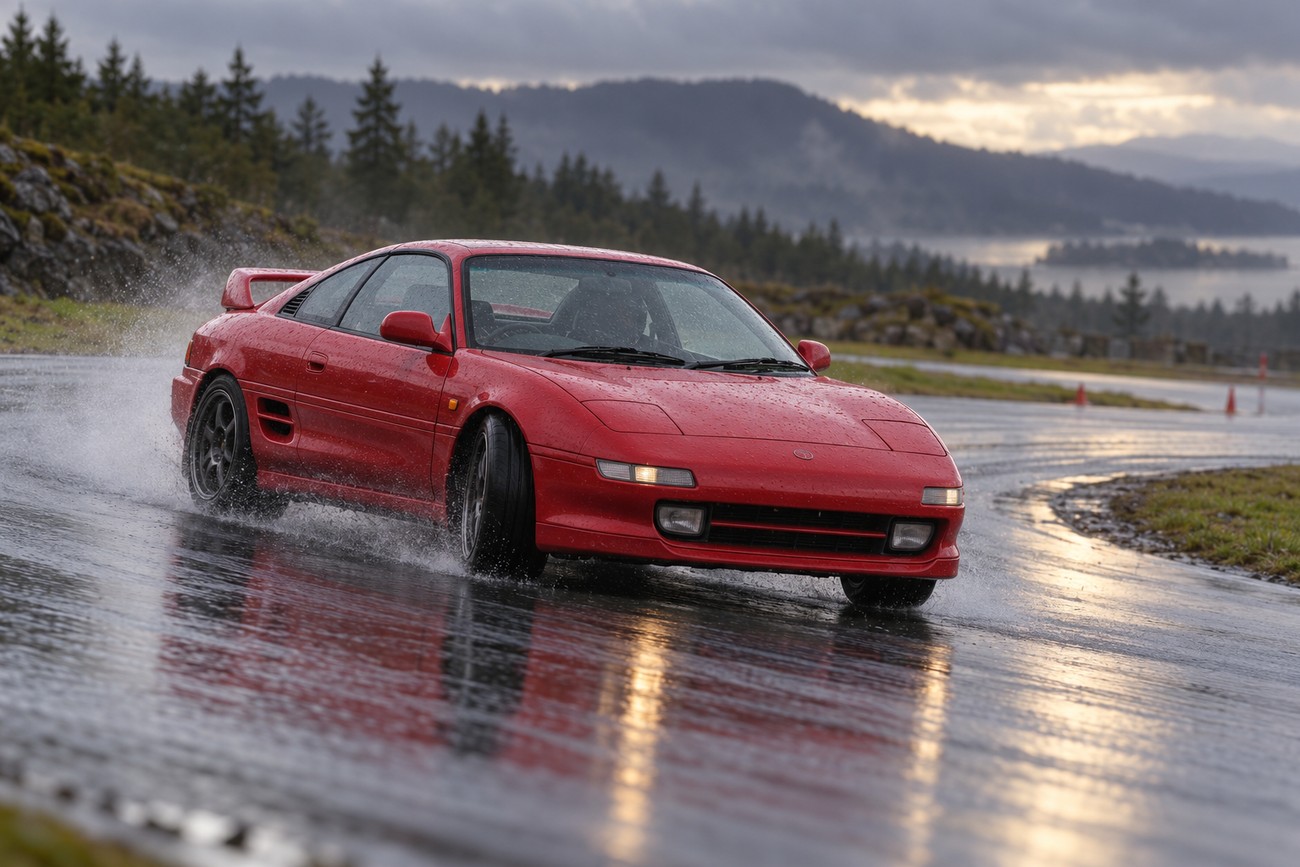
Snap oversteer occurs when the rear tires lose grip quickly after an abrupt throttle lift or an aggressive steering input. In a mid-engine car, the mass distribution can make the transition from cornering balance to rear-axle slip happen with little warning. A driver who lifts suddenly in a fast bend can remove drive force from the rear tires while also transferring load forward, reducing the rear axle’s available grip.
The risk increases on wet roads, old-specification road tires, and cars with poor alignment or damaged suspension geometry. Early pre-revision SW20 cars have a sharper handling reputation, while later revisions changed suspension geometry and settings to reduce the tendency. Those changes matter when comparing an early import with a later-market car, although they do not remove the underlying physics of the layout.
Ride height, alignment, rear toe, and evidence of crash repair deserve inspection before springs, power, or anti-roll bars are changed. A poor baseline can make an MR2 feel dangerous regardless of the parts list.
Quality modern sport tires or semi-slicks can substantially improve grip and confidence. They do not eliminate the underlying weight-transfer behavior, and extra grip can make a badly bent or incorrectly set-up chassis reach a more serious failure point at higher speed.
The practical lesson is straightforward: learn the car progressively and verify its geometry before exploring its limits. A nervous SW20 may have a reputation problem, but it may also have worn bushings, incorrect ride height, uneven rear toe, or a poorly repaired shell. Replacing parts at random can hide the cause while adding cost.
Ownership Reality: Toyota Reliability With Sports-Car Costs
The 3S-GTE can be durable with correct service, but turbo heat, poor fuel, detonation, and cheap tuning can cause serious failures. The engine’s strong reputation encourages some owners to tolerate boost increases, questionable chips, neglected oil changes, or improvised cooling solutions. That confidence becomes expensive when a piston, turbocharger, head gasket, or transmission finally shows the cost of earlier neglect.
The mid-engine layout makes routine access and repairs more labor-intensive than on an ordinary front-engine coupe. A task that looks simple from above may involve removing surrounding components, working through limited access, or allowing additional time for hoses and connections. This affects labor bills even when the replacement part itself remains affordable.
Cooling deserves particular attention. The long coolant path between the engine and front radiator is sensitive to neglected radiators, blocked passages, poor bleeding, and damaged plumbing. Overheating risk rises in hot climates or during sustained hard use, so a temperature gauge that appears normal during a short test drive proves little about the system’s reserve.
Noise, vibration, firm suspension, and limited luggage space make the MR2 a compromised daily driver. Insurance and taxes can also exceed expectations because the turbo engine and sports-car classification matter more to insurers and authorities than the Toyota badge. Living examples are becoming more expensive, while original body panels, targa components, glass, and trim are increasingly difficult to source.
A well-maintained car can still be rewarding, but its budget belongs closer to an aging sports car than to an ordinary compact Toyota. Routine preventive work, quality tires, proper brakes, and careful cooling-system maintenance are part of the ownership proposition rather than optional upgrades.
Buying an MR2 Turbo: The Expensive Mistakes to Avoid
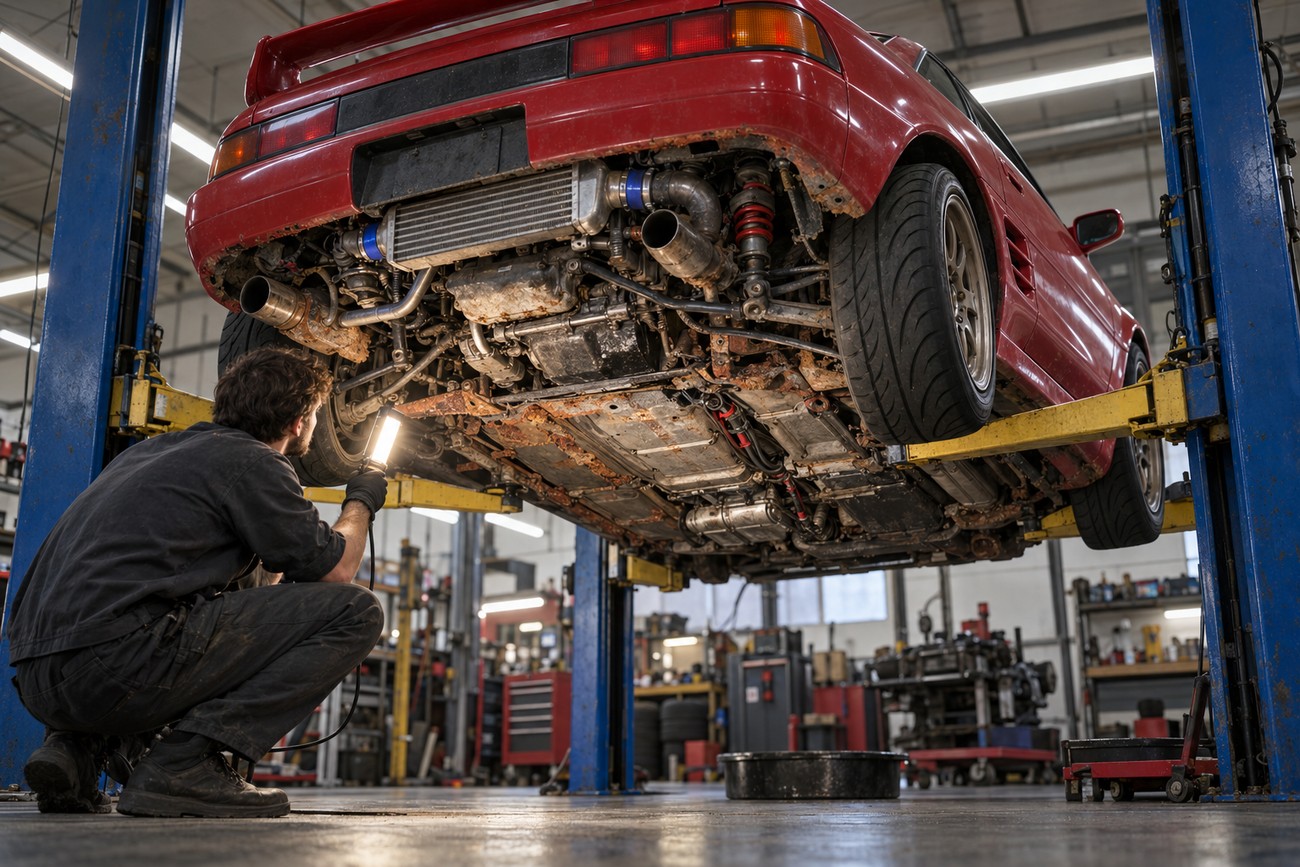
Start with the shell and suspension geometry. Corrosion in the floor, structural members, or mounting areas can make further tuning economically pointless, even when the exterior looks straight in photographs. A clean paint finish may conceal previous crash repair, filler, or corrosion around the underside and chassis seams.
Modified examples require documentation, inspection, and restraint. Undocumented chips, boost increases, low-quality turbo parts, and altered wiring can turn a desirable car into a restoration project. Returning a badly modified car to stock can cost more than expected because the original parts may be missing and the wiring may no longer match factory layouts.
Examine the tires, brakes, dampers, springs, bushings, ride height, and alignment as a single system. Cheap tires or tired brake components are especially poor choices on a mid-engine car, where the driver may approach corners quickly and encounter sharp weight-transfer effects. Uneven tire wear can also point to bent suspension components or incorrect rear toe rather than simple neglect.
The cooling system and turbocharger need evidence-based checks. Look for overheating symptoms, unstable temperatures, oil contamination, detonation damage, poor boost control, smoke, and improvised hoses or intercooler plumbing. A compression test, leak-down test where appropriate, cooling-system pressure test, and inspection of the engine management system can reveal problems that a short drive misses.
A pre-purchase inspection should prioritize chassis condition, suspension geometry, cooling, turbo health, wiring, and evidence of overheating or detonation. It should also confirm market specification and the provenance of imported cars. Spending on inspection is cheaper than discovering after purchase that the “cheap” MR2 needs structural repair, a wiring overhaul, and a return to a safe baseline.
Toyota MR2 Turbo by Market: U. S. Versus Japanese GT Versions
Market specification matters more than a badge or an online horsepower claim. The following figures show the broad distinction while keeping disputed catalog data separate from confirmed market ranges.
| Specification | U. S.-market turbo | Japanese and some other-market GT versions | Practical implication |
|---|---|---|---|
| Engine | 2.0-liter 3S-GTE turbocharged and intercooled inline-four | 2.0-liter 3S-GTE turbocharged and intercooled inline-four | The basic engine family is shared, but calibration, equipment, and condition vary by market. |
| Published output | Approximately 200 hp | Up to approximately 245 hp | Higher-output cars can feel substantially quicker and place greater demands on fuel and maintenance. |
| Published torque | Approximately 200 lb-ft | Up to approximately 304 Nm | Torque delivery and traction make condition and tire quality important. |
| Disputed catalog figure | Some catalogs list 224 hp for the 2.0 turbo manual | Catalog and source figures may differ from Japanese GT claims | Check the exact market, year, engine code, and measurement method before comparing listings. |
| Ownership expectation | Often easier to document in its original market | Import history, fuel requirements, and parts compatibility require closer verification | More power does not compensate for poor maintenance or incomplete records. |
Japanese and other-market GT versions can offer stronger performance, but their higher output can be more demanding of fuel quality and service. Imported cars need verification of their actual engine, calibration, cooling system, and modification history rather than reliance on the seller’s headline figure.
Frequently asked questions
What does “pre-revision” mean on an SW20 MR2?
“Pre-revision” refers to earlier SW20 cars built before Toyota revised suspension geometry and settings to reduce the car’s sharper oversteer tendency. These cars are not automatically unsafe, but their setup deserves more careful evaluation, especially if the suspension has been altered or the car has a history of poor repairs.
For a buyer, the term is a setup and inspection consideration rather than a simple reason to reject the car. Verify the model year, chassis condition, rear toe, ride height, alignment, tire specification, and suspension parts. A later car with damaged geometry can be more troublesome than a correctly maintained early example.
Why can two MR2 Turbos show different horsepower figures?
Power figures vary because the SW20 was sold in different markets with different specifications, and catalogs do not always use the same rating method. U. S.-market cars are approximately 200 hp and 200 lb-ft, while Japanese and some other-market GT versions reached up to approximately 245 hp and 304 Nm. Some catalogs list 224 hp for the 2.0 turbo manual, which should be treated as a disputed catalog figure rather than a universal specification.
Dyno results add another variable. Fuel, ambient conditions, drivetrain losses, engine health, turbo condition, and measurement method can all change the number shown on the sheet. An imported car should therefore be identified by its market, engine, ECU, and service history before its advertised output is accepted.
What car is known as the baby Ferrari?
The second-generation Toyota MR2 Turbo, chassis SW20, is commonly called the “Baby Ferrari.” The nickname comes from its low wedge profile, two-seat cabin, targa roof, and mid-engine rear-wheel-drive layout.
It is an informal comparison, not a Ferrari identity. The separate Ferrari Mythos was a Ferrari concept car with no engineering relationship to the SW20.
What is the rarest MR2?
There is no single universally accepted answer because rarity depends on the market, production year, body style, engine, and surviving condition. Limited-market turbo, GT, targa, and late-production specifications can be much harder to find in some countries than in others.
For buyers, documented specification and structural condition matter more than a vague rarity claim. A scarce car with corrosion, missing trim, or undocumented modifications can be a poorer purchase than a more common, correctly maintained example.
Which car is known as poor man’s Ferrari?
The Toyota MR2 is one of the cars commonly described as a “poor man’s Ferrari,” particularly the SW20 Turbo because its mid-engine layout and proportions resemble older Ferrari sports cars. The phrase describes an accessible visual and mechanical idea, not equal performance, finish, or ownership experience.
The MR2’s strongest case is its compact size, Toyota drivetrain, and comparatively approachable purchase and running costs. Those advantages remain meaningful only when the buyer budgets for the demands of an aging turbocharged sports car.







