
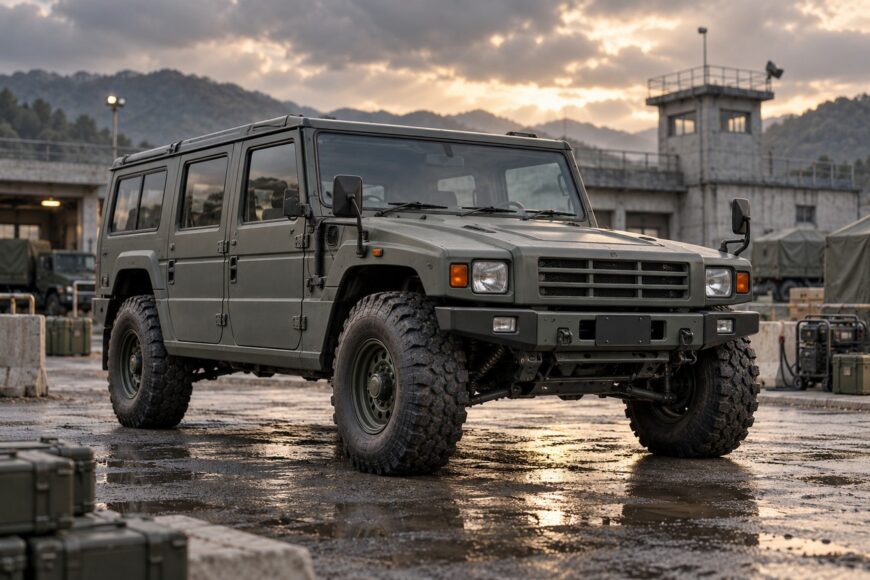
The Toyota Mega Cruiser combines military-grade hardware with a claimed 420 mm minimum ground clearance, yet its modest power, extreme width, and scarce parts can make ownership difficult. Its 4.1-liter diesel produces an official 150 hp, while the body stretches approximately 2.17 m across. That is serious off-road equipment, followed by awkward realities on ordinary roads.
It was never an invisible Hummer clone. Toyota sold a small civilian version in Japan, while most examples served Japan’s Self-Defense Forces, police, and rescue services. The useful question is whether its portal axles, locking differentials, and four-wheel steering justify the cost, complexity, and compromises of finding and maintaining one today.
- What the Toyota Mega Cruiser Actually Was
- Toyota Mega Cruiser Specifications That Matter in Real Use
- Why Its Off-Road Hardware Is More Than a Hummer Comparison
- Military BXD10 vs. Civilian BXD20: The Version Changes Everything
- The Ownership Reality: Width, Power, Comfort, and Parts
- Buying and Importing One: Checks Before the Badge Wins You Over
- Frequently asked questions
- How much does a Toyota Mega Cruiser cost?
- Was the Toyota Mega Cruiser discontinued?
- How many civilian Toyota Mega Cruisers were made?
What the Toyota Mega Cruiser Actually Was
Toyota produced the Mega Cruiser approximately from 1995 to 2002 as a high-mobility vehicle for demanding service work. Its main users included Japan’s Self-Defense Forces, police, and rescue organizations. The design sat between military equipment and a civilian SUV, sharing the former’s chassis priorities while offering a road-registered configuration for private buyers.
The BXD10 was the military and service model, also described as the High Mobility Vehicle. Depending on its assignment, it could carry personnel, tow a mortar, support radar equipment, or serve as a platform for a missile system. These roles mean that two BXD10s can have very different wiring, mounts, interior condition, and mechanical histories.
The civilian BXD20 was offered with low- or high-roof configurations. It brought the same unusual mechanical layout to Japanese civilian roads, although the civilian population remained small compared with the military and service fleet. The often-repeated estimate of about 3,000 military vehicles and 133 civilian vehicles should be treated cautiously because no primary Toyota production register has been identified.
That history explains the Mega Cruiser’s reputation. It is rare enough to attract collectors, technically serious enough to interest off-road specialists, and impractical enough to punish casual buyers. Calling it Japan’s Hummer H1 captures the visual concept while overlooking Toyota’s separate engineering choices and the much smaller civilian market.
Toyota Mega Cruiser Specifications That Matter in Real Use
The figures below are most useful when read as a description of operating compromises rather than as a list of headline numbers.
| Item | Toyota Mega Cruiser specification |
|---|---|
| Engine | 4.1-liter turbocharged four-cylinder diesel, 15B-FT or 15B-FTE |
| Official output | 150 hp and 39.0 kgf·m at 1,800 rpm |
| Disputed secondary output | Some civilian specifications and listings quote 153 hp and 382 Nm; this is not a universal Mega Cruiser figure |
| Drive system | Permanent four-wheel drive, two-speed transfer case, center differential lock, and front and rear differential locks |
| Claimed minimum ground clearance | 420 mm |
| Wheelbase | 3,395 mm |
| Rear steering | Rear wheels steer up to 12 degrees |
| Claimed turning radius | 5.6 m |
| Overall width | Approximately 2.17 m |
The four-cylinder diesel is tuned for low-rpm pulling power, with peak torque officially listed at 1,800 rpm. That suits crawling, towing, and slow work better than rapid acceleration or sustained high-speed travel. Some civilian listings quote 153 hp and 382 Nm, but those figures are version- or source-dependent; Toyota’s stated 150 hp and 39.0 kgf·m remain the safer reference.
The 3,395 mm wheelbase and broad body give the Mega Cruiser a large footprint, while rear steering changes how it uses that footprint. The rear wheels can steer up to 12 degrees, helping produce the claimed 5.6 m turning radius. This maneuverability comes from four-wheel steering rather than a short wheelbase, so it depends on a complex system that must work correctly.
A claimed 420 mm minimum clearance is valuable in deep ruts and over steps, though it does not place every underbody component at that height under every load. The measurement also says little about side-slope stability, body width, or the risk of contacting a protruding axle, suspension, or chassis component.
Why Its Off-Road Hardware Is More Than a Hummer Comparison
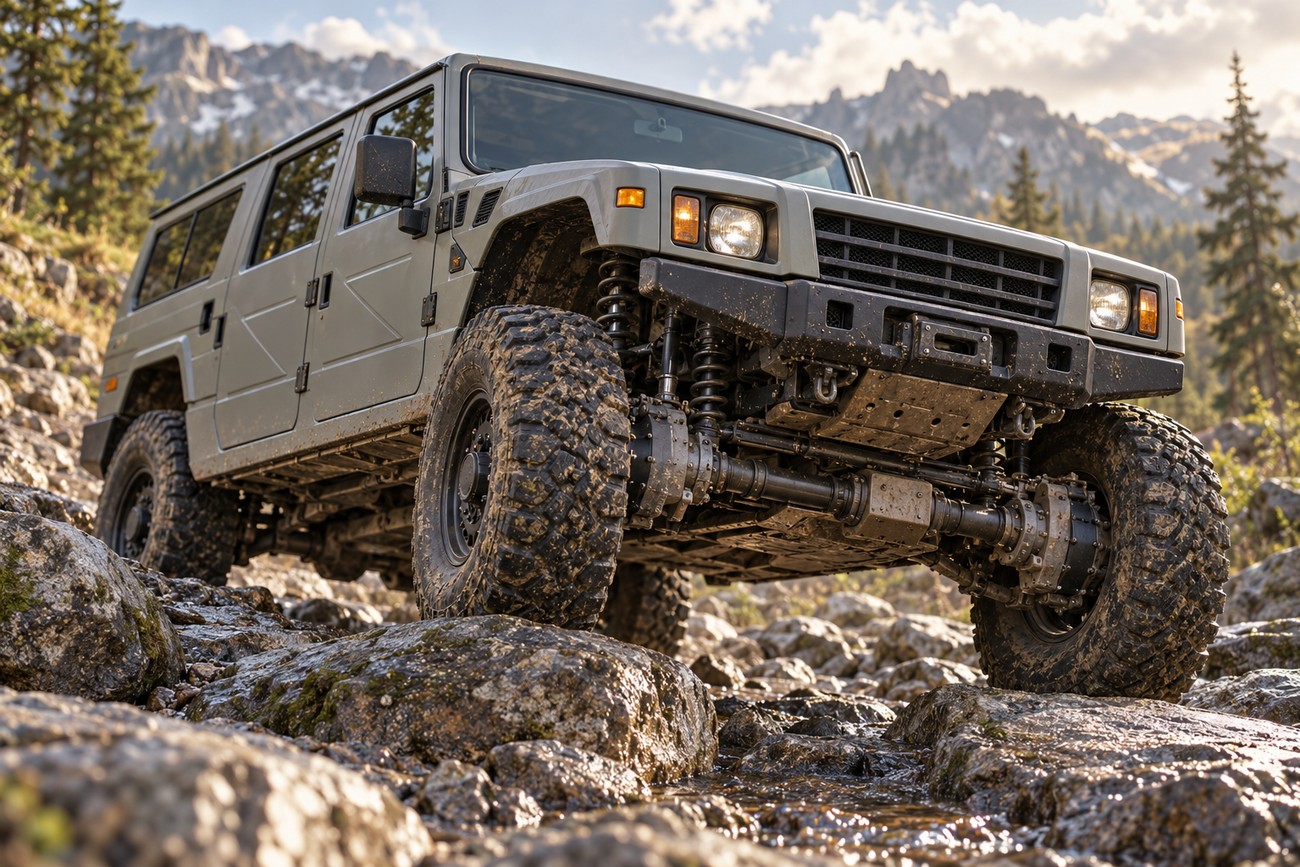
Portal axles raise the axle and chassis above the wheel centerline by using reduction gears at the wheel ends. This arrangement creates substantial ground clearance while allowing the main axle tubes to sit higher. The price is greater unstrung mass, more rotating components, and specialist service work when a portal reducer develops wear or damage.
The permanent four-wheel-drive system adds a two-speed transfer case, a center differential lock, and front and rear differential locks. Together, these systems can keep torque moving when wheels lose traction. They also give the vehicle more failure points and make fluid condition, adjustment, and correct engagement important during inspection.
The HMMWV and civilian Hummer H1 provide a useful comparison because they share the broad idea of a wide, military-derived vehicle with portal-style clearance and serious off-road geometry. The Mega Cruiser remains its own design, using a 4.1-liter four-cylinder diesel and distinctive four-wheel steering. Its low-speed ability should not be confused with high power or fast road performance.
Four-wheel steering is an especially important distinction. It improves maneuverability in tight spaces, yet a fault in the rear-steering system can materially change the vehicle’s handling. A functional front axle or clean-looking body cannot prove that the rear steering, locks, and portal hubs are healthy.
Military BXD10 vs. Civilian BXD20: The Version Changes Everything
The BXD10 and BXD20 share the Mega Cruiser name, but their intended lives were different. BXD10 vehicles were built around service roles, including personnel transport, mortar towing, radar carrying, and missile-system support. Their equipment history can be more important than their odometer reading.
Military mounts, auxiliary wiring, removed equipment, and improvised repairs deserve close inspection. Corrosion or fatigue around attachment points may remain after the original equipment has gone. Wiring that appears redundant can affect lighting, controls, charging, or registration work after import.
The BXD20 was the civilian model and came with low- or high-roof bodies. It is usually the easier starting point for private ownership, although rarity does not make every civilian example well preserved. A high-roof body may improve usable interior volume, while a low-roof vehicle can have a different equipment and parts history.
Parts identification must begin with the model code, engine designation, and exact component version. Ordering a part under the general name “Mega Cruiser” can lead to the wrong steering, brake, electrical, or drivetrain item. The military majority also means that many online photographs and claims describe BXD10 equipment rather than the civilian BXD20 being considered.
The Ownership Reality: Width, Power, Comfort, and Parts
At approximately 2.17 m wide, the Mega Cruiser is difficult in places designed for ordinary SUVs. Narrow Japanese roads, parking structures, automatic washes, loading ramps, and transport trailers can all become practical obstacles. The turning radius helps in tight corners, but it cannot reduce the vehicle’s physical width.
Approximately 150 hp feels modest for a vehicle of this mass and size. Acceleration is slow, and maintaining a fast highway pace may require planning, especially with passengers, equipment, or gradients. The engine’s low-speed torque supports controlled off-road movement; it does not turn the Mega Cruiser into a quick road vehicle.
The cabin also reflects its service origins. Sound insulation, seating comfort, controls, and trim quality were secondary to durability and function. A large body creates expectations of generous carrying ability, yet reported payload estimates are approximately 600–750 kg, so visual size should not be mistaken for unlimited cargo capacity.
Body panels, glass, interior pieces, specialist brakes, steering components, and portal-axle parts may require Japanese dismantlers or individual sourcing. Four-wheel steering, differential locks, and hub reduction units also need a technician familiar with this vehicle. A general workshop may be capable of routine diesel maintenance while lacking the tools or experience for its unique systems.
The Mega Cruiser is therefore a poor substitute for a common Land Cruiser if predictable ownership matters most. Its appeal lies in the engineering and rarity. Buyers should budget for storage, transport, specialist inspection, and parts delays before treating the purchase price as the main cost.
Buying and Importing One: Checks Before the Badge Wins You Over
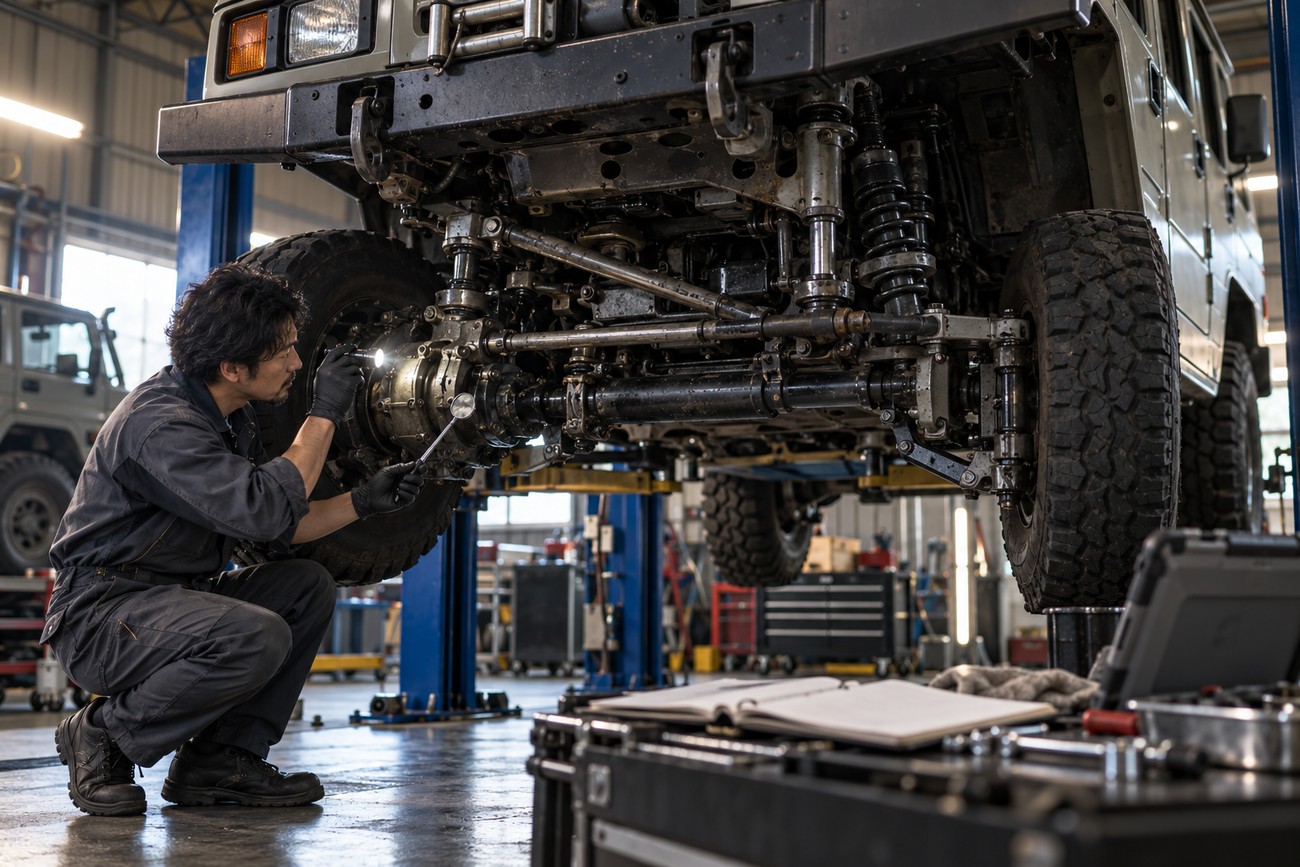
Start by confirming whether the vehicle is a BXD10 or BXD20, then record the exact engine and component specifications. Check the identity documents, equipment history, chassis condition, and any modifications made after service use. A low odometer reading carries limited value if the vehicle spent years working slowly under heavy loads.
Test the four-wheel steering through its full operating range and check for warning signs, uneven response, or abnormal play. Inspect the portal hubs for leaks, noise, heat damage, and evidence of neglected lubrication. Engage the center, front, and rear differential locks according to the correct procedure, confirming actual operation rather than relying on dashboard indicators.
Inspect military wiring, equipment mounts, floor repairs, suspension attachment points, and areas where heavy hardware was installed. Examine body panels and glass for future availability before buying. A small crack or missing trim item can become a long sourcing exercise when the part has no ordinary aftermarket equivalent.
Import approval depends on the destination country’s rules for lighting, width, vehicle category, emissions, and registration. There is no universal legal solution for every market. Confirm the requirements before shipping, because correcting the vehicle after arrival can cost more than the original transport decision.
Finally, treat the 420 mm clearance as a specification to verify, not a guarantee of immunity from damage. A specialist inspection should cover the chassis, brakes, steering, portal reducers, differentials, and load-related fatigue. The right Mega Cruiser can be a remarkable machine; the wrong one can become an immobilized engineering project.
Frequently asked questions
How much does a Toyota Mega Cruiser cost?
There is no reliable universal global price for a Toyota Mega Cruiser. Age alone does not establish value because civilian and military specifications, restoration quality, export costs, documentation, and parts risk can move asking prices sharply.
A preserved BXD20, a rebuilt service vehicle, and an incomplete BXD10 may look similar in photographs while representing very different financial commitments. Buyers should value inspection results and future parts access alongside the vehicle’s condition and location.
Was the Toyota Mega Cruiser discontinued?
Yes. Toyota produced the Mega Cruiser approximately from 1995 to 2002, so it is no longer a current-production model. A buyer today is choosing among used, preserved, restored, or rebuilt vehicles.
The end of production also explains the importance of specialist sourcing. Mechanical condition, body completeness, and documentation matter more than the age shown in an advertisement.
How many civilian Toyota Mega Cruisers were made?
The frequently repeated figure is 133 civilian vehicles, but available material does not provide a primary Toyota production register confirming that total. It should therefore be treated as an estimate rather than a verified factory number.
The reliable conclusion is that civilian BXD20 production was small compared with the military and service fleet. That rarity helps explain unusual prices and the difficulty of finding body, glass, interior, and drivetrain parts.







