
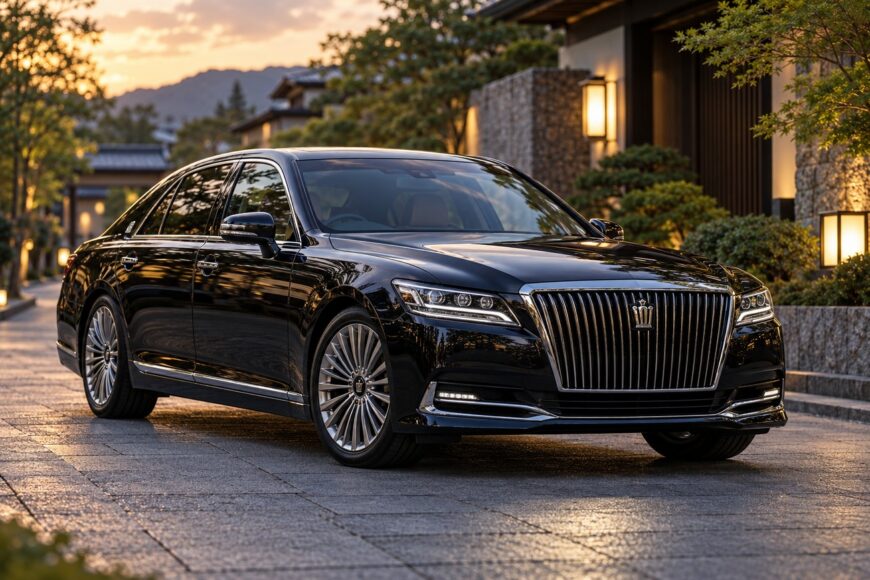
The Toyota Crown Majesta is an unusually sophisticated Japanese luxury sedan whose low purchase price can conceal expensive decisions about suspension, electronics, parts, and fuel. It was engineered to deliver the quiet ride, equipment, and rear-seat comfort expected from a flagship, and that equipment remains compelling when the car has been maintained correctly.
Age changes the calculation. Air suspension, electronic cabin functions, cameras, powered closures, complex engines, and Japan-specific control systems can turn a cheap-looking car into a substantial recommissioning project. The Majesta badge alone tells you too little: the exact chassis code, engine, transmission, drivetrain, factory equipment, and present condition matter far more.
- What Makes the Toyota Crown Majesta Different
- Engines, Drivetrains, and the Versions Buyers Confuse
- Luxury, Air Suspension, and the Cost of Ageing Technology
- How to Inspect a Used Toyota Crown Majesta
- Fuel Economy, Maintenance, and Parts Reality
- Majesta Myths That Can Lead to a Bad Purchase
- Frequently asked questions
- What is the price of a Toyota Crown Majesta?
What Makes the Toyota Crown Majesta Different
The Majesta occupies a higher-specification position within the Crown family, with a strong emphasis on quietness, ride quality, cabin isolation, and passenger comfort. It was designed as a luxury sedan rather than a simple executive car with a larger engine. Depending on generation and trim, buyers may find advanced seat functions, extensive electronic equipment, rear-passenger conveniences, cameras, powered closures, and air suspension.
That description covers several different cars. The Majesta name spans multiple generations and powertrains, so a listing that says only “Crown Majesta” is incomplete. A third-generation example measured 4,900 mm in length, 1,795 mm in width, and used a 2,800 mm wheelbase. Those dimensions create useful cabin space, especially for rear passengers, while making narrow parking spaces, body repairs, and parts sourcing less forgiving.
The appeal is strongest when the supporting systems are healthy. A quiet cabin depends on more than the engine: air-suspension condition, suspension bushings, correct tires, wheel alignment, and sound insulation all shape the way the car feels. A powerful Majesta with worn bushings and inappropriate tires can ride noisily and harshly, losing much of the quality that justified its complexity.
Right-hand drive also narrows the practical audience. Visibility at intersections, toll-road procedures, parking, and access to suitable service can require adjustment in left-hand-drive markets. Some Japanese-market body, interior, and electronic parts are difficult to source, and a general repair shop may lack the equipment or knowledge to diagnose Japanese control units or an air-suspension system correctly.
Engines, Drivetrains, and the Versions Buyers Confuse
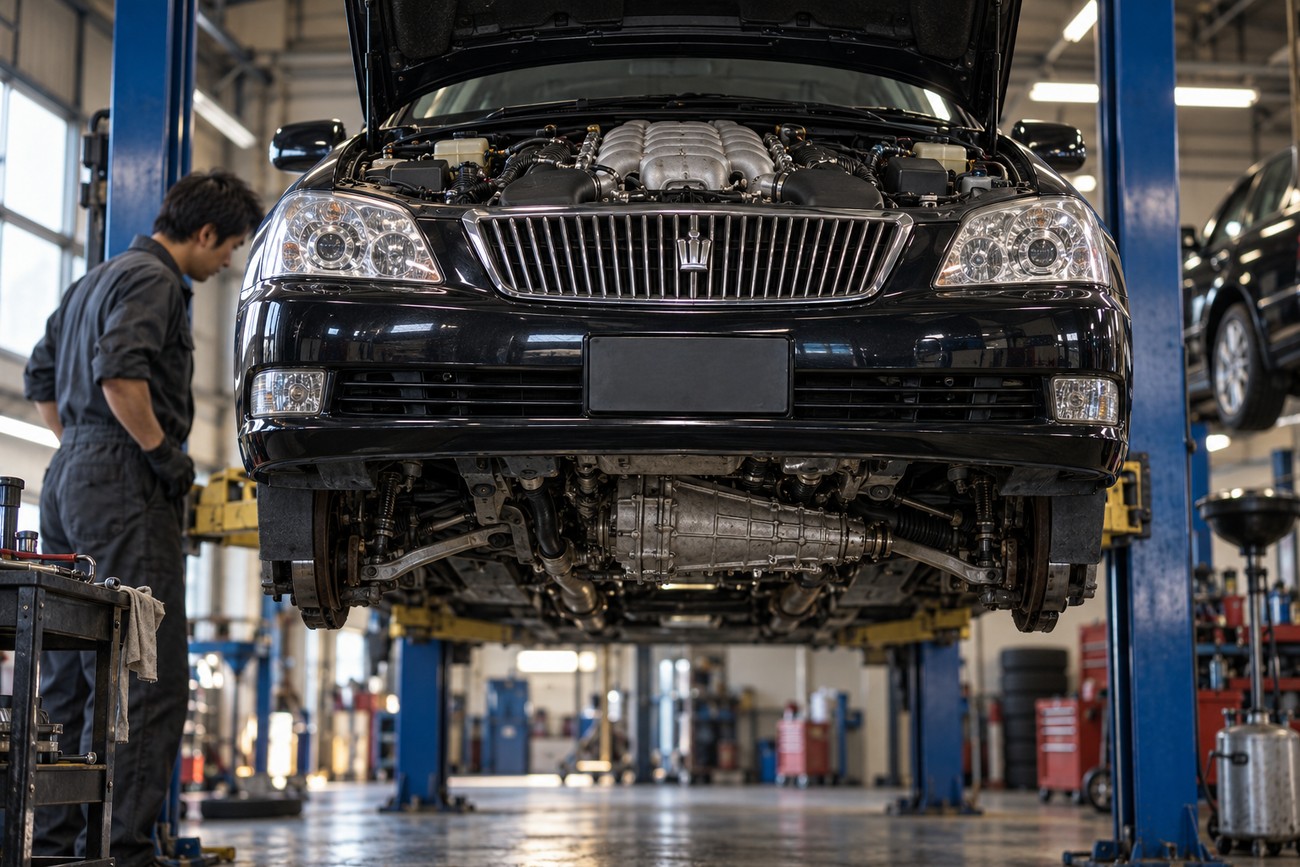
Toyota used several distinct powertrain lines in the Majesta: the 3.0-liter 2JZ-FSE, 4.0-liter 1UZ-FE, 4.3-liter 3UZ-FE, 4.6-liter 1UR-FSE, and a 3.5-liter V6 hybrid. This range matters because engine character, fuel requirements, transmission behavior, parts compatibility, and diagnostic procedures change with the specification. Descriptions such as “V8 Majesta” still leave too much unsaid.
The UZS186 is a useful reference point. Toyota’s Japanese specification lists a 4,292 cc 3UZ-FE producing 280 hp and 430 Nm, with rear-wheel drive and a six-speed automatic transmission. It offers the smooth, quiet delivery associated with the model, but age, cooling-system condition, seals, sensors, accessories, and fuel-injection service still deserve attention even when the engine starts cleanly and idles well.
The rear-wheel-drive URS206 is a different proposition. It uses the 4.6-liter 1UR-FSE, produces 347 hp, and is paired with an eight-speed automatic. That combination provides a newer powertrain layout and stronger performance, yet it also makes the exact engine and transmission identification essential when ordering parts or comparing maintenance requirements with an older UZS-series car.
The UZS207 i-Four is frequently confused with the URS206 because both are later, high-specification Majestas. The UZS207 uses the 4.3-liter 3UZ-FE, all-wheel drive, and a six-speed automatic. Toyota documentation lists a mass of 1,810 kg, a 71-liter tank, premium gasoline, and air-suspension elements for this version. It is therefore not simply an all-wheel-drive URS206 with a different badge.
Earlier cars broaden the choice further. The 2JZ-FSE version was rated at 220 hp, while the 1UZ-FE version was rated at 280 hp. The 2013 hybrid used a 3.5-liter Atkinson-cycle V6 with D-4S injection. For every version, confirm the chassis code and factory data before assuming that an engine, gearbox, suspension component, wheel, or electronic module will interchange.
Luxury, Air Suspension, and the Cost of Ageing Technology
A healthy Majesta feels special because several systems work together. The engine supplies smooth thrust, the cabin filters out road noise, and the suspension controls the body without the abruptness associated with a neglected heavy sedan. Rear-seat accommodation is a major part of the design, especially on long-wheelbase configurations, where passengers benefit from the car’s substantial footprint.
Air suspension creates much of that composure while adding a complete network of age-sensitive parts. The system comprises compressors, air lines, sensors, valves, and air-spring elements. A fault in one area can make another component work harder, so a compressor that runs longer than normal may be an early warning rather than an isolated inconvenience.
A short inspection can miss a slow air leak. Leave the car parked long enough to expose a change in ride height, then scan the Japanese control modules before approving the engine or cosmetic condition.
A car may sit level during a brief viewing and still sag after an overnight stop. The buyer should compare ride height at all corners, listen to compressor operation, inspect the lines and air-spring areas, and check whether the system responds consistently to its height settings. A prolonged compressor cycle deserves investigation before the car is treated as mechanically sound.
Cabin technology creates a second aging risk. Electrical faults may affect multimedia functions, cameras, powered closures, seat equipment, or other interior actuators, and there is no universal evidence showing that one symptom occurs at a fixed rate across all generations. Large dimensions improve rear accommodation, but they also raise the cost and difficulty of parking and body repairs. A damaged bumper, mirror, camera, or trim panel may be harder to replace than the purchase advertisement suggests.
How to Inspect a Used Toyota Crown Majesta
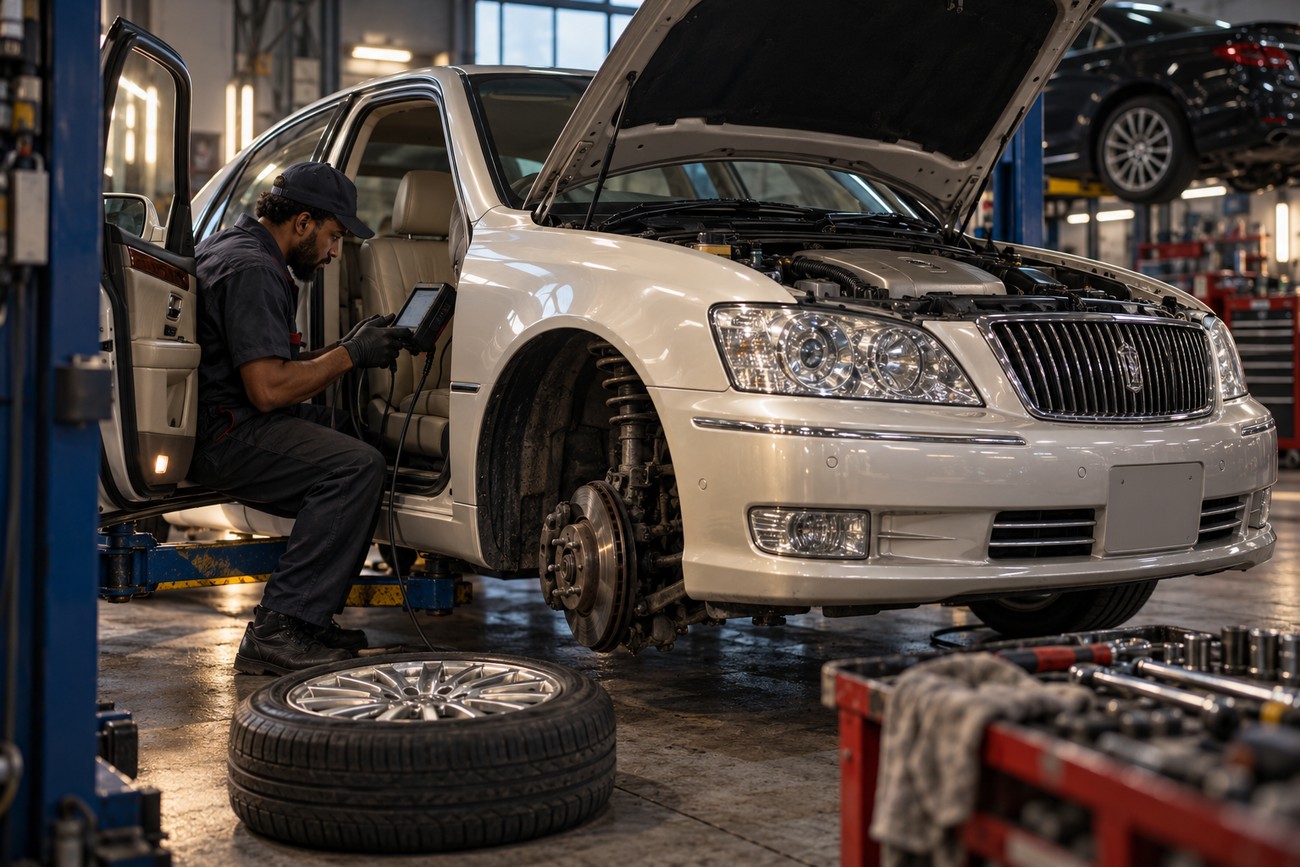
Begin with identity, not enthusiasm. Verify whether the car is a URS206, UZS207, UZS186, or another exact chassis, then confirm the engine, transmission, drivetrain, factory suspension, wheel size, tire specification, and equipment level. Auction information, registration records, under-hood labels, and vehicle identification data should agree. A generic listing can easily combine specifications from different Majesta versions.
Next, arrange a proper diagnostic inspection. The workshop should be familiar with JDM vehicles and able to communicate with the relevant Japanese control units, including the air-suspension system where fitted. Scan for stored and current faults, inspect live data where available, and check whether warning lights have merely been cleared. A clean dashboard is useful evidence only when it is supported by a scan and a coherent service history.
Inspect the car cold and allow time for a road test. Look for difficult starting, abnormal smoke, unstable idle, cooling-system concerns, transmission hesitation, unusual driveline noise, and warning messages. A formally healthy V8 can still carry deferred costs in cooling components, seals, sensors, accessories, and fuel-injection service. The absence of an obvious fault does not establish that those systems have been recently maintained.
Air suspension deserves its own sequence. Measure or compare the ride height before starting the car, observe the system’s response, listen for excessive compressor operation, and inspect the suspension after the test drive. Ideally, leave the vehicle parked overnight and check it again in the morning. A slow leak may remain invisible during a short appointment but become clear after prolonged parking.
Finally, inspect the body, underside, interior functions, cameras, powered closures, tires, wheels, bushings, and signs of previous repairs. Check that replacement wheels and tires match the factory requirements for the exact configuration. The supplied evidence does not establish universal failure intervals or repair prices, so a buyer should treat condition-based inspection and a realistic contingency budget as more reliable than broad claims about “typical” costs.
Fuel Economy, Maintenance, and Parts Reality
The purchase price is only one part of the ownership calculation. A V8 Majesta brings fuel consumption that can be high in city driving and on short trips, while premium fuel may be specified for a particular engine. Toyota’s UZS207 documentation specifies premium gasoline, a 71-liter tank, a mass of 1,810 kg, and an official result of 8.6 km/L on the Japanese test cycle. Fuel requirements should always be checked against the exact engine and market specification.
Across V8 versions, stated figures of 8.6–9.1 km/L are Japanese laboratory-cycle results, not guaranteed real-world consumption. Traffic, cold starts, short journeys, tire pressure, vehicle condition, and driving style can materially change the result. Treating a catalog number as an everyday city expectation is one of the quickest ways to underestimate running costs.
The 2013 hybrid changes the fuel discussion. Its 3.5-liter Atkinson-cycle V6 uses D-4S injection, and Toyota rated it at 18.2 km/L on the JC08 cycle. That figure is also an official test result rather than a promise of city or highway consumption. On an older hybrid, battery condition and access to qualified hybrid diagnostics are central purchase considerations.
Parts availability can be more troublesome than engine availability. Some body, interior, trim, and electronic components are difficult to source, and specialist labor may be necessary for Japanese control units or pneumatic systems. Cheap suspension components may fit physically while changing ride quality, noise, geometry, or service life, particularly under a heavy luxury sedan. Correct tires, wheel dimensions, and suspension parts are part of the car’s engineering rather than optional finishing details.
Majesta Myths That Can Lead to a Bad Purchase

The first myth is that every Majesta has a 4.3-liter V8. In reality, Toyota used 3.0-, 4.0-, 4.3-, and 4.6-liter engines, as well as a 3.5-liter V6 hybrid. The engine code affects fuel requirements, maintenance, performance, diagnostics, and parts selection, so the advertisement’s general model name should never replace verification of the chassis plate and service documents.
A second mistake is assuming that all-wheel-drive and rear-wheel-drive cars share the same drivetrain. The URS206 pairs the 4.6-liter 1UR-FSE with an eight-speed automatic, while the UZS207 pairs the 4.3-liter 3UZ-FE with a six-speed automatic and all-wheel drive. Their differences extend beyond the driven wheels, affecting transmission components, engine-related parts, suspension details, weight, and the way the car should be inspected.
Official economy figures create another trap. The hybrid’s 18.2 km/L result comes from the JC08 cycle, while the 8.6–9.1 km/L V8 figures come from Japanese laboratory cycles. These numbers are useful for comparing official specifications within their testing system, but they cannot guarantee daily city or highway consumption.
Air suspension is not maintenance-free simply because it improves comfort. Height control and a supple ride come with compressors, air lines, sensors, valves, and air-spring elements that age together. Wheel and tire choices also matter: the vehicle’s mass and geometry make incorrect dimensions or low-quality suspension components noticeable in noise, harshness, handling, and durability.
The sound decision rule is straightforward: buy the best-documented and correctly inspected example, rather than the cheapest or most powerful one. A lower-output car with a healthy suspension, correct equipment, accessible parts, and a clear service history can be a better luxury sedan than a neglected flagship specification.
Frequently asked questions
What is the price of a Toyota Crown Majesta?
There is no single global price for a Toyota Crown Majesta. Value varies with generation, chassis code, engine, drivetrain, mileage, condition, import rules, location, equipment, and documentation. A URS206, UZS207, older UZS186, and hybrid should not be treated as interchangeable market products simply because they share the Majesta name.
The advertised vehicle price is only the starting point. A buyer should separately account for inspection, shipping or import costs, registration, recommissioning, tires, fluids, suspension work, electronic diagnosis, and hard-to-source body or interior parts. Comparing the total cost of a correctly inspected and usable car is more informative than choosing the lowest listing price.







