
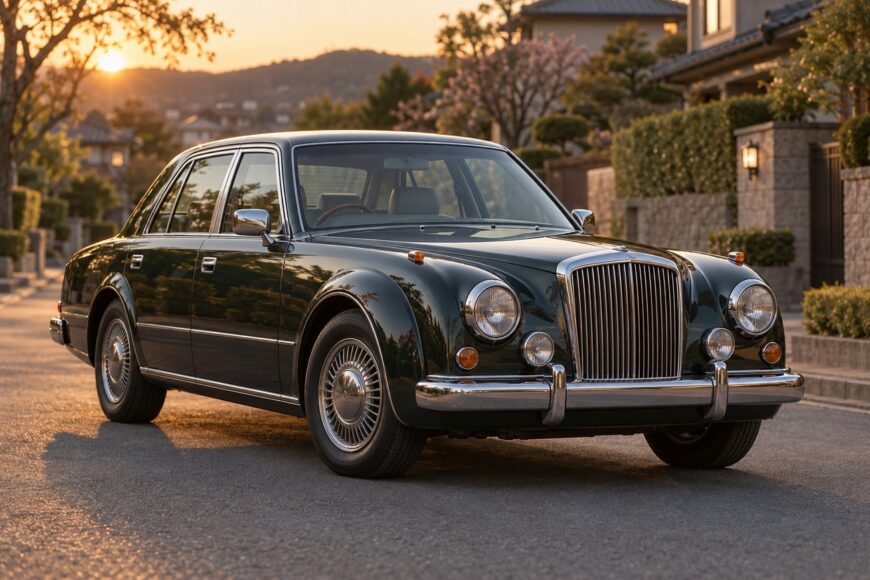
The Toyota Classic looks like a sedan from Toyota’s prewar past, yet its mechanical foundation comes from a fifth-generation Hilux. That tension defines the car: its long hood, upright grille, and formal body suggest an early Toyota AA, while the chassis underneath belongs to a much more utilitarian era.
For a collector, the appeal is clear. Toyota released the Classic in 1996 as an anniversary tribute, and only 100 cars were produced. For an owner, however, rarity changes the calculation. The car offers unusual presence and historical interest, while its Hilux-derived engineering, modest power, and scarce model-specific trim demand a more careful approach than the badge alone might suggest.
- A 1996 tribute, not a surviving prewar Toyota
- Why a Hilux sits beneath the sedan body
- Toyota Classic specifications at a glance
- What the retro cabin and modest engine feel like in use
- The ownership trap: familiar mechanical, scarce unique parts
- How to judge an example when records and listings disagree
- Frequently asked questions
- What is the American counterpart to the Toyota Hilux?
- What is Toyota’s rarest car?
- What car hit 1,000,000 miles?
- What is America’s version of the Toyota Hilux?
A 1996 tribute, not a surviving prewar Toyota
Toyota built the Classic to honor the heritage of the Toyota AA, the company’s prewar passenger car. The connection is visual and commemorative rather than literal. The Classic is a 1996 Toyota with retro styling, not an original Toyota AA or a mechanically faithful reproduction.
Its proportions were designed to recall an earlier period, with a tall body, formal front end, and prominent fenders. Those cues create the impression of a much older automobile, but they should be read as Toyota’s interpretation of its own history. The project was closer to a factory-built heritage statement than to a restoration.
Only 100 Toyota Classics were produced. That limited run gives each surviving car collector interest, although rarity alone does not establish luxury, investment value, or an easy resale market. A rare car can still be difficult to use, repair, and sell if the next buyer is unwilling to accept its compromises.
The most accurate way to view the Classic is as a limited-production retro Toyota. Its significance lies in the decision to place a heritage-inspired body over relatively familiar Toyota engineering, preserving a recognizable link to the brand without recreating a prewar vehicle in every technical detail.
Why a Hilux sits beneath the sedan body
The Toyota Classic uses a fifth-generation Toyota Hilux-derived, rear-wheel-drive ladder-frame chassis. That construction helps explain why the car feels different from a purpose-designed luxury sedan. Its underlying architecture was developed around utility, durability, and a separate body structure.
The key dimensional coincidence was the 2,850 mm wheelbase, which matched the wheelbase of the Toyota AA. That gave Toyota a practical foundation for achieving AA-inspired proportions without designing an entirely new chassis for a production run of only 100 cars.
This shared wheelbase explains the project’s unusual balance of appearance and engineering. The body could present a formal, prewar-inspired silhouette, while the chassis remained related to a working pickup. The result is distinctive, but the visual language should not be mistaken for a separate premium platform.
Hilux ancestry also needs to be described carefully. It may help identify the broad mechanical origin, but it does not prove that every suspension, body, lamp, trim, or interior component is interchangeable with a Hilux. Component-level verification remains necessary.
Toyota Classic specifications at a glance
The core specifications are relatively clear, while published power figures and some transmission listings require qualification.
| Specification | Toyota Classic detail |
|---|---|
| Release | 1996 |
| Production | 100 cars |
| Chassis | Fifth-generation Toyota Hilux-derived, rear-wheel-drive ladder-frame chassis |
| Wheelbase | 2,850 mm |
| Dimensions | 4,885 × 1,735 × 1,650 mm |
| Approximate weight | 1,480 kg |
| Engine | 2.0-liter petrol 3Y-E |
| Published power | 96–97 hp, depending on the source |
| Transmission | Four-speed automatic is the commonly documented Toyota Classic transmission; manual listings require model-specific verification |
What the retro cabin and modest engine feel like in use
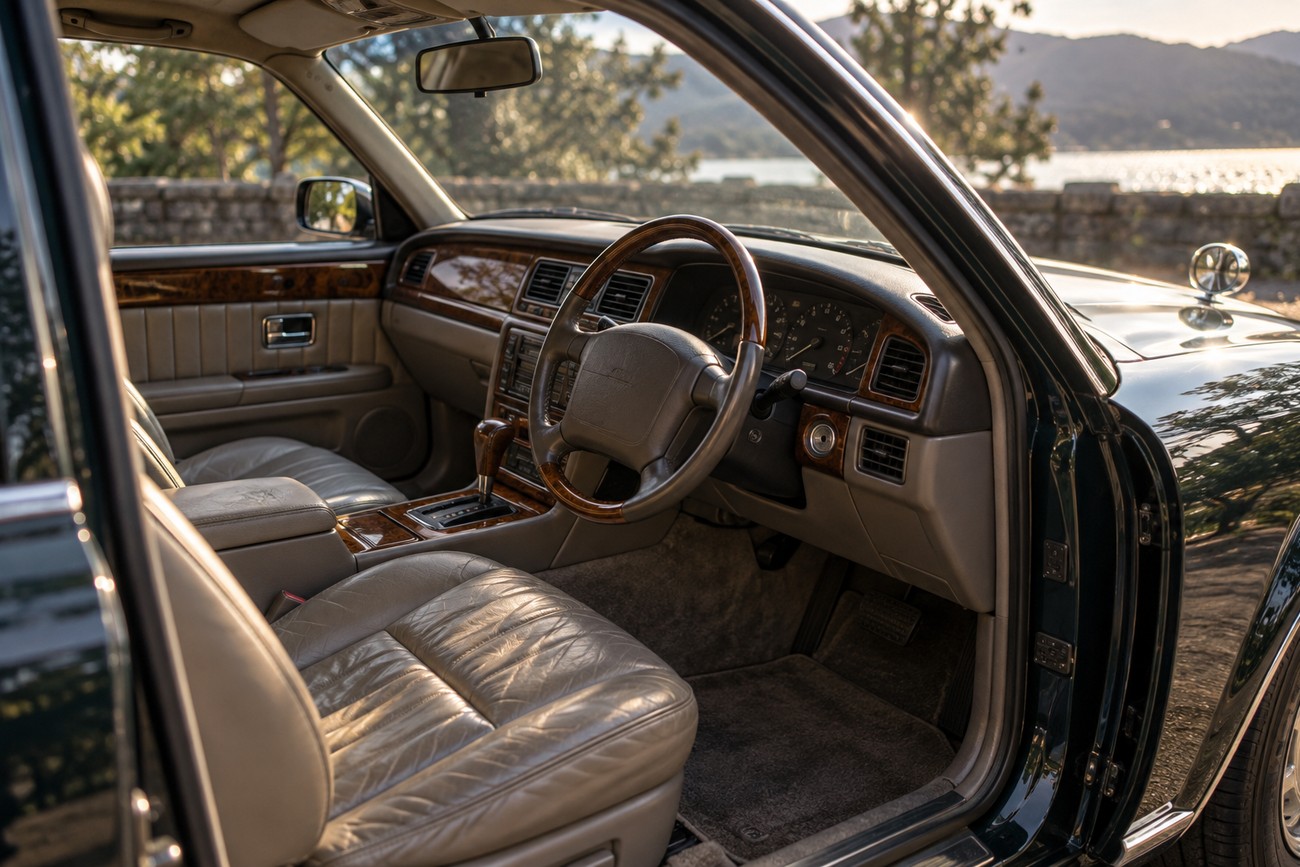
The cabin uses wood and leather finishes to support the car’s formal presentation. Beneath those materials, however, the architecture remains recognizably Toyota rather than a fully bespoke prewar-style interior. That distinction matters because decorative materials can raise the perceived status of a car without changing its seating position, controls, or underlying ergonomics.
The 2.0-liter 3Y-E petrol engine is reported at 96–97 hp, and the car weighs approximately 1,480 kg. With the commonly documented four-speed automatic, its character is best understood as relaxed transport rather than sports-sedan performance. The styling promises ceremony, while the powertrain favors calm progress.
The frame-based construction and pickup-derived origins also shape the driving impression, although exact ride behavior depends on the condition of each individual car. Age, suspension wear, tire choice, and previous repairs can influence the experience more than the retro trim suggests.
That mismatch is part of the Classic’s charm for some owners and its main frustration for others. It stands out at events and attracts attention immediately, but it does not deliver the effortless refinement that its formal appearance may imply. Its strongest quality is presence, supported by genuine scarcity and a clear place in Toyota’s design history.
The ownership trap: familiar mechanical, scarce unique parts
The Hilux-derived foundation can make the car’s mechanical origins easier to understand than its bodywork. A Toyota specialist may recognize the engine family, drivetrain layout, and ladder-frame concept, but that does not guarantee that a replacement component will fit a Classic or remain readily available.
The distinctive body panels, lamps, exterior fittings, woodwork, leather trim, and other cabin details are the greater ownership risk. With only 100 cars produced, suppliers have little reason to reproduce every unique item. Damage that would be routine on a mass-produced sedan may become a costly repair or a search for a donor part.
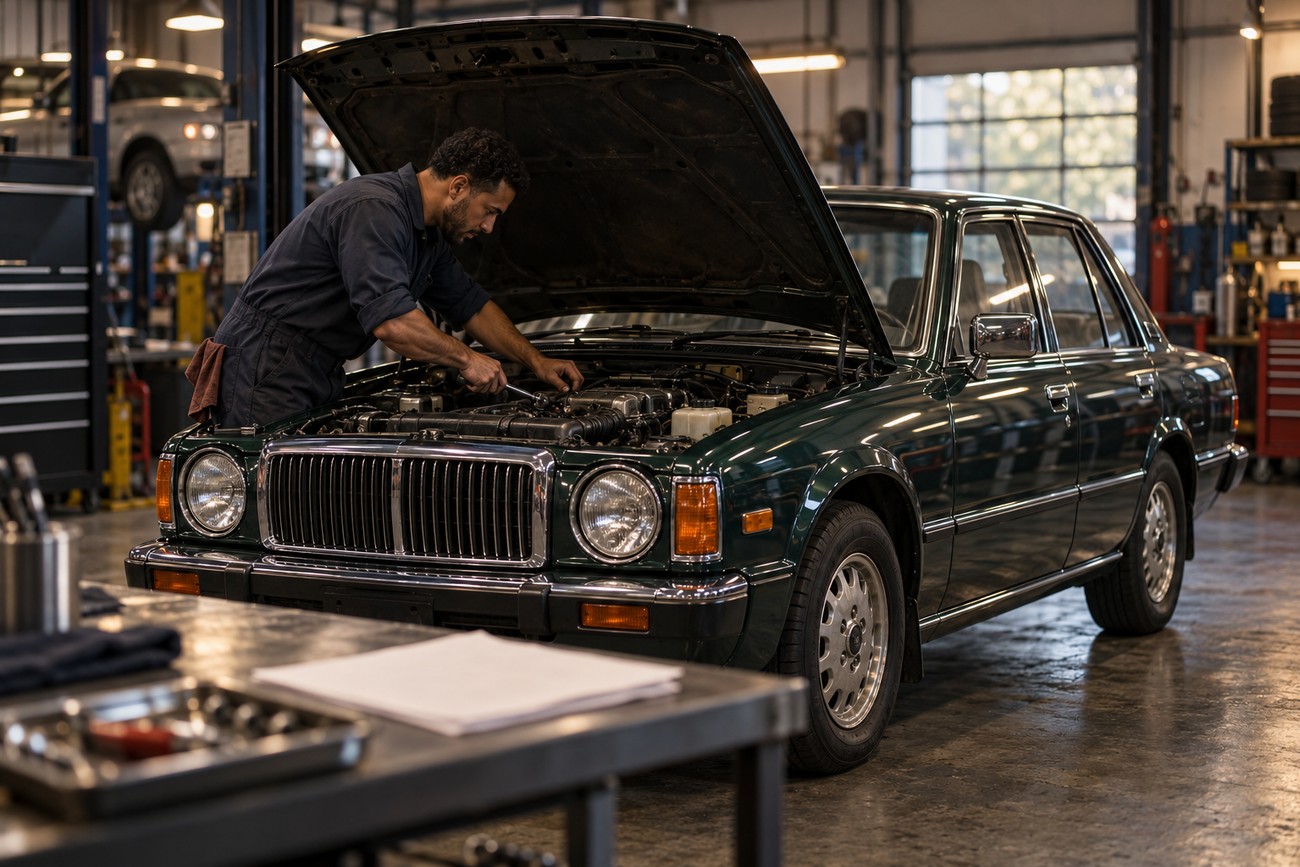
A sensible inspection should begin with the ladder frame and any corrosion, followed by suspension condition and evidence of structural or accident repairs. Next, inspect the exterior for missing or poorly repaired panels, lamps, brightwork, and other model-specific pieces. Finish with the cabin, where damaged wood, leather, switches, and trim may be harder to replace than the mechanical parts.
Documentation should support the inspection rather than substitute for it. A usable Toyota powertrain does not make this limited-run car as straightforward or inexpensive to own as an ordinary sedan. Before purchase, confirm availability, repairability, and likely cost for each unusual component that the particular car needs.
How to judge an example when records and listings disagree
Start by establishing that the car is genuinely a Toyota Classic. Match the vehicle identification details with registration and ownership records, then compare the body, cabin, engine, transmission, and visible trim with period information. At a production total of 100 cars, a convincing history is especially valuable because a vague advertisement can conceal an incomplete, modified, or incorrectly described vehicle.
Published specifications are not perfectly uniform. Engine output appears as either 96 or 97 hp, a minor discrepancy that should be recorded rather than “corrected” through guesswork. More importantly, a four-speed automatic is the commonly documented Classic transmission, while manual references in some listings need evidence from the specific car rather than assumptions based on Hilux versions.
The publicly accessible model page is marked under construction and provides little substantive technical information. That limitation makes independent records, photographs, inspection findings, and period documentation more important than a single online specification sheet.
Rarity should therefore increase due diligence, not end it. The best example is one with coherent identification, credible ownership records, complete original-looking trim, and a sound frame. A rare vehicle can be highly desirable to the right collector while remaining a narrow and potentially illiquid purchase for everyone else.
Frequently asked questions
These questions put the Classic’s Hilux connection and rarity in context. A pickup that fills a similar role in another market is not necessarily a source of compatible parts. Production totals and individual mileage records also answer different questions about a car.
What is the American counterpart to the Toyota Hilux?
The Toyota Tacoma is the familiar U. S.-market counterpart to the Hilux. It occupies a similar midsize-pickup role, but it is not an interchangeable donor for a Hilux-based Toyota Classic.
Parts compatibility must be checked component by component. Model year, market, engine, chassis design, and the Classic’s special bodywork can all affect whether a part is suitable.
What is Toyota’s rarest car?
There is no single answer without defining whether the comparison includes prototypes, one-off racing cars, special editions, or road-legal production models. The Toyota Classic is among Toyota’s exceptionally limited production cars, with only 100 built, but that figure alone does not establish it as the rarest Toyota in every category.
For buyers, the practical point is clearer than the ranking: the Classic’s small production run makes original trim, documentation, and condition especially important.
What car hit 1,000,000 miles?
One of the best-known million-mile cars is a Volvo P1800, whose high mileage became part of automotive folklore. That achievement concerns an individual car and its maintenance history, not a guarantee that every example of the model will reach the same distance.
It also has no direct bearing on the Toyota Classic’s collectibility. A Classic should be judged by its own structure, service record, originality, and parts situation.
What is America’s version of the Toyota Hilux?
For the U. S. market, the Toyota Tacoma is the closest familiar equivalent to the Hilux. It fills a similar market role rather than serving as a universal substitute, and it should not be assumed to provide direct replacement parts for a Toyota Classic.
Any proposed Tacoma or Hilux component should be verified against the individual Classic by dimensions, mounting points, specifications, and application records.







