
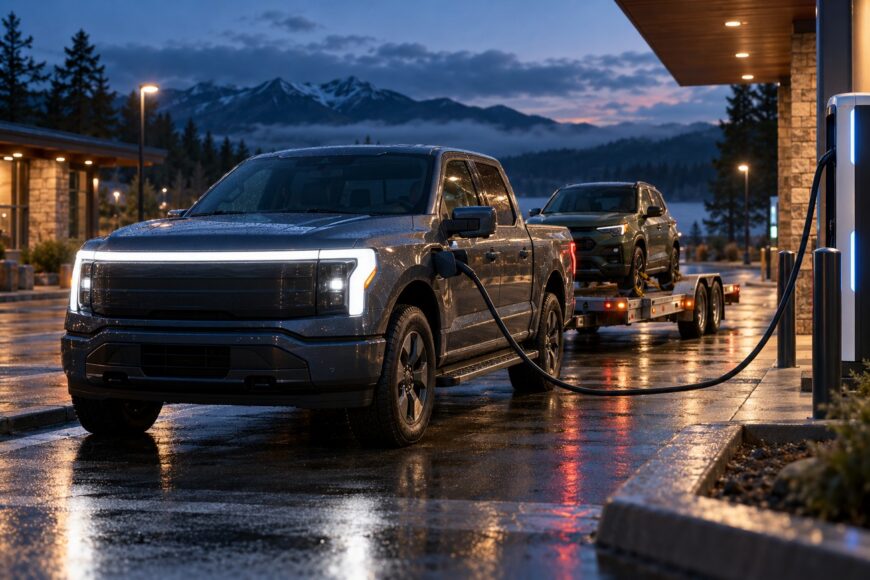
The F-150 Lightning combines strong electric torque with a headline maximum towing rating of 10,000 lb, yet a trailer can reduce usable highway range to roughly 90–160 km. That changes the towing equation. The truck may have enough power to move the load, while the next charging stop becomes the limiting factor.
A sensible buying decision therefore depends on the exact battery and tow package, trailer aerodynamics, payload, speed, weather, and charger access. The maximum tow rating describes a correctly equipped truck in defined conditions; it does not predict how far you can travel between charging stops with passengers, cargo, and a tall trailer attached.
- F-150 Lightning Towing Capacity by Configuration
- Hitch Weight, Payload, and Trailer Stability
- Real-World Range While Towing
- Charging With a Trailer: The Hidden Constraint
- How to Tow More Safely With the Lightning
- Common Buying Mistakes and Who Should Choose the Lightning
- Frequently asked questions
- How do I put my F-150 Lightning in Tow/Haul mode?
- What is the towing capacity of the F-150 Lightning Flash?
- How do I put my F-150 in tow mode?
F-150 Lightning Towing Capacity by Configuration
Lightning towing capacity depends on model year and equipment. The 10,000-lb rating applies only to an Extended Range battery combined with the Max Trailer Tow package. For trailers over 5,000 lb, Ford requires Trailer Tow package 53D, and the vehicle’s own tow table should take priority over a dealer listing or generic specification.
| Towing scenario | Battery or configuration | Required equipment and caveat |
|---|---|---|
| 5,000 lb | Most versions without Max Trailer Tow | Confirm the exact window sticker and tow table |
| 7,700 lb | Some properly equipped configurations | Trailer Tow or Max Trailer Tow equipment may be required |
| 8,600 lb | Platinum, in the applicable configuration | Verify model year and installed equipment |
| 10,000 lb | Extended Range battery | Max Trailer Tow required; this is the maximum official rating |
The Standard Range discussion deserves particular care. Some dealer and review material cites 7,700 lb, while specification tables show 5,000 lb without the applicable package and 7,700 lb with Trailer Tow or Max Trailer Tow. Because the answer varies by model year and equipment, check the truck’s window sticker and official towing table before buying or renting a trailer.
These ratings apply to a conventional trailer connected to the truck’s hitch. Ford does not recommend fifth-wheel or gooseneck towing for the F-150 Lightning, even though comparable gasoline F-150s may be configured for those trailer types.
Hitch Weight, Payload, and Trailer Stability
Tow rating is only one limit in the combination. Passengers, luggage, bed cargo, hitch hardware, and tongue weight all use the truck’s available carrying capacity. A trailer that is below the headline tow rating can still create an overloaded or poorly balanced setup once the truck is fully occupied.
Use up to 10% of the trailer’s weight as the recommended tongue-weight target, then verify it rather than estimating by feel. The Lightning’s Smart Hitch is designed to help check this load. The aim is enough weight on the hitch for stable tracking without exceeding the truck, hitch, or trailer limits.
Loading also determines how the trailer behaves in crosswinds, during lane changes, and under braking. Keep heavy cargo low and appropriately forward, secure it, and follow the trailer manufacturer’s loading guidance. Too little weight at the front can encourage sway; too much can overload the rear of the truck and reduce steering authority.
A properly balanced tandem-axle trailer can feel more settled than a poorly loaded single-axle trailer of similar weight. That does not make tandem axles a substitute for correct loading. The trailer must track straight before the combination is taken onto a high-speed road.
Real-World Range While Towing
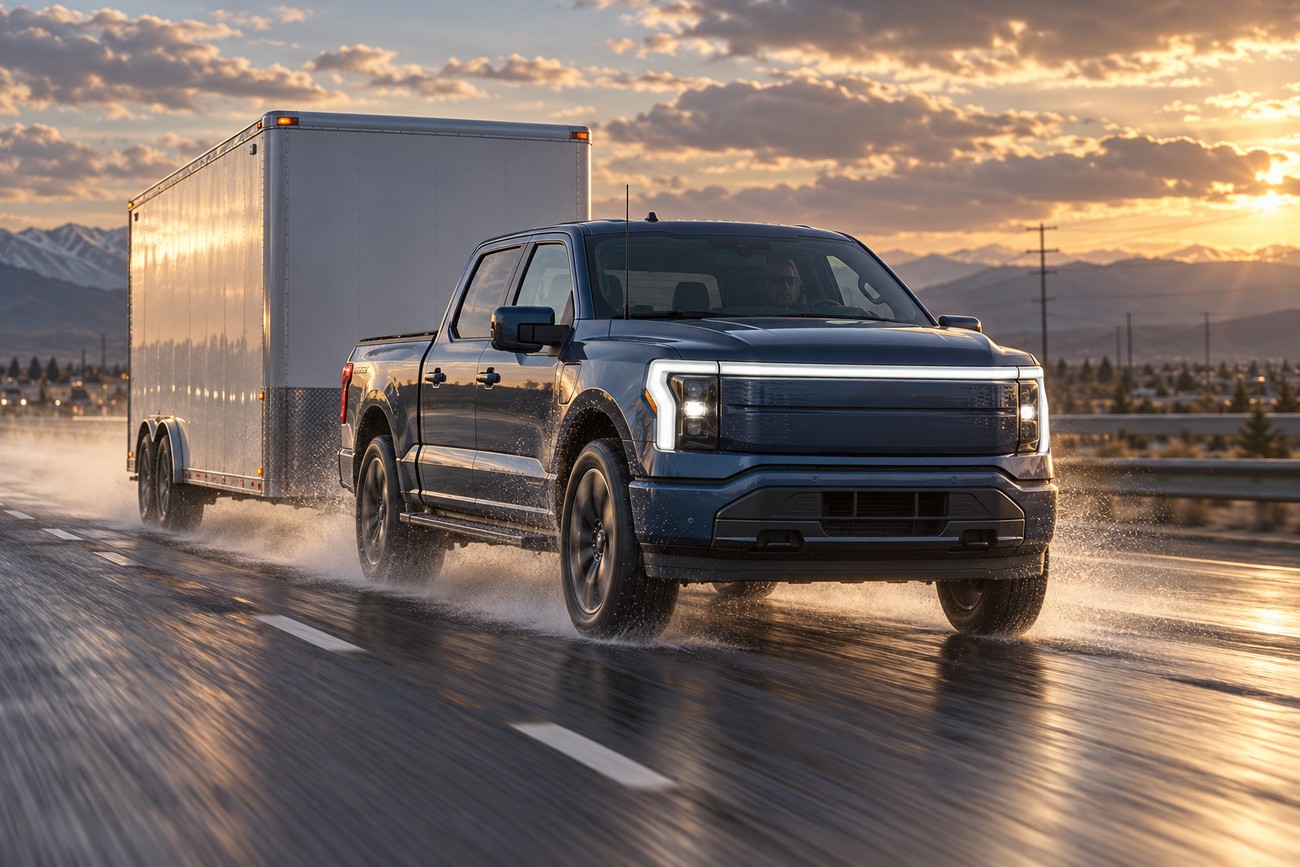
EPA range is a poor trip-planning figure once a large trailer is attached. Tests with 6,100–6,800-lb trailers at 70 mph have produced roughly 90–160 km of range. In demanding towing conditions, usable range can fall to about 25–35% of the official EPA range.
Speed is a major reason. A tall trailer creates a large aerodynamic wall, and the energy required to push it through the air rises sharply as speed increases. A low, narrow, more aerodynamic car trailer can use substantially less energy than a high, boxy camper of similar weight.
Headwinds and grades compound the problem. Cold temperatures can reduce available range as well, while a full cabin, bed cargo, and a loaded trailer add further weight. The same trailer that is manageable on a mild, flat day may require a much larger charging margin in mountains or strong wind.
Many drivers find 55–60 mph a practical compromise for long towing trips. Lower speed reduces aerodynamic losses and can make the overall journey more predictable, even if the truck spends more time moving. Charging may still be needed about every 1.5–2 hours on demanding routes.
Trailer shape often matters more than a modest difference in trailer weight. A lower, cleaner trailer can preserve useful range where a tall box trailer turns the same route into a sequence of short charging legs.
That is why a range estimate should be treated as a live planning reference, not a promise. Leave a reserve for wind, hills, temperature changes, detours, and the possibility that the next charger cannot be used conveniently with the trailer attached.
Charging With a Trailer: The Hidden Constraint
Charging infrastructure can be harder to use than the truck’s towing hardware. Many fast-charging sites have ordinary parking spaces or short pull-through lanes, so a trailer blocks neighboring stalls or prevents the Lightning from reaching the connector.
The practical solution may be to uncouple the trailer, position the truck at the charger, charge, and reconnect before continuing. That adds maneuvering, time, and the need for a safe place to stop. A route with fewer chargers but suitable trailer access can be better than the nearest charger shown on a map.
After a trailer is connected, the truck can recalculate the estimated range. That feature is useful, but navigation estimates may still understate the effect of hills, wind, and cold temperatures. Plan around terrain and weather, and keep a larger reserve than you would use on an unloaded trip.
Choose charging stops by layout, not only by distance. A site where the trailer can be detached safely and reconnected without blocking traffic is often more valuable than a closer station that forces difficult reversing or tight maneuvering.
Before departure, inspect the route at likely charging points and identify an alternative. On a demanding towing trip, the charging stop is part of the driving schedule rather than a brief interruption that can be improvised after the battery warning appears.
How to Tow More Safely With the Lightning
Select Tow/Haul mode before entering traffic with the trailer connected. It provides trailer-focused vehicle behavior and supports trailer-connected range estimation. Confirm that the truck recognizes the trailer, then check the lights, safety chains, electrical connection, brake controller, and tire condition before moving.
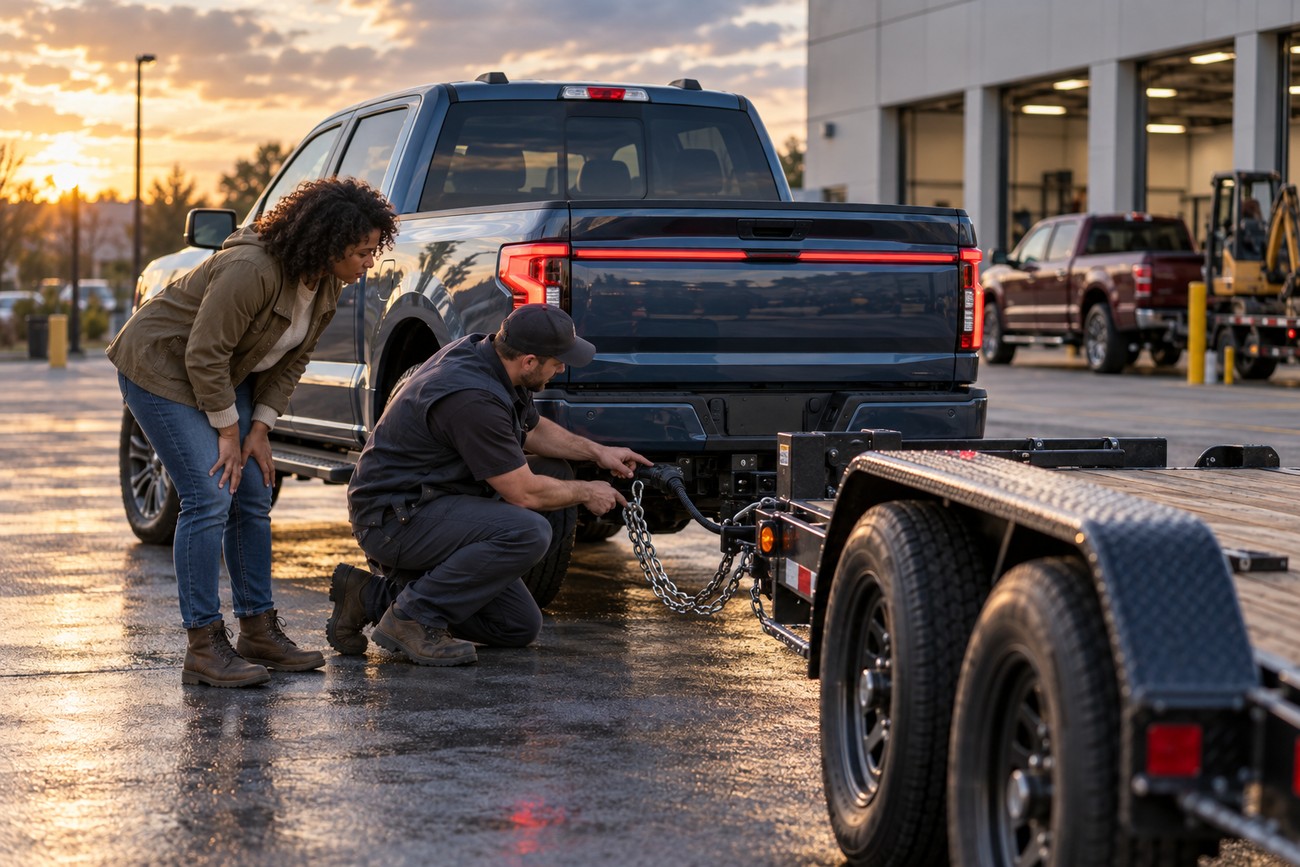
Use Smart Hitch to verify tongue weight, and recheck the load after cargo has been added or rearranged. Make sure the trailer is level as required by its equipment, the coupler is locked, and the hitch pin and safety devices are correctly secured. These simple checks address failures that a powerful electric drivetrain cannot correct.
Regenerative braking and one-pedal driving can be used while towing. Use the controls smoothly and allow extra stopping distance, especially on descents or when the trailer brakes are unfamiliar. Instant electric torque makes it easy to accelerate briskly, but aggressive launches add stress and waste energy without improving a long towing journey.
Keep speed conservative when conditions change. Lower speed reduces aerodynamic demand, leaves more time to correct sway, and gives the combination more braking margin. If the trailer begins to oscillate, ease off the accelerator, avoid abrupt steering, and follow the trailer and vehicle manufacturer’s guidance for safe correction.
Common Buying Mistakes and Who Should Choose the Lightning
The first mistake is shopping by the 10,000-lb headline. That figure is available only with the Extended Range battery and Max Trailer Tow. A truck without the required equipment may be rated at 5,000 lb, while some properly equipped configurations reach 7,700 lb and an applicable Platinum configuration can reach 8,600 lb.
The second mistake is assuming that a gasoline F-150 towing setup transfers directly to the Lightning. The electric truck can deliver strong towing performance, but its long-distance workflow is different: speed, weather, trailer shape, charger layout, and charging time become central parts of the trip.
Package availability also matters. Confirm Trailer Tow package 53D for trailers over 5,000 lb, check the installed battery, and read the official tow table for that model year. The Standard Range 5,000-lb versus 7,700-lb discussion cannot be settled by a generic trim name or an incomplete online listing.
The Lightning suits owners who tow moderate distances, can charge at home, and are prepared to travel at an efficient speed with planned charging stops. Frequent long-distance towing, tall high-drag trailers, or fifth-wheel and gooseneck use may call for another truck. In those cases, charging access and trailer compatibility matter more than peak tow capacity.
Frequently asked questions
Exact controls, ratings, and procedures can vary by model year and equipment. Use the owner’s manual and the truck’s official tow information when the vehicle-specific instructions differ from general guidance.
How do I put my F-150 Lightning in Tow/Haul mode?
Use the truck’s drive-mode or towing controls to select Tow/Haul mode, following the prompts shown on the instrument display. The exact control path can vary by model year and trim, so confirm it in the owner’s manual if the menu is different.
After activation, confirm that the trailer connection is recognized, then test the trailer lights and brake controller at low speed. Check that the range estimate has updated for the connected trailer before committing to the route.
What is the towing capacity of the F-150 Lightning Flash?
Flash does not have one timeless tow rating. Capacity depends on model year, battery, axle, and tow-package configuration, so verify the vehicle’s official tow table or window sticker.
As a guide, Lightning configurations range from 5,000 lb for most versions without Max Trailer Tow to 7,700 lb for some properly equipped trucks. The maximum official rating is 10,000 lb only with the Extended Range battery and Max Trailer Tow; an applicable Platinum configuration can reach 8,600 lb.
How do I put my F-150 in tow mode?
With the trailer safely connected, select the towing or Tow/Haul setting through the truck’s drive-mode controls. Confirm the trailer wiring, lights, brake response, and connection status before entering traffic.
Do not rely on the mode alone to make an unstable load safe. Check tongue weight, secure the cargo, and allow the truck to update its trailer-connected range estimate. The vehicle’s manual remains the final reference for the controls and equipment fitted to that F-150.







