
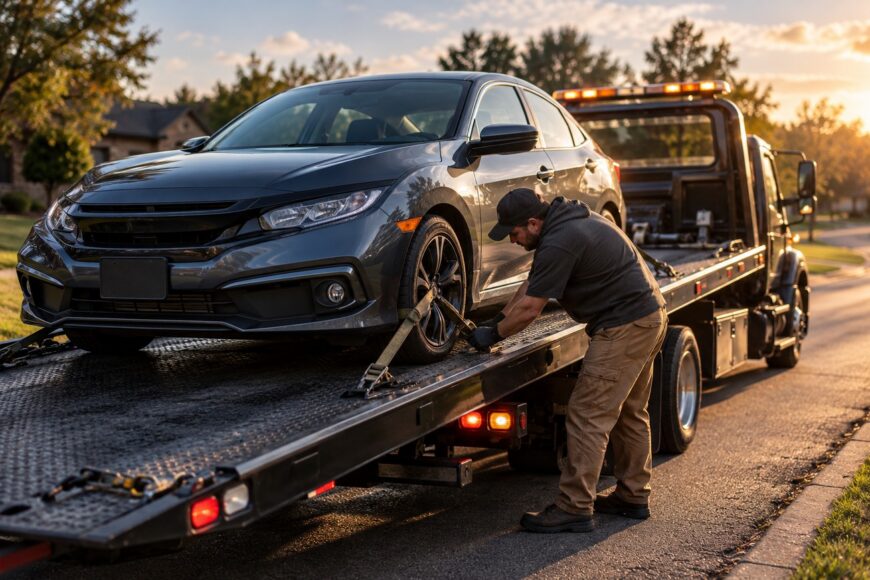
A Honda Civic that rolls freely is not automatically safe to tow with its drive wheels on the road. A factory tow hook is a recovery point, not a complete towing system with approved attachment, lighting, braking, and drivetrain protection.
The correct method depends on the Civic’s model year, VIN, drivetrain, transmission, market, and exact failure. A flatbed is usually the safest default because all four wheels remain off the road, while a correctly configured dolly or full trailer may suit some vehicles. Four-wheel flat towing belongs only to configurations expressly approved by the owner’s manual.
- Can You Tow a Broken Honda Civic?
- Check Your Civic’s Limits Before Choosing Equipment
- The Safest Ways to Move a Disabled Civic
- How to Use a Tow Dolly or Trailer Safely
- Why a Tow Hook and Rope Are Not a Towing System
- Choose the Method Based on the Failure, Not Just the Weight
- Frequently asked questions
- Which Honda models can be flat towed?
- Where is the tow hook on a Honda Civic?
- Do I need separate lights when transporting a Civic on a dolly?
Can You Tow a Broken Honda Civic?
You can move some disabled Civics with a dolly or trailer, but the answer cannot be generalized across every generation and configuration. Moving a broken car is different from towing a trailer: the Civic’s own wheels, steering, brakes, transmission, and suspension become part of the towing system.
For a U. S.-market Civic, there is no single universal factory trailer-towing answer for every generation and configuration. The exact owner’s manual, door-jamb information, and vehicle specifications control the decision. Market differences also matter, so advice for a British or European Civic may not apply to a U. S. vehicle with the same model name.
A flatbed generally provides the safest transport because it removes the Civic from the road surface entirely. A properly selected tow dolly or full trailer can be an alternative when the vehicle’s condition and the manual allow it. Four-wheel flat towing is acceptable only when the specific manual expressly permits it for that year, trim, transmission, and market.
Check Your Civic’s Limits Before Choosing Equipment
Start with the VIN-specific owner’s manual and the label on the driver-side door jamb. Check the Civic’s GVWR and GAWR, then account for passengers, luggage, accessories, equipment, and any hitch tongue weight. These figures help establish whether the vehicle and towing equipment remain within their permitted loads.
For applicable Civic configurations, Honda lists a combined loading limit of 850 lb (385 kg). This is a total loading limit that includes passengers, luggage, accessories, and hitch tongue weight; it is not a trailer rating. Some Civic 6MT configurations list a combined loading limit of 680 lb (308 kg).
That distinction matters during recovery planning. A dolly or trailer may appear suitable by its own weight label while the towing vehicle still exceeds its available loading, braking, or axle limits once occupants and equipment are included.
European specifications must remain separate from U. S. specifications. For example, the current British Civic Hybrid example lists 750 kg with braked trailers and 600 kg with unbaked trailers. Those market-specific figures must not be transferred to a U. S.-market Civic without matching official documentation.
The Safest Ways to Move a Disabled Civic
The main transport choices differ in how much of the Civic remains mechanically involved. The following comparison is a starting point; the owner’s manual and the condition of the disabled vehicle still determine whether a method is permitted.
| Method | Wheel contact | Best use case | Main limitation | Required verification |
|---|---|---|---|---|
| Flatbed | All four Civic wheels off the road | Most disabled vehicles, especially where the failure is uncertain | Requires suitable loading space and secure tie-downs | Flatbed capacity, ramp clearance, tie-down points, and operator procedure |
| Tow dolly | Normally supports the front drive wheels on a conventional FWD Civic | A Civic with an approved configuration and mechanically sound non-driven wheels | Unsuitable for some steering, wheel, axle, hub, or transmission failures | Vehicle manual, dolly instructions, drive-wheel placement, straps, chains, and lights |
| Full trailer | All four Civic wheels supported | Vehicles with drivetrain, wheel, steering, or locked-wheel concerns | Greater equipment size and towing-vehicle demands | Trailer capacity, braking, attachment, lighting, and vehicle loading limits |
| Four-wheel flat towing | All four Civic wheels remain on the road | Only an expressly approved Civic configuration | Requires correct base plate, lighting, and other approved equipment | Exact manual, year, trim, transmission, market, and certified equipment |
For a conventional front-wheel-drive Civic, a tow dolly normally supports the front drive wheels. That arrangement still depends on the owner’s manual and the failure condition. A dolly marketed as fitting a Civic does not establish eligibility by itself.
A full trailer or flatbed is preferable when a CVT, differential, axle, hub, steering system, or wheel may be damaged. Locked wheels can prevent safe loading onto a dolly and can overload straps or ramps. A vehicle that cannot steer or roll normally usually needs equipment that supports all four wheels.
Four-wheel flat towing requires explicit approval for the exact Civic configuration. It also requires a certified base plate and the associated lighting and supplemental equipment specified for the setup. A recovery eyelet alone does not satisfy those requirements.
How to Use a Tow Dolly or Trailer Safely
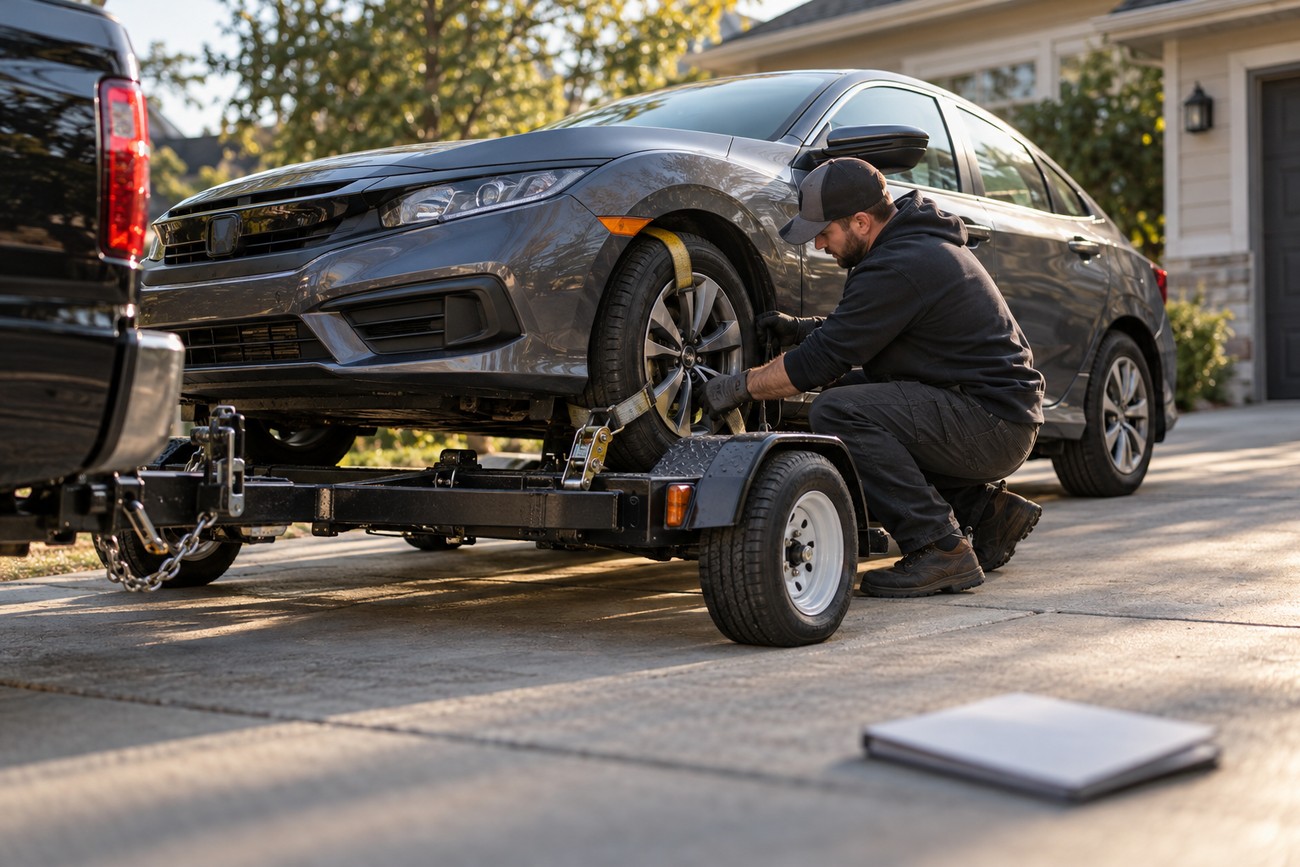
Before loading, identify the Civic’s driven wheels and read both the vehicle manual and the dolly or trailer instructions. For a conventional FWD Civic, place the front drive wheels on the dolly unless the vehicle documentation gives different instructions. Inspect the tires, wheels, steering, parking brake, and underbody before committing to the load.
Set the steering and parking brake exactly as specified by the vehicle and equipment instructions. Follow the stated transmission procedure rather than assuming that neutral protects every Civic. Neutral is not a universal solution for every Civic transmission or mechanical failure, particularly where a CVT, differential, axle, or hub may be damaged.
Center the Civic on the ramps and check bumper clearance, approach and departure angles, turning radius, and rear-wheel overhang. Confirm that the tires sit fully within the dolly tracks or trailer deck and that the straps can be placed around approved tire areas without rubbing against suspension components, brake lines, body panels, or sharp edges.
Check tire-strap placement and chain slack again after the first short movement. Initial tightening can settle as the tires and suspension take the load, so a brief stop and recheck can prevent a developing attachment problem from becoming a roadside failure.
Install the required tire restraints, safety chains, and working lights, then follow the dolly manufacturer’s required procedures. Check that chains do not drag, straps are evenly tensioned, and the lighting system is visible from the required angles. Recheck the setup after the first short movement and at every planned stop.
Photograph the Civic, its wheels, body panels, straps, chains, lights, and attachment points before departure. These images document pre-existing damage and the loading condition if a dispute later involves an operator, repair facility, warranty, or insurer.
Why a Tow Hook and Rope Are Not a Towing System
A front-wheel-drive layout does not automatically authorize towing with the front wheels on the road. When a stationary Civic’s drive wheels rotate, the drivetrain may lack the normal lubrication conditions required for safe operation. Damage can occur even if the car appears to roll smoothly.
A factory tow hook or recovery eyelet is designed for specified recovery use. It does not replace a certified base plate for permanent four-wheel flat towing, and it does not provide the lighting, braking, steering, or drivetrain provisions required by an approved towing system.
A rope or strap also solves only the connection between vehicles. It cannot resolve transmission restrictions, wheel alignment, steering control, braking requirements, lighting visibility, load limits, or safe attachment geometry. A short distance does not automatically make an unapproved configuration safe.
Before any pull, establish whether the vehicle is being recovered from an immediate hazard or transported over a road. A short, controlled recovery may follow different procedures from road transport, but the equipment must still be rated and attached to the points specified by the vehicle documentation.
Choose the Method Based on the Failure, Not Just the Weight
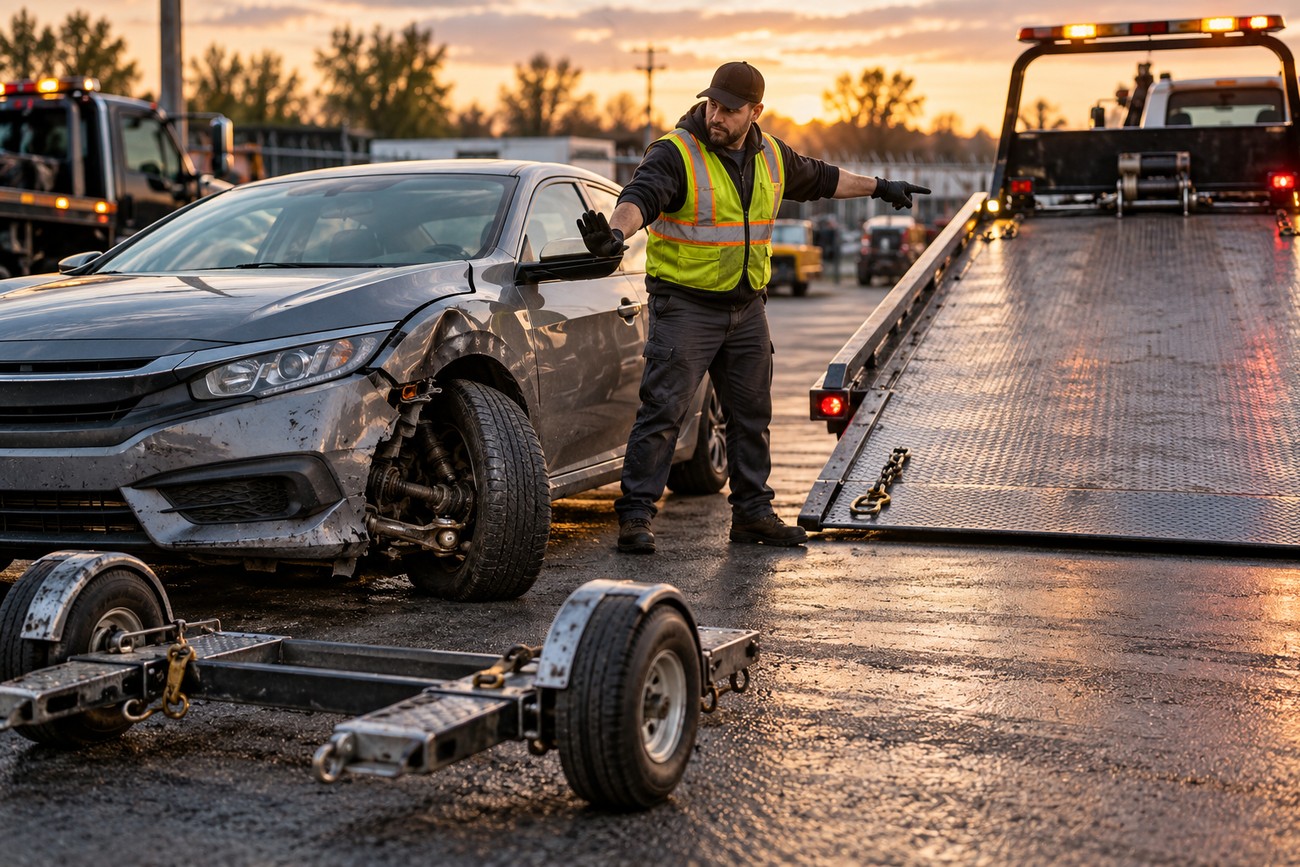
A dolly’s advertised Civic compatibility is only a preliminary fit. Eligibility depends on the model year, drivetrain, transmission, vehicle condition, and the official instructions for both the Civic and the dolly. The label “fits Civic” cannot override a restriction in the owner’s manual.
Weight compatibility alone does not prove safe braking, cornering, vertical loading, or secure attachment. The towing vehicle must also control the combined load, and the equipment must handle the forces created during turns, stops, uneven pavement, and emergency maneuvers.
A platform is the conservative choice when a CVT, differential, axle, hub, steering system, or wheel cannot rotate normally. It also avoids relying on a damaged component to support or transmit movement. Locked wheels and uncertain drivetrain damage are strong reasons to use a flatbed or full trailer.
Incorrect towing can create more than mechanical damage. An unapproved method may complicate warranty and insurance claims, especially when the loading procedure or attachment points cannot be documented. If the failure type is unclear, paying for equipment that removes all four wheels from the road is often the more controlled decision.
Frequently asked questions
Which Honda models can be flat towed?
Flat-towing eligibility is model-year- and transmission-specific. Approval for one Honda model, body style, or Civic generation cannot be used as evidence that another Honda can be towed on all four wheels.
Check the owner’s manual for the exact VIN, market, trim, drivetrain, and transmission. If the manual does not expressly approve the configuration, use a flatbed, full trailer, or another method specifically allowed by the documentation.
Where is the tow hook on a Honda Civic?
The access point and removable eyelet location vary by model year and body style. The owner’s manual identifies the recovery-point cover and explains how the eyelet is installed, if that equipment is provided.
That location is for the specified recovery operation. It does not show that the Civic is suitable for permanent four-wheel flat towing or that the eyelet can replace a certified base plate.
Do I need separate lights when transporting a Civic on a dolly?
You may need separate working lights on the dolly or trailer, especially when the Civic’s rear lamps are obscured by the equipment or load. The Civic’s own lamps may not remain visible to following traffic from every angle.
Use the dolly or trailer lighting system required by its instructions and applicable local rules. Check the tail lamps, brake lamps, turn signals, and electrical connection before departure, then verify them again after securing the vehicle.







