
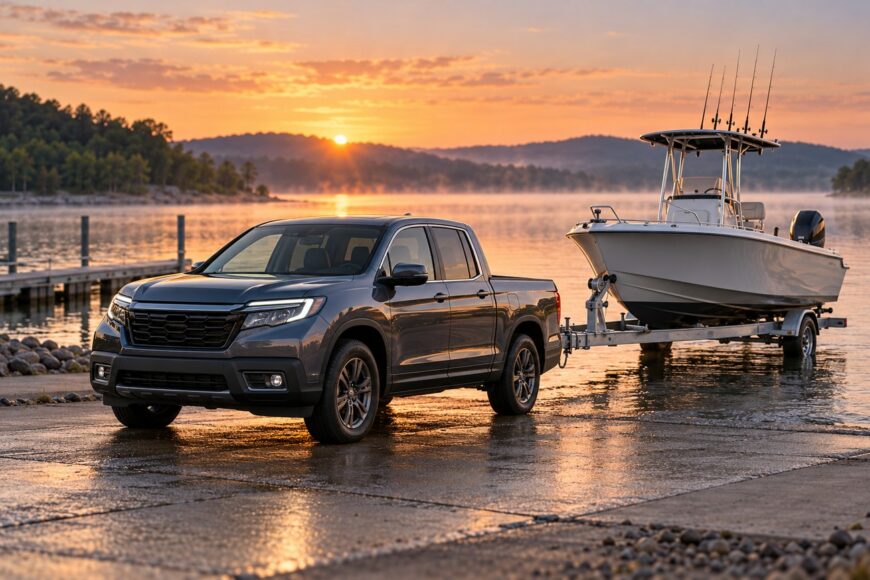
The Honda Ridgeline has a respectable advertised towing capacity, yet its comfortable real-world range is lower when the load is a heavy boat. Drivetrain, loaded trailer weight, braking, tongue weight, cooling, and launch-ramp conditions matter more than the headline rating.
A boat’s dry hull weight is only the starting point. The motor, fuel, batteries, water, equipment, trailer, passengers, and cargo can move the combination into a different safety category. The sound decision is based on the fully loaded rig, its weight distribution, and the reserve left below every applicable rating.
- Honda Ridgeline Boat Towing Capacity: The Numbers That Matter
- Honda Ridgeline Towing Limits by Drivetrain
- Calculate the Boat’s Real Loaded Trailer Weight
- Why the Comfortable Limit Is Lower Than the Maximum
- Hitch, Tongue Weight, and Trailer Stability Setup
- Braking, Cooling, and Road-Speed Risks
- Launching and Towing the Boat on the Water
- Common Ridgeline Boat-Towing Mistakes and Hidden Costs
- Is the Honda Ridgeline the Right Boat Tow Vehicle?
- Frequently asked questions
- What is the best SUV for pulling a boat?
- What size trailer can a Honda Ridgeline tow without trailer brakes?
- How should I maintain a Ridgeline after launching a boat in salt water?
Honda Ridgeline Boat Towing Capacity: The Numbers That Matter
Ridgeline towing capacity varies by model year, drivetrain, trim, and equipment. Front-wheel-drive versions are approximately 1,585–1,600 kg, while all-wheel-drive versions are approximately 2,268–2,600 kg. These are ranges rather than one universal rating for every Ridgeline.
Towing capacity describes the permitted trailer mass under specified conditions. It does not replace the vehicle’s payload rating, hitch rating, tongue-weight limit, or gross vehicle weight rating. The official vehicle payload is approximately 665–718 kg; the frequently cited 750 kg figure is an informal upper reference, not a universal factory rating.
Payload includes people and cargo carried by the Ridgeline, as well as the trailer’s vertical load on the hitch. A heavy tongue can use a substantial part of the available payload before any equipment is placed in the bed. The combined vehicle, trailer, passengers, and cargo must remain within the applicable GVWR, payload, hitch, and trailer-weight ratings.
Check the certification label, owner’s manual, and hitch label for the specific vehicle. Dealer summaries can be useful for comparison, but they should not be treated as the governing specification for an individual truck.
Honda Ridgeline Towing Limits by Drivetrain
Drivetrain changes the usable towing range, and the higher AWD figures depend on the correct equipment and suitable trailer braking. A number near the maximum describes a controlled rating condition, not an ideal target for every regular boat trip.
| Drivetrain | Approximate towing range | Equipment assumptions | Practical interpretation |
|---|---|---|---|
| FWD | 1,585–1,600 kg | Verify the model year, trim, hitch, and trailer requirements. Braking requirements depend on local rules and the exact combination. | Suitable for lighter, properly balanced boat-and-trailer combinations. A heavy boat can leave little reserve for hills, wind, or launch ramps. |
| AWD | 2,268–2,600 kg | Correct factory or certified towing equipment is required. The higher figures are generally associated with a properly equipped braked trailer. | Provides the higher rated range, but regular use near the maximum can still be demanding for acceleration, braking, cooling, and stability. |
Verify the exact year, trim, owner’s manual, hitch label, and trailer-brake requirements before buying or towing a boat. Local regulations may also impose requirements that differ from the vehicle manufacturer’s rating.
Calculate the Boat’s Real Loaded Trailer Weight
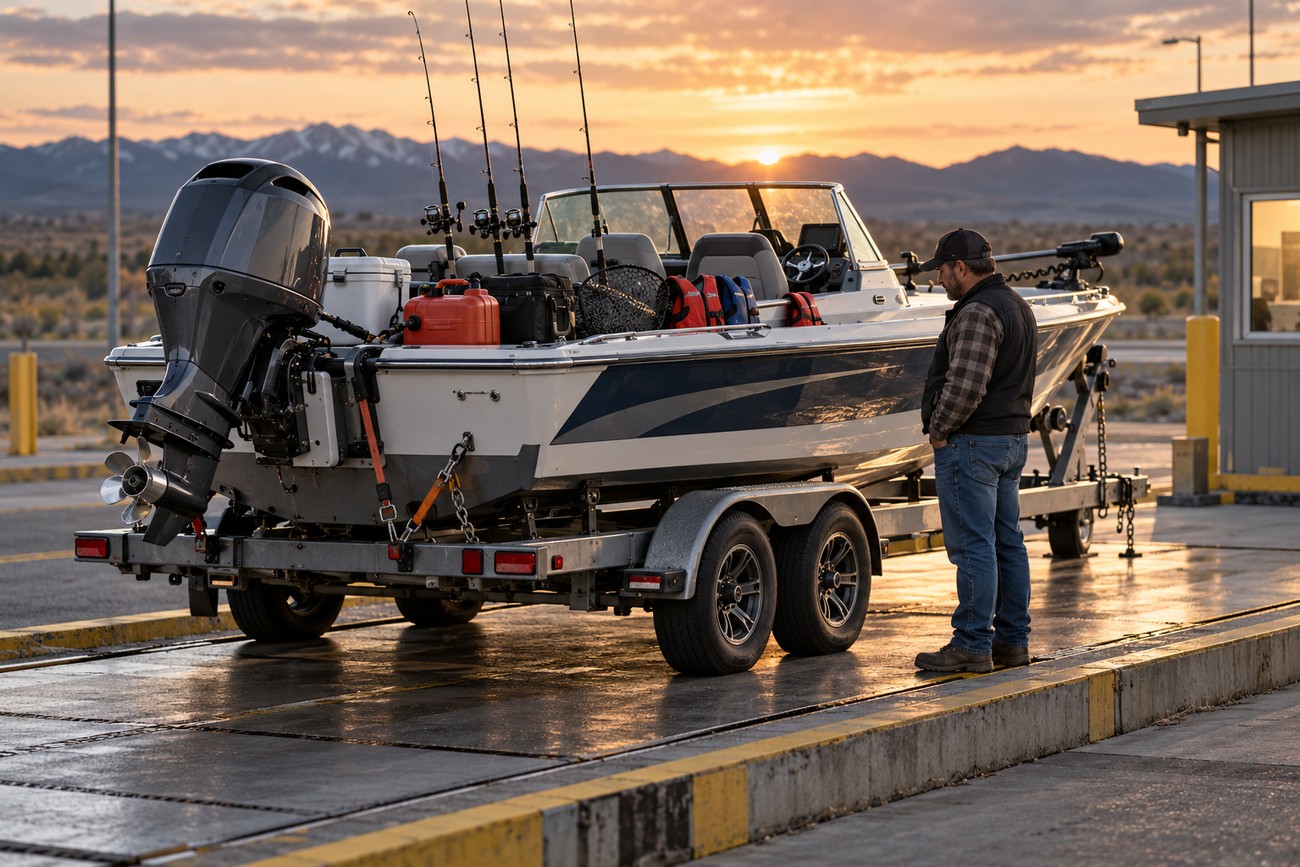
Dry hull weight is an unsafe basis for choosing a tow vehicle. Add the outboard motor, fuel, batteries, water, safety equipment, fishing gear, anchors, covers, accessories, and personal items. The trailer itself also counts toward the loaded trailer mass.
Use the fully loaded figure that will apply on the road, rather than the lightest configuration shown in a brochure. A boat that appears comfortably below the rating can move closer to the limit after fuel, batteries, a heavier propeller, and ordinary trip equipment are added.
Keep two calculations separate. The boat, trailer, and their contents count against the Ridgeline’s trailer rating, while passengers, luggage, tools, and the trailer’s tongue load count against vehicle payload and gross vehicle weight.
The Ridgeline’s official payload is approximately 665–718 kg. The commonly cited 750 kg figure is only an informal upper reference, so it should not be used to justify a loaded combination without checking the vehicle’s own certification label.
Why the Comfortable Limit Is Lower Than the Maximum
A technical maximum and a sensible recurring limit serve different purposes. Experienced owners commonly suggest approximately 1,500–1,800 kg of fully loaded boat-and-trailer mass for regular trips, even when a particular AWD configuration has a higher rating. This is practical guidance, not a Honda factory limit.
Near maximum load, acceleration falls, the engine revs more, the transmission shifts more often, and fuel consumption rises. A tall boat with considerable aerodynamic drag can feel harder to control than a lower boat of the same mass. Wind, hills, and wet pavement reduce the remaining margin further.
Judge the combination by acceleration, rear-end squat, steering feel, transmission temperature, and downhill braking reserve rather than treating the published maximum as a routine target.
The Ridgeline uses unibody construction rather than a traditional body-on-frame pickup design. That does not prevent boat towing, but it generally leaves less reserve for repeated maximum-load work than a comparable frame-based pickup. A practical comfort limit may be approximately 20–30% below the technical maximum.
Hitch, Tongue Weight, and Trailer Stability Setup
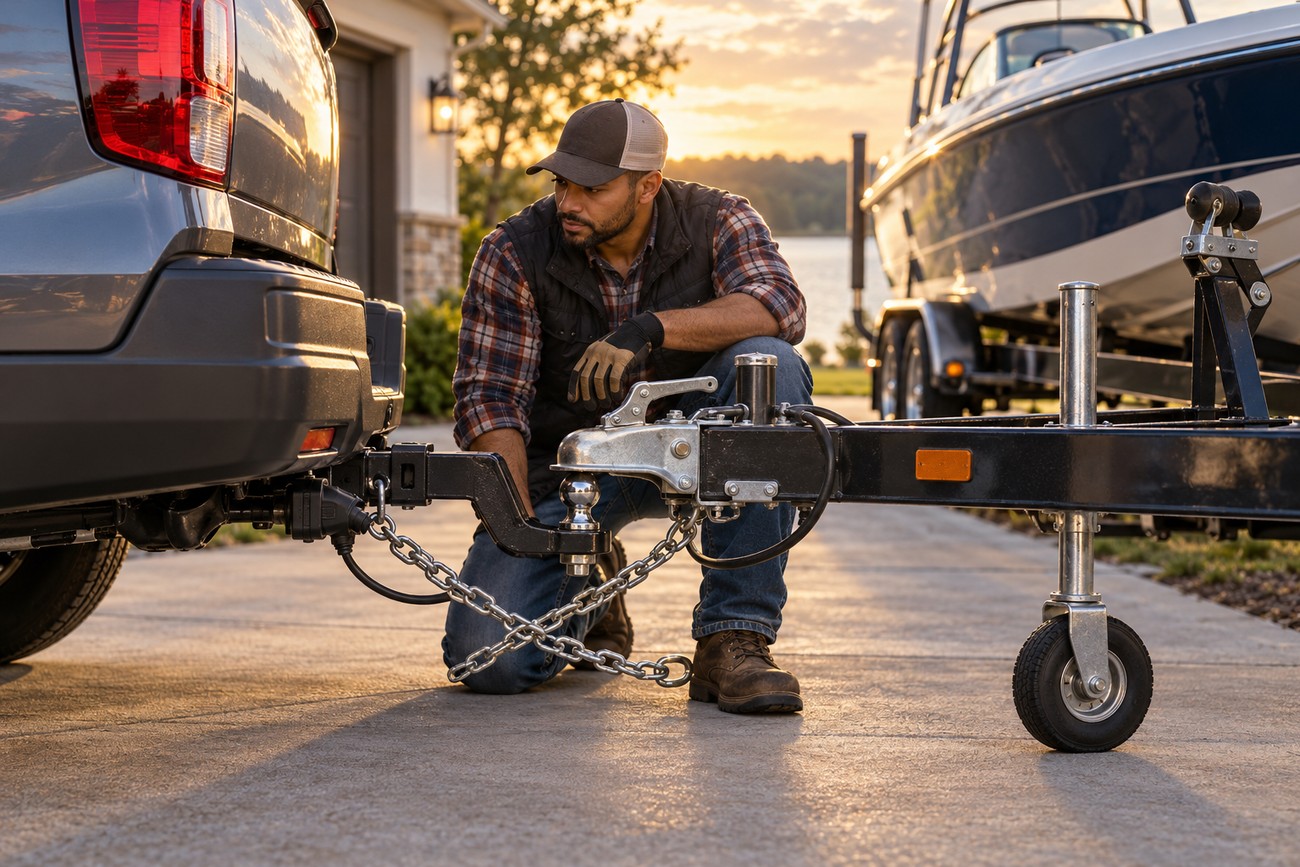
Use a factory or certified hitch with clearly stated horizontal and vertical load ratings. The hitch, ball mount, ball, safety chains, wiring, and mounting hardware must all suit the loaded combination. A low-cost uncertified hitch can develop looseness or corrosion and may transfer damaging loads into the vehicle.
Tongue weight must be sufficient to keep the trailer tracking straight, while excessive tongue weight can cause rear suspension sag and reduce front-end grip. Too little tongue weight can produce sway, wobble, and a light or unsettled feel at road speed.
Load the boat and trailer so the combination remains stable without relying on steering corrections. Secure movable equipment, inspect the winch post and transom straps, and check that the trailer sits level when connected. A boat that is stable at low speed can still become unpredictable when crosswinds or passing traffic add aerodynamic force.
Recheck the setup after the first short drive. Loose hitch hardware, corroded mounting points, and shifting gear can change tongue weight during a trip and turn a previously acceptable combination into an unstable one.
Braking, Cooling, and Road-Speed Risks
The highest Ridgeline towing figures, especially approximately 2,268–2,600 kg, should be treated as requiring a properly equipped braked trailer. Trailer brakes reduce the load placed on the vehicle’s brakes and are especially important on descents, in wet conditions, and during a launch or recovery on a slope.
Heavy towing increases stress on the automatic transmission, cooling system, brakes, and suspension. Use the vehicle’s lower gearing or manual gear selection where appropriate on long descents, and avoid maintaining speed with repeated hard brake applications. Follow the owner’s manual for gear selection and temperature warnings.
For frequent heavy towing, practical owner guidance treats an additional transmission cooler as effectively necessary. The correct installation should suit the vehicle and its existing cooling system; it should not be treated as a substitute for staying within the ratings.
For long-distance towing, experienced users often limit speed to approximately 90–100 km/h when conditions and local law permit. Lower speed reduces sway, aerodynamic load, heat generation, and braking demand. Tire condition, pressure, trailer alignment, and brake adjustment remain essential at any speed.
Downhill approaches to a ramp deserve particular care. Wet surfaces, a heavy trailer, and repeated braking can expose weaknesses that remain unnoticed on level roads, so leave extra stopping distance and avoid rushing the launch sequence.
Launching and Towing the Boat on the Water
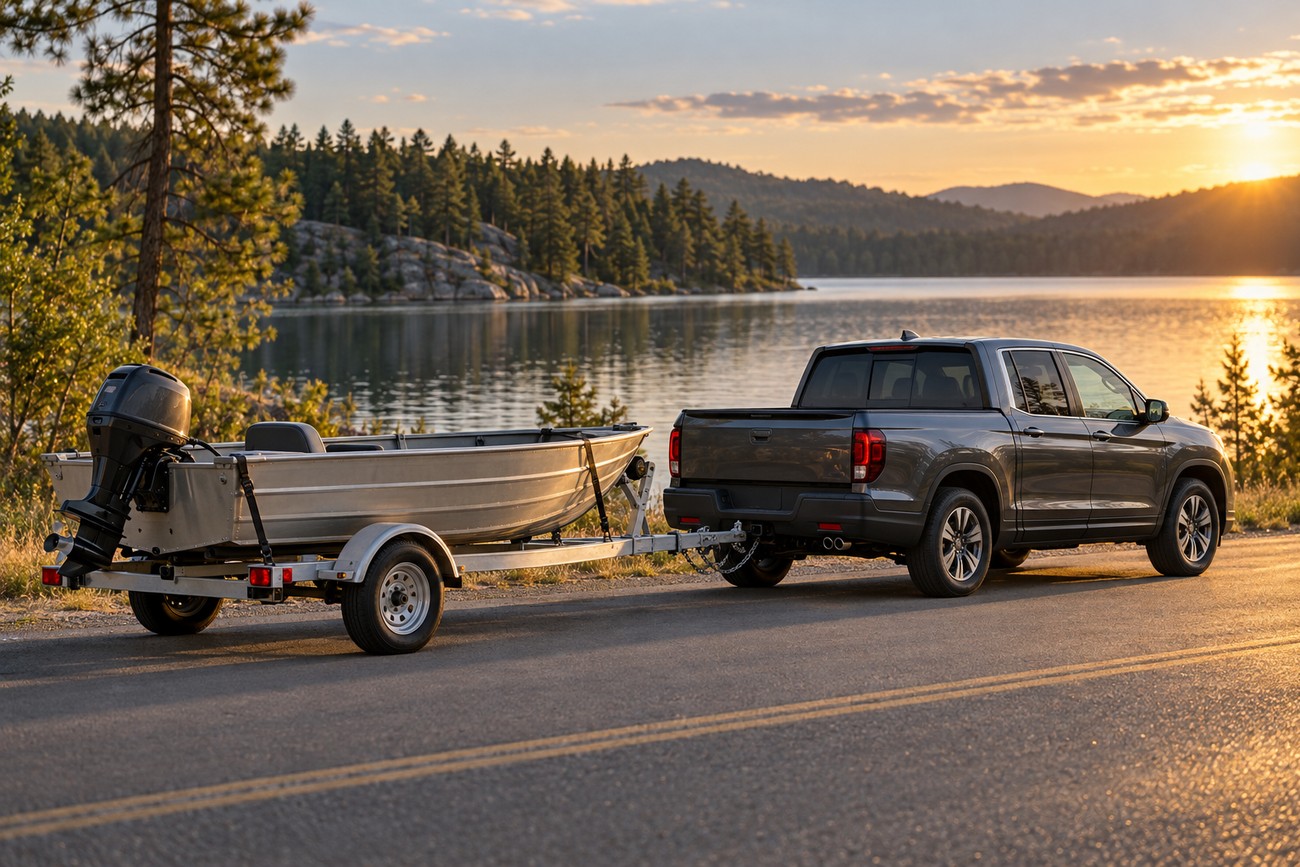
Road towing and towing a boat behind another boat are different operations. On water, use minimum speed, accelerate smoothly, and keep passengers out of the boat being towed. The tow line and attachment points must suit the boat and conditions.
A Y-shaped bridle attached to two stern points is preferred to a single central attachment because it reduces turning forces. Use a tow line long enough for the boats to move safely relative to each other, with floats that reduce the risk of propeller entanglement.
Short or heavy unmarked lines can create sharp shock loads, dive into the water, or reach the propeller during a turn. Inspect the line, bridle, attachment points, and knots before departure, and stop if the towed boat begins yawing or taking on water.
Keep people and excess gear out of the bow of the towed boat. Too much bow weight can cause yawing, bow digging, and poor tracking, particularly in a following wake. Distribute essential equipment low and toward the center or stern while maintaining the boat’s safe trim.
Common Ridgeline Boat-Towing Mistakes and Hidden Costs
Exceeding the stated trailer rating because a trip is “only occasional” can overload the transmission, suspension, brakes, and hitch structure. One successful journey does not prove that the combination has adequate reserve for heat, crosswinds, emergency braking, or a steeper ramp.
Another common mistake is using the dry boat weight and ignoring distribution. Skipping trailer brakes, accepting rear-end sag, or trusting a weak hitch can create handling problems before the driver notices a mechanical failure. The full loaded mass and tongue load should be checked before every long trip.
Repeated heavy towing accelerates wear on the automatic transmission, brake discs and pads, suspension components, and cooling system. Frequent launches also increase corrosion risk around the hitch, wiring, trailer brakes, and vehicle underbody, especially after exposure to salt water.
The Ridgeline’s unibody design and lower practical comfort limit make it less suited to repeated maximum-load towing than a body-on-frame pickup. Owners who tow a heavy boat often may spend less over time by choosing more reserve capacity rather than operating continuously at the edge of the rating.
Is the Honda Ridgeline the Right Boat Tow Vehicle?
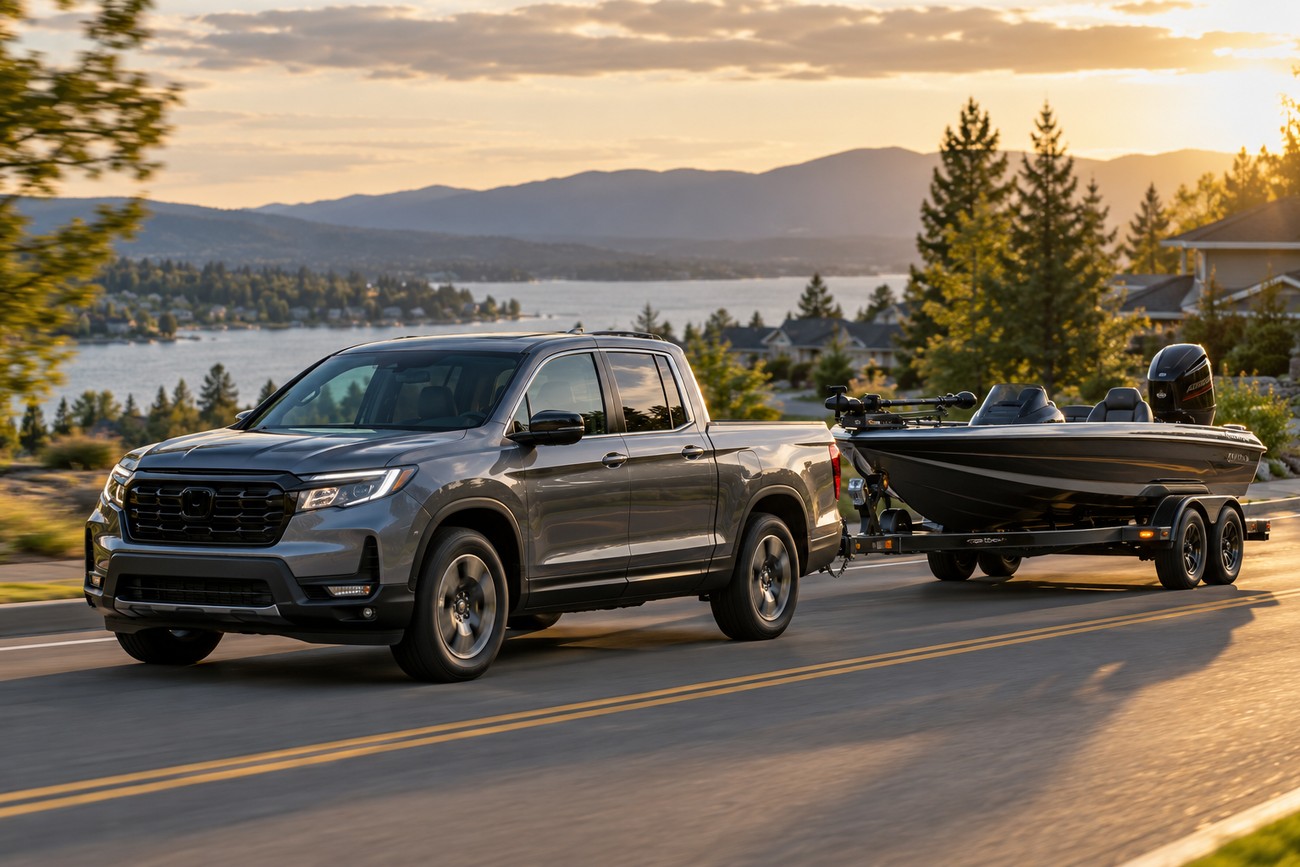
The Ridgeline is a reasonable choice for a moderate, properly braked boat trailer, particularly when the loaded mass is within a conservative range and the vehicle is equipped correctly. AWD provides the higher approximately 2,268–2,600 kg towing range, while FWD is approximately 1,585–1,600 kg.
For regular trips, approximately 1,500–1,800 kg of fully loaded boat-and-trailer mass is commonly recommended by experienced owners. A lower-profile, well-balanced boat may be easier to manage than a taller boat at the same weight.
Heavy, tall, or frequently towed boats can expose the Ridgeline’s limits in acceleration, cooling, suspension reserve, braking, and launch traction. Comparable body-on-frame pickups often offer greater reserve and higher ratings, although their suitability still depends on the complete combination.
The best tow vehicle is selected by loaded trailer mass, drivetrain, braking, launch traction, stability, cooling capacity, and reserve below the maximum rating. A lower headline capacity with ample margin is usually safer and less stressful than a higher rating used continuously at its limit.
Frequently asked questions
What is the best SUV for pulling a boat?
There is no universal best SUV for boat towing. Choose a vehicle whose drivetrain, cooling system, hitch, brakes, payload, and trailer rating comfortably cover the fully loaded boat-and-trailer mass, including passengers and cargo.
Launch traction and reserve capacity matter as much as the published maximum. A vehicle with AWD or another suitable traction system, effective trailer brakes, stable weight distribution, and meaningful reserve below its rating is usually a better choice than one selected only by its largest advertised number.
What size trailer can a Honda Ridgeline tow without trailer brakes?
The general Ridgeline model name does not provide one universal brake-free trailer limit. The answer depends on the exact model year, drivetrain, trim, owner’s manual, hitch rating, trailer specification, and the applicable legal threshold.
Check those sources before towing, and treat the higher approximately 2,268–2,600 kg AWD figures as braked-trailer figures. Even where a brake-free trailer is technically permitted, its weight, tongue load, stopping performance, and launch conditions may make a lower limit the safer choice.
How should I maintain a Ridgeline after launching a boat in salt water?
Rinse the hitch, wiring connectors, trailer brakes, wheels, suspension, and vehicle underbody with fresh water after each saltwater launch. Remove salt and mud from crevices, then inspect for damaged coatings, loose hardware, corrosion, and trapped water.
Check the trailer lights, brake function, safety chains, and hitch mounting points before the next trip. Lubricate or service components according to their specifications, and address corrosion early because repeated water exposure can weaken electrical connections and hardware long before a visible failure.







