
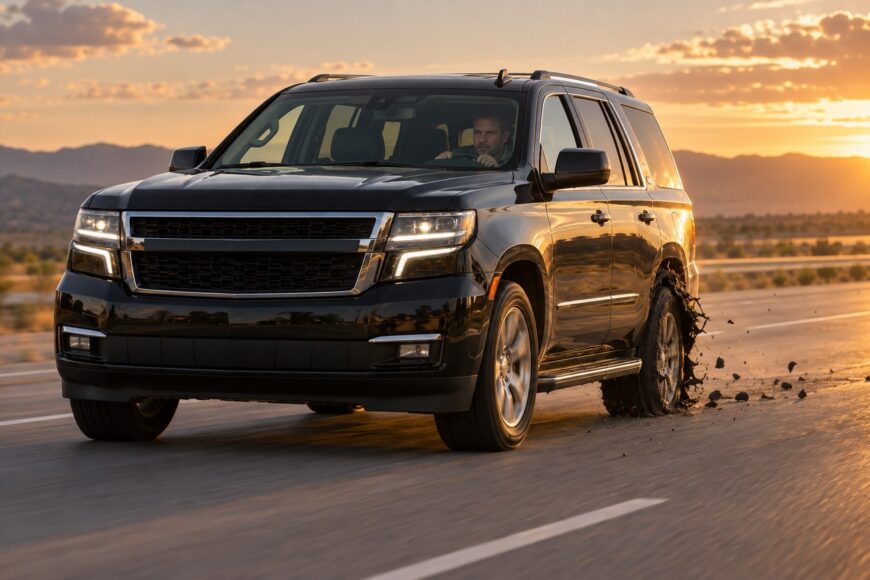
A tire blowout at 70 mph can make a Chevy Tahoe pull sharply toward the failed wheel while the steering wheel kicks back against your hands. The heavy body may sway, and the sudden change in grip and rolling resistance can make the SUV feel as if it is trying to leave its lane. The noise is alarming, but the first decision matters more than the sound: stabilize the Tahoe before trying to stop.
Hold the vehicle on its intended course, reduce speed smoothly, and move to a safe stopping place only when the Tahoe is under control. This guide explains how to respond, how far you should move after the failure, and which tire, load, pressure, and maintenance issues can turn a small warning into a roadside emergency.
- What a Blowout at 70 MPH Does to a Chevy Tahoe
- What to Do Immediately After the Tire Fails
- Why Tahoe Tires Blow Out—and What Drivers Miss
- Choosing and Checking Tires for a Tahoe
- Frequently asked questions
- Why do my tires shake at 70 mph?
- How far can I drive on a blowout tire?
- What is the number one cause of tire blowouts?
What a Blowout at 70 MPH Does to a Chevy Tahoe
During a serious failure, air may escape extremely quickly. One practical analysis describes pressure falling to atmospheric pressure in a fraction of a second, although the exact behavior varies with the damage. The tire then loses much of its normal support, while the damaged side develops different grip and rolling resistance from the other wheels.
That imbalance can pull the Tahoe toward the failed wheel. The steering may feel heavy or jerk suddenly, and the body can begin to sway as the driver corrects. A failure at 70 mph can therefore cause a sharp loss of control, even on a straight, dry road.
The Tahoe’s mass and relatively high center of gravity make abrupt steering inputs particularly risky. A quick countersteer, lane change, or brake application can create a second loss of control after the original tire failure. This does not mean every blowout causes a rollover, but it does mean smooth inputs are especially important in this SUV.
What to Do Immediately After the Tire Fails
Grip the steering wheel firmly with both hands and keep the Tahoe pointed as straight as practical. Do not make a sharp countersteer toward the direction of the pull. Release the accelerator smoothly and allow the vehicle to slow progressively; the immediate priority is directional control, not an instant maximum-braking stop.
As the speed falls and the Tahoe becomes more stable, make a shallow, deliberate move toward the shoulder or another safer area. Use the hazard lights as soon as you can do so without losing control. Stopping in a travel lane may expose you to a secondary collision, so continue only far enough to reach a safer position.
Turning sharply toward the shoulder too early is a common roadside mistake. Stabilize the vehicle first, then make a gradual lane move with small steering inputs.
Once safely stopped, do not keep driving to a repair shop. A conventional failed tire can quickly damage the wheel, suspension, or wheel well, and the damaged wheel may also affect nearby components. There is no universally safe mileage for driving on it; move only the minimum distance needed to get clear of traffic.
Stay away from passing traffic when possible, use the hazard lights, and place warning equipment only if it is safe to leave the Tahoe. Inspecting the tire, wheel, and surrounding area from a safe position is useful, but a major blowout generally calls for roadside assistance rather than a roadside repair beside fast traffic.
Why Tahoe Tires Blow Out—and What Drivers Miss
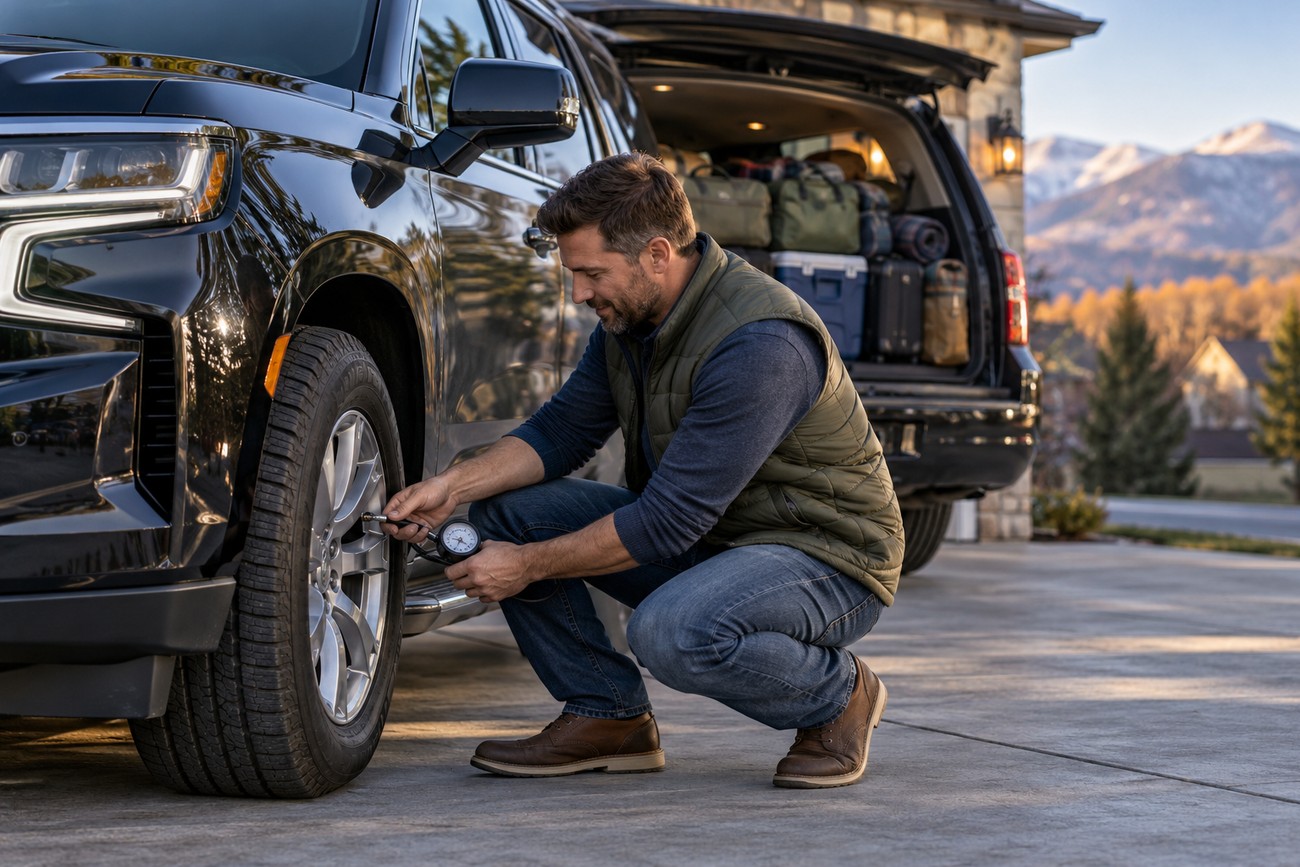
Incorrect or neglected inflation is a major preventable contributor to tire failure. Underinflation increases flexing and heat, while overinflation reduces the tire’s ability to absorb impacts. Check pressure when the tires are cold and use the vehicle maker’s specified value, rather than adjusting it by guesswork after a drive.
Load also matters. A heavily loaded Tahoe places greater demand on its tires than an unloaded vehicle, especially during highway travel, hot weather, or a long trip. Exceeding the tire or vehicle load requirement can leave less safety margin when a tire encounters an impact or develops damage.
A pothole or hard road impact can damage tire cords internally, even when the outside still looks normal. A bulge, cut, vibration, or gradual pressure loss deserves inspection, but the absence of a visible defect does not prove that the tire is sound. A tire professional may need to remove and inspect it to assess internal damage.
Wear is another basic warning. For passenger cars and SUVs, the commonly cited EAEU technical-regulation threshold is 1.6 mm of remaining tread depth; heavier categories commonly use 2 mm. Tread depth alone does not clear a tire with age-related deterioration, impact damage, a damaged valve, or repeated pressure loss.
Do not lower pressure to compensate for pressure growth during driving. Pressure normally changes as the tire heats, and the correct response is to set the specified cold pressure before travel. If a tire fails, inspect the other tires, too: the same overload, impact, or maintenance problem may have affected all four.
Choosing and Checking Tires for a Tahoe
SUV tires are not interchangeable simply because they fit the wheel. H/T tires are primarily road-oriented, A/T tires suit mixed road and off-road use, and M/T tires target more demanding off-road conditions. The choice changes highway noise, ride, steering response, and the tire’s suitability for the loads and speeds the Tahoe will see.
The tire must meet the vehicle manufacturer’s requirements, including the specified size, load, and speed capability. A generic seller’s recommendation for an SUV is not enough. Check the owner’s information and the vehicle’s tire-information label before fitting a replacement, particularly if the Tahoe is regularly loaded or used for towing.
A/T tires are often heavier and noisier than highway-focused tires. That may be a reasonable trade-off for mixed surfaces, but it can also affect fuel use, comfort, and the way the Tahoe responds to steering corrections on pavement. Set pressure with a reliable gauge when the tires are cold, and check the valve, tread, sidewalls, and spare during routine inspections.
The spare may have different wear or a different condition from the tires on the vehicle. Replacing one wheel can therefore make handling less predictable, especially if the remaining tire on that axle is substantially worn. After fitting a spare, drive only as appropriate for that spare and arrange a proper tire inspection or replacement promptly.
Frequently asked questions
Why do my tires shake at 70 mph?
A shake at 70 mph is a warning symptom, not proof that a blowout has already occurred. Imbalance, uneven wear, wheel damage, a bent rim, loose hardware, or internal tire damage can all create vibration. Reduce speed smoothly, avoid sudden braking, and have the vehicle inspected rather than testing whether the vibration will disappear.
A confirmed blowout usually brings rapid pressure loss, a strong pull, unusual noise, or visible tire damage, but symptoms can overlap. If the Tahoe remains controllable, move to a safe stopping position and inspect the tire and wheel without standing in an exposed traffic lane.
How far can I drive on a blowout tire?
There is no safe universal mileage allowance for a conventional failed tire. Drive only the minimum distance required to reach a safer stopping position, because continued movement can destroy the wheel, suspension, and wheel well as well as the tire.
A purpose-built run-flat system is different and must be used within its specific speed and distance limits. That equipment does not make a conventional blowout tire safe to drive on.
What is the number one cause of tire blowouts?
No single cause explains every Tahoe blowout. Incorrect or neglected inflation is a major preventable contributor, while impact damage, overload, tread wear, and the tire’s overall condition can also be involved.
These factors can combine: a tire weakened by a pothole may fail sooner when underinflated or heavily loaded. Regular cold-pressure checks, correct load-rated tires, tread inspections, and prompt assessment after impacts address more risk than searching for one universal cause.







