
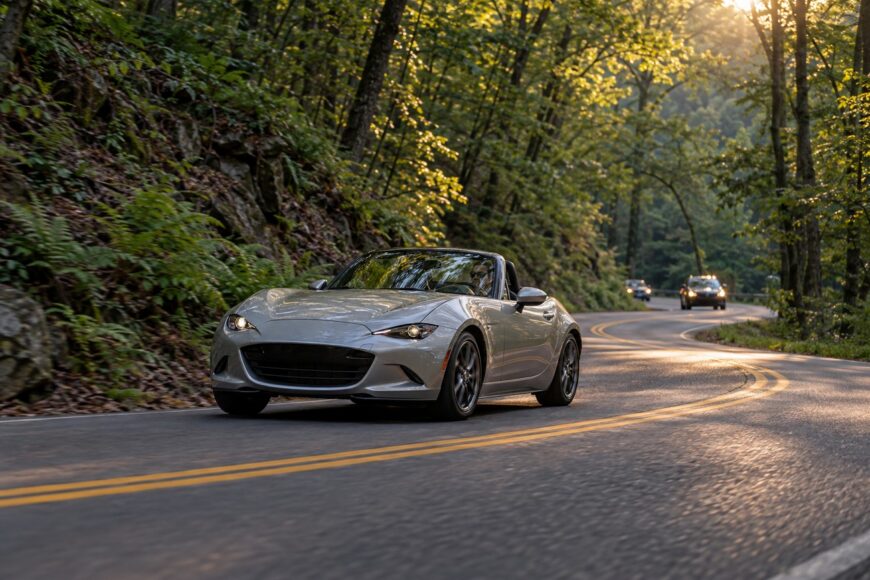
The Mazda Miata appears almost perfectly matched to the Tail of the Dragon: light, rear-wheel drive, compact, and easy to place on a winding road. Yet the Tail of the Dragon is a public road at the Tennessee–North Carolina border, with opposing traffic, blind corners, changing pavement, and little room for a mistake. Its reputation can encourage the wrong mindset before the car even reaches the first turn.
The practical frustrations are less glamorous than the road’s image. Slow vehicles can create a convoy, safe passing space is scarce, downhill braking can expose weak preparation, and shaded pavement may be damp or covered with leaves. A successful Miata drive therefore depends on restraint, visibility, and mechanical consistency more than on chasing a personal-best pace.
- Why the Tail of the Dragon Suits a Mazda Miata
- The Public-Road Reality: Traffic, Blind Corners, and No Margin
- Miata Preparation: Brakes, Tires, Fluids, and Alignment First
- How to Drive the Dragon Smoothly in a Miata
- What Can Ruin a Miata Run—and What the Myths Get Wrong
- Frequently asked questions
- Where does the Tail of the Dragon start and finish?
- Why is the Tail of the Dragon so famous?
- What type of person typically drives a Mazda Miata?
- What is the rarest Mazda Miata?
Why the Tail of the Dragon Suits a Mazda Miata
The Tail of the Dragon, also called Deal’s Gap, is a section of US 129 at the Tennessee–North Carolina border. It has approximately 318 turns over roughly 11 miles, creating a dense sequence of direction changes with very little time spent traveling straight. The route is a public road with opposing traffic, not a closed racing circuit.
A modern Mazda Miata ND typically weighs about 1,040–1,150 kg, depending on version and market. That low mass reduces inertia, so the car needs less effort to change direction and places less demand on its brakes and tires. On a narrow, technical road, those qualities can matter more than a large engine or high peak power.
The Miata’s rear-wheel-drive layout, short wheelbase, precise steering, and predictable chassis also make it easy to understand at moderate speeds. You can place the car accurately, adjust your line with small inputs, and carry momentum without relying on aggressive acceleration between corners. The car’s compact dimensions help you maintain a useful position within the lane, although they do not create extra space around it.
That advantage has a clear limit. Light weight and balanced handling improve control; they do not make blind corners safe to attack. The Miata suits the Dragon because it rewards smooth, measured driving, not because it gives permission to use every bit of available grip.
The Public-Road Reality: Traffic, Blind Corners, and No Margin
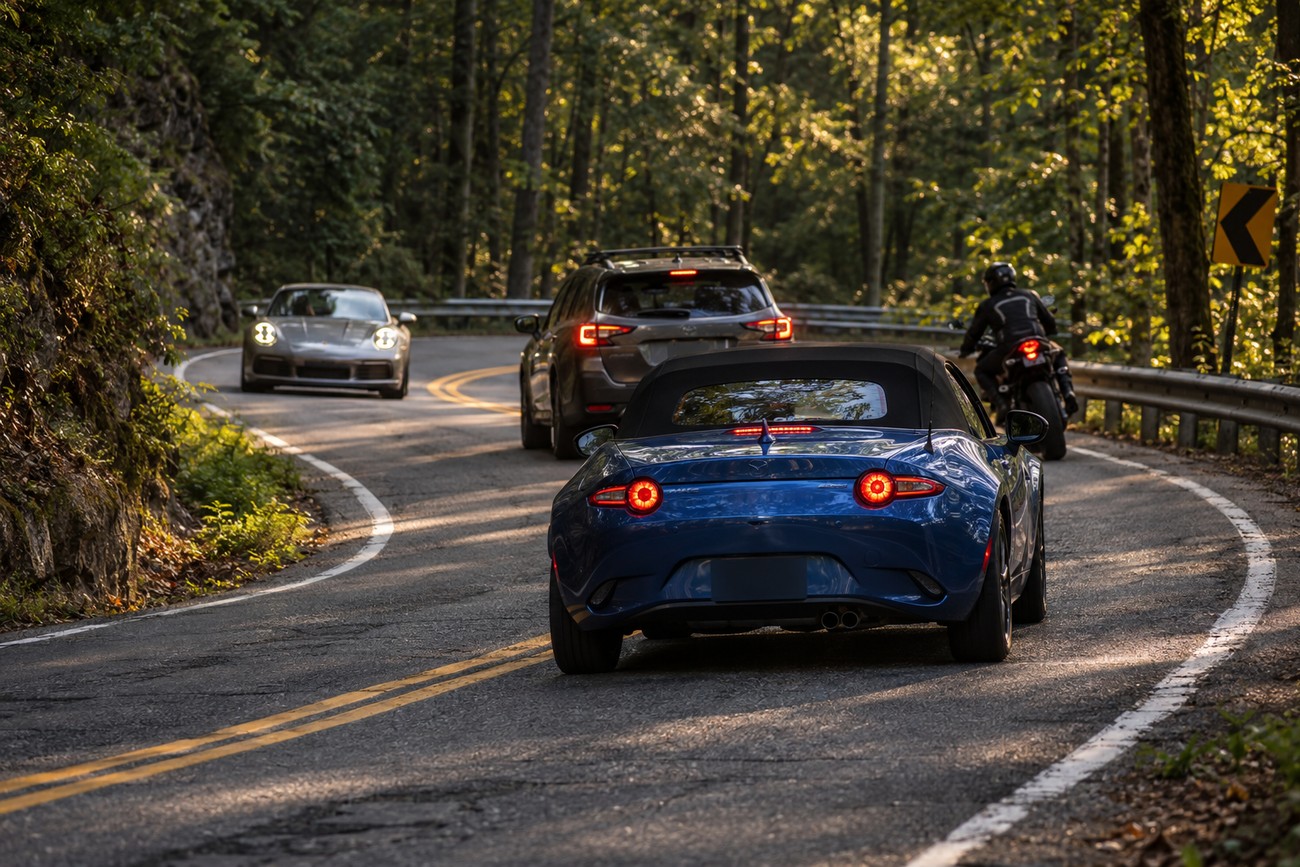
The road’s character changes as soon as other users enter the picture. Motorcycles, sports cars, tourists, and slower vehicles share the same narrow route, while opposing traffic can appear around any blind bend. A powerful car may accelerate more strongly on a short straight, yet traffic density and the lack of safe passing space often determine the pace.
Some sections commonly have speed limits around 30 mph, and practical speeds may be lower in tight or obstructed corners. Visibility, pavement condition, traffic, and grade changes can all require more margin than the posted limit alone suggests. Treat the limit as a ceiling, not as a target for every bend.
Narrow lanes, blind apexes, elevation changes, shaded damp areas, leaves, debris, and patched pavement are recurring hazards. Runoff and recovery space can be minimal, so a small error in lane position may leave little room for correction. Cutting across the centerline is especially dangerous because an approaching motorcycle or car may be hidden until the last moment.
Following distance matters more here than the road’s flowing appearance suggests. A driver ahead may brake suddenly for a motorcycle, a stopped vehicle, a surface hazard, or a corner that tightens unexpectedly. Leaving space also reduces the temptation to copy another driver’s speed when that driver has a different line, car, or level of risk tolerance.
Miata Preparation: Brakes, Tires, Fluids, and Alignment First
Preparation should focus on consistency. Inspect the tires for age, damage, uneven wear, and adequate tread, then set pressures according to the car’s condition and the manufacturer’s guidance before the drive. Check brake-pad thickness, rotor condition, pedal feel, and fluid age, and confirm that the cooling system has no leaks or signs of overheating.
Fresh brake fluid is especially valuable when the route includes repeated downhill braking. A suitable pad can preserve pedal consistency, but track-oriented pads are common among active Miata drivers rather than a universal requirement. Firmer performance tires can also work well, provided they are appropriate for the weather and road surface; an extreme compound can be a poor choice if it performs badly when cold or wet.
Fresh fluid, predictable tires, and a conservative alignment usually reveal weaknesses before an extreme suspension setup does. Repeated downhill braking and uneven pavement reward a car that keeps its tire contact and pedal feel, rather than one configured only for a smooth circuit.
Alignment deserves attention because incorrect toe or uneven camber can make the Miata nervous under braking and inconsistent through linked corners. Excessive suspension stiffness can reduce tire contact on rough or patched pavement, especially when the road surface changes while the car is loaded in a turn. A healthy cooling system also matters because low-speed traffic and repeated engine load can expose problems that normal commuting never shows.
Begin with a careful warm-up. Cold tires and cold brakes can make the first few corners feel slower and less secure, while a quiet opening run helps you learn the surface and traffic pattern. Pack lightly, secure anything in the cabin, and remember that a passenger and luggage affect braking, acceleration, and the car’s response on short straights.
How to Drive the Dragon Smoothly in a Miata
Use conservative entry speeds and look through each corner as far as visibility allows. The useful sequence is to brake in a straight line, choose a speed that leaves room for an unseen tightening, and stabilize the car before the apex. A single smooth steering input gives the tires a clearer job than a series of hurried corrections.
Blind corners demand patience with the throttle. Keep the car within your lane, avoid crossing the centerline, and wait until the corner opens and the surface is visible before applying power progressively. The Miata’s balance rewards momentum, yet abrupt throttle or brake applications can unsettle the rear tires and reduce the control that makes the car enjoyable.
Cold tires and cold brakes can make an early run deceptive. The car may feel secure because the pace is modest, while available grip and pedal response remain below their normal operating condition. Repeated aggressive downhill braking can then overheat the brakes and reduce pedal or stopping consistency after several sections, so use the car’s feedback as a reason to reduce pace and cool the system.
Maintain a generous following distance. A vehicle ahead may stop, slow for a motorcycle, or cut its line without warning, and a close gap removes the time needed to respond. If traffic forms, accept the slower rhythm or use a clearly designated legal stopping area when available; forcing a pass where sight lines and lane width do not support it creates risk for everyone.
Limited straight-line power is no reason to compensate with late braking or excessive corner entry speed. The Miata generally makes better progress through clean exits, stable braking, and smooth transitions than through aggression. A controlled drive that leaves room for surface changes and oncoming traffic is the correct performance standard for a public mountain road.
What Can Ruin a Miata Run—and What the Myths Get Wrong
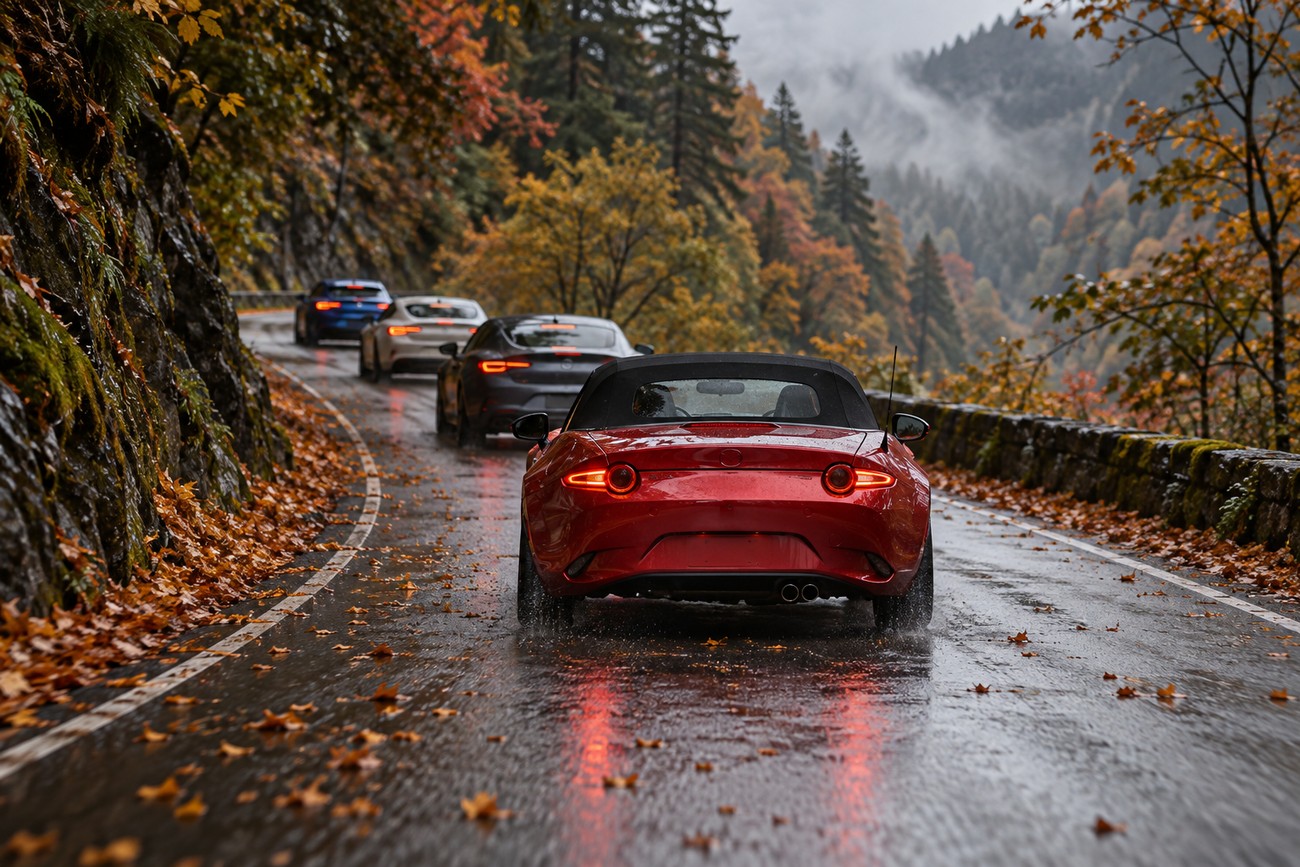
Traffic is the most common reason the experience fails to match the fantasy. Slow cars, motorcycles, tourists, and vehicles traveling in both directions can turn a sequence of corners into a stop-and-go convoy. There may be no safe passing space, so a driver who arrives expecting uninterrupted rhythm is likely to become frustrated and make poorer decisions.
Surface surprises add another layer. Leaves, damp patches, repairs, debris, and shaded pavement can change available grip between sections, even when the road looks dry from a distance. Drivers who enter by feel alone may discover that the available margin has disappeared; a conservative approach to an unseen surface is faster in the only sense that matters on a public road—it keeps the car controllable.
A Miata can feel underpowered on short straights, especially with a passenger and luggage. That limitation matters less on a route dominated by corners, where low mass, balance, and direction changes help the car maintain useful momentum. Maximum horsepower cannot solve a blind apex, a blocked lane, or a vehicle appearing in the opposite direction.
The same principle applies to suspension. A very stiff setup may feel sharp on smooth pavement, yet it can reduce grip when the road is patched or uneven. The Tail of the Dragon is not a place to drive at the limit: it has public traffic, blind corners, and real consequences. A cooler weekday or early-morning window may reduce congestion, based on practical local advice, but it is not a safety guarantee.
Frequently asked questions
The Tail of the Dragon’s appeal comes from its dense corners and demanding public-road setting. The following answers clarify the route, its reputation, and how the Miata fits into that environment. They also separate enthusiast interest from the practical limits of the road.
Where does the Tail of the Dragon start and finish?
The Tail of the Dragon is commonly identified with Deal’s Gap on US 129 at the Tennessee–North Carolina border. The named driving section is generally treated as the concentrated winding stretch of US 129, while the surrounding roads continue beyond the part most visitors mean by “the Dragon.”
Maps, businesses, and local references may use slightly different endpoint conventions. Check the route you intend to drive instead of assuming that every sign or navigation result marks the same start and finish. This distinction matters because the surrounding roads can have different traffic patterns, surfaces, and points of interest.
Why is the Tail of the Dragon so famous?
Its fame comes from an unusually dense sequence of approximately 318 turns over roughly 11 miles, combined with the public-road setting and a strong motorcycle and sports-car culture. The route demands precise speed control, lane discipline, and repeated direction changes, which makes it memorable even when driven at a restrained pace.
That reputation should not be confused with a race venue. Opposing traffic, tourists, blind corners, and limited recovery space remain part of the route. The same features that make it attractive to enthusiasts also make patience and visibility more important than a dramatic-looking run.
What type of person typically drives a Mazda Miata?
Miata drivers often value feedback, lightness, manageable running costs, and momentum over status or straight-line power. The car appeals to people who enjoy understanding what the chassis and tires are doing, whether they use it for touring, commuting, autocross, or occasional track work.
That profile fits the Dragon’s technical layout because the Miata communicates changes in grip and direction clearly. It still requires disciplined driving, and its small size or friendly handling should never be treated as protection from an unsafe line or excessive speed.
What is the rarest Mazda Miata?
There is no single globally accepted answer without defining the market, production run, and whether rarity means factory volume, surviving examples, or special-edition specification. Mazda has produced market-specific and limited-production Miata variants, so a version that is scarce in one country may be less unusual elsewhere.
Collectability also has little connection with suitability for the Tail of the Dragon. A rare edition may command attention because of its production history or equipment, while a standard, well-maintained Miata can be equally effective on a technical public road. For a specific claim, verify the model’s original market and production records rather than relying on a generic “rarest Miata” label.







